
UNITED STATES
SECURITIES AND EXCHANGE COMMISSION
Washington, D.C. 20549
FORM 10-K
| ANNUAL REPORT PURSUANT TO SECTION 13 OR 15(d) OF THE SECURITIES EXCHANGE ACT OF 1934 | |||||
For the fiscal year ended December 31 , 2024
OR
| TRANSITION REPORT PURSUANT TO SECTION 13 OR 15(d) OF THE SECURITIES EXCHANGE ACT OF 1934 | |||||
For the transition period from to
Commission File Number 001-41043

(Exact name of registrant as specified in its charter)
| (State or other jurisdiction of incorporation or organization) | (I.R.S. Employer Identification No.) | |||||||
| (Address of principal executive offices) | (Zip code) | |||||||
Registrant’s telephone number, including area code: (971) 365-3939
Securities registered pursuant to Section 12(b) of the Act:
| Title of each class | Trading Symbol | Name of each exchange on which registered | ||||||||||||
Securities registered pursuant to Section 12(g) of the Act: None
Indicate by check mark if the registrant is a well-known seasoned issuer, as defined in Rule 405 of the Securities Act. Yes ☐ No ☒
Indicate by check mark if the registrant is not required to file reports pursuant to Section 13 or 15(d) of the Act. Yes ☐ No ☒
Indicate by check mark whether the registrant (1) has filed all reports required to be filed by Section 13 or 15(d) of the Securities Exchange Act of 1934 during the preceding 12 months (or for such shorter period that the registrant was required to file such reports), and (2) has been subject to such filing requirements for the past 90 days. Yes ☒ No ☐
Indicate by check mark whether the registrant has submitted electronically every Interactive Data File required to be submitted pursuant to Rule 405 of Regulation S-T (§232.405 of this chapter) during the preceding 12 months (or for such shorter period that the registrant was required to submit such files). Yes ☒ No ☐
Indicate by check mark whether the registrant is a large accelerated filer, an accelerated filer, a non-accelerated filer, a smaller reporting company or an emerging growth company. See the definitions of “large accelerated filer,” “accelerated filer,” “smaller reporting company” and “emerging growth company” in Rule 12b-2 of the Exchange Act.
Large accelerated filer ☐ | ||||||||
Non-accelerated filer ☐ | Smaller reporting company | |||||||
Emerging growth company | ||||||||
If an emerging growth company, indicate by check mark if the registrant has elected not to use the extended transition period for complying with any new or revised financial accounting standards provided pursuant to Section 13(a) of the Exchange Act. ☐
Indicate by check mark whether the registrant has filed a report on and attestation to its management’s assessment of the effectiveness of its internal control over financial reporting under Section 404(b) of the Sarbanes-Oxley Act (15 U.S.C. 7262(b)) by the registered public accounting firm that prepared or issued its audit report. ☒
If securities are registered pursuant to Section 12(b) of the Act, indicate by check mark whether the financial statements of the registrant included in the filing reflect the correction of an error to previously issued financial statements. ☐
Indicate by check mark whether any of those error corrections are restatements that required a recovery analysis of incentive-based compensation received by any of the registrant's executive officers during the relevant recovery period pursuant to §240.10D-1(b). ☐
Indicate by check mark whether the registrant is a shell company (as defined in Rule 12b-2 of the Act): Yes ☐ No ☒
The aggregate market value of the registrant's Class A common stock, par value $0.0001 per share, held by non-affiliates of the registrant was approximately $88 million as of June 28, 2024, the last business day of the registrant's most recently completed second fiscal quarter, computed based on the closing sale price of the Class A common stock on the Nasdaq Stock Market LLC on such date.
As of February 24, 2025, there were approximately 79,507,184 shares of the registrant's Class A common stock outstanding, 4,209,827 shares of the registrant's LT10 common stock outstanding, and 7,695,524 shares of the registrant's LT50 common stock outstanding.
DOCUMENTS INCORPORATED BY REFERENCE
Information required in response to Part III of this Annual Report on Form 10-K (Items 10, 11, 12, 13 and 14) is hereby incorporated by reference to portions of the registrant’s Proxy Statement for its Annual Meeting of Stockholders to be held in 2025. The Proxy Statement will be filed by the registrant with the Securities and Exchange Commission no later than 120 days after the end of the registrant’s fiscal year ended December 31, 2024.
Table of Contents
| Page | ||||||||
| PART I | ||||||||
| Item 1. | ||||||||
| Item 1A. | ||||||||
| Item 1B. | ||||||||
| Item 1C. | ||||||||
| Item 2. | ||||||||
| Item 3. | ||||||||
| Item 4. | ||||||||
| PART II | ||||||||
| Item 5. | ||||||||
| Item 6. | ||||||||
| Item 7. | ||||||||
| Item 7A. | ||||||||
| Item 8 | ||||||||
| Item 9. | ||||||||
| Item 9A. | ||||||||
| Item 9B. | ||||||||
| Item 9C. | ||||||||
| PART III | ||||||||
| Item 10. | ||||||||
| Item 11. | ||||||||
| Item 12. | ||||||||
| Item 13. | ||||||||
| Item 14 | ||||||||
| PART IV | ||||||||
| Item 15. | ||||||||
| Item 16. | ||||||||
1
Special Note Regarding Forward-Looking Statements
This Annual Report on Form 10-K contains forward-looking statements about us and our industry that involve substantial risks and uncertainties. We intend such forward-looking statements to be covered by the safe harbor provisions for forward-looking statements contained in Section 27A of the Securities Act of 1933, as amended (the “Securities Act”), and Section 21E of the Securities Exchange Act of 1934, as amended (the “Exchange Act”). All statements other than statements of historical facts contained in this Annual Report on Form 10-K, including statements regarding our strategy, future financial condition, future operations, projected costs, prospects, plans, objectives of management and expected market growth, are forward-looking statements. In some cases, you can identify forward-looking statements because they contain words such as “may,” “will,” “shall,” “should,” “expects,” “plans,” “anticipates,” “could,” “intends,” “target,” “projects,” “contemplates,” “believes,” “estimates,” “predicts,” “potential,” “goal,” “objective,” “seeks,” or “continue” or the negative of these words or other similar terms or expressions that concern our expectations, strategy, plans, or intentions. There are a number of risks, uncertainties, and other important factors, many of which are beyond our control, that could cause our actual results to differ materially from the forward-looking statements contained in this Annual Report on Form 10-K. Such risks, uncertainties and other important factors include, among others:
•our expectations regarding our financial performance and future operating performance;
•our ability to attract and retain members, expand usage of our platform, sell subscriptions to our platform and convert individuals and organizations into paying customers;
•the timing and success of new features, integrations, capabilities and enhancements by us, or by competitors to their products, or any other changes in the competitive landscape of our market;
•the amount and timing of operating expenses and capital expenditures that we may incur to maintain and expand our business and operations to remain competitive;
•the sufficiency of our cash, cash equivalents and investments to meet our liquidity needs;
•our ability to make required payments under and to comply with the various requirements of our current and future indebtedness;
•our cash flows, the prevailing stock prices, general economic and market conditions and other considerations that could affect the specific timing, price and size of repurchases under our stock repurchase program or our ability to fund any stock repurchases;
•geopolitical tensions, including the war in Ukraine and the conflict in Israel, Gaza and surrounding areas;
•the impact of inflation on us and our members;
•our borrowing costs have and may continue to increase as a result of increases in interest rates;
•our ability to effectively manage our exposure to fluctuations in foreign currency exchange rates;
•the size of our addressable markets, market share and market trends;
•anticipated trends, developments and challenges in our industry, business and the highly competitive markets in which we operate;
•any adverse impact on our business operations as a result of using artificial intelligence or other machine learning technologies in our services;
•our expectations regarding our income tax liabilities and the adequacy of our reserves;
•our ability to effectively manage our growth and expand our infrastructure and maintain our corporate culture;
1
•our ability to identify, recruit and retain skilled personnel, including key members of senior management;
•the safety, affordability and convenience of our platform and our offerings;
•our ability to successfully defend litigation brought against us;
•our ability to successfully identify, manage and integrate any existing and potential acquisitions of businesses, talent, technologies or intellectual property;
•general economic conditions in either domestic or international markets, including geopolitical uncertainty and instability and their effects on software spending;
•our ability to protect against security incidents, technical difficulties, or interruptions to our platform;
•our ability to maintain, protect and enhance our intellectual property; and
•the other risks and uncertainties under Item 1A. "Risk Factors" and elsewhere in this Annual Report on Form 10-K.
You should not rely upon forward-looking statements as predictions of future events. We have based the forward-looking statements contained in this Annual Report on Form 10-K primarily on our current expectations, estimates, forecasts and projections about future events and trends that we believe may affect our business, results of operations, financial condition and prospects. Although we believe that we have a reasonable basis for each forward-looking statement contained in this Annual Report on Form 10-K, we cannot guarantee that the future results, levels of activity, performance, or events and circumstances reflected in the forward-looking statements will be achieved or occur at all. The outcome of the events described in these forward-looking statements is subject to risks, uncertainties and other factors described in the section titled “Risk Factors” and elsewhere in this Annual Report on Form 10-K. Moreover, we operate in a very competitive and rapidly changing environment. New risks and uncertainties emerge from time to time, and it is not possible for us to predict all risks and uncertainties that could have an impact on the forward-looking statements contained in this Annual Report on Form 10-K. The results, events and circumstances reflected in the forward-looking statements may not be achieved or occur, and actual results, events or circumstances could differ materially from those described in the forward-looking statements.
The forward-looking statements made in this Annual Report on Form 10-K relate only to events as of the date on which the statements are made. We undertake no obligation to update any forward-looking statements made in this Annual Report on Form 10-K to reflect events or circumstances after the date of this Annual Report on Form 10-K or to reflect new information or the occurrence of unanticipated events, except as required by law. If we update one or more forward-looking statements, no inference should be drawn that we will make additional updates with respect to those or other forward-looking statements. We may not actually achieve the plans, intentions, or expectations disclosed in our forward-looking statements, and you should not place undue reliance on our forward-looking statements. Our forward-looking statements do not reflect the potential impact of any future acquisitions, mergers, dispositions, joint ventures, or investments we may make.
In addition, statements that “we believe” and similar statements reflect our beliefs and opinions on the relevant subject. These statements are based upon information available to us as of the date of this Annual Report on Form 10-K, and while we believe such information forms a reasonable basis for such statements, such information may be limited or incomplete, and our statements should not be read to indicate that we have conducted an exhaustive inquiry into, or review of, all potentially available relevant information. These statements are inherently uncertain, and you are cautioned not to unduly rely upon these statements. Unless otherwise indicated or unless the context requires otherwise, all references in this document to “Expensify,” the “Company,” “we,” “us,” “our” or similar references are to Expensify, Inc. Capitalized terms used and not defined above are defined elsewhere within this Annual Report on Form 10-K.
2
Risk Factor Summary
Our business is subject to a number of risks and uncertainties of which you should be aware. These risks are more fully described in the section titled “Risk Factors.” These risks include, among others, the following:
•Our quarterly and annual results of operations have fluctuated in the past and may fluctuate significantly in the future and may not meet our expectations or those of investors or securities analysts.
•Our expense management feature drives the majority of our subscriptions, and any failure of this feature to satisfy customer demands or to achieve increased market acceptance could adversely affect our business, results of operations, financial condition and growth prospects.
•If we fail to adapt and respond effectively to rapidly changing technology, evolving industry standards and changing customer needs or preferences, our platform may become less competitive.
•If we are unable to attract new customers on a cost-effective basis, convert individuals using our free basic expense management feature and organizations using our trial subscriptions into paying customers, retain existing customers and expand usage within organizations, our revenue growth will be harmed.
•We may fail to accurately predict the optimal pricing strategies necessary to attract new customers, retain existing customers and respond to changing market conditions.
•We may not successfully develop or introduce new features, enhancements, integrations, capabilities and versions of our existing features that achieve market acceptance, and our business could be harmed and our revenue could suffer as a result.
•We face significant competition, the market in which we operate is rapidly evolving, and if we do not compete effectively, our results of operations and financial condition could be harmed.
•An economic downturn or economic uncertainty could negatively impact our customers and materially and adversely affect our business, financial condition and results of operations.
•Payments and other financial services-related laws and regulations and government oversight are material to our business. The actions of various policymakers across government levels may create a complexity of multiple, conflicting and changing governmental laws and regulations. Our failure to comply with such laws and regulations could materially harm our business and can subject us to criminal and civil liability.
•The success of our business largely depends on our senior management team, and we depend on professional services firms for a portion of our finance function. The loss of any key employees or our outsourced finance team could adversely affect our business.
•We cannot guarantee that our share repurchase program will be fully consummated or that it will enhance long-term stockholder value. Share repurchases could also increase the volatility of the trading price of our common stock and could diminish our cash reserves.
•If we or our third party providers fail to protect our IT Systems against security incidents, or otherwise to protect our Confidential Information, there may be damage to our reputation and brand, material financial penalties, and legal liability, which could substantially harm our business, financial condition and results of operations.
•Our business depends on a strong brand, and if we are not able to maintain and enhance our brand, our ability to expand our base of customers may be impaired, and our business and results of operations will be harmed.
3
•We may be adversely affected by global economic and political instability, including escalating geopolitical tensions such as the war in Ukraine and the conflict in Israel, Gaza and surrounding areas.
•Sales to customers outside the United States and our international operations expose us to risks inherent in international sales and operations.
•We receive, process, store and use business and personal data, which subjects us to governmental regulation and other legal obligations related to data protection and security, and our actual or perceived failure to comply with such obligations could harm our business and expose us to liability.
•If we fail to manage our technical operations infrastructure, or experience service outages, interruptions, or delays in the deployment of our platform, our results of operations may be harmed.
•The multiple class structure of our common stock and the ownership of substantially all of our LT10 and LT50 common stock by holders through a trust agreement (the "Voting Trust") have the effect of concentrating voting control with the Voting Trust for the foreseeable future, which will limit your ability to influence corporate matters, including a change in control. We are controlled by the Voting Trust, whose interests may differ from those of our public stockholders. Our amended and restated certificate of incorporation also delegates significant authority to our Executive Committee of our Board of Directors (the "Executive Committee").
•We may not be able to successfully implement our growth strategies on a timely basis or at all. Even if we are successful, if we fail to effectively manage our growth, our business and results of operations could be harmed.
•Our culture has contributed to our success, and if we cannot maintain this culture as we grow, we could lose the high employee engagement fostered by our culture, which could harm our business.
4
Part I.
Item 1. Business
OVERVIEW
Expensify is a leading cloud-based expense management software platform that helps the smallest to the largest businesses simplify the way they manage money. Every day, people from all walks of life in organizations around the world use Expensify to scan and reimburse receipts from flights, hotels, coffee shops, office supplies and ride shares. Since our founding in 2008, we have added over 15 million members to our community, and processed and automated over 1.7 billion expense transactions on our platform as of December 31, 2024, freeing people to spend less time managing expenses and more time doing the things they love. For the quarter ended December 31, 2024, an average of 687,000 paid members across an average of 47,600 companies and over 200 countries and territories used Expensify to make money easy.
Small and medium-sized businesses (“SMBs”) are the cornerstone of the global economy, making up almost all businesses and the majority of employment in Organisation for Economic Co-operation and Development ("OECD") member countries. Despite their significance to the global economy, the vast majority of SMBs still rely on manual, inefficient processes to manage the critical back office functions that power their businesses every day. Expense management, which refers to the collection, processing, auditing and reimbursement of employee expenses, is one of the last great holdouts of paper-based back office processes, with employees stuffing actual physical receipts into an envelope and handing it to their accountant. As SMBs seek to modernize back office functions like expense management to better compete in today’s digital economy, we believe they will look for comprehensive technologies that are easy to discover, implement, purchase, manage and use. At the same time, individual employees are becoming a powerful source of change as they increasingly expect to bring their own choice of technology into the workplace.
Since the beginning of Expensify, our guiding principle has been improving the experience of the actual end users of expense management software: everyday employees. We designed Expensify to be easy to set up, integrate, configure and use from almost any device, which has enabled us to serve employees of all types and organizations of all sizes, industries and geographies. Our first breakthrough was revolutionizing receipt tracking with our patented scanning technology, SmartScan, which allows anyone to simply take a photo of any receipt – no matter the currency or quality of handwriting – for fast, automatic and accurate transcription of a receipt with just one tap. After removing the need for people to keep a pocket full of crumbled receipts and spend hours manually tracking expenses, we moved on to automating the entire expense journey, from the initial receipt scan all the way through to categorization, expense approval, reconciliation and next-day reimbursement. Since then, we have expanded our platform to include features that help businesses manage corporate credit cards, generate and send invoices, pay bills, collect payments and book travel, all from our single, easy-to-use mobile application. We intend to continue adding complementary features to retain and add value to existing customers and attract new members.
Our intense focus on improving the everyday experience of regular employees with an easy-to-use but powerful platform has enabled a viral, bottom-up business model that is capital efficient and extremely scalable. By allowing people to spend less time managing receipts and more time pursuing their real goals, our members have adopted, championed and spread Expensify to their colleagues, managers and friends. We believe our happy members are the best form of marketing, and our self-service, bottom-up approach takes advantage of strong, organic word-of-mouth adoption.
Behind our platform is a company with passionate people and a unique culture that guides everything we do. Our company operates with a flat, generalist organizational structure united by a robust set of common values that foster the long-term happiness and retention of our employees. The efficiency of our
5
business model allows us to prioritize attracting, retaining and inspiring talented, ambitious and humble people committed to a long-term vision. We are a team that likes to solve real problems, and though expense reports are problematic for most people, there are other pressing problems facing our world that we want to also help solve.
OUR INDUSTRY
Given their size, SMBs typically have one person overseeing the discovery and implementation of new systems, a responsibility that is often in addition to their core job function. As a result, SMBs have specific requirements when adopting new technologies:
•Easy to discover. With job responsibilities spanning multiple functions, SMBs do not have the bandwidth and expertise to discover, meet with and evaluate several technology vendors. As such, SMBs increasingly rely on online channels for finding new technologies and heavily consider recommendations from experts, friends and colleagues.
•Easy to implement. IT departments within SMBs are often one person or the business owner themselves, and are incapable of taking time away from their business to support cumbersome implementation, maintenance and training requirements. As a result, SMBs prefer solutions that are easy to implement, onboard and integrate and that require little ongoing maintenance.
•Easy to purchase. With no procurement department and limited resources, the individuals making the purchasing decision at SMBs often prefer vendors with transparent, self-service monthly subscription plans that can be paid by credit card.
•Easy to manage. Unlike large enterprises, which often require multiple, customized point solutions for specialized business processes, SMBs prefer a single, comprehensive platform from one provider that can solve multiple pain points.
•Easy to use. Many SMBs prioritize ease of use and convenience over cost and seek solutions with elegant, intuitive user experiences that require no training or expertise to operate.
In short, SMBs look for “easy money” management.
OUR APPROACH
Since our founding, we have taken a unique approach to expense management built on key, complementary elements:
•Platform strategy hyper-focused on the employee. We designed Expensify to be easily configured and used by every single employee within an organization, not just decision makers or managers. Expensify is a highly integrated mobile platform with many features designed to make our members’ lives easier, simple enough for freelancers and small businesses, and powerful enough for large enterprises with tens of thousands of employees. Our product development is compounding and driven by member feedback, with every new feature making every past feature a little bit better, as well as methodically laying a strategic foundation for features yet to come.
•Viral, bottom-up business model driven by the employee. Our employee-focused platform strategy enables a viral, bottom-up adoption cycle that starts with an individual employee. After signing up for free on the website or downloading our free app to submit expenses and realizing the benefits of using Expensify, our enthusiastic members champion our platform internally, spreading it via word-of-mouth to other employees and convincing decision makers to adopt Expensify company-wide. This enables us to focus our time and resources on making our features better for our members, and avoid the reliance on a costly, traditional top-down sales and marketing approach to attract and retain customers.
•Word-of-mouth adoption supported by a market consensus approach. We believe that our happy members are the best form of marketing. We strive to build a superior platform that makes the lives of
6
employees and admins easier so that they become our champions and promote us to other individuals and organizations. We deploy large scale brand advertising to build on this platform superiority and help create market consensus that Expensify is the category leader for expense management software. We believe this enables us to focus on creating great features for our members rather than rely on the expensive and ineffective activities of traditional sales and marketing to drive customer acquisition.
•Unique company culture and long-term vision. Our platform strategy and business model are complemented by our unique company culture and intense focus on the long-term happiness of our employees. Our organization is flat, generalist, transparent and inclusive, and we value ideas from every corner of our company, no matter who or where it comes from. We believe our special culture and the long-term commitment from our employees are key drivers to our success.
We believe that these elements of our approach are hard to replicate, self-reinforcing and work together to drive a powerful competitive advantage.
Our Platform Strategy
Expensify is a leading cloud-based expense management software platform that allows any business to simplify how it manages expenses. We built our platform to be intuitive and easy to deploy, with powerful features that increase our network effect within and between companies. This helps us reach more potential members and expand our value by solving more pain points for our customers. While our core features enable businesses to easily manage expenses, our platform includes features for managing corporate cards, paying bills, generating invoices, collecting payments and booking travel. Our platform strategy centers around the following key concepts:
•Built for everyone. We designed our platform to be used by everyone in an organization, from employees to managers to the finance department. We offer an intuitive, elegant user interface that everyday employees can easily understand and operate from almost any device. We deliver guided workflows for administrators to accurately and quickly approve expenses in accordance with their unique company policies. Our platform is simple enough for SMBs, but powerful features can be enabled for use across enterprises with tens of thousands of employees. We believe that the more intuitive and simple Expensify is, the more employees and administrators will want to use it.
•Easy to set up. We designed our platform to be easily implemented and configured without the need to speak with a sales person. Any employee can download our free application from mobile app stores or sign up on the website, create an account and start submitting expenses within minutes. When an expense report is submitted, the manager who receives it also automatically becomes a member. Concierge, our proprietary AI-powered customer support engine, helps new members set up an account, connect teammates, assign company policies and immediately sync Expensify with existing accounting, HR and travel systems. We believe that making our platform easily accessible, simple to set up and easily configurable attracts more members to download and try Expensify.
•Designed to improve experiences for all members. We designed our platform to leverage leading technology, such as our patented SmartScan and our proprietary AI-powered customer support engine, Concierge, to automate and reduce errors from the cumbersome, manual tasks associated with managing expenses. By doing so, we give employees, contractors and administrators in businesses of all shapes and sizes more time to spend on things they care about, leading to improved costs, enhanced productivity and higher job satisfaction. We believe that always having the pain points of our members at the center of every technology decision and feature we develop enables us to consistently deliver an improved experience for every employee in an organization.
•One platform, many features. Expensify is one platform, with one price that unlocks access to every feature on the platform, from expense management to bill payment. Our features are just different configurations of the same underlying tool, and are not different products in some kind of combined suite. We develop our features in a compounding manner, which means that everything we build
7
improves everything we've already built, and lays a foundation for what we will build next. This enables increasingly rapid deployment of new features that solve other problems for our members and allows us to extend the network effect of our platform.
•Highly integrated. We designed our platform to easily integrate with other business and consumer applications. We offer over 50 pre-built integrations, allowing Expensify to seamlessly connect with accounting and HR systems, travel management software, business and employee bank accounts and credit cards. These integrations enable our members to synchronize data in real-time across their technology ecosystem and automate expense management with the applications and tools they use every day.
We believe that elements of our platform strategy are a critical driver of the viral, widespread adoption of Expensify across and between any type of organization.
Our Business Model
Our platform strategy enables a viral bottom-up business model that is capital efficient and extremely scalable. Anyone can easily download our mobile application or go to our website to sign up for free on their own, and later upgrade to a paid subscription for advanced features. The adoption of Expensify within an organization often starts with the individual employee, who downloads our mobile application or signs up on our website for free and uses it to easily submit expenses to their manager with a few taps. After the employee realizes the benefits of our platform, they become a champion of Expensify and often spread it internally to other employees. With multiple employees using Expensify and valuable features simplifying the manager’s job, the decision maker purchases a subscription to Expensify and becomes a paying customer with a few members. Our usage within an organization expands further as the company adds members and adopts new features such as the Expensify Visa® Commercial Card ("Expensify Card"), Expensify Travel or Bill Pay.
We offer simple, transparent and flexible subscription plans for both individuals and businesses that are completely self-service and payable by credit card. Rather than the traditional software sales model of complex pricing, user thresholds and inconsistent fees, we designed our pricing plans to facilitate the easy adoption of our platform by the smallest mom-and-pop stores to the largest and most complex organizations. Purchasers can select a transparent plan with features that best suit their specific needs, all without interacting with a sales representative or paying hidden costs for implementation, maintenance, or support.
Our individual subscriptions include our Track and Submit plans, which include an optional paid monthly upgrade for anyone wishing to SmartScan more than 25 receipts in a given month:
•Free Plans (Optional upgrade for unlimited SmartScan)
◦Track. Our free Track plan comes with our SmartScan receipt scanning functionality and is used primarily by individuals and sole proprietors to streamline their receipt and mileage tracking.
◦Submit. Our free Submit plan includes the same functionality in Track, and also adds the ability to automatically submit expense reports to anyone for reimbursement.
Our business subscriptions can be used by teams, organizations, and companies on one of our paid plans, which include our Collect and Control plans, following a free trial. We bill customers on Collect and Control plans at the start of each month based on the number of policy members who were active in the previous month. Each customer has either a "pay per use" plan in which they are billed a flat rate for each active member, or an "annual" plan where they commit to a minimum number of monthly seats in
8
exchange for a discount. Collect and Control customers can access additional discounts if they spend on the Expensify Card:
•Paid Plans
◦Collect. Our Collect plan enables our members to integrate with popular small business accounting systems, configure simple expense report approval workflows, as well as pay employees, contractors and volunteers via Direct Deposit ACH or internationally via Global Reimbursements.
◦Control. Our Control plan, which is by far our most popular plan, includes everything in Collect and adds the ability to configure rules-based approval workflows and integrate with financial, travel, HR, as well as other internal systems commonly used by mid-market and enterprise companies.
We also leverage partnerships with accounting and bookkeeping firms, who provide validation of our platform and refer customers to us. We partner with strategic accounting software partners such as Intuit, NetSuite, Xero and Sage Intacct to integrate our software in their clients’ back offices, and recognize us as a top expense tool when their clients are browsing and selecting integrated solutions. Additionally, our ExpensifyApproved! Partner Program trains and supports accountants to use our platform and encourages their customers to use Expensify. We work hard to maintain top expense partner status with all partners to support our market consensus strategy.
Our Growth Strategies
We intend to drive the growth of our business by executing on the following strategies:
•Build new features that create additional value for existing members. Our word-of-mouth model works well because people genuinely enjoy using Expensify. We intend to continue to invest in building features that increase the value our software delivers to our existing members. Our flat, generalist and democratic structure cultivates a diversity of ideas from every single one of our employees, which enables an efficient, scalable and rigorous product development process. By efficiently investing in new features that prioritize the needs of our members, we can continue to retain existing members and attract new members via word-of-mouth;
•Build new features that attract new members beyond employees who submit expenses. We have and will continue to invest in developing features complementary and adjacent to expense management. At most companies, not every employee generates expenses that would be submitted via an expense report. As we add additional features that can be used by all employees rather than just those that submit expense reports, we have the potential to monetize the segment of our customers’ employees that are not submitting expense reports on a monthly basis, and increase revenue without adding more customers or raising prices. These features will enable easy financial collaboration within communities and between friends and family;
•Build viral loops into our member experience that increase adoption by new customers. We design our expense management platform and every new feature with the aim of frictionless adoption. Individual employees download the Expensify mobile app or sign up on our website, for free, and use it to submit their expenses to their bosses – turning every expense report into a highly targeted marketing message, straight to a decision maker. Outside of expense management, we have expanded our platform and built invoicing and bill payment features with the goal of replicating the frictionless adoption of our expense management feature. By sending an invoice using Expensify, accounts receivable departments naturally promote Expensify to their clients. A company that adopts Expensify bill payment tacitly promotes Expensify to all of their vendors: any one vendor that sends a manual invoice receives an email notifying them that their invoice was converted into an Expensify invoice, and they should sign in to collect payment online. We continue to focus on maintaining and extending the virality of our features to support our viral, bottom-up business model;
9
•Expand and monetize transaction volume from existing and new customers. We intend to continue to increase the promotion of the Expensify Card to both new and existing customers to drive growth in adoption;
•Promote Expensify’s culture and values. We believe that consumers are more likely to both use and recommend products from brands they admire. By consistently acting on and vocally promoting our values, we have the ability to both drive positive change and create brand awareness that can add to the virality of our platform. We believe our company code of ethics and conduct demonstrates our culture and values, including our adherence to Environmental, Social, and Governance ("ESG") principles;
•Continue to strengthen our market consensus. We have worked hard to establish and maintain Expensify as a dominant expense management platform for SMBs. We leverage a variety of targeted marketing strategies that involve industry conferences, industry influencers, partner marketing, our own conference and more with the goal of achieving market consensus that Expensify is the premier, industry standard expense management platform. This is essential to our viral and word-of-mouth business model. We plan to reinforce the market consensus surrounding our platform, as well as expand on these strategies across new feature verticals and markets;
•Expand integrations and strengthen partnerships. Expense management touches many functions across a company. To provide a seamless experience for our customers, we integrate with the accounting, HR and travel software used by SMBs and their employees every day. We also have frictionless integrations with many of the technology providers that generate the most receipts for our members, such as Uber and Lyft. Through our ExpensifyApproved! Partner Program, we train and support accountants who then encourage their customers to use Expensify. We intend to continue to invest in both integrations and partnerships as they are critical to delivering best-in-class user experiences and ensuring that Expensify is deeply embedded within our customer base; and
•Expand internationally. We see significant opportunity to acquire new customers internationally. Because word-of-mouth drives significant adoption, we have experienced member growth outside of our core geographies without investment in marketing or regional sales forces. We have the opportunity to accelerate international growth by investing in marketing, developing a localized platform experience and expanding international partnership and integrations.
We believe that the combination of the strength of our platform, our scalable business model and our special company culture has us well-positioned to achieve these growth strategies.
Our Platform
Expensify makes money easy for SMBs by enabling them to collaborate and complete financial tasks more efficiently. Our AI-driven, mobile-first, cloud-based platform offers a best-in-class experience for companies looking to modernize their financial processes away from paper and excel spreadsheets for the first time.
We define preaccounting as the systemized set of processes through which employees, or non-accountants, gather, code, aggregate and normalize financial data. While other financial processes have seen vast efficiency improvements with the widespread adoption of cloud-based ecosystems, company-focused preaccounting tasks such as expense management have largely remained unchanged, and therefore are still overwhelmingly inefficient, unscalable and time-consuming. Our comprehensive financial platform offers a wide range of easy-to-use but powerful features that automate the preaccounting processes for businesses of all sizes – including managing expenses, capturing and managing spend via the Expensify Card and more recently, paying bills and sending invoices, all included in the Expensify platform.
10
Expense Management
Expenses are among the most complicated preaccounting workflow, no matter the size of a company. Expenses touch every employee, span every layer of the organization and require interaction with a host of internal and external business systems. While the expense management process is incredibly complex, it largely occurs in three distinct, sequential phases: Capture > Approve > Pay.
CAPTURE
Most of today’s financial data still exists on paper. Expensify streamlines the capture and normalization of disparate financial data in the following ways:
•SmartScan. Snap a photo of your receipt, forward receipts from email, or upload attachments directly in the application. SmartScan optimizes for high-accuracy data extraction to support our “fire and forget” receipt capture.
•Credit card matching. Receipts and emails are automatically matched to incoming credit card transactions in real-time, preventing duplicates and reducing the need to manually reconcile credit card statements at month end.
•Mobile expense capture. With mobile apps for Android and iOS, it’s possible to capture receipts, mileage expenses and per diems while in the office or anywhere else in the world – online or offline. In addition, members can automatically import receipts from their favorite travel tools, including Uber, Lyft, Grab, Hotel Tonight, among others.
APPROVE
Once financial transactions are captured, we deliver AI-driven insights into the nature of company spend, as well as adherence to company-specific rules and guidelines. Expensify’s robust approval functionality can be scaled up and down in the following ways:
•Multi-level approval workflows. Customizable approval workflows help companies of all sizes tailor their approval hierarchies, route specific expenses to budget or project owners and approve expenses through an intuitive “Guided Review” that highlights specific items requiring review.
•Intelligent auditing. Process data automatically or configure which types of transactions require review. Expensify detects receipt duplicates by default and automatically verifies that any manually-entered expenses match attached receipts.
•Powerful integrations. Connect directly with leading cloud accounting and finance platforms such as QuickBooks, Xero, Oracle NetSuite, Sage Intacct and FinancialForce, among others. A continuous real-time sync means that information is dynamically updated across all connected platforms. Expensify connects directly with the top banks in the U.S., as well as leading HR, practice management, tax reclamation, recruiting and travel management systems. A self-service API is available to anyone who wants to integrate Expensify into their technology ecosystem on their own without additional cost.
•Comprehensive visibility. Whether companies require visibility into transaction approvals, help with corporate credit card reconciliation and remittance, or insights into travel spend, financial data is visible throughout the platform.
11
PAY
After capturing and approving relevant company spend, businesses require an easy and fast method for disbursing funds to employees and vendors. Expensify’s payments platform streamlines how modern payments are made and reconciled in the following ways:
•Next day ACH direct deposit. For companies that enable automatic processing and reimbursement, employees receive expense reimbursements in their bank account the following business day.
•Global reimbursement. For companies or employees based outside of the United States, Expensify offers reimbursement in 5 currencies across 200 countries and territories.
•Centralized travel procurement. Manage and centrally pay for travel bookings made with any Expensify Card, all while ensuring compliance with company travel policies.
•Corporate card remittance. Streamline the process of managing and remitting corporate card payments.
Expensify Card
The Expensify Card is a natural extension of our expense management platform and is powered by the Visa network. Companies can use the Expensify Card in conjunction with existing expense policies at no additional cost, or independently as a separate corporate card program through our platform.
The Expensify Card leverages our wealth of experience acquired by working directly with finance administrators. The feature is designed to fix the common pain points seen with traditional corporate cards, namely the lack of real-time receipt capture and transaction visibility, enhanced access to credit for small businesses and streamlined setup of corporate card programs.
Key capabilities of the Expensify Card include:
•Streamlined card application/setup. Companies receive an automated approval decision in seconds, and card provisioning for an entire organization is possible in a few minutes. Every member receives a virtual card for immediate use.
•Unlimited virtual cards. Companies can issue an unlimited number of virtual cards with fixed amount or monthly spend limits. This allows for issuing cards for specific merchants or subscriptions and ensuring spend does not exceed your budget.
•Continuous automatic reconciliation. Card transactions are synchronized in real-time between Expensify and a company’s accounting systems. This removes the need for an arduous once-a-month statement reconciliation.
•Real-time compliance. Cardholders receive an immediate push notification when their card is charged, which helps protect against fraud. In addition, eReceipts mean that no receipt capture is required for nearly all purchases, though companies can stipulate their own receipt policy where preferred.
•Spend control with Smart Limits. Companies control the maximum exposure they will accept for each employee by stipulating their individual unapproved spend, which is another cash control feature. If a cardholder fails to submit their expenses in a timely fashion, card activity is suspended until historical card spend is approved.
•Cashback. Companies with settled spend in the United States ("U.S.") over $250,000 per month on their Expensify Cards under the Updated Card Program (defined below) receive 2% cashback for all U.S. purchases or 1% for all U.S. purchases if monthly settled spend in the U.S. is under $250,000.
12
•Daily settlement option. Ensure that employees never overspend what a company is able to pay. Daily settlement also helps smooth cash flows throughout the month, as opposed to one large, uncertain lump sum at month end. Companies can also choose monthly settlement if they prefer a more classic experience.
We believe we have growth potential in many areas in regards to the Expensify Card. Our goal is to continue increasing the number of companies that have adopted the Expensify Card and the number of members that have a card provisioned per company, both of which would increase the amount of total spend converted to the Expensify Card.
Under the original Expensify Card program launched in 2020 (“Legacy Card Program”), Expensify has an agreement with the payment processor, Marqeta, Inc. ("Marqeta"), and relied on Marqeta to manage the relationship with the issuing bank, Sutton Bank, and the card network, Visa, in authorizing and settling transactions. In October 2023, the Company amended the Expensify Card program (“Updated Card Program”) to separately enter into an agreement with a new issuing bank, The Bancorp Bank, N.A. ("Bancorp"), to issue Expensify Cards to customers and authorize and settle transactions on the Visa card network, in providing overall card program management services. The Updated Card Program launched in February 2024 and all new Expensify Cards issued subsequent to the launch of the Updated Card Program operate under that program. As of December 31, 2024, our transition of cardholders from the Legacy Card Program to the Updated Card Program was substantially complete.
Expensify Travel
Expensify Travel is a travel platform that simplifies business travel by integrating booking, approvals, payments, and collaboration into one seamless experience. It has the following key capabilities:
•Seamless bookings. Easily book flights, hotels, rail, and car rentals all from the Expensify app, with options tailored to fit your company’s travel policy. This is designed to provide travelers the best options while staying within their company's budget and compliance guidelines.
•Smart approvals. Real-time, policy-driven approvals ensure trips are authorized quickly, reducing the risk of unnecessary change or cancellation fees. Managers can approve trips with confidence, knowing they align with company policies.
•Streamlined payments and reporting. Centralized virtual card payments simplify expense reconciliation, while automated reporting instantly captures every receipt and change fee for hassle-free tracking. This eliminates manual expense reporting and speeds up reimbursements.
•Real-time collaboration. Dedicated chat rooms connect travelers and travel managers, keeping everyone on the same page with instant updates, approvals, and duty-of-care communication throughout the trip. This facilitates smooth coordination and immediate support when needed.
Invoicing & Bill Pay
Key capabilities of our invoicing and bill payment features include:
•Payments made easy. With multiple payment options, including credit/debit card, ACH and check, customers across the globe have access to quick, easy and frictionless payment options.
•Eliminate manual entry. Bills sent to a company’s @expensify.cash address are automatically SmartScanned, which captures key details for easy review and processing.
•Real-time communication. Customers can leave comments or ask questions on the invoice and both parties can chat in real time directly in Expensify, or receive an email instantly.
13
•Extensive integrations. Companies can save time by exporting invoices and bills to QuickBooks, Xero, Sage Intacct, Oracle NetSuite and more. Invoices are automatically linked to the corresponding customer and exported as a receivable in the accounting system. Bills are automatically linked to the corresponding vendor and exported as a payable.
Expensify.org
We started Expensify.org with a goal to “create a just and generous world” with the belief that doing good is good for business. We aim to integrate the Expensify.org mission into everything we do. If nothing else, it's good for employee retention and morale, by framing our work in a more powerful context than it might otherwise seem. Everyone here knows that we cannot succeed as a business without also giving back and making the world a better place than we found it.
Though Expensify.org launched in January 2020 and is now a 501(c)(3) non-profit, the concept was set into motion before Expensify was founded when David Barrett, Expensify's founder and CEO, had an idea of how to help feed unhoused neighbors he passed every day walking through San Francisco. He developed a platform to load gift cards on-demand from his personal credit card to offer funds immediately for individuals in his neighborhood to purchase food. While this idea didn’t take off, David held onto the concept for more than a decade until it became a reality with the launch of Expensify.org.
Through Expensify.org, we seek to empower individuals and communities to eliminate injustice around the world by making giving and volunteering more convenient, accountable, meaningful and collaborative. The foundation of Expensify.org was built on applying our expertise in expense management to increase the transparency of how funds are used, the convenience of how donations are gathered and — most importantly — the emotional connection between donors, volunteers and recipients.
Our Compliance and Data Security
We are PCI-DSS Level 1, SOC1 Type II, and SOC2 Type II compliant, with external parties performing "grey box" testing. We are integrated with most major banks in the United States, and we process billions of dollars in expense reimbursements every year and are audited periodically by our processing bank. We take privacy and data security seriously and design our systems and processes based on applicable domestic and international data privacy regulations, which sometimes change faster than the wind.
Our Data
As of December 31, 2024, we have processed over 1.7 billion expense transactions for our customers. These expenses span across employees from all functions and layers in organizations of all sizes, industries and geographies. To process these expenses, our platform runs on our proprietary distributed and fully replicated technology architecture that is built to process many multiples of our current transaction volume. We also designed our platform to be deeply integrated and connected with a broad suite of back office systems, consumer applications and banking technology infrastructures that our customers use every day. The combination of the scale and diversity of the expenses we process, the breadth and depth of our integrations and the scalability of our infrastructure has enabled us to build a massive data asset that continually enhances the value of our platform.
We derive powerful insights from our data such as the unique buying behavior of our members, the spending trends of the businesses they work for and changes in the technologies businesses use for multiple back-office workflows. These insights provide continuous and real-time input into our product development and enable us to develop features that reflect the behavior and preferences of our members and the organizations they work for. Our data asset also benefits from significant network effects, with every new member and transaction adding incremental value to our platform. Every receipt we process through our OCR technology makes our SmartScan technology more accurate, every transaction we process and backtest enhances our fraud protection capabilities and every customer inquiry we resolve
14
allows Concierge to answer future questions faster. We believe that our data asset will continue to expand the value of our platform and drive future growth.
Our Culture, Employees and Human Capital
At Expensify, our culture is deeply embedded in everything we do. We strive to create a diverse, inclusive and collaborative workplace that prioritizes and fosters the long-term happiness of our employees. We operate with a flat, generalist organizational structure, where everybody is encouraged to participate in the discussions and contribute to the decisions they choose to. Our culture is centered on the belief that a life well lived is one that enables you to achieve the following three goals, which we all work towards with a long-term mindset:
•Live Rich. This means we want to have ample means, and the time to enjoy it. We want to participate in a diverse, equitable, inclusive and fundamentally just society — both inside and outside our own walls. We want to have a “comfortable baseline,” where on a dull, ordinary day we wake up refreshed and excited to take on the day’s challenges, and go to bed each night fully satisfied in life well lived and a job well done.
•Have Fun. Sometimes, we want to do stuff that is awesome just for the sake of awesomeness. Not too often, but often enough to remind ourselves that we are living life to its fullest, and enabling others to do the same. For example, we aim to bring the whole company, plus families and kids, to a warm and sunny international location every year for a month-long "working vacation" to enable our employees to collaborate in person from a remote beach, build friendships with their colleagues, broaden their perspective and have a great time. These “Offshore” trips are productivity powerhouses that have resulted in some of our most impressive platform developments to date.
•Save The World. We like the phrasing of this goal precisely because it is bombastic. We want to play an active role in unwinding the systemic bias that has prevented so many from living rich. We believe that even a small team with limited resources, given enough time and focus, can move the world. This is why we started Expensify.org, to “create a just and generous world”, and we are all wholly committed to its mission.
We believe that there are three common qualities critical to achieving these three goals and the success of our company:
•Talent. Each of us can learn without being taught, and can teach whatever we’ve learned.
•Ambition. Each of us has a genuine desire to accomplish something meaningful to us individually, to create more than we consume in this world.
•Humility. Each of us genuinely values the opinions and perspectives of others, and seeks above all to find the right solution to any given problem, no matter who came up with it.
Finally, our long-term commitment to our three life goals is guided by two simple rules:
•Get Shit Done. We have little-to-no internal hierarchy; nobody reports to anyone else. Everyone is responsible for their own time and empowered to spend it in the way they feel will best advance their own goals, and the goals of the company.
•Don’t Ruin It for Everyone Else. Whenever there is some complicated scenario with an unclear resolution, we always brainstorm the fairest possible solution — and then put in the hard work to make that ideal solution our actual solution. Fairness rarely comes easy, and is typically far, far from the norm.
We believe that our unique culture and our employees’ happiness and long-term commitment to Expensify is a critical component of our success. As of December 31, 2024 we had 115 full-time employees. None of our employees are represented by a labor union or covered by collective bargaining agreements.
15
We also engage third-party vendors to supply on-demand workers as needed to support our operations. We have not experienced any work stoppages, and we believe that our employee relations are strong. We remain committed to reevaluating ourselves and continuing to foster a workplace environment that prioritizes the well-being of each and every Expensify employee.
We provide our employees with competitive compensation, comprehensive healthcare options and equity ownership across our organization. We encourage a balanced lifestyle by offering our employees the flexibility to work remotely and set their own schedules.
RESEARCH AND DEVELOPMENT
We have a product-led growth strategy, so our ability to scale our platform depends on our ability to innovate and continue to deliver quality and valuable features for members. As such, we prioritize our research and development above all other investments. Our Customer Success team works closely with our customers to identify our members’ greatest needs and act as our primary Product Managers to develop features that reflect their feedback. We build our software with the end user at the center of every decision, investing substantial time, energy and resources to ensure we have a deep understanding of our members’ needs.
CUSTOMER SUCCESS
Concierge is our customer support engine. Concierge is designed for speed and accuracy and optimized for cost. Concierge is powered by AI and trained by customer support agents, with different levels of skill and training, spread out across the world.
Concierge is also supported with generative AI trained on how to use Expensify. All customer inquiries are screened to see if they can be answered from our help documentation. If they can be, Concierge will automatically respond with an answer formulated by generative AI using the help documentation as its source. Approximately 80% of initial inquiries are able to be answered automatically by Concierge without escalation.
First Responders provide simple support that requires minimal training, with the primary requirement being English proficiency. Second Responders receive more in depth training and answer more complex questions, as well as those that require a deeper understanding of the platform. The costs of maintaining a team of First and Second Responders scales according to support volume, but thanks to Concierge, benefits from extraordinary economies of scale as well as consistency in speed and quality. First and Second Responders are employed and managed by vendors, which helps us efficiently scale up and down based on support volumes.
Success Coaches are full-time employees who manage the bulk of our product management. Approximately 25% of Success Coach time is spent on traditional product management activity (i.e., writing product proposals, engaging with the product development team, testing new functionality, updating documentation). The remaining approximately 75% is spent doing traditional account management tasks and performing "supervised training" of the Concierge AI in response to edge case conversations escalated from Second Responders. We believe that by keeping our product managers involved with the customers we design and develop features that customers like to use — supporting our product-led growth.
MARKETING
Our members are our best marketers. They have adopted, championed and spread Expensify to their colleagues, managers and friends. We have empowered employees to simplify and streamline expense management and in the process we have created champions of our solutions who naturally demonstrate the value of Expensify to decision makers at their broader organizations.
We make our platform available for free trial online, which facilitates rapid and widespread adoption. The strength of our solution and its user-friendly nature creates advocates of our platform and allows
16
Expensify to spread virally, through word-of-mouth, across teams, departments and organizations. This word-of-mouth marketing increases organically as more individual members and teams discover our platform.
Our marketing efforts are designed to support the bottom-up viral nature of our platform by establishing our brand as a premiere option in preaccounting software. We invest in brand and platform promotion through partners, conference participation, thought leadership, direct marketing and advertising and content development to educate the market about the benefits of our platform and create market consensus.
Creating market consensus requires a major investment to establish and requires ongoing commitment to our product to maintain. So long as the market agrees in the strength of our platform, it is relatively inexpensive to maintain that perception. This creates an asymmetric advantage against challengers to our brand. This market consensus strategy enables us to attract new customers without needing to pay a high marginal cost to acquire each new customer.
SALES
Our viral and word-of-mouth lead generation enables us to employ a self-service and inbound sales model. Potential customers are generally first introduced to Expensify when an employee submits an expense report using Expensify, when they hear of us through their networks, or indirectly through accountants and accounting platforms. Customers then seek out our mobile app and website to try, adopt and use our platform.
Our sales model focuses on enabling customer self-service and low-friction entry points enhanced with AI powered customer service. Our customers can access free and fully functional trials. When a member has completed their platform evaluation, purchasing is coordinated online through an automated, easy-to-use web or mobile based process. Any customer can get on the phone with our team during or after the sales process, but due to the segment of the market we serve, the overwhelming majority prefer to complete the sales and onboarding process online.
Our Competition
Our primary competition remains the antiquated manual processes that SMBs have been relied upon for decades. Other competitors include traditional horizontal platform solutions with basic expense management features, corporate card providers, and niche expense management point solutions. Because of the strength, flexibility and interoperability of our offering, many of our customers use Expensify in tandem with some of our competitors’ products. We differentiate ourselves from our competition by remaining hyper-focused on our members, continuing to innovate features that add value to our members and maintaining market consensus to facilitate word-of-mouth marketing and support our viral, bottom-up go-to-market motion.
We believe the principal competitive factors that drive leadership in the markets we compete in include the following:
•End user design focus;
•Ease of access, adoption, deployment and use;
•Platform functionality and ability to automate processes;
•Mobile access across devices;
•Ability to purchase without a sales representative;
•Viral, bottom-up business model supported by word-of-mouth adoption;
•High interoperability with internal and third party systems and consumer applications;
17
•Flexible, employee-centric legal terms regarding data ownership;
•Data security and privacy;
•Speed and scalability of architecture underlying the platform;
•Brand reputation and market consensus around platform superiority; and
•Customer service and support.
We believe we compete favorably with our competitors on the basis of the factors described above. We believe our unique approach, business model, and company culture drive significant competitive differentiation. We continue our intense design focus on the employee experience, to support our viral bottom-up business model to drive profitable growth and to nurture our one-of-a-kind company structure and culture to maintain this competitive advantage.
Intellectual Property
Our intellectual property is an important aspect of our business and helps us maintain our competitive position. To establish and protect our rights in our proprietary intellectual property, we rely upon a combination of patent, copyright, trade secret and trademark laws, and contractual restrictions such as confidentiality agreements, licenses and intellectual property assignment agreements.
As of December 31, 2024, we had 16 trademark registrations in the United States, including EXPENSIFY, EXPENSICON, PERSONAL KARMA, EXPENSIFY THIS, SMARTSCAN, CONCEIRGE, CORPORATE KARMA, YOU WEREN’T BORN TO DO EXPENSES, LAT* TALKS, LAT TALKS, SWIPE TO WIN, and LONG ASS TABLE TALKS. Various other marks have also been published by us such as EXPENSIFY PAYMENTS, AT THE SPEED OF CHAT, TRAVEL AND EXPENSE AT THE SPEED OF CHAT, EASY MONEY, EXPENSIFY IS EASY MONEY, EXPENSIFY – IT’S EASY MONEY, NEW EXPENSIFY, KARMA POINTS and the Expensify “E” Logo. We also had approximately 101 trademark registrations (including international registrations) and approximately 11 pending applications in certain foreign jurisdictions, including Canada, the European Union, the United Kingdom, Mexico, Brazil, Australia and New Zealand. We will pursue additional trademark registrations to the extent we believe it would be beneficial and cost effective. We also own several domain names, including www.expensify.com, use.expensiffy.com, www.expensify.org, and new.expensify.com.
As of December 31, 2024, we had 26 issued patents and 12 pending patent applications in the United States. Our issued patents expire between August 18, 2028 and March 26, 2040. We have 2 pending applications in each of Europe, Australia and Canada, and 1 pending application in the Patent Cooperation Treaty. We continually review our development efforts to assess the existence and patentability of new intellectual property.
We control access to our intellectual property and confidential information through internal and external controls. We maintain a policy requiring our employees, contractors, consultants and other third parties involved in the development of intellectual property on our behalf to enter into confidentiality and proprietary rights agreements to control access to our proprietary information. Intellectual property laws and our procedures and restrictions provide only limited protection, and any of our intellectual property rights may be challenged, invalidated, circumvented, infringed, or misappropriated.
For additional information about our intellectual property and associated risks, see the section titled “Risk Factors—Risks Related to Our Business.”
18
Government Regulation
Our business activities are subject to various federal, state, local and foreign laws, rules and regulations. Compliance with these laws, rules and regulations has not had, and is not expected to have, a material effect on our capital expenditures, results of operations and competitive position as compared to prior periods. Nevertheless, compliance with existing or future governmental regulations, including, but not limited to, those pertaining to global trade, business acquisitions, consumer and data protection and taxes, could have a material impact on our business in subsequent periods. For more information on the potential impacts of government regulations affecting our business, see “Risk Factors—Risks Related to Our Business.”
Corporate Information
We were incorporated on April 29, 2009 as Expensify, Inc., a Delaware corporation. Our principal executive offices are located at 401 SW 5th Street, Portland, Oregon 97204.
Available Information
Our website address is www.expensify.com. Information contained on, or that can be accessed through, our website does not constitute part of this Annual Report on Form 10-K. The U.S. Securities and Exchange Commission (“SEC”) maintains an Internet site that contains reports, proxy and information statements, and other information regarding issuers that file electronically with the SEC at www.sec.gov. Our Annual Reports on Form 10-K, Quarterly Reports on Form 10-Q, Current Reports on Form 8-K and amendments to reports filed or furnished pursuant to Sections 13(a) and 15(d) of the Securities Exchange Act of 1934, as amended, (the “Exchange Act”) are also available free of charge on our investor relations website, investors.expensify.com as soon as reasonably practicable after we electronically file such material with, or furnish it to, the SEC.
We provide notifications of news or announcements regarding our financial performance, including SEC filings, investor events, press and earnings releases, on our investor relations website. The contents of these websites are not intended to be incorporated by reference into this report or in any other report or document we file.
19
Item 1A. Risk Factors
Our business involves a high degree of risk. You should carefully consider the risks described below, as well as the other information contained or incorporated by reference in this Annual Report on Form 10-K, including our consolidated financial statements and related notes, as well as our other filings with the SEC. The occurrence of any of the events or developments described below could materially and adversely affect our business, financial condition, results of operations and growth prospects. In such an event, the market price of our Class A common stock could decline, and you may lose all or part of your investment. Additional risks and uncertainties not presently known to us or that we currently believe are not material may also impair our business, financial condition, results of operations and growth prospects.
Risks Related to Our Business
Our quarterly and annual results of operations have fluctuated in the past and may fluctuate significantly in the future and may not meet our expectations or those of investors or securities analysts.
Our quarterly and annual results of operations, including the levels of our revenue, working capital and cash flows, have varied significantly in the past and may vary significantly in the future, such that period-to-period comparisons of our results of operations may not be meaningful. Our quarterly and annual financial results may fluctuate due to a variety of factors, many of which are outside of our control and may be difficult to predict, including, but not limited to:
•the level of demand across our platform and for individual features within our platform;
•our ability to grow or maintain our gross logo retention rate and net seat retention rate (each as described under the section titled "Management's Discussion and Analysis of Financial Condition and Results of Operations—Key Factors Affecting Our Performance—Retaining Existing Customers"), expand usage within organizations, retain and increase sales to existing customers and attract new members and customers;
•our ability to convert individuals and organizations using our free features or trial subscriptions into paying customers;
•our ability to predictably generate revenue through marketing and sales efforts;
•the timing and success of new features, integrations, capabilities and enhancements by us to our platform, or by our competitors to their products, or any other changes in the competitive landscape of our market;
•our ability to grow and maintain our relationships and/or integrations with our network of third-party partners, including integration partners, channel partners and professional service partners;
•our ability to regulate members and member interactions on an increasingly collaborative platform;
•our ability to grow revenue share and customer referrals from our partner ecosystem;
•our ability to attract new customers and retain existing customers;
•the success of our customers’ businesses;
•our ability to achieve widespread acceptance and use of our platform and features, including the Expensify Card and any new features we may introduce;
•our ability to retain customers on annual subscriptions;
•our ability to maintain and improve employee efficiency, and our ability to manage third party, outsourced or open source workers to provide value-added services like receipt processing, customer support and engineering;
20
•errors in our forecasting of the demand for our platform and features, which would lead to lower revenue, increased costs, or both;
•the amount and timing of operating expenses and capital expenditures, as well as entry into operating leases, that we may incur to maintain and expand our business and operations and to remain competitive;
•the timing of expenses and recognition of revenue;
•actual or perceived security breaches, technical difficulties, or interruptions to our platform and features;
•pricing pressure as a result of competition or otherwise;
•ineffective pricing strategies that could limit customer base expansion, revenue growth and subscription renewals;
•adverse litigation judgments, other dispute-related settlement payments, or other litigation-related costs;
•the number of new employees hired;
•the timing of the grant or vesting of equity awards to employees, directors, or consultants;
•declines in the values of foreign currencies relative to the U.S. dollar;
•changes in, and continuing uncertainty in relation to, the legislative or regulatory environment;
•legal and regulatory compliance costs in new and existing markets;
•costs and timing of expenses related to the potential acquisition of talent, technologies, businesses or intellectual property, and their integration, including potentially significant amortization costs and possible write-downs;
•health crises, such as the COVID-19 pandemic, or other conditions that impact travel and business spending; and
•general economic and market conditions in either domestic or international markets, including geopolitical uncertainty and instability and their effects on software spending.
Any one or more of the factors above may result in significant fluctuations in our quarterly and annual results of operations, which may negatively impact the trading price of our Class A common stock. You should not rely on our past results as an indicator of our future performance.
The variability and unpredictability of our quarterly and annual results of operations or other operating metrics could result in our failure to meet our expectations or those of investors or analysts with respect to revenue or other metrics for a particular period. If we fail to meet or exceed such expectations for these or any other reasons, the trading price of our Class A common stock could fall, and we would face litigation, including securities class action lawsuits, which could subject us to substantial costs, divert resources and the attention of management from our business and adversely affect our business, results of operations, and financial condition.
We may not be able to successfully implement our growth strategies on a timely basis or at all. Even if we are successful, if we fail to effectively manage our growth, our business and results of operations could be harmed.
We operate in a relatively new and rapidly changing category of preaccounting software, and widespread acceptance and use of our platform and features, particularly our expense management feature, is critical
21
to our future growth and success. We believe our growth depends on a number of factors, including, but not limited to, our ability to:
•attract new individuals and organizations to use our features, particularly our expense management feature;
•convert individuals and organizations using our free features or trial subscriptions into paying customers;
•grow or maintain our gross logo retention rate and net seat retention rate, and expand usage within organizations;
•price our subscription plans effectively and competitively;
•retain our existing individual and organizational customers;
•achieve widespread acceptance and use of our platform and features, including in markets outside of the United States;
•continue to successfully advance our bottom-up sales strategy as well as strategic relationships with our channel partners;
•continue to maintain and build a platform and brand that drives word-of-mouth exposure to new potential members;
•grow or maintain our brand through marketing, advertising campaigns, partnerships and other methods;
•gain member traction for and generate revenue from our new features and services;
•grow or maintain current levels of consideration from a vendor and/or fees generated through transaction-based features;
•expand the features and capabilities of our platform and features;
•provide excellent customer experience and customer support;
•maintain the security and reliability of our platform and features;
•maintain the trust of our customers;
•successfully compete against established companies and new market entrants, as well as existing software tools;
•successfully respond to other competitive challenges in the United States and globally;
•attract, hire and retain highly skilled personnel;
•the impact of any future pandemic, epidemic or other public health crisis and the corresponding pace and rate of recovery on our business;
•obtain, expand, maintain, enforce and protect our intellectual property portfolio;
•operate as a public company;
•grow our member and customer base in new countries and/or markets, and increase awareness of our brand on a global basis; and
•obtain and maintain compliance and licenses material to our current and future businesses, and comply with existing and new applicable laws and regulations including in markets outside of the United States.
22
If we are unable to accomplish these tasks, our growth, including our revenue growth, would be harmed.
Our ability to accurately plan for and model future growth is limited and subject to a number of risks and uncertainties, due in part to our global operations, customer preferences and mix of products and features. If our assumptions regarding these risks and uncertainties, which we use to plan our business strategies and operations, are incorrect or change due to industry or market developments, or if we do not address these risks successfully, our operating results could differ materially from our expectations and our business could suffer. Additionally, the growth and expansion of our business and platform may place a significant strain on our management and our administrative, operational and financial reporting resources. For example, we are required to manage multiple relationships with various strategic, integration and channel partners, customers and other third parties. In the event of further growth of our operations or in the number of our third-party relationships, our computer systems, procedures, or internal controls may not be adequate to support our operations, and our management may not be able to manage such growth effectively. To effectively manage growth, we must continue to implement and improve our operational, financial and management information and reporting systems and manage our employee base. If future revenue growth does not offset any increases in our operating expenses, our business, results of operations, and financial condition will be harmed, and we may not be able to maintain profitability. In addition, as we seek to continue to expand internationally, we will likely encounter unexpected challenges and expenses due to unfamiliarity with local regulations, requirements, practices and markets.
Our expense management feature drives the majority of our subscriptions, and any failure of this feature to satisfy customer demands or to achieve increased market acceptance could adversely affect our business, results of operations, financial condition and growth prospects.
A majority of our subscriptions are driven by bottom-up adoption related to our expense management feature. Although we have added, and expect to continue to add, new features to expand our offerings, and all of our features are accessible under a single subscription, at least in the near term, we expect our expense management feature to continue to drive the majority of our subscriptions. As a result, market acceptance of our expense management feature is critical to our success. Demand for our expense management feature, as well as our other features, is affected by a number of factors, many of which are beyond our control, such as the adoption of our features by new and existing customers; the timing of development and release of upgraded or new features on our platform; products and services introduced or upgraded by our competitors or partners; our ability to determine optimal pricing for our platform, including in international markets; pricing offered by our competitors; technological change; and growth or contraction in our addressable market. We increased our subscription prices in 2020, and although the increased prices have not substantially affected our business to date, we cannot guarantee any future price increases we choose to implement will not adversely affect our business. If we are unable to meet customer demand for our expense management feature; do not price our subscriptions optimally or make changes to our subscription or pricing models that are not accepted by the market; or fail to convert members of our free expense management feature or trial subscriptions to paying subscribers, our business, results of operations, financial condition and growth prospects will suffer.
If we fail to adapt and respond effectively to rapidly changing technology, evolving industry standards and changing customer needs or preferences, our platform may become less competitive.
The software industry is subject to rapid technological change, evolving industry standards and practices and changing customer needs and preferences. The success of our business will depend, in part, on our ability to adapt and respond effectively to these changes by continually modifying and enhancing our features to keep pace with changes in hardware systems and software applications, database technology and evolving technical standards and interfaces on a timely basis. If we are unable to develop and market new technology, features and functionality for our platform that keep pace with rapid technological and industry change and satisfy our customers, our revenue and operating results could be adversely affected. If new technologies emerge that deliver competitive products at lower prices, more efficiently, more conveniently, or more securely, it could adversely impact our ability to compete.
23
Our platform must also integrate with a variety of network, hardware, mobile and software platforms and technologies. We need to continuously modify and enhance our platform to adapt to changes and innovation in these technologies. This development effort may require significant engineering, marketing and sales resources, all of which would affect our business and operating results. Any failure of our platform to operate effectively with future technologies could reduce the demand for our platform. If we are unable to respond to these changes in a cost effective manner, our platform may become less marketable and less competitive or obsolete, and our operating results may be negatively affected.
If we are unable to attract new customers on a cost-effective basis, convert individuals using our free basic expense management feature and organizations using our trial subscriptions into paying customers, retain existing customers and expand usage within organizations, our revenue growth will be harmed.
To increase our revenue, we must increase our customer base through various methods, including but not limited to, retaining existing customers, adding new customers, converting individuals using our free basic expense management feature and organizations using our trial subscriptions into paying customers, and expanding usage within organizations. Our business is subscription-based, with monthly and annual subscriptions, and customers are not obligated to and may not renew their subscriptions after their existing subscriptions expire.
One of our primary marketing strategies is to offer a free basic version of our expense management feature to individuals within organizations. We rely on these individuals to expose others within their organizations to our platform and features and to convince those individuals to become new members, which could eventually lead to the engagement of the organization or individuals or departments within the organization as paying customers. To encourage viral adoption, we offer viral features that are free and accessible without a paid subscription, and we also offer time-limited trial subscriptions. We believe these free basic features and trial subscriptions promote brand awareness and organic adoption of our platform. While our viral model means that employees or contractors often introduce Expensify into SMBs, companies subscribe and pay for the majority of our paid members. To the extent that increasing numbers of these individuals and organizations who utilize the free aspects of our platform do not become, or lead others to become, paying customers, we will not realize the intended benefits of these marketing strategies, we will continue to pay the costs associated with hosting such free basic features and trial subscriptions, our ability to grow our business will be harmed, and our business, results of operations and financial condition will suffer.
Numerous factors may impede our ability to attract new customers, convert individuals and organizations using our free basic features and trial subscriptions into paying customers, expand usage within organizations, increase use of our other features such as the Expensify Card and gain new subscriptions, including but not limited to, failure to retain and motivate our personnel; failure to establish, maintain or expand relationships with channel and integration partners; failure to compete effectively against alternative products or services; our ability to determine optimal pricing for our subscriptions, including in international markets; failure to successfully deploy new features and integrations; failure to provide a quality customer experience and customer support; or failure to ensure the effectiveness of our bottom-up sales approach and other marketing programs. Channel partnerships are also an important aspect of our growth strategy, and we will need to maintain our partnerships with existing channel partners and identify and attract new channel partners in order to maintain the effectiveness of this strategy. Moreover, we believe that many of our new customers originate from word-of-mouth and other non-paid referrals from existing customers, so we must ensure that our existing customers remain loyal to our platform in order to continue receiving those referrals.
Our business is subscription-based, and customers are not obligated to and may not renew their subscriptions after their existing subscriptions expire. We cannot ensure that customers will renew subscriptions with the same or greater number of members or for the same level of subscription plan or that they will upgrade to use features such as bi-directional accounting sync and invoicing features or the Expensify Card. Customers may or may not renew their subscriptions as a result of a number of factors, including their satisfaction or dissatisfaction with our platform; changes we may implement in our pricing
24
or structure; the pricing or capabilities of the products and services offered by our competitors; the effects of general economic conditions; or customers’ budgetary constraints. If customers do not renew their subscriptions, renew on less favorable terms, or fail to add members, or if we fail to convert individuals and organizations into paying members, or expand the adoption of our platform within their organizations, our revenue may decline or grow less quickly than anticipated, which would harm our business, results of operations and financial condition. Our future success also depends in part on our ability to provide additional features to attract new members at existing customers, as well as increase transaction monetization from the Expensify Card. If our efforts to do so are not successful, our revenue may decline or grow less quickly than anticipated, which would harm our business, results of operations and financial condition.
We may fail to accurately predict the optimal pricing strategies necessary to attract new customers, retain existing customers and respond to changing market conditions.
We have in the past, and may in the future, need to change our pricing model from time to time. As the market for our platform matures, or as competitors introduce new solutions that compete with ours, we may be unable to attract new customers at the same prices or based on the same pricing models that we have used historically. While we do and will attempt to set prices based on our prior experiences and customer feedback, our assessments may not be accurate and we could be underpricing or overpricing our platform. In addition, if the offerings on our platform change, then we may need to revise our pricing strategies. Any such changes to our pricing strategies or our ability to efficiently price our offerings could adversely affect our business, operating results and financial condition. Pricing pressures and decisions could result in reduced sales, reduced margins, losses or the failure of our platform to achieve or maintain more widespread market acceptance, any of which could negatively impact our overall business, operating results and financial condition. Moreover, the organizations which we target may demand substantial price concessions. As a result, we may be required to price below our targets in the future, which could adversely affect our revenue, profitability, cash flows and financial condition.
We may not successfully develop or introduce new features, enhancements, integrations, capabilities and versions of our existing features that achieve market acceptance, and our business could be harmed and our revenue could suffer as a result.
Our ability to attract new customers and increase revenue from existing customers depends in large part upon the successful development, introduction and customer acceptance of new features, enhancements, integrations, capabilities and versions of our existing features. If we are unable to expand our platform offerings in a manner that increases retention of existing customers and attracts new customers, our customers could migrate to competitors who may offer a broader or more attractive range of products and services. Unexpected delays in releasing new or enhanced features or versions of our features, or errors following their release, could result in loss of sales, delay in market acceptance of our features, or customer claims against us, any of which could harm our business. The success of any new feature, enhancement, integration, capability or version depends on several factors, including timely completion and delivery, competitive pricing, adequate quality testing, integration with existing technologies, proper marketing of the feature and market acceptance. We may not be able to develop new features successfully or to introduce and gain market acceptance of new features in a timely manner, or at all.
The successful development, introduction and customer acceptance of new features, enhancements, integrations, capabilities and versions of our existing features is costly and time-consuming, and our business could be harmed if we fail to deliver new features, enhancements, integrations, capabilities and versions of our existing features that meet customer needs on a timely and cost effective basis.
For example, in 2021 we released the first version of an open-source financial group chat optimized for financial conversations, designed to be used both in and outside of work, and maintained by a community of open source developers. The current version has a subset of the features of our legacy app available as we continue development. We expect our open-source offering to be a complete rewrite of the Expensify front end, built on a new React Native platform that uses the same codebase across iOS, Android, web and desktop once completed. Although we see this direction as a natural next step in our long-term
25
product vision, we have not developed an open-source financial group chat (or similar feature) before, and it may not meet customer needs, gain member traction or generate revenue sufficient to offset the costs of development, which could harm our business even if and when the feature complete version is released.
We face significant competition, the market in which we operate is rapidly evolving, and if we do not compete effectively, our results of operations and financial condition could be harmed.
We face significant competitive challenges from do-it-yourself approaches as well as companies that provide traditional horizontal platform solutions with expense management features, corporate card providers and niche expense management solutions. Traditional do-it-yourself approaches (for example, using spreadsheets, email, messaging and legacy project management tools) are people-intensive and involve internal personnel manually performing expense management processes. Many businesses using do-it-yourself approaches believe that these manual processes are adequate and may be unaware that Expensify can replace several expensive, disconnected services with one fully connected preaccounting platform for a fraction of the cost, resulting in an inertia that can be difficult to overcome. It is difficult to predict adoption rates and demand for our platform, the future growth rate and size of the market for expense management and other preaccounting products, or the entry of competitive offerings. The expansion of the expense management and other preaccounting products market depends on a number of factors, including the cost, performance and perceived value associated with these solutions. If expense management and other preaccounting solutions do not achieve widespread adoption, or there is a reduction in demand for expense management and other preaccounting products caused by a lack of customer acceptance, technological challenges, weakening economic conditions, security or privacy concerns, competing technologies and products, decreases in corporate spending, or otherwise, it could result in decreased revenue, and our business, results of operations and financial condition would be adversely affected.
In addition, there are a number of competing companies that provide traditional horizontal platform solutions with expense management features, some of which have substantially greater revenue, personnel and other resources than we do. These firms have historically targeted primarily large enterprise customers, but many of them also market to SMBs in search of growth in revenue or market share. We also face competition from a growing number of other businesses offering expense management solutions and corporate cards. Our smaller competitors who currently focus their product offerings on SMBs may be better positioned than larger competitors to increase their market share with SMBs, whether by competing based on price, service, or otherwise. Increased competition may impact our ability to add new customers at the rates we have historically achieved. Additionally, competition may increase in the future from new market entrants. With the introduction of new technologies and the entry of new companies into the market, we expect competition to persist and intensify. This could harm our ability to increase our customer base, maintain subscription renewals and maintain our prices.
Additionally, it is possible that large enterprises with substantial resources that operate in adjacent accounting, finance or compliance verticals may decide to pursue expense management automation and become immediate, significant competitors. Merger and acquisition activity in the technology industry could increase the likelihood that we compete with other large technology companies. Many of our existing competitors have, and our potential competitors could have, substantial competitive advantages such as greater name recognition, longer operating histories, larger sales and marketing budgets and resources, greater customer support resources, lower labor and development costs, larger and more mature intellectual property portfolios and substantially greater financial, technical and other resources. Some of our larger competitors also have substantially broader product lines and market focus and will therefore not be as susceptible to downturns in a particular market. Conditions in our market could change rapidly and significantly as a result of technological advancements, partnering by our competitors, or continuing market consolidation. New startup companies that innovate, and large companies that are making significant investments in research and development, may invent similar or superior products and technologies that compete with our platform, including the addition of bottom-up adoption features. Some of our larger competitors use broader product offerings to compete, including by selling at zero or
26
negative margins, by bundling their product, or by closing access to their technology platforms. Potential customers may prefer to purchase from their existing suppliers rather than a new supplier regardless of product performance or features. Furthermore, potential customers may be more willing to incrementally add solutions to their existing infrastructure from competitors than to replace their existing infrastructure with our platform. These competitive pressures in our market, or our failure to compete effectively, may result in price reductions, fewer new customers, lower revenue and loss of market share. Any failure to successfully and effectively compete with current or future competitors could cause us to lose business and harm our revenue growth, business, results of operations and financial condition.
An economic downturn or economic uncertainty could negatively impact our customers and materially and adversely affect our business, financial condition and results of operations.
Our business depends on the economic health of our current and prospective customers and the overall state of the economy. Declining levels of economic activity may lead to declines or delays in business spending, declines in the number of paid monthly members of our platform and fewer transactions for which our platform may be used, which may result in decreased revenue for us. Uncertain and adverse economic conditions may cause customers to change their company policies to limit expense reimbursement and have led to increased requests for, and may lead to, increased refunds and chargebacks. Additionally, economic uncertainty and negative economic pressures may cause prospective or existing customers to defer investment or expansion in their business, and they may become more price-sensitive and perceive our platform as too costly. As of December 31, 2024, businesses with fewer than 1,000 employees accounted for approximately 95% of our customers by revenue, and we focus our product, marketing and sales efforts on these businesses, including SMBs. These customers may be more susceptible to general economic conditions than larger businesses, which may have greater liquidity and access to capital. Our competitors, many of whom are larger and more established than we are, may respond to market conditions by lowering their prices and attempting to lure away our customers. Many of our larger competitors currently focus their product offerings on larger customers who may be less susceptible to general economic conditions. As a result, our larger competitors may be better positioned than we are to increase their market share with businesses of all sizes. In addition, the increased pace of consolidation in certain industries may result in reduced overall spending on our platform offerings. We cannot predict the timing, strength or duration of any economic slowdown, instability or recovery, generally or within any particular industry. If the economic conditions of the general economy or markets in which we operate worsen from present levels, our business, results of operations and financial condition could be materially and adversely affected.
Payments and other financial services-related laws and regulations and government oversight are material to our business. The actions of various policymakers across government levels may create a complexity of multiple, conflicting and changing governmental laws and regulations. Our failure to comply with such laws and regulations could materially harm our business and can subject us to criminal and civil liability.
The regulatory environment in which we conduct our business is extensive and complex. The local, state, and federal laws, rules, regulations, licensing and other authorization schemes, and industry standards that govern our business, including our payment services, include, or may in the future include, those relating to banking, invoicing, cross-border and domestic money transmission, foreign exchange, payments services (such as payment processing and settlement services), anti-money laundering, combating terrorist financing, escheatment, U.S. and international sanctions regimes, and compliance with the Payment Card Industry Data Security Standard ("PCI-DSS"), a set of requirements designed to ensure that all companies that process, store, or transmit payment card information maintain a secure environment to protect cardholder data.
These laws, rules, regulations, licensing and other authorization schemes, and industry standards are administered and enforced by multiple authorities and governing bodies in the United States, including but not limited to the U.S. Department of the Treasury, the Federal Deposit Insurance Corporation, the Board of Governors of the Federal Reserve System, Office of Foreign Assets Control, self-regulatory
27
organizations, and numerous state and local governmental and regulatory authorities. These various authorities and governing bodies may enact conflicting laws or regulations that are complex and may change frequently. Responding to such conflicting, complex or changing rules and regulations entails inherent costs, and any actual or perceived failure to comply with existing or new laws and regulations, or orders of any governmental authority, including changes to or expansion of their interpretations, may subject us to significant fines, penalties, criminal and civil lawsuits, forfeiture of significant assets, enforcement actions in one or more jurisdictions, result in additional compliance and licensure requirements, and increased regulatory scrutiny of our business. In addition, we may be forced to restrict or change our operations or business practices, make product changes, or delay planned product launches or improvements. Any of the foregoing could materially adversely affect our brand, reputation, business, results of operations, and financial condition.
Expensify Payments LLC (“Expensify Payments”) is a licensed money transmitter (or its equivalent) in various U.S. states and territories and is in the process of obtaining money transmission licenses in a number of additional states and territories. As a licensed money transmitter, Expensify Payments, its ultimate beneficial owners, and its control persons are subject to a range of restrictions and ongoing compliance obligations under the money transmitter statutes (or their equivalent) administered by the banking departments (or their equivalent) of the various U.S. states and territories where it is licensed, including requirements with respect to the investment of customer funds, financial recordkeeping and reporting, reconciliation of customer funds, bonding, minimum capital, minimum net worth, disclosure, and inspection by regulatory authorities concerning various aspects of its business. In a number of cases, evaluation of our compliance efforts, as well as questions of whether and to what extent our activities in connection with the provision of certain products and services (both current and historical) are considered money transmission, are matters of regulatory interpretation and could change over time. In the past, regulators have identified violations or alleged violations by us of certain statutory and regulatory requirements, and we have been subject to fines and other penalties by state regulatory authorities due to their interpretation and application of their respective state money transmitter regime to our activities. As a result of the laws and regulations applicable to us and our business, we are and could in the future be subject to investigations, inspections, examinations, and supervision, and resulting liability, including governmental fines, restrictions on our business, or other similar enforcement actions, and we could be forced to cease conducting certain aspects of our business with residents of certain jurisdictions, be forced to change our business practices in certain jurisdictions, or be required to obtain additional licenses, regulatory approvals, or other similar authorizations. We cannot make any assurances that we will be able to obtain or maintain any such licenses, regulatory approvals, and other similar authorizations, and there could be substantial costs and potential product changes involved in obtaining and maintaining any such licenses, approvals, or other similar authorizations, which could have a material adverse effect on our business. In addition, there are substantial costs and potential product changes involved in maintaining and renewing any licenses, regulatory approvals, and other similar authorizations, and we could be subject to fines or other enforcement action if we are found to violate disclosure, reporting, anti-money laundering, capitalization, net worth, corporate governance, or other requirements applicable to us, including those required in connection with maintaining such licenses, approvals, or authorizations. These factors could impose substantial additional costs on us, involve considerable delay to the development or provision of our products or services to our customers, require significant and costly operational changes, or prevent us from providing our products or services in any given market.
Governmental and regulatory bodies and authorities may also impose new or additional requirements on our business or issue or promulgate new laws, regulations, or rules applicable to persons engaged in money transmission that adversely affect our business, including those that:
•prohibit, restrict, and/or impose taxes or fees on money transmission transactions in, to or from certain countries or with certain governments, individuals, or entities;
•impose additional customer identification and customer due diligence requirements;
28
•impose additional reporting or recordkeeping requirements, or require enhanced transaction monitoring;
•limit the types of entities capable of providing money transmission services, or impose additional licensing or registration requirements;
•impose minimum capital or other financial requirements;
•limit or restrict the revenue that may be generated from money transmission, including revenue from interest earned on customer funds, transaction fees, and revenue derived from foreign exchange;
•require enhanced disclosures to our money transmission customers;
•require the principal amount of money transmission originated in a country to be invested in that country or held in trust until paid;
•limit the number or principal amount of money transmission transactions that may be sent to or from a jurisdiction, whether by an individual or in the aggregate;
•restrict or limit our ability to process transactions using centralized databases, for example, by requiring that transactions be processed using a database maintained in a particular country or region; or
•impose other requirements in furtherance of their missions.
For example, as a result of the bankruptcy and collapse of Synapse Financial Technologies, Inc., Expensify Payments has become subject to further recordkeeping requirements and received increased inquiries from regulators regarding our record keeping systems and process. These increased requirements and inquiries could lead to increased costs for maintaining our compliance with required regulations.
The success of our business largely depends on our senior management team, and we depend on professional services firms for a portion of our finance function. The loss of any key employees or our outsourced finance team could adversely affect our business.
Our success depends largely upon the continued services of our key executive officers and employees, including our founder and CEO, David Barrett. We also rely on our leadership team in the areas of research and development, marketing, sales, services and general and administrative functions, and on mission-critical individual contributors in research and development. From time to time, there may be changes in our executive management team resulting from the hiring or departure of executives, which could disrupt our business. We do not have employment agreements with our executive officers or other key personnel that require them to continue to work for us for any specified period and, therefore, they could terminate their employment with us at any time. The loss of one or more of our executive officers or key employees could have a serious adverse effect on our business.
In addition, we depend on certain professional services firms for a portion of our finance function. If we lose the services of these outsourced finance teams for any reason, our ability to complete key accounting processes and reviews and provide timely and accurate financial reporting could be seriously harmed, and we could experience material weaknesses in our disclosure controls and procedures and our internal control over financial reporting. In addition, we may be unable to retain a new outside professional services firm or expand the size and expertise of our internal accounting team sufficiently and quickly enough to implement the processes and reviews necessary to ensure that material misstatements do not occur, which could seriously harm our business. Any failure to provide timely and accurate financial reporting or to maintain effective disclosure controls and internal control over financial reporting could harm our business, results of operations and financial condition, and could cause investors to lose confidence in our financial reports and our financial reporting generally, which could cause a decline in the trading price of our Class A common stock.
29
We cannot guarantee that our share repurchase program will be fully consummated or that it will enhance long-term stockholder value. Share repurchases could also increase the volatility of the trading price of our common stock and could diminish our cash reserves.
On February 25, 2025, the Executive Committee authorized a share repurchase program to repurchase up to $50 million of our outstanding Class A common stock, which replaces the Company's share repurchase program that was approved in 2022. Although the Executive Committee has authorized this repurchase program, the program does not obligate us to repurchase any specific dollar amount or to acquire any specific number of shares. The actual timing, manner, price and total amount of future repurchases will depend on a variety of factors, including business, economic and market conditions, corporate and regulatory requirements, prevailing stock prices, restrictions under the terms of loan agreements and other considerations. The share repurchase program may be modified, suspended, or terminated at any time, and we cannot guarantee that the program will be fully consummated or that it will enhance long-term stockholder value. The program could affect the trading price of our stock and increase volatility, and any announcement of a termination of this program may result in a decrease in the trading price of our stock. In addition, this program could diminish our cash and cash equivalents and marketable securities.
We rely on a single third-party vendor, issuing bank and card network for our Expensify Card, and if we lose any of these services, our business, results of operations, financial condition and growth prospects could be harmed.
The Expensify Card is an important element of our growth strategy, and we believe that, over time, the Expensify Card will be a prominent corporate card solution for SMBs in our core markets. For our Legacy Card Program, launched in 2020, we rely on a single third-party vendor, Marqeta, for the Expensify Card, who also manages the relationship with the card's issuing bank, Sutton Bank, and the card network, Visa. In the annual periods ended December 31, 2024, 2023 and 2022, consideration from this vendor representing monetized Expensify Card activities reduced our cost of revenue by $7.2 million, $10.1 million, and $6.2 million, respectively. Our agreement with Marqeta initially had a three year term that was renewed in June 2022 and now automatically renews annually thereafter unless either party provides 90 days’ notice prior to renewal.
Under our Updated Card Program, which launched in February 2024, we rely on Marqeta as the payment processor, Bancorp as the card’s issuing bank, and Visa as the card network. In the annual period ended December 31, 2024, interchange revenue earned under the Updated Card Program was $9.2 million. Under the Updated Card Program, our agreement with Marqeta has an initial term of approximately four years, and will automatically renew annually thereafter. Our agreement with Bancorp has an initial five year term, and will automatically renew annually thereafter.
In addition to standard termination for cause provisions, either party can terminate without cause upon 180 days' notice, and under certain circumstances Marqeta may terminate with reduced or no notice, including if required to do so by the issuing bank or any regulator with jurisdiction over the issuing bank or Marqeta, or in the event of that we issue cards outside of approved use cases. In the event of termination or expiration of the agreement with Marqeta, we have the right to request Marqeta's assistance in transitioning to a new vendor, and during the transition period the agreement will continue on the same terms. If such transition is not successful, or if we otherwise lose our Expensify Card vendor, issuing bank or card network for any reason, we could experience service interruptions as well as delays and additional expenses, and we may be unable to replace these services on competitive terms, or at all, which could harm our business, results of operations, financial condition and growth prospects.
We rely on a single third-party vendor and travel management company ("TMC") for Expensify Travel, and if we lose any of these services, our business, results of operations, financial condition and growth prospects could be harmed.
Expensify Travel is an important element of our growth strategy, and we believe that, over time, Expensify Travel will be a prominent travel booking solution for SMBs in our core markets. We rely on a single third-
30
party vendor, Spotnana, for Expensify Travel who manages the booking platform and interfaces with the TMC, Solutions Travel, LLC, to complete bookings. Our agreement with the TMC has a three year term that automatically renews annually thereafter unless either party provides 30 days' notice prior to renewal.
In addition to standard termination for cause provisions, either party can terminate without cause upon 90 days' notice after the first year term is completed. In the event of termination, we have the right to request transition services for up to three months after termination, and during the transition period the agreement will continue on the same terms. If such transition is not successful, or if we otherwise lose the TMC for any reason, we could experience service interruptions as well as delays and additional expenses, and we may be unable to replace these services on competitive terms, or at all, which could harm our business, results of operations, financial condition, and growth prospects. Such termination or loss could lead to our customers having to go directly to airlines, hotels, or other providers for support instead of through Expensify or the TMC.
If we or our third party providers fail to protect our IT Systems against security incidents, or otherwise to protect our Confidential Information, there may be damage to our reputation and brand, material financial penalties, and legal liability, which could substantially harm our business, financial condition, and results of operations.
We rely on computer systems, hardware, software, technology infrastructure and online sites and networks for both internal and external operations that are critical to our business (collectively, “IT Systems”). We own and manage some of these IT Systems, but also rely on third parties for a range of IT Systems and related products and services. We and certain of our third-party providers also collect, maintain, and process data about our customers, including personal information and information about their financial transactions. We also process personal information about our employees, vendors, and business partners, and those who purchase products or services from our customers – as well as proprietary information such as trade secrets (collectively, “Confidential Information”).
We face numerous and evolving cybersecurity risks that threaten the confidentiality, integrity, and availability of our IT Systems and Confidential Information, through diverse attack vectors, such as social engineering/phishing, malware (including ransomware), malfeasance by insiders, human or technological error, and as a result of malicious code embedded in open-source software, or misconfigurations, “bugs” or other vulnerabilities in commercial software that is integrated into our (or our suppliers’ or service providers’) IT Systems, products, or services. Attacks upon information technology systems are increasing, and expected to continue increasing, in their frequency, levels of persistence, sophistication and intensity – including through the use of artificial intelligence – and are being conducted by diverse threat actors including sophisticated and organized groups and individuals with a wide range of motives and expertise. Furthermore, because the techniques used to obtain unauthorized access to, or to sabotage, systems change frequently and often are not recognized until launched against a target, we may be unable to anticipate these techniques or implement adequate preventative measures. We may also be subject to vulnerabilities or experience security incidents that may remain undetected for an extended period as attacks may circumvent security controls, evade detection, and remove forensic evidence. As a result, we may be unable to detect, investigate, remediate or recover from future attacks or incidents, or to avoid a material adverse impact to our IT Systems, Confidential Information, or business.
There can be no assurance that our cybersecurity risk management program and processes, including our policies, controls, or procedures, will be fully implemented, complied with or effective in protecting our IT Systems and Confidential Information. Because we make extensive use of third party suppliers and service providers, successful cyberattacks that disrupt or result in unauthorized access to third party IT Systems can materially impact our operations and financial results. Additionally, many of our employees and service providers work remotely, in part due to a significant increase in remote work stemming from the COVID-19 pandemic that has been maintained. As a result, we may be more vulnerable to cybersecurity-related events such as phishing attacks and other security challenges. Many companies that provide cloud based services have reported a significant increase in cyberattack activity since the beginning of the COVID-19 pandemic and related increase in remote work.
31
We and certain of our third-party providers regularly experience cyberattacks and other incidents, and we expect such attacks and incidents to continue in varying degrees. While to date no incidents have had a material impact on our operations or financial results, we cannot guarantee that material incidents will not occur in the future. Any adverse impact to the availability, integrity, or confidentiality of our IT Systems or Confidential Information can result in intentional or accidental unauthorized access to our IT Systems or our customers’ or partners’ sites, networks, systems and accounts; unauthorized access to, and misappropriation or disclosure of Confidential Information; viruses, worms, spyware, ransomware, or other malware being served from our platform, mobile application, networks, or systems, including as a result of supply chain attacks; deletion or modification of content or the display of unauthorized content on our platform; interruption, disruption, or malfunction of operations; costs relating to remediation, deployment of additional personnel and protection technologies, and response to governmental investigations and media inquiries and coverage; engagement of third-party experts and consultants; or risk of loss, litigation, regulatory action and other potential liabilities. If any of these adverse impacts should occur, we cannot guarantee data loss can be prevented. Additionally, if any adverse impacts occur, our reputation and brand could be damaged, our business may suffer, and we could be required to expend significant capital and other resources to alleviate problems caused by such breaches. Actual or anticipated cyber security attacks may cause us to incur increasing costs, including costs to deploy additional personnel and protection technologies, train employees and engage third-party experts and consultants. Any computer malware, viruses, computer hacking, fraudulent use attempts, phishing attacks, or other data security incidents among other things, could harm our reputation and our ability to retain existing customers and attract new customers.
Any actual or perceived compromise of our IT Systems or Confidential Information, or those of our customers, partners, or third-party service providers, could also violate applicable privacy, data protection, data security, network and information systems security and other laws, and cause significant legal and financial exposure, adverse publicity, and a loss of confidence in our security measures, which could have a material adverse effect on our business, results of operations, and financial condition. In addition, any insurance we maintain may be insufficient to cover our losses resulting from disasters, cyber-attacks, or other business interruptions, and any incidents may result in loss of, or increased costs of, such insurance. We may need to devote significant resources in the future to address problems caused by cyber attacks, including notifying affected individuals and responding to any resulting litigation, which in turn, diverts resources from the growth and expansion of our business.
Moreover, we are subject to the Payment Card Industry Data Security Standard (“PCI-DSS”), issued by the Payment Card Industry Security Standards Council. PCI-DSS contains compliance guidelines with regard to our security surrounding the physical and electronic storage, processing and transmission of cardholder data. If we or our service providers are unable to comply with the security standards established by banks and the payment card industry, we may be subject to fines, restrictions and expulsion from card acceptance programs, which could materially and adversely affect our business.
Our business depends on a strong brand, and if we are not able to maintain and enhance our brand, our ability to expand our base of customers may be impaired, and our business and results of operations will be harmed.
We believe that the brand identity that we have developed has significantly contributed to the success of our business. We also believe that maintaining and enhancing the “Expensify” brand is critical to expanding our customer base and establishing and maintaining relationships with partners. Successful promotion of our brand will depend largely on the effectiveness of our marketing efforts, our ability to ensure that our platform remains high-quality, reliable, useful and competitively priced, the quality and perceived value of our platform, our ability to successfully differentiate our platform and features from those of our competitors and the ability of our customers to achieve successful results by using our platform and features. Maintaining and enhancing our brand may require us to make substantial investments not just in our core expense management service but also in newer features, such as our financial chat services, and to make substantial investments in foreign markets, and these investments may not be successful. We also plan to enhance our brand and drive interest in our overall platform by
32
introducing certain consumer-focused features, which may not be successful. Substantial advertising expenditures may be required to maintain and enhance our brand, which may not prove successful. Advertising and other brand promotion activities may not generate customer awareness or increase revenue, and even if they do, any increase in revenue may not offset the expenses we incur in building our brand. For example, in 2023 we opened the Expensify Lounge in San Francisco, CA as a brand awareness campaign, but it ultimately did not yield the expected results and was shut down in late 2023. Further, in 2023 we hosted our third ExpensiCon, an invite-only, all-expenses paid industry conference set in an exotic location that included a full itinerary of events and excursions. We spent significant resources on ExpensiCon and achieved mixed results. There can be no assurance that similar initiatives will achieve desired results. Additionally, there could be a negative reaction to certain advertising campaigns and values-based activity and communications. If we fail to promote and maintain the “Expensify” brand, or if we incur excessive expenses in this effort, we may fail to attract or retain customers necessary to realize a sufficient return on our brand-building efforts or to achieve the widespread brand awareness that is critical for broad customer adoption of our platform and features. We anticipate that, as our market becomes increasingly competitive, maintaining and enhancing our brand may become more difficult and expensive.
We expect to continue to make substantial investments and expenditures related to the growth of our business.
To improve the scalability, security, efficiency and failover aspects of our features, and to support our ongoing efforts to expand and enhance our platform and our business, we are continually updating our software and content and investing in the development, introduction and customer acceptance of new features, enhancements, integrations, capabilities and versions of our existing features. Additionally, we have and will need to continue to make substantial investments and expenditures to, among other things:
•hire new and retain existing employees;
•maintain, expand, update and improve our infrastructure;
•expand our sales and marketing activities, including to obtain channel partners and to expand our SMB and consumer advertising;
•expand our operations across multiple geographies; and
•pay for increasing costs associated with our general and administrative organization.
We may also review or revise our software architecture as we grow, which may require significant resources and investments. For example, in 2021 we released the first version of an open-source financial group chat optimized for financial conversations, designed to be used both in and outside of work, and maintained by a community of open source developers. We expect our open-source offering to be a complete rewrite of the Expensify front end, built on a new React Native platform that uses the same codebase across iOS, Android, web and desktop once it is completed. There can be no assurance that this direction will achieve customer acceptance or that we will realize the anticipated return on our investment even if and when the feature complete version is released.
If we experience increasing demand for our features, we may not be able to augment our infrastructure quickly enough to accommodate this demand, which may limit our growth or cause disruptions, outages and other performance problems that could lead to financial liabilities or affect our brand and reputation. If our subscription sales decrease, certain of our fixed costs, such as for capital equipment, may make it difficult for us to adjust our expenses downward quickly.
Our business is substantially dependent upon the continued development of the market for, and acceptance of, cloud based software features.
We have derived, and expect to continue to derive, substantially all of our revenue from the sale of subscriptions for our cloud based platform. The market for cloud based software is not as mature as the
33
market for on premises software applications. We do not know whether the trend of adoption of cloud based software that we have experienced in the past will continue in the future, and the adoption rate of cloud based software may be slower at companies in industries with heightened data security interests or sensitivity to communication network slowdowns or outages. Additionally, international acceptance of cloud-based software varies by country, and is limited in certain countries where we may seek to expand. Our success will depend to a substantial extent on the widespread adoption of cloud based software products in general, and of cloud based preaccounting products in particular. Many businesses have invested substantial personnel and financial resources to integrate on premises software products into their businesses and have been reluctant or unwilling to migrate to cloud based software products. Furthermore, some businesses may be reluctant or unwilling to use cloud based products because they have concerns regarding the risks associated with the security of their data and the reliability of the technology and service delivery model associated with solutions like ours. Additionally, integration opportunities for our cloud-based platform may be limited without widespread adoption of other cloud-based software products, which may prevent a member from maximizing their experience with our platform. In addition, if we or other cloud based providers experience security incidents, loss of customer data, disruptions in delivery, or other problems, the market for cloud based software solutions as a whole, including for our solutions, may be negatively impacted. If the adoption of cloud based software solutions does not continue at the rate we anticipate, the market for these solutions may stop developing or may develop more slowly than we expect, either of which would harm our business.
We use third-party artificial intelligence technologies in our business, and the deployment, use, and maintenance of these technologies involve technological and legal risks.
We use third-party artificial intelligence (“AI”), machine learning, and automated decision-making technologies (collectively, “AI Technologies”) throughout our business, and are making significant investments in this area.
For example we use AI Technologies to optimize our internal processes, including analyzing and processing receipts, responding to customer support requests, and drafting personalized marketing communications.
We expect that increased investment will be required in the future to continuously improve our use of AI Technologies. As with many technological innovations, there are significant risks involved in developing, maintaining and deploying these technologies and there can be no assurance that the usage of or our investments in such technologies will always enhance our products or services or be beneficial to our business, including our efficiency or profitability.
In particular, if the models underlying our AI Technologies are: incorrectly implemented; reliant on incomplete, inadequate, inaccurate, biased or otherwise poor quality data; used without sufficient oversight and governance to ensure their responsible use; and/or adversely impacted by unforeseen defects, technical challenges, cybersecurity threats or material performance issues, the performance of our products, services and business, as well as our reputation, could suffer or we could incur liability resulting from the violation of laws or contracts to which we are a party or civil claims.
We use third-party AI Technologies and infrastructure which may pose operational and data security risks.
We use AI Technologies licensed from third parties, such as OpenAI, in our technologies and our ability to continue to use such technologies at the scale we need may be dependent on access to OpenAI’s software and infrastructure. While we believe that there are alternative third-party AI Technologies which would be suitable, we cannot control the availability or pricing of such third-party AI Technologies, especially in a highly competitive environment, and we may be unable to negotiate favorable economic terms with the applicable providers. If any such third-party AI Technologies become incompatible with our solutions or unavailable for use, or if the providers of such models unfavorably change the terms on which their AI Technologies are offered or terminate their relationship with us, our solutions may become less appealing to our customers and our business will be harmed. In addition, to the extent any third-party AI Technologies are used as a hosted service, any disruption, outage, or loss of information through such
34
hosted services could disrupt our operations or solutions, damage our reputation, cause a loss of confidence in our solutions, or result in legal claims or proceedings, for which we may be unable to recover damages from the affected provider.
Additionally, our reliance on third-party AI Technologies, such as those licensed from OpenAI, involves certain data privacy and security risks. While we generally seek to obtain contractual commitments from the applicable providers that prohibit the use of our data to train or refine their AI models, we may not be able to implement technical measures to prevent such providers from doing so in contravention to their contractual obligations. For more information on data privacy and security risks, see the risk factor “We receive, process, store and use business and personal data, which subjects us to governmental regulation and other legal obligations related to data privacy, protection and security, and our actual or perceived failure to comply with such obligations could harm our business and expose us to liability.”
The use of generative AI Technologies may produce inaccurate or infringing content, leading to reputational damage and legal challenges.
There is a risk that generative AI Technologies could produce inaccurate or misleading content or other discriminatory or unexpected results or behaviors, such as hallucinatory behavior that can generate irrelevant, nonsensical, or factually incorrect results, all of which could harm our reputation, business, or customer relationships. While we take measures designed to ensure the accuracy of such AI generated content and to monitor for potential inaccuracies, those measures may not always be successful, and in some cases, we may need to rely on end users to report such inaccuracies.
The regulatory framework governing the use of AI Technologies is rapidly evolving, and we cannot predict how future legislation and regulation will impact our ability to offer products or services that we develop which leverage AI Technologies.
The regulatory framework for AI Technologies is rapidly evolving as many federal, state and foreign government bodies and agencies have introduced or are currently considering additional laws and regulations. Additionally, existing laws and regulations may be interpreted in ways that would affect the operation of our AI Technologies, or could be rescinded or amended as new administrations take differing approaches to evolving AI Technologies. As a result, implementation standards and enforcement practices are likely to remain uncertain for the foreseeable future, and we cannot yet completely determine the impact future laws, regulations, standards, or market perception of their requirements may have on our business and may not always be able to anticipate how to respond to these laws or regulations.
Already, certain existing legal regimes (e.g., relating to data privacy) regulate certain aspects of AI Technologies, and new laws regulating AI Technologies have been enacted in China and either entered into force in the United States and the EU in 2024 or are expected to enter into force in 2025.
Additionally, In the United States, the Trump administration has rescinded an executive order relating to the safe and secure development of AI Technologies that was previously implemented by the Biden administration. The Trump administration then issued a new executive order that, among other things, requires certain agencies to develop and submit to the president action plans to “sustain and enhance America’s global AI dominance,” and to specifically review and, if possible, rescind rulemaking taken pursuant to the rescinded Biden executive order. Thus, the Trump administration may continue to rescind other existing federal orders and/or administrative policies relating to AI Technologies, or may implement new executive orders and/or other rule making relating to AI Technologies in the future. Any such changes at the federal level could require us to expend significant resources to modify our products, services, or operations to ensure compliance or remain competitive. U.S. legislation related to AI Technologies has also been introduced at the federal level and is advancing at the state level. For example, the California Privacy Protection Agency is currently in the process of finalizing regulations under the CCPA regarding the use of automated decision-making. California also enacted seventeen new laws in 2024 that further regulate use of AI Technologies and provide consumers with additional protections around companies’ use of AI Technologies, such as requiring companies to disclose certain uses of generative AI. Other states have also passed AI-focused legislation, such as Colorado’s Artificial Intelligence Act, which will
35
require developers and deployers of “high-risk” AI systems to implement certain safeguards against algorithmic discrimination, and Utah’s Artificial Intelligence Policy Act, which establishes disclosure requirements and accountability measures for the use of generative AI in certain consumer interactions. Such additional regulations may impact our ability to develop, use, procure and commercialize AI Technologies in the future.
In Europe, on August 1, 2024, the EU Artificial Intelligence Act (the “EU AI Act”) entered into force, and establishes a comprehensive, risk-based governance framework for AI in the EU market. The majority of the substantive requirements will apply from August 2, 2026. The EU AI Act applies to companies that develop, use and/or provide AI in the EU and—depending on the AI use case—includes requirements around transparency, conformity assessments and monitoring, risk assessments, human oversight, security, accuracy, general purpose AI and foundation models, and fines for breach of up to 7% of worldwide annual turnover. In addition, the revised EU Product Liability Directive came into force in December 2024, to be implemented into EU member state national law by December 2026. This Directive extends the EU’s existing strict product liability regime to AI Technologies and AI-enabled products, and facilitates civil claims in respect of harm caused by AI. Once fully applicable, the EU AI Act and the EU Product Liability Directive will have a material impact on the way AI is regulated in the EU. The EU AI Act, together with developing guidance and/or decisions in this area, may affect our use of AI Technologies and our ability to provide, improve or commercialize our services, require additional compliance measures and changes to our operations and processes, result in increased compliance costs and potential increases in civil claims against us, and could adversely affect our business, operations and financial condition.
It is possible that further new laws and regulations will be adopted in the United States and in other non-U.S. jurisdictions, or that existing laws and regulations, including competition and antitrust laws, may be interpreted in ways that would limit our ability to use AI Technologies for our business, or require us to change the way we use AI Technologies in a manner that negatively affects the performance of our products, services, and business and the way in which we use AI Technologies. We may need to expend resources to adjust our products or services in certain jurisdictions if the laws, regulations, or decisions are not consistent across jurisdictions. Further, the cost to comply with such laws, regulations, or decisions and/or guidance interpreting existing laws, could be significant and would increase our operating expenses (such as by imposing additional reporting obligations regarding our use of AI Technologies). Such an increase in operating expenses, as well as any actual or perceived failure to comply with such laws and regulations, could adversely affect our business, financial condition and results of operations.
If we fail to offer a high-quality customer experience, our business and reputation will suffer.
While we have designed our platform and features to be easy to adopt and use, once individuals and organizations begin using Expensify, they rely on our support services to resolve any related issues. High-quality member and customer education and customer experience have been key to the adoption of our platform and features and for the conversion of individuals and organizations using our free features and trial subscriptions into paying customers. The importance of high-quality customer experience will increase as we expand our business and pursue new customers. For instance, if we do not help organizations on our platform quickly resolve issues and provide effective ongoing member experience at the individual and organizational levels, our ability to convert organizations on our trial subscription into paying customers will suffer, and our reputation with existing or potential customers will be harmed. Further, the success of our bottom-up business model is highly dependent on our business reputation and on word-of-mouth positive recommendations from existing individuals and organizations using our platform and features. Any failure to maintain high-quality customer experience, or a market perception that we do not maintain high-quality customer experience, could harm our reputation, our ability to sell our platform to existing and prospective customers and our business, results of operations and financial condition.
36
In addition, as we continue to grow our operations and reach a larger and increasingly global customer and member base, we need to be able to provide efficient customer support that meets the needs of organizations using our platform and features globally at scale. Our platform is designed to leverage our proprietary AI-powered customer support engine, Concierge. Our Concierge service is powered by AI and trained by customer support agents. As we continue to grow and add features, we will need to hire additional support personnel to be able to continue to provide efficient customer support globally at scale, and if we are unable to provide such support, our business, results of operations and financial condition would be harmed.
We must continue to attract and retain highly qualified personnel, including an on-demand workforce in certain jurisdictions and for certain aspects of our business, to continue to execute on our business strategy and growth plans.
In order to continue to execute on our business strategy and growth plans, including the development of new features, and to maintain and upgrade our existing features, we will need to attract a sufficient number of highly qualified personnel, especially software engineers. Competition for software engineers and other key personnel in our industry is intense, especially for engineers with high levels of experience in designing and developing software for Internet-related services. As we become a more mature company, we may find our recruiting efforts more challenging.
In addition, one of our business strategies is to supplement our small core team of generalists with a large number of specialist contractors, managed by third-party vendors, from around the world. For example, we rely on certain third-party vendors to provide a specialized on-demand workforce to provide 24/7 real-time chat support and free phone onboarding for every Expensify member. We have used and will continue to use this strategy to pair our core group of engineering generalists with a global network of open source engineering specialists, such as for the development and maintenance of our open-source financial group chat. If we are unable attract a sufficient number of specialized on-demand workers, or if changes to applicable foreign, state and local laws governing the definition or classification of independent contractors make it difficult or impossible for us to hire a sufficient number of specialized on-demand workers in a cost-effective manner, our costs could increase and our business, results of operations and financial condition could be harmed.
Job candidates and existing employees often consider the value of the equity awards they receive in connection with their employment. The incentives to attract, retain and motivate employees provided by our equity awards or other compensation arrangements may not be as effective as in the past. If the perceived value of our stock declines, it may adversely affect our ability to recruit and retain highly skilled employees.
Many of the companies with which we compete for experienced personnel have greater resources than we have. If we hire employees from competitors or other companies, their former employers may attempt to assert that these employees or our company have breached their legal obligations, resulting in a diversion of our time and resources.
Our recruiting efforts may also be limited by laws and regulations, such as restrictive immigration laws, and restrictions on travel or availability of visas. If we do not succeed in attracting excellent personnel or retaining or motivating existing personnel, we may be unable to innovate quickly enough to support our business model or grow effectively.
Our culture has contributed to our success, and if we cannot maintain this culture as we grow, we could lose the high employee engagement fostered by our culture, which could harm our business.
We believe that a critical component of our success has been our culture, which is deeply embedded in everything we do. Our culture is centered on a belief that a life well lived is one that enables you to achieve the following three goals: Live Rich, Have Fun and Save the World. We have invested substantial time and resources in building our team with an emphasis on collaboration and innovation, ensuring customer success and a commitment to diversity and inclusion. We invest in our culture to create fun,
37
diverse and memorable experiences for our employees, including certain employee travel to company-wide meetings in the U.S. and abroad. As we continue to grow and develop the infrastructure associated with being a public company, we will need to maintain our culture among a larger number of employees dispersed in various geographic regions. Any failure to preserve our culture could negatively affect our future success, including our ability to retain and recruit personnel.
Our payments services and our Expensify Card are targets for illegal or improper uses, and our risk management efforts may not be effective, which could expose us to losses and liability and otherwise harm our business.
We offer payments services and the Expensify Card to our customers, and we are responsible for vetting and monitoring these customers and determining whether the transactions we process for them are legitimate. When our features and services are used to process illegitimate transactions, and we settle those funds to sellers and are unable to recover them, we suffer losses and liability. These types of illegitimate transactions can also expose us to governmental and regulatory sanctions. The highly automated nature of, and liquidity offered by, our payments services make us a target for illegal or improper uses, including fraudulent or illegal sales of goods or services, money laundering and terrorist financing. Identity thieves and those committing fraud using stolen or fabricated credit card or bank account numbers, or other deceptive or malicious practices, can potentially steal significant amounts of money from our business. In configuring our payments services, we face an inherent trade-off between security and customer convenience. Our risk management policies, procedures, techniques and processes may not be sufficient to identify all of the risks to which we are exposed, to enable us to mitigate the risks we have identified, or to identify additional risks to which we may become subject in the future. In addition, when we introduce new services, focus on new business types, or begin to operate in markets where we have a limited history of fraud loss, we may be less equipped to forecast and reserve accurately for those losses. Furthermore, if our risk management policies and processes contain errors or are otherwise ineffective, we may suffer large financial losses, we may be subject to civil and criminal liability, and our business may be materially and adversely affected.
We are currently, and will continue to be, exposed to risks associated with chargebacks and refunds in connection with payment card fraud or relating to the goods or services provided by our sellers. In the event that a billing dispute between a cardholder and a seller is not resolved in favor of the seller, including in situations where the seller engaged in fraud, the transaction is typically “charged back” to the seller and the purchase price is credited or otherwise refunded to the cardholder. If we are unable to collect chargeback or refunds from the seller’s account, or if the seller refuses to or is unable to reimburse us for a chargeback or refunds due to closure, bankruptcy, or other reasons, we may bear the loss for the amounts paid to the cardholder. We do not collect and maintain reserves from our sellers to cover these potential losses. The risk of chargebacks is typically greater with those of our sellers that promise future delivery of goods and services, which we allow on our service. If we are unable to maintain our losses from chargebacks at acceptable levels, the payment card networks could fine us, increase our transaction fees, or terminate our ability to process payment cards. Any increase in our transaction fees could damage our business, and if we were unable to accept payment cards, our business would be materially and adversely affected.
If we experience excessive fraudulent activity, we could incur substantial costs and lose the right to accept credit cards for payment, which could cause our customer base to decline significantly.
A large portion of our paying customers authorize us to bill their credit card accounts through our third-party payment processing partners for our paid subscription plans. If customers pay for their subscription plans with stolen credit cards, we could incur substantial third-party vendor costs for which we may not be reimbursed. Further, our customers provide us with credit card billing information online, and we do not review the physical credit cards used in these transactions, which increases our risk of exposure to fraudulent activity. We also incur chargebacks from the credit card companies for claims that the customer did not authorize the credit card transaction for subscription plans, something that we have experienced in the past. If the number of claims of unauthorized credit card transactions becomes
38
excessive, we could be assessed substantial fines for excess chargebacks, and we could lose the right to accept credit cards for payment. In addition, credit card issuers may change merchant standards, including data protection and documentation standards, required to utilize their services from time to time. Our third-party payment processing partners must also maintain compliance with current and future merchant standards to accept credit cards as payment for our paid subscription plans. Substantial losses due to fraud or our inability to accept credit card payments would cause our customer base to significantly decrease and would harm our business.
Sales to customers outside the United States and our international operations expose us to risks inherent in international sales and operations.
Our revenue generated from customers outside the United States was $12.4 million (9% of our revenue), $13.3 million (9% of our revenue), and $14.7 million (9% of our revenue) for the annual periods ended December 31, 2024, 2023 and 2022, respectively. Our core geographies are the United States, the United Kingdom, Canada and Australia. In the future, we may pursue expansion of our international operations. Operating in international markets requires significant resources and management attention and subjects us to regulatory, economic and political risks that are different from those in the United States. In addition, we face risks in doing business internationally that could adversely affect our business and results of operations, including:
•the need to localize and adapt our platform and features for specific countries, including translation into foreign languages, tax and regulatory updates and associated expenses;
•data privacy laws that impose different and potentially conflicting obligations with respect to how personal data is processed or require that customer data be stored in a designated territory;
•more fragmented partner market which proves to be harder for our platform to integrate with;
•difficulties in staffing and managing foreign operations;
•regulatory and other delays and difficulties in setting up foreign operations;
•different pricing environments, longer accounts receivable payment cycles and collections issues;
•new and different sources of competition;
•weaker protection for intellectual property and other legal rights than in the United States and practical difficulties in enforcing intellectual property and other rights outside of the United States;
•laws and business practices favoring local competitors;
•compliance challenges related to the complexity of multiple, conflicting and changing governmental laws and regulations;
•exposure to liabilities under anti-corruption and anti-money laundering laws, including the U.S. Foreign Corrupt Practices Act, U.S. bribery laws, the UK Bribery Act and similar laws and regulations in other jurisdictions;
•increased financial accounting and reporting burdens and complexities;
•declines in the values of foreign currencies relative to the U.S. dollar;
•restrictions on the transfer of funds;
•potentially adverse tax consequences;
•the cost of and potential outcomes of any claims or litigation;
•future accounting pronouncements and changes in accounting policies;
39
•changes in tax laws or tax regulations;
•health or similar issues, such as a pandemic or epidemic; and
•regional and local economic and political conditions.
As we continue to expand our business globally, our success will depend, in large part, on our ability to anticipate and effectively manage these risks. These factors and others could harm our ability to increase international revenue and, consequently, would materially impact our business and results of operations. The expansion of our existing international operations and entry into additional international markets will require significant management attention and financial resources. Our failure to successfully manage our international operations and the associated risks effectively could limit the future growth of our business.
We may be adversely affected by global economic and political instability.
As we seek to expand our business globally, our overall performance will depend in part on worldwide economic and geopolitical conditions. Economies domestically and internationally have been affected from time to time by falling demand for a variety of goods and services, restricted credit, poor liquidity, reduced corporate profitability, employment pressures in services sectors, volatility in credit, equity and foreign exchange markets, bankruptcies and health crises, as well as war, terrorist activity, political unrest, civil strife and other geopolitical uncertainty, and the resulting impact on business continuity and travel, supply chain disruptions, inflation, security issues, and overall uncertainty with respect to the economy, including with respect to tariff and trade issues. See the risk factor titled, “—Changes in government trade policies, including the imposition of tariffs, could materially adversely affect our results of operations” for more information.
For example, the invasion of Ukraine by Russian military forces in February 2022 and Hamas's attack on Israel in October 2023 has resulted in sustained conflict and disruption in those regions and the surrounding areas. The length, impact and outcome of these conflicts are highly unpredictable; however, they caused and could continue to cause significant market and other disruptions, some of which have already been experienced, including significant volatility in commodity prices and supply of energy resources, instability in financial markets, supply chain interruptions, political and social instability and changes in consumer or purchaser preferences, as well as an increase in cyberattacks and espionage. Additionally, sanctions or other measures implemented by other countries, as well as potential responses from other countries, could adversely affect the global economy and financial markets, which could in turn have a material adverse effect on our business, financial condition and results of operations. In addition, political instability or adverse political developments and new or continued economic deterioration in any of the countries in which we operate could harm our business, results of operations and financial condition.
We face exposure to foreign currency exchange rate fluctuations.
While we have historically transacted in U.S. dollars with the majority of our customers and vendors, we have transacted in some foreign currencies with such parties and for our payroll in those foreign jurisdictions where we have operations, and expect to continue to transact in more foreign currencies in the future. Accordingly, declines in the value of foreign currencies relative to the U.S. dollar can adversely affect our revenue and results of operations due to remeasurement that is reflected in our earnings. Also, fluctuations in the values of foreign currencies relative to the U.S. dollar could make it more difficult to detect underlying trends in our business and results of operations.
We are subject to anti-corruption, anti-bribery, anti-money laundering and similar laws. Non-compliance with such laws can subject us to criminal and/or civil liability and harm our business.
We must comply with anti-corruption laws and regulations imposed by governments around the world with jurisdiction over our operations, which may include the U.S. Foreign Corrupt Practices Act of 1977 (“FCPA”) and the U.K. Bribery Act 2010 (“Bribery Act”), as well as the laws of the countries where we do business. These laws and regulations apply to companies, individual directors, officers, employees and
40
agents, and may restrict our operations, trade practices, investment decisions and partnering activities. Where they apply, the FCPA and the Bribery Act prohibit us and our officers, directors, employees and business partners acting on our behalf, including joint venture partners and agents, from corruptly offering, promising, authorizing or providing anything of value to public officials for the purposes of influencing official decisions or obtaining or retaining business or otherwise obtaining favorable treatment. The Bribery Act also prohibits non-governmental “commercial” bribery and accepting bribes. As part of our business, we may deal with governments and state-owned business enterprises, the employees and representatives of which may be considered public officials for purposes of the FCPA and the Bribery Act. We also are subject to the jurisdiction of various governments and regulatory agencies around the world, which may bring our personnel and agents into contact with public officials responsible for issuing or renewing permits, licenses or approvals or for enforcing other governmental regulations. In addition, some of the international locations in which we operate lack a developed legal system and have elevated levels of corruption.
Our wholly owned subsidiary, Expensify Payments LLC, is registered as a “Money Services Business” with the U.S. Department of Treasury’s Financial Crimes Enforcement Network (“FinCEN”), and subject to regulatory oversight and enforcement by FinCEN under the Bank Secrecy Act, as amended by the USA PATRIOT Act of 2001 (“BSA”). Among other things, the BSA requires money services businesses to develop and implement risk-based anti-money laundering programs, report large cash transactions and suspicious activity and maintain transaction records. The BSA prohibits, among other things, our involvement in transferring the proceeds of criminal activities. Regulators in the United States and globally may require us to further revise or expand our compliance program, including the procedures we use to verify the identity of our customers and to monitor international and domestic transactions. In addition, we are contemplating offering certain products in the future that may require us to obtain licenses to operate as a money transmitter (or its equivalent) in various states and territories where such licenses are required. We have already obtained such licenses in certain states and have pending license applications in others. If we are unable to obtain a license to operate as a money transmitter, our ability to grow certain of our services may be limited. As a licensed money transmitter, we would be subject to obligations and restrictions with respect to the handling and investment of customer funds, record keeping and reporting requirements, bonding requirements and inspection by state regulatory agencies.
There are substantial costs and potential changes to our offerings involved in obtaining, maintaining and renewing these licenses and registrations. We could be subject to significant fines or other enforcement actions if we are found to violate disclosure, reporting, anti-money laundering, economic and trade sanctions, corporate governance and internal controls, banking secrecy, or other laws and requirements. These factors could involve considerable delay to the development or provision of our offerings or services, require significant and costly operational changes, impose restrictions, limitations, or additional requirements on our business, or prevent us from providing our offerings or services in a given geography.
Our business also must be conducted in compliance with applicable economic and trade sanctions and export control laws and regulations, such as those administered and enforced by the U.S. Department of Treasury’s Office of Foreign Assets Control, the U.S. Department of State, the U.S. Department of Commerce, the United Nations Security Council and other relevant sanctions authorities, which impose restrictions or prohibitions on the sale or supply of certain products or services to embargoed or sanctioned countries, governments, persons, and entities. Although we take precautions to prevent our platform from being provided in violation of such laws, our platform may have been in the past, and could in the future be, provided inadvertently in violation of such laws, despite the precautions we take. Our global operations expose us to the risk of violating, or being accused of violating, anti-corruption, anti-money laundering, export control and economic and trade sanctions laws and regulations. Our failure to comply with these laws and regulations may expose us to reputational harm as well as significant penalties, including criminal fines, imprisonment, civil fines, disgorgement of profits, injunctions and debarment from government contracts, as well as other remedial measures. Investigations of alleged violations can be expensive and disruptive. Despite our compliance efforts and activities we cannot assure compliance by our employees or representatives for which we may be held responsible, and any such
41
violation could materially adversely affect our reputation, business, financial condition and results of operations.
We receive, process, store and use business and personal data, which subjects us to governmental regulation and other legal obligations related to data privacy, protection and security, and our actual or perceived failure to comply with such obligations could harm our business and expose us to liability.
We receive, process, store and use business and personal data relating to our employees, business contacts, members and customers around the world (collectively, “Personal Data”), including the United States and the European Economic Area (“EEA”). As a result, our business is subject to a number of federal, state, local and foreign laws, regulations, regulatory codes and guidelines governing data privacy, data protection and security, including with respect to the collection, storage, use, processing, transmission, disclosure and protection of Personal Data.
For example, in the United States, the data protection landscape is rapidly growing and evolving on both the state and federal level. As our operations and business grow, we may become subject to or affected by new or additional data protection laws and regulations and face increased scrutiny or attention from regulatory authorities. For example, over a third of U.S. states have passed their own comprehensive consumer privacy laws that have or will soon go into effect that introduce new data privacy rights for consumers and new operational requirements for companies. For instance, the California Consumer Privacy Act (“CCPA”) provides data privacy rights for California residents and operational requirements for covered businesses. Among other things, companies covered by the CCPA must provide new disclosures to California residents and afford such residents certain privacy rights relating to their Personal Data. The CCPA also considers certain financial information to be “sensitive personal information” imposing additional requirements on businesses. The CCPA is enforceable by the California Attorney General and the California Privacy Protection Agency, a new, additional enforcement bureau. The California Privacy Protection Agency is continuously amending the CCPA regulations, building upon the requirements in the CCPA, including with respect to automated decision making, risk assessment, and cybersecurity audits. In the event of an actual or perceived violation of the CCPA, these regulators could seek severe statutory damages, injunctive relief or agreed settlements providing for ongoing audit and reporting requirements. There is also a private right of action relating to certain data security incidents. Additionally, laws in all fifty U.S. states require notification of certain incidents to a number of third parties, such as impacted customers, regulators, credit reporting agencies or others when certain information has been compromised as a result of a security breach. We cannot fully predict the impact of these laws, or subsequent guidance, regulations or rules on our business or operations, but they may increase our compliance costs and potential liability, particularly in the event of a data breach, and could have a material adverse effect on our business, including how we use Personal Data, our financial condition, and the results of our operations or prospects. Further, if we become subject to new state-level privacy laws, guidelines or regulations in the future, we may be required again to modify our data collection or processing practices and policies and to incur substantial costs and expenses in an effort to comply and increase our potential exposure to regulatory enforcement and/or litigation.
Furthermore, at the federal level, we are also subject to laws, regulations and standards covering financial institutions, marketing, advertising, cookies, tracking technologies, e-marketing, and other activities conducted by telephone, email, mobile devices and the internet, such as the Gramm-Leach-Bliley Act (“GLBA”), the Federal Wiretap Act, the Telephone Consumer Protection Act, the Controlling the Assault of Non-Solicited Pornography and Marketing Act, and similar state consumer protection and communication privacy laws. The GLBA regulates, among other things, the use of certain information about individuals (“non-public personal information”) in the context of the provision of financial services. The GLBA includes both a “Privacy Rule,” which imposes obligations on financial institutions relating to the use or disclosure of non-public personal information, and a “Safeguards Rule,” which imposes obligations on financial institutions and, indirectly, their service providers to implement and maintain physical, administrative and technological measures to protect the security of non-public personal financial information. Any failure to comply with the GLBA could result in substantial financial penalties.
42
Additionally, the Federal Trade Commission ("FTC") and many state Attorneys General continue to enforce federal and state consumer protection laws against companies for online collection, use, dissemination and security practices that appear to be unfair or deceptive. For example, according to the FTC, failing to take appropriate steps to keep consumers’ Personal Data secure can constitute unfair acts or practices in or affecting commerce in violation of Section 5(a) of the Federal Trade Commission Act. The FTC expects a company’s data security measures to be reasonable and appropriate in light of the sensitivity and volume of consumer information it holds, the size and complexity of its business, and the cost of available tools to improve security and reduce vulnerabilities. There are a number of legislative proposals in the United States, at both the federal and state level, and in the EU and more globally, that could impose new obligations in areas such as e-commerce and other related legislation or liability for copyright infringement by third parties. We cannot yet determine the impact that these future laws, regulations and standards may have on our business.
In addition, the EU General Data Protection Regulation (the “EU GDPR”) and to the United Kingdom General Data Protection Regulation and Data Protection Act 2018 (collectively, the “UK GDPR”) (the EU GDPR and UK GDPR together referred to as the "GDPR") which impose stringent data protection requirements for processing the Personal Data of individuals. The GDPR places data protection obligations on processors and controllers of personal data, including, for example, disclosure and transparency requirements, limitations on retention and processing of personal data, and mandatory data breach notification requirements. In addition, the GDPR regulates transfers of Personal Data subject to the GDPR to third countries that have not been found to provide adequate protection to such Personal Data, and we expect the existing legal complexity and uncertainty regarding international personal data transfers to continue. In particular, we expect the European Commission approval of the current EU-US Data Privacy Framework for data transfers to certified entities in the United States to be challenged and international transfers to the United States and to other jurisdictions more generally to continue to be subject to enhanced scrutiny by regulators. As the regulatory guidance and enforcement landscape in relation to data transfers continue to develop, we could suffer additional costs, complaints and/or regulatory investigations or fines; we may have to stop using certain tools and vendors and make other operational changes; we may have to implement alternative data transfer mechanisms under the GDPR and/or take additional compliance and operational measures; and/or it could otherwise affect the manner in which we provide our services, and could adversely affect our business, operations and financial condition.
Since we are under the supervision of relevant data protection authorities in both the EEA and the UK, we may be fined under both the EU GDPR and UK GDPR for the same breach. Penalties for certain breaches are up to the greater of EUR 20 million/ GBP 17.5 million or 4% of our global annual turnover. In addition to fines, a breach of the GDPR may result in regulatory investigations, reputational damage, orders to cease/ change our data processing activities, enforcement notices, assessment notices for a compulsory audit and/or civil claims (including class actions).
We are also subject to evolving EU and UK privacy laws on cookies, tracking technologies and e-marketing. In the EU and UK, informed consent is required for the placement of certain cookies or similar tracking technologies on an individual’s device and for direct electronic marketing. Consent is tightly defined and includes a prohibition on pre-checked consents and a requirement to obtain separate consents for each type of cookie or similar technology. Recent European court and regulator decisions are driving increased attention to cookies and similar tracking technologies.
In addition to the EU, a growing number of other global jurisdictions are considering or have passed legislation implementing data protection requirements or requiring local storage and processing of Personal Data or similar requirements that could increase the cost and complexity of delivering our platform, particularly as we expand our operations internationally. Some of these laws, such as the General Data Protection Law in Brazil, or the Act on the Protection of Personal Information in Japan, impose similar obligations as those under the GDPR. Others, such as those in Russia, India and China, could potentially impose more stringent obligations, including data localization requirements.
43
We seek to comply with applicable laws, regulations, policies, legal obligations and industry standards and have developed privacy policies, data processing addenda and internal privacy procedures to reflect our practices designed to achieve such compliance. However, such laws, regulations, regulatory codes and guidelines regulations are complex, may be inconsistent across jurisdictions or conflict with other rules and their interpretation is rapidly evolving, making implementation and enforcement, and thus compliance requirements, ambiguous, uncertain, and potentially inconsistent and therefore, there can be no assurance that our policies and process will be fully implemented, complied with, or effective. For instance, laws in all fifty U.S. states and outside the United States (and sometimes contractual and/or other obligations) and certain international laws and regulations require notification of certain incidents to a number of third parties, such as impacted customers, regulators, credit reporting agencies or others when certain information has been compromised as a result of a security breach. Compliance with such laws may require changes to our data collection, use, transfer, disclosure, other processing, and certain other related business practices and may thereby increase compliance costs or have other material adverse effects on our business. Further, any significant change in applicable laws, regulations, or industry practices regarding the use or disclosure of our Personal Data, could require us to modify our platform, possibly in a material manner, and may limit our ability to develop new services and features that make use of Personal Data regarding our members and customers.
If we are unable to develop and offer features that meet legal requirements or help our members and customers meet their obligations under the laws or regulations relating to privacy, data protection, or information security, or if we violate or are perceived to violate any laws, regulations, or other obligations relating to privacy, data protection, or information security, we may experience reduced demand for our platform, harm to our reputation and become subject to investigations, claims and other remedies, which would expose us to significant fines, penalties and other damages, all of which would harm our business. Further, given the breadth and depth of changes in global data protection obligations, compliance has caused us to expend significant resources, and such expenditures are likely to continue into the future as we continue our compliance efforts and respond to new interpretations and enforcement actions.
In addition to laws relating to data privacy and security, we are subject to self-regulatory standards and industry certifications that may legally or contractually apply to us. These include the Payment Card Industry Data Security Standards ("PCI-DSS") with which we are currently compliant. In the event that we fail to comply with the PCI-DSS, we could be in breach of our obligations under customer and other contracts, fines and other penalties could result, and we may suffer reputational harm and damage to our operations, financial performance, reputation and business. Further, our clients may expect us to comply with more stringent privacy and data security requirements than those imposed by laws, regulations, or self-regulatory requirements, and we may be obligated contractually to comply with additional or different standards relating to our handling or protection of data on or by our offerings.
If we fail to manage our technical operations infrastructure, or experience service outages, interruptions, or delays in the deployment of our platform, our results of operations may be harmed.
Because our operations involve delivering a suite of preaccounting features to our customers through a cloud-based software platform, our continued growth depends in part on the ability of our platform and related computer equipment, infrastructure and systems to continue to support our features. In the past, we have experienced temporary platform disruptions, outages in our features and degraded levels of performance due to human and software errors, file corruption and capacity constraints associated with the number of customers accessing our platform simultaneously. While our past experiences have not materially impacted us, in the future we may face more disruptions, outages, or performance problems. Factors that may cause such disruptions or problems include:
•human error;
•security breaches;
•telecommunications failures or outages from third-party providers;
44
•computer viruses, malware, vulnerability exploits, or cyber-attacks;
•software errors, failures, vulnerabilities or bugs in our features;
•acts of terrorism, sabotage or other intentional acts of vandalism;
•unforeseen interruption or damages;
•pandemics and epidemics;
•tornados, fires, earthquakes, floods and other natural disasters; and
•power loss.
In addition, continued growth in our customer base could place additional demands on our platform and features and could cause or exacerbate slowdowns or interrupt the availability of our platform. As we expand our platform capabilities to other features, like the Expensify Card, those new features may come with different technological demands, like real time transactions. If we are unable to plan or develop our platform accordingly, it could have a negative impact on our business. If there is a substantial increase in the volume of usage across our platform, we will be required to further expand and upgrade our technology and infrastructure. There can be no assurance that we will be able to accurately project the rate or timing of increases, if any, in the use of our platform or expand and upgrade our systems and infrastructure to accommodate such increases on a timely basis. In such cases, if our members are not able to access our platform and features or encounter slowdowns when doing so, we may lose customers or partners, which would adversely impact our reputation and revenue. Further, any changes in the service levels at our data centers or any errors, defects, disruptions or other performance problems with our network infrastructure may result in lengthy interruptions in the availability of our platform and features. In such cases, we may lose our customers’ trust and confidence in our platform, and customer and employee data from recent transactions may be permanently lost and we could be exposed to significant claims by clients, particularly if the access interruption is associated with problems in the timely delivery of funds due to employees. In order to remain competitive, we must continue to enhance and improve the responsiveness, functionality and features of our platform and products. Our disaster recovery plan may not be sufficient to address all aspects or any unanticipated consequence or incidents, and our insurance may not be sufficient to compensate us for the losses that could occur.
We lease the cloud computing infrastructure that we use to host our platform, mobile application and many of the internal tools we use to operate our business. Any significant disruption of, limitation of our access to, or other interference with our use of the cloud services would negatively impact our operations and could seriously harm our business. Our business relies on the availability of our platform for our members and customers, and we may lose members or customers if they are not able to access our platform or encounter difficulties in doing so.
In addition, we rely on third-party hosting services, hardware and infrastructure purchased or leased from third parties and software licensed from third parties to operate critical business functions. Our business would be disrupted if any of this third-party hardware, software and infrastructure becomes unavailable on commercially reasonable terms, or at all. Furthermore, delays or complications with respect to the transition of critical business functions from one third-party product to another, or any errors or defects in third-party hardware, software, or infrastructure could result in errors or a failure of our platform, which could harm our business and results of operations.
Moreover, our platform and features depend on our customers’ high speed broadband or wireless access to the Internet. Increasing numbers of customers and bandwidth requirements may degrade the performance of our features due to capacity constraints and other Internet infrastructure limitations, and additional network capacity to maintain adequate data transmission speeds may be unavailable or unacceptably expensive. If adequate capacity is not available to us, our features may be unable to achieve or maintain sufficient data transmission, reliability, or performance. In addition, if Internet service providers and other third parties providing Internet services, including incumbent phone companies, cable
45
companies and wireless companies, have outages or suffer deterioration in their quality of service, our customers may not have access to or may experience a decrease in the quality of our platform and features. These providers may take measures that block, degrade, discriminate, disrupt, or increase the cost of customer access to our features. Any of these disruptions to data transmission could lead customers to switch to our competitors or avoid using our features, which could negatively impact our revenue or harm our opportunities for growth.
We rely upon data centers and other systems and technologies provided by third parties to operate our business, and interruptions or performance problems with these centers, systems and technologies may adversely affect our business and operating results.
We rely on data centers and other technologies and services provided by third parties in order to operate our business. If any of these services becomes unavailable or otherwise is unable to serve our requirements, there could be a delay in activating a mirrored data center or our disaster recovery system.
Our business depends on our ability to protect the growing amount of information stored in our data centers and related systems, offices and hosting facilities, against damage from earthquake, floods, fires, other extreme weather conditions, power loss, telecommunications failures, hardware failures, unauthorized intrusion, overload conditions and other events. If our data centers or related systems fail to operate properly or become disabled even for a brief period of time, we could suffer financial loss, a disruption of our business, liability to customers, or damage to our reputation. Our response to any type of disaster may not be successful in preventing the loss of customer data, service interruptions and disruptions to our operations, or damage to our important facilities.
Our data center providers have no obligations to renew their agreements with us on commercially reasonable terms, or at all, and it is possible that we will not be able to switch our operations to another provider in a timely and cost effective manner should the need arise. If we are unable to renew our agreements with these providers on commercially reasonable terms, or if in the future we add additional data center facility providers, we may face additional costs or expenses or downtime, which could harm our business.
Any unavailability of, or failure to meet our requirements by, third party data centers, technologies, or services, could impede our ability to provide services to our customers, harm our reputation, subject us to potential liabilities, result in contract terminations and adversely affect our customer relationships. Any of these circumstances could adversely affect our business and operating results.
If we are unable to ensure that our platform interoperates with a variety of software applications that are developed by others, including our integration partners, we may become less competitive and our business, results of operations and financial condition may be harmed.
Our platform must integrate with a variety of hardware and software platforms, and we need to continuously modify and enhance our platform to adapt to changes in hardware, software and browser technologies. In particular, we have developed our platform to be able to easily integrate with third-party applications, including the applications of software providers that compete with us as well as our partners, through the interaction of APIs and/or platforms. In general, we rely on the providers of such software systems to allow us access to their APIs to enable these integrations. We are typically subject to standard terms and conditions of such providers, which govern the distribution, operation and fees of such software systems, and which are subject to change by such providers from time to time. Our business will be harmed if any provider of such software systems:
•discontinues or limits our access to its software or APIs;
•modifies its terms of service or other policies, including fees charged to, or other restrictions on us, or other application developers;
•changes how information is accessed by us or our customers;
46
•establishes more favorable relationships with one or more of our competitors; or
•develops or otherwise favors its own competitive offerings over our platform.
Third-party services and products are constantly evolving, and we may not be able to modify our platform to assure its compatibility with that of other third parties. In addition, some of our competitors may be able to disrupt the operations or compatibility of our platform with their products or services, or exert strong business influence on our ability to, and terms on which we operate our platform. Should any of our competitors modify their products or standards in a manner that degrades the functionality of our platform or gives preferential treatment to competitive products or services, whether to enhance their competitive position or for any other reason, the interoperability of our platform with these products could decrease and our business, results of operations and financial condition would be harmed. If we are not permitted or able to integrate with these and other third-party applications in the future, our business, results of operations and financial condition would be harmed.
Further, our platform includes a mobile application to enable individuals and organizations to access our platform through their mobile devices. If our mobile application does not perform well, our business will suffer. In addition, our platform interoperates with servers, mobile devices and software applications predominantly through the use of protocols, many of which are created and maintained by third parties. We therefore depend on the interoperability of our platform with such third-party services, mobile devices and mobile operating systems, as well as cloud-enabled hardware, software, networking, browsers, database technologies and protocols that we do not control. The loss of interoperability, whether due to actions of third parties or otherwise, and any changes in technologies that degrade the functionality of our platform or give preferential treatment to competitive services could adversely affect adoption and usage of our platform. Also, we may not be successful in developing or maintaining relationships with key participants in the mobile industry or in ensuring that Expensify operates effectively with a range of operating systems, networks, devices, browsers, protocols and standards. If we are unable to effectively anticipate and manage these risks, or if it is difficult for customers to access and use our platform, our business, results of operations and financial condition may be harmed.
We rely on third parties maintaining open marketplaces to distribute our mobile application. If such third parties interfere with the distribution of our platform, our business would be adversely affected.
We rely on third parties maintaining open marketplaces, including the Apple App Store and Google Play, which make our mobile application available for download. We cannot assure you that the marketplaces through which we distribute our mobile application will maintain their current structures or that such marketplaces or any new marketplaces will not charge us additional fees to list our application for download. We are also dependent on these third-party marketplaces to enable us and our members to timely update our mobile application, and to incorporate new features, integrations and capabilities.
In addition, Apple Inc. and Google, among others, for competitive or other reasons, could stop allowing or supporting access to our mobile application through their products, could allow access for us only at an unsustainable cost, or could make changes to the terms of access in order to make our mobile application less desirable or harder to access.
We rely on traditional web search engines and prominence in mobile application marketplaces to drive interest in our platform. If our website fails to rank prominently in organic search results, or our mobile application is not featured prominently in marketplaces, the discoverability of our platform could decline and our business would be adversely affected.
Our success depends in part on our discoverability – our ability to attract new members through unpaid Internet search results on traditional web search engines such as Google and through the prominence of our mobile application in open marketplaces. The number of members we are able to attract through these platforms is due in large part to how our website ranks in organic search results and how our mobile application ranks against similar applications. These rankings can be affected by a number of factors, many of which are not in our direct control, and they may change frequently. For example, a search engine
47
may change its ranking algorithms, methodologies, or design layouts. As a result, links to our website may not be prominent enough to drive traffic to our website, and we may not know how or otherwise be in a position to influence the results. Any reduction in our discoverability could reduce our revenue or require us to increase our sales and marketing expenditures.
Changes in laws and regulations related to the Internet or changes in the internet infrastructure itself may diminish the demand for our applications, and could have a negative impact on our business.
The future success of our business depends upon the continued use of the Internet as a primary medium for commerce, communication and business. Federal, state and foreign government bodies or agencies have in the past adopted, and may in the future adopt, laws or regulations affecting the use of the Internet as a commercial medium. Changes in these laws or regulations could require us to modify our applications in order to comply with these changes. In addition, government agencies or private organizations may impose taxes, fees or other charges for accessing the Internet or commerce conducted via the Internet. These laws or charges could limit the growth of Internet-related commerce or communications generally, or result in reductions in the demand for Internet-based applications such as ours.
In addition, the use of the Internet as a means of conducting business could be adversely affected due to delays in the development or adoption of new standards and protocols to handle increased demands of Internet activity, security, reliability, cost, ease of use, accessibility and quality of service. The performance of the Internet has been adversely affected by “viruses,” “worms” and similar malicious programs and the Internet has experienced a variety of outages and other delays as a result of damage to portions of its infrastructure. If the use of the Internet is adversely affected by these issues, demand for our applications could suffer.
Third parties may claim that our platform infringes their intellectual property rights and this may create liability for us or otherwise adversely affect our business, operating results and financial condition.
There is considerable patent and other intellectual property litigation in our industry. Our competitors, as well as a number of other entities, including non-practicing entities and individuals, may own or claim to own intellectual property relating to our industry. There may be third-party intellectual property rights, including issued or pending patents, that cover significant aspects of our technologies or business methods. As we face increasing competition and our public profile increases, the possibility of intellectual property rights claims against us may also increase. From time to time, our competitors or other third parties have claimed, and may in the future claim, that we are infringing upon, misappropriating, or violating their intellectual property rights, even if we are unaware of the intellectual property rights that such parties may claim cover our platform or some or all of the other technologies we use in our business.
Our success depends, in part, on our ability to develop and commercialize our solutions and services without infringing, misappropriating or otherwise violating the intellectual property rights of third parties. In a patent infringement claim against us, we may assert, as a defense, that we do not infringe the relevant patent claims, that the patent is invalid or both. The strength of our defenses will depend on the patents asserted, the interpretation of these patents, and our ability to invalidate the asserted patents. However, we could be unsuccessful in advancing non-infringement or invalidity arguments in our defense. In the United States, issued patents enjoy a presumption of validity, and the party challenging the validity of a patent claim must present clear and convincing evidence of invalidity, which is a high burden of proof. Conversely, the patent owner need only prove infringement by a preponderance of the evidence, which is a lower burden of proof. We may also be unaware of the intellectual property rights of others that may cover some or all of our technology. Because patent applications can take years to issue and are often afforded confidentiality for some period of time, there may currently be pending applications, unknown to us, that later result in issued patents that could cover one or more of our products and there is also a risk that we could adopt a technology without knowledge of a pending patent application, which technology would infringe a third-party patent once that patent is issued. Any litigation may also involve non-practicing entities or other adverse patent owners that have no relevant solution revenue, and therefore,
48
our patent portfolio may provide little or no deterrence as we would not be able to assert our patents against such entities or individuals.
We may also face exposure to third party intellectual property infringement, misappropriation, or violation actions if we engage software engineers or other personnel who were previously engaged by competitors or other third parties and those personnel inadvertently or deliberately incorporate proprietary technology of third parties into our features. Any intellectual property claims, with or without merit, could be very time-consuming and expensive to settle or litigate, could cause us to incur significant expenses, pay substantial amounts in damages, ongoing royalty or license fees, or other payments, or could prevent us from offering all or aspects of our platform or using certain technologies, require us to re-engineer all or a portion of our platform or require that we comply with other unfavorable terms. The costs of litigation are considerable, and such litigation may divert management and key personnel’s attention and resources, which might seriously harm our business, results of operations and financial condition. We may be required to settle such litigation on terms that are unfavorable to us. For example, a settlement may require us to obtain a license to continue practices found to be in violation of a third party’s rights, which may not be available on reasonable terms and may significantly increase our operating expenses. A license to continue such practices may not be available to us at all. As a result, we may also be required to develop alternative non-infringing technology or practices or discontinue the practices. The development of alternative non-infringing technology or practices would require significant effort and expense. Similarly, if any litigation to which we may be a party fails to settle and we go to trial, we may be subject to an unfavorable judgment that may not be reversible upon appeal. For example, the terms of a judgment may require us to cease some or all of our operations or require the payment of substantial amounts to the other party. Any of these events would cause our business and results of operations to be materially and adversely affected as a result.
We are also frequently required to indemnify our reseller partners and customers in the event of any third-party infringement claims against our customers and third parties who offer our platform, and such indemnification obligations may be excluded from contractual limitation of liability provisions that limit our exposure. These claims may require us to initiate or defend protracted and costly litigation on behalf of our customers and reseller partners, regardless of the merits of these claims. If any of these claims succeed, we may be forced to pay damages on behalf of our customers and reseller partners, may be required to modify our allegedly infringing platform to make it non-infringing, or may be required to obtain licenses for the products used. If we cannot obtain all necessary licenses on commercially reasonable terms, our customers may be forced to stop using our platform, and our reseller partners may be forced to stop selling our platform.
If we are unable to protect our intellectual property rights, the value of our brand and other intangible assets may be diminished, and our business may be adversely affected.
Our success is dependent, in part, upon protecting our intellectual property rights and proprietary information. We rely and expect to continue to rely on a combination of trademark, copyright, patent and trade secret protection laws to protect our intellectual property rights and proprietary information. Our trademarks and service marks include EXPENSIFY, SMARTSCAN and various marketing slogans. Additionally, we maintain a policy requiring our employees, consultants, independent contractors and third parties who are engaged to develop any material intellectual property for us to enter into confidentiality and invention assignment agreements to control access to and use of our proprietary information and to ensure that any intellectual property developed by such employees, contractors, consultants and other third parties are assigned to us. However, we cannot guarantee that the confidentiality and proprietary agreements or other employee, consultant, or independent contractor agreements we enter into adequately protect our intellectual property rights and other proprietary information. In addition, we cannot guarantee that these agreements will not be breached, that we will have adequate remedies for any breach, or that the applicable counter-parties to such agreements will not assert rights to our intellectual property rights or other proprietary information arising out of these relationships. If we lose valuable personnel, our ability to develop, market and support potential features or enhancements could also be hampered, which could severely harm our business. Furthermore, the
49
steps we have taken and may take in the future may not prevent misappropriation of our proprietary features or technologies, particularly with respect to officers and employees who are no longer employed by us.
Moreover, third parties may knowingly or unknowingly infringe or circumvent our intellectual property rights, and we may not be able to prevent infringement without incurring substantial expense. Litigation brought to protect and enforce our intellectual property rights may be costly, time-consuming and distracting to management and key personnel, and could result in the impairment or loss of portions of our intellectual property. Furthermore, our efforts to enforce our intellectual property rights may be met with defenses, counterclaims and countersuits attacking the validity and enforceability of our intellectual property rights. If the protection of our intellectual property rights is inadequate to prevent use or misappropriation by third parties, the value of our brand and other intangible assets may be diminished and competitors may be able to more effectively mimic our platform and methods of operations. Any of these events would have a material adverse effect on our business, results of operations and financial condition.
Our proprietary rights may be difficult to enforce, which could enable others to copy or use aspects of our platform without compensating us and negatively affect our business.
Our future success and competitive position depends in part upon our ability to obtain or maintain certain intellectual property used in our platform. We rely primarily on patent, trademark, copyright and trade secrets laws and confidentiality procedures and contractual provisions to protect our technology. While we have been issued patents for certain aspects of our intellectual property in the United States and have additional patent applications pending in the United States, we have not applied for patent protection in foreign jurisdictions, and may be unable to obtain patent protection for the technology covered in our patent applications. In addition, we cannot ensure that any of the patent applications will issue or that the claims allowed on any issued patents will be sufficiently broad to protect our technology or platform and provide us with competitive advantages. Moreover, failure to comply with applicable procedural, documentary, fee payment and other similar requirements with the United States Patent and Trademark Office could result in abandonment or lapse of the affected patent, trademark or application. Furthermore, any issued patents may be challenged, invalidated, or circumvented by third parties.
Many patent applications in the United States may not be public for at least 18 months after they are filed, and since publication of discoveries in the scientific or patent literature tends to lag behind actual discoveries by several months, we cannot be certain that we will be the first creator of inventions covered by any patent application we make or that we will be the first to file patent applications on such inventions. In addition, recent changes to the patent laws in the United States may bring into question the validity of certain software patents and may make it more difficult and costly to prosecute patent applications. Such changes may lead to uncertainties or increased costs and risks surrounding the prosecution, validity, ownership, enforcement and defense of our issued patents and patent applications and other intellectual property, the outcome of third-party claims of infringement, misappropriation, or other violation of intellectual property brought against us and the actual or enhanced damages (including treble damages) that may be awarded in connection with any such current or future claims, and could have a material adverse effect on our business.
We also rely on unpatented proprietary technology. Despite our efforts to protect our proprietary rights, unauthorized parties may attempt to copy aspects of our technology or obtain and use information that we regard as proprietary. It is possible that others will independently develop the same or similar technology or otherwise obtain access to our unpatented technology. To protect our trade secrets and other proprietary information, we require employees, consultants and independent contractors to enter into confidentiality agreements. However, such agreements may not be enforceable in full or in part in all jurisdictions and any breach could have a negative effect on our business and our remedy for such breach may be limited. The contractual provisions that we enter into may not prevent unauthorized use or disclosure of our proprietary technology or intellectual property rights and may not provide an adequate remedy in the event of unauthorized use or disclosure of our proprietary technology or intellectual
50
property rights. As such, we cannot guarantee that the steps taken by us will prevent misappropriation of our technology. We cannot assure you that these agreements will provide meaningful protection for our trade secrets, know-how, or other proprietary information in the event of any unauthorized use, misappropriation, or disclosure of such trade secrets, know-how, or other proprietary information. If we are unable to maintain the proprietary nature of our technologies, our business would be materially adversely affected.
We rely on our trademarks, trade names and brand names to distinguish our features from the products of our competitors, and have registered or applied to register many of these trademarks in the United States and certain countries outside the United States. However, occasionally third parties may have already registered identical or similar marks for products or features that also address the software market. As we rely in part on brand names and trademark protection to enforce our intellectual property rights, efforts by third parties to limit use of our brand names or trademarks and barriers to the registration of brand names and trademarks in various countries may restrict our ability to promote and maintain a cohesive brand throughout our key markets. Occasionally trademark offices have taken the view that certain of our trademarks, including SMARTSCAN, are merely descriptive or not inherently protectable. There can also be no assurance that pending or future U.S. or foreign trademark applications will be approved in a timely manner or at all, or that such registrations will effectively protect our brand names and trademarks. Third parties may also oppose our trademark applications, or otherwise challenge our use of the trademarks. For example, our applications to register KARMA POINTS as a trademark in the European Union and United Kingdom have been opposed by a third party. In the event that our trademarks are successfully challenged or we do not adequately protect our trademarks, we could be forced to rebrand our platform, which would result in loss of brand recognition and would require us to devote resources to advertising and marketing new brands.
Policing unauthorized use of our technology and trademarks is difficult. In addition, the laws of some foreign countries do not protect our proprietary rights to as great an extent as the laws of the United States, and many foreign countries do not enforce these laws as diligently as government agencies and private parties in the United States. For example, many foreign countries limit the enforceability of patents against certain third parties, including government agencies or government contractors. In these countries, any patents that we may obtain may provide limited or no benefit. Effective trade secret protection may also not be available in every country in which our features are available or where we have employees or independent contractors. The loss of trade secret protection could make it easier for third parties to compete with our features by copying functionality. In addition, any changes in, or unexpected interpretations of, the trade secret and employment laws in any country in which we operate may compromise our ability to enforce our trade secret and intellectual property rights. From time to time, legal action by us may be necessary to enforce our patents and other intellectual property rights, to protect our trade secrets, to determine the validity and scope of the proprietary rights of others or to defend against claims of infringement or invalidity. Such litigation could result in substantial costs and diversion of resources and could negatively affect our business, operating results and financial condition. If we are unable to protect our proprietary rights (including aspects of our software and platform protected other than by patent rights), we will find ourselves at a competitive disadvantage to others who need not incur the additional expense, time and effort required to create our platform and other innovative features that have enabled us to be successful to date. Moreover, we may need to expend additional resources to defend our intellectual property rights in foreign countries, and our inability to do so could impair our business or adversely affect our international expansion.
Our use of “open source” and third-party software could impose unanticipated conditions or restrictions on our ability to commercialize our features and could subject us to possible litigation.
A portion of the technologies we use in our platform, database infrastructure (Bedrock), Expensify.com, new.expensify.com and mobile application incorporate “open source” software, and we may incorporate open source software in our platform and mobile application in the future. From time to time, companies that use third-party open source software have faced claims challenging the use of such open source software and their compliance with the terms of the applicable open source license. We may be subject to
51
suits by parties claiming ownership of what we believe to be open source software, or claiming non-compliance with the applicable open source licensing terms. If we combine our proprietary software with open source software in a certain manner, we could, under certain open source licenses, be required to release the source code of our proprietary software to the public, including authorizing further modification and redistribution, or otherwise be limited in the licensing of our services, each of which could provide an advantage to our competitors or other entrants to the market, allow them to create similar products with lower development effort and time, and ultimately result in a loss of sales for us. While we employ practices designed to monitor our compliance with the licenses of third-party open source software and protect our valuable proprietary source code, we may inadvertently use third-party open source software in a manner that exposes us to claims of non-compliance with the applicable terms of such license, including claims for infringement of intellectual property rights or for breach of contract. Additionally, if a third-party software provider has incorporated open source software into software that we license from such provider, we could be required to disclose source code that incorporates or is a modification of such licensed software. Furthermore, there is an increasing number of open-source software license types, almost none of which have been tested in a court of law, resulting in a dearth of guidance regarding the proper legal interpretation of such license types. If an author or other third party that distributes open source software that we use or license were to allege that we had not complied with the conditions of the applicable open source license, we may also have to expend substantial time and resources to re-engineer some or all of our software, incur significant legal expenses defending against such allegations, be subject to significant damages, or be enjoined from the sale of our platform that contained the open source software.
In addition, the use of third-party open source software typically exposes us to greater risks than the use of third-party commercial software because open-source licensors generally do not provide warranties or controls on the functionality or origin of the software. Use of open source software may also present additional security risks because the public availability of such software may make it easier for hackers and other third parties to determine how to compromise our platform. Any of the foregoing could be harmful to our business, results of operations, or financial condition.
We license technology from third parties, and our inability to maintain those licenses could harm our business.
We rely on software licensed from third parties to offer our platform. In addition, we may need to obtain future licenses from third parties to use intellectual property rights associated with the development of our platform, which might not be available on acceptable terms, or at all. Any loss of the right to use any third-party software required for the development and maintenance of our platform or mobile application could result in loss of functionality or availability of our platform or mobile application until equivalent technology is either developed by us, or, if available, is identified, obtained and integrated. Any errors or defects in third-party software could result in errors or a failure of our platform or mobile application. Licensing technologies from third parties also exposes us to increased risk of being the subject of intellectual property infringement due to, among other things, our lower level of visibility into the development process with respect to such technology and the care taken to safeguard against infringement risks. We cannot be certain that our licensors do not or will not infringe on the intellectual property rights of third parties or that our licensors have or will have sufficient rights to the licensed intellectual property in all jurisdictions in which we may sell our platform. Some of our agreements with our licensors may be terminated by them for convenience, or otherwise provide for a limited term. If we are unable to continue to license technology because of intellectual property infringement claims brought by third parties against our licensors or against us, or if we are unable to continue our license agreements or enter into new licenses on commercially reasonable terms, our ability to develop and sell features and services containing or dependent on that technology would be limited, and our business could be harmed. Additionally, if we are unable to license technology from third parties, we may be forced to acquire or develop alternative technology, which we may be unable to do in a commercially feasible manner or at all, and may require us to use alternative technology of lower quality or performance standards. This could limit or delay our ability to offer new or competitive features and increase our costs. Any of the foregoing
52
would disrupt the distribution and sale of subscriptions to our platform and harm our business, results of operations and financial condition.
Any litigation against us could be costly and time-consuming to defend.
We have in the past and may in the future become subject to legal proceedings and claims that arise in the ordinary course of business. We could be subject to claims, lawsuits (including class actions and individual lawsuits), government investigations and other proceedings involving consumer protection, labor and employment, immigration, import and export practices, product labeling, competition, accessibility, securities, tax, marketing and communications practices, commercial disputes, defamation, civil rights infringement, negligence, intellectual property rights infringement, invasion of privacy, product liability, regulatory compliance, or other legal claims, including claims relating to information that is published or made available via our platform. For example, in November 2020, the Federal Election Commission ("FEC") notified us of a number of complaints filed against us in connection with David Barrett's email on October 23, 2020 urging customers to protect democracy. We responded to the complaints in November and December 2020, requesting dismissal of all complaints. On May 31, 2022 we received notice from the FEC clearing us of any wrongdoings in relation to these complaints. However, we cannot assure you that the matter will not result in further complaints, regulatory inquiries or future proceedings. See Part I, Item 3 "Legal Proceedings" for additional information regarding our legal proceedings.
The number and significance of our legal disputes and inquiries have increased as we have grown larger, as our business has expanded in scope and geographic reach, and as our features and services have increased in complexity, and we expect the potential for future legal proceedings, claims and disputes will continue to increase.
Regardless of the outcome, legal proceedings might result in substantial costs and may divert management and key personnel’s attention and resources, which might seriously harm our business, results of operations and financial condition. Plaintiffs may seek, and we may become subject to, preliminary or provisional rulings in the course of litigation, including preliminary injunctions requiring us to cease some or all of our operations. We may decide to settle legal disputes on terms that are unfavorable to us; for example, we may be required to cease some or all of our operations or pay substantial amounts to the other party, which could materially and adversely affect our business. Furthermore, if any litigation to which we are a party is resolved adversely, we may be subject to an unfavorable judgment that we may not choose to appeal or that may not be reversed upon appeal. We may have to seek a license to continue practices found to be in violation of a third party’s rights. If we are required, or choose to enter into, royalty or licensing arrangements, such arrangements may not be available on reasonable terms or at all and may significantly increase our operating costs and expenses. As a result, we may also be required to develop or procure alternative non-infringing technology or discontinue use of technology, and doing so could require significant effort and expense or may not be feasible. In addition, insurance might not cover these claims, might not provide sufficient payments to cover all the costs to resolve one or more such claims, and might not continue to be available on terms acceptable to us. A claim brought against us that is uninsured or underinsured could result in unanticipated costs and could have a material adverse effect on our business, results of operations and financial condition.
Our employees, commercial partners and vendors may engage in misconduct or other improper activities, including noncompliance with regulatory standards and requirements.
We are exposed to the risk that our employees, commercial partners and vendors may engage in fraudulent or illegal activity. Misconduct by these parties could include intentional, reckless and/or negligent conduct or disclosure of unauthorized activities to us that violate: (i) the rules of the applicable regulatory bodies; (ii) data privacy laws or other similar non-United States laws; or (iii) laws that require the true, complete and accurate reporting of financial information or data. It is not always possible to identify and deter misconduct by our employees and other third parties, and the precautions we take to detect and prevent these activities may not be effective in controlling unknown or unmanaged risks or
53
losses or in protecting us from governmental investigations or other actions or lawsuits stemming from a failure to be in compliance with such laws or regulations. In addition, we are subject to the risk that a person or government could allege such fraud or other misconduct, even if none occurred. If any such actions are instituted against us and we are not successful in defending ourselves or asserting our rights, those actions could result in the imposition of significant fines or other sanctions, including the imposition of civil, criminal and administrative penalties, additional integrity reporting and oversight obligations. Whether or not we are successful in defending against any such actions or investigations, we could incur substantial costs, including legal fees, and divert the attention of management in defending ourselves against any of these claims or investigations, which could have a material adverse effect on our business, financial condition and results of operations.
We may need additional capital, and we cannot be sure that additional financing will be available.
In the future, we may raise additional capital through additional debt or equity financings to support our business growth, to respond to business opportunities, challenges, or unforeseen circumstances, or for other reasons. On an ongoing basis, we evaluate sources of financing and may raise additional capital in the future. Our ability to obtain additional capital will depend on our development efforts, business plans, investor demand, operating performance, the condition of the capital markets, and other factors. We cannot assure you that additional financing will be available to us on favorable terms when required, or at all. If we raise additional funds through the issuance of equity or equity-linked securities, those securities may have rights, preferences, or privileges senior to the rights of existing stockholders, and existing stockholders may experience dilution. Debt financing, if available, may involve restrictive covenants relating to our capital raising activities and other financial and operational matters, which could reduce our operational flexibility or make it more difficult for us to obtain additional capital and to pursue business opportunities. In addition, subject to limited exceptions, our loan and security agreement with Canadian Imperial Bank of Commerce ("CIBC"), as amended and restated on February 21, 2024 and as amended on February 13, 2025, and as may be further amended from time to time, ("2024 Amended Loan and Security Agreement"), restricts us from incurring indebtedness without the prior written consent of the lender. Further, if we are unable to obtain additional capital when required, or are unable to obtain additional capital on satisfactory terms, our ability to continue to support our business growth or to respond to business opportunities, challenges, or unforeseen circumstances would be adversely affected.
Our operating activities may be restricted as a result of covenants related to the indebtedness under our 2024 Amended Loan and Security Agreement and/or future indebtedness, and we may be required to repay the outstanding indebtedness in an event of default, which would have an adverse effect on our business.
Our 2024 Amended Loan and Security Agreement consists of a $25.0 million revolving line of credit, which matures in September 2025, and subjects us, and any future indebtedness would likely subject us, to various customary covenants, including requirements as to financial reporting, insurance and certain liquidity and leverage thresholds and restrictions on our ability to maintain cash deposits outside of CIBC above certain thresholds, dispose of our business or property, to change our line of business, to liquidate or dissolve, to enter into any change in control transaction, to merge or consolidate with any other entity or to acquire all or substantially all the capital stock or property of another entity, to incur additional indebtedness, to incur liens on our property, to pay any dividends or other distributions on capital stock other than dividends payable solely in capital stock, to redeem capital stock, to engage in transactions with affiliates, to encumber our intellectual property and certain other restrictions on our activities. Our business may be adversely affected by these restrictions on our ability to operate our business.
Additionally, our ability to meet our debt obligations and other expenses will depend on our future performance, which will be affected by financial, business, economic, regulatory and other factors, many of which we are unable to control. We may be required to repay any outstanding indebtedness if an event of default occurs under the 2024 Amended Loan and Security Agreement. Under the 2024 Amended Loan and Security Agreement, an event of default will occur if, among other things, we fail to make payments under such agreement; we breach certain of our covenants under such agreement, subject to specified
54
cure periods with respect to certain breaches; we or our assets become subject to certain legal proceedings, such as bankruptcy proceedings; we are unable to pay our debts as they become due; or we default on contracts with third parties which would permit CIBC to accelerate the maturity of such indebtedness or that could have a material adverse change on us. We may not have enough available cash or be able to raise additional funds through equity or debt financings to repay such indebtedness at the time any such event of default occurs. CIBC could also exercise its rights as collateral agent to take possession of, and to dispose of, the collateral securing the loan, which collateral includes substantially all of our personal property (including intellectual property). Our business, financial condition and results of operations could be materially adversely affected as a result of any of these events. We may seek to enter into an extension of the 2024 Amended Loan and Security Agreement or enter into a new facility with another lender. We may not be able to extend the term or obtain other debt financing on terms that are favorable to us, if at all, and we could be subject to additional restrictions on our business operations. If we are unable to obtain adequate financing or financing on satisfactory terms when required, our ability to support our business growth and to respond to business challenges could be significantly impaired, and our business may be harmed.
As of December 31, 2024, we were not in compliance with all debt covenants under the 2024 Amended Loan and Security Agreement, specifically the covenant restricting the amount of repurchases of common stock, which includes net share settlements of stock-based awards. On February 13, 2025, we entered into a third amendment to the 2024 Amended Loan and Security Agreement, which amended the covenant restricting the amount of repurchases of common stock, which includes net share settlements of stock-based awards, to allow for certain additional net share settlement activity and which provided a waiver from CIBC for our non-compliance with the previous version of such covenant as of December 31, 2024. We do not believe non-compliance with this covenant had any material impact on our operations.
We expect to be in compliance with all debt covenants under the 2024 Amended Loan and Security Agreement by the end of the fiscal quarter ended March 31, 2025. However, if a waiver from CIBC is required in the future for potential non-compliance, CIBC may be unwilling to provide a waiver and could, as a result, call our outstanding debt obligations immediately which could have a material adverse effect on our financial condition.
Interest rate fluctuations may affect our results of operations and financial condition.
Because a substantial portion of our debt is variable-rate debt, fluctuations in interest rates could have a material effect on our business. We incur higher interest costs if interest rates increase. We are currently experiencing a high interest rate environment, and there is no guarantee that there will not be any further increases in the future. Any such increase in interest costs could have a material adverse impact on our financial condition and the levels of cash we maintain for working capital.
Changes in government trade policies, including the imposition of tariffs, could materially adversely affect our results of operations.
We lease servers and other hardware in order to provide our services. These servers are highly custom, built to order servers, which from time to time need to be upgraded, repaired or replaced. Many of these servers contain parts that are manufactured in Taiwan, China, and other international regions. The Trump Administration has threatened to impose severe tariffs on imports from some or all of these regions. The imposition of such tariffs could materially increase the cost of maintenance for our servers or prevent us from being able to obtain parts all together. While our systems are designed to be redundant and fault tolerant, our inability to upgrade or repair them could result in our inability to continue to provide services to the expectations of our customers, which could lead to a loss of customers and materially adversely affect our results of operations.
55
A failure to maintain an effective system of disclosure controls and internal control over financial reporting could adversely affect our ability to produce timely and accurate financial statements or comply with applicable regulations. Additionally, investors may lose confidence in the accuracy and completeness of our financial reports, and the market price of our Class A common stock may be seriously harmed.
The Sarbanes-Oxley Act of 2002 (the "Sarbanes-Oxley Act") requires, among other things, that we maintain effective disclosure controls and procedures and internal control over financial reporting. In order to develop, maintain and, if required, improve the effectiveness of our disclosure controls and procedures and internal control over financial reporting, we have expended, and may continue to expend, significant resources, including accounting-related costs and investments to strengthen our accounting systems. If any of these new or improved controls and systems do not perform as expected, we may experience material weaknesses in our controls.
If we are unable to maintain effective internal control over financial reporting or disclosure controls and procedures, our ability to record, process and report financial information accurately, and to prepare financial statements within required time periods, could be adversely affected, which could subject us to litigation or investigations requiring management resources and payment of legal and other expenses, negatively affect investor confidence in our financial statements and adversely impact our stock price. If we are unable to assert that our internal control over financial reporting is effective, or if our independent registered public accounting firm is unable to express an unqualified opinion as to the effectiveness of our internal control over financial reporting, investors may lose confidence in the accuracy and completeness of our financial reports, the market price of our Class A common stock could be adversely affected. We could also become subject to litigation or investigations by the stock exchange on which our securities are listed, the SEC or other regulatory authorities, which could require additional financial and management resources.
Additionally, our current controls and any new controls that we develop may become inadequate because of changes in conditions in our business, and weaknesses in our disclosure controls and internal control over financial reporting may be discovered in the future. Any failure to develop or maintain effective controls or any difficulties encountered in their implementation or improvement could harm our results of operations or cause us to fail to meet our reporting obligations and may result in a restatement of our consolidated financial statements for prior periods. Such failure could also adversely affect the results of periodic management evaluations and annual independent registered public accounting firm attestation reports regarding the effectiveness of our internal control over financial reporting that we are required to include in our periodic reports that are filed with the SEC. Ineffective disclosure controls and procedures and internal control over financial reporting could also cause investors to lose confidence in our reported financial and other information, which would likely have a negative effect on the trading price of our Class A common stock. In addition, if we are unable to continue to meet these requirements, we may not be able to remain listed on the Nasdaq Stock Market LLC ("Nasdaq").
Pursuant to Sections 302 and 404 of the Sarbanes-Oxley Act, our independent registered public accounting firm has provided an attestation report regarding our internal control over financial reporting. We have incurred and expect to continue to incur significant expenses and devote substantial management effort toward ensuring compliance with the auditor attestation requirements of Section 404 of the Sarbanes-Oxley Act. As a result of the complexity involved in complying with the rules and regulations applicable to public companies, our management’s attention may be diverted from other business concerns, and we may need to expend additional significant resources, each of which could harm our business, results of operations and financial condition.
If our estimates or judgments relating to our critical accounting policies prove to be incorrect, our results of operations could be adversely affected.
The preparation of financial statements in conformity with generally accepted accounting principles in the United States ("GAAP") requires management to make estimates and assumptions that affect the amounts reported in our consolidated financial statements. We base our estimates on historical experience and on various other assumptions that we believe to be reasonable under the circumstances,
56
as provided in the section titled “Management’s discussion and analysis of financial condition and results of operations.” The results of these estimates form the basis for making judgments about the carrying values of assets, liabilities and equity, and the amount of revenue and expenses that are not readily apparent from other sources. Significant assumptions and estimates used in preparing our consolidated financial statements include those related to the useful lives and recoverability of long-lived assets, the fair value of common stock prior to being a publicly traded company and stock-based compensation expense, as well as those used to allocate our employee and employee related expense, which consist of contractor costs, employee salary and wages, stock-based compensation and travel and other employee-related costs, to their appropriate financial statement line items due to our generalist model and organizational structure. Our results of operations may be adversely affected if our assumptions change or if actual circumstances differ from those in our assumptions, which could cause our results of operations to fall below the expectations of securities analysts and investors, resulting in a decline in the trading price of our Class A common stock.
Our business and financial performance may differ from any projections that we disclose or any information that may be attributed to us by third parties.
From time to time, we may provide guidance via public disclosures regarding our projected business or financial performance. However, any such projections involve risks, assumptions and uncertainties, and our actual results could differ materially from such projections. Factors that could cause or contribute to such differences include, but are not limited to, those identified in these risk factors, some or all of which are not predictable or within our control. Other unknown or unpredictable factors also could adversely impact our performance, and we undertake no obligation to update or revise any projections, whether as a result of new information, future events, or otherwise. In addition, various news sources, bloggers and other publishers often make statements regarding our historical or projected business or financial performance, and you should not rely on any such information even if it is attributed directly or indirectly to us. Moreover, we may choose not to provide guidance regarding our projected business or financial performance, which may have an adverse impact on our stock price.
Our international operations subject us to potentially adverse tax consequences.
We report our taxable income in various jurisdictions worldwide based upon our business operations in those jurisdictions. Our intercompany relationships are subject to complex transfer pricing regulations administered by taxing authorities in various jurisdictions. The relevant taxing authorities may disagree with our determinations as to the value of assets sold or acquired or income and expenses attributable to specific jurisdictions. If such a disagreement were to occur, and our position were not sustained, we could be required to pay additional taxes, interest and penalties, which could result in one-time tax charges, higher effective tax rates, reduced cash flows and lower overall profitability of our operations.
We could be required to collect additional sales, use, value-added and other indirect taxes, or be subject to other tax liabilities in various jurisdictions, which could adversely affect our results of operations.
The application of indirect taxes, such as sales and use, value-added tax, provincial, goods and services, business, digital services and gross receipts taxes, to businesses like ours is a complex and evolving issue. Significant judgment is required to evaluate applicable tax obligations and, as a result, amounts recorded are estimates and are subject to adjustments. In many cases, the ultimate tax determination is uncertain because it is not clear when and how new and existing statutes might apply to our business. If we are found to have not adequately addressed our tax obligations, our business could be adversely impacted.
The U.S. Supreme Court held in South Dakota v. Wayfair that a U.S. state may require an online retailer to collect sales taxes imposed by the state in which the buyer is located, even if the retailer has no physical presence in that state, thus permitting a wider enforcement of such sales tax collection requirements. If our calculation, collection and remittance of taxes in the jurisdictions in which we do business were determined to be deficient, our business and results of operations could be adversely impacted. A successful assertion by a taxing authority that we should collect additional sales, use or other taxes or
57
remit such taxes directly to states could result in substantial tax liabilities for past sales and additional administrative expenses, which could seriously harm our business.
Changes in our effective tax rate or tax liability may adversely affect our operating results.
Our effective tax rate could increase due to several factors, including:
•changes in the relative amounts of income before taxes in the various jurisdictions in which we operate due to differing statutory tax rates in various jurisdictions;
•changes in tax laws, tax treaties and regulations or the interpretation of them;
•changes to our assessment about our ability to realize our deferred tax assets that are based on estimates of our future results, the prudence and feasibility of possible tax planning strategies and the economic and political environments in which we do business;
•the outcome of future tax audits, examinations, or administrative appeals; and
•limitations or adverse findings regarding our ability to do business in some jurisdictions.
Any of these developments could adversely affect our operating results.
We may have exposure to greater than anticipated tax liabilities.
Our tax obligations are varied and include U.S., federal, state and local taxes and international taxes due to the nature of our business. The tax laws that are applicable to our business are subject to interpretation and require significant judgment. We may recognize additional tax expense and be subject to additional tax liabilities due to changes in tax laws, regulations, and administrative practices and principles, including changes to the tax framework in the jurisdictions in which we operate.
We are subject to regular review and audit by U.S. federal, state, and foreign tax authorities. Tax authorities may disagree with certain positions we have taken, and any adverse outcome of such a review or audit could increase the amount of taxes imposed on our business, and harm our financial position, results of operations, and cash flows. In particular, we are currently under examination by the Internal Revenue Service ("IRS") for our 2021 and 2022 tax years. We are continuing to respond to inquiries related to these examinations. These examinations could result in challenges to various positions we have asserted in our tax filings and could impact our tax liability. The ultimate resolution of these examinations, and any other reviews, audits or litigation, may differ from the amounts recorded in our financial statements and may materially affect our financial results in the period or periods for which such determination is made.
In addition, economic and political pressures to increase tax revenue in various jurisdictions may make resolving tax disputes in our favor more difficult. While to date no material adjustments have been requested by tax authorities, including by the IRS related to its examination of the 2021 and 2022 tax years, an unfavorable outcome from any tax examination or audit could result in higher tax costs, penalties and interest, thereby adversely affecting our financial condition or results of operations. We regularly assess the likely outcomes of any audits and other tax disputes to determine the appropriateness of our tax provision and establish reserves for material, known tax exposures. However, the calculation of such tax exposures involves the application of complex tax laws and regulations in many jurisdictions. Therefore, there can be no assurance that we will accurately predict the outcomes of any tax examination, audit or other tax dispute or that issues raised by tax authorities will be resolved at a financial cost that does not exceed our related reserves.
58
Risks Related to the Multiple Class Structure of Our Common Stock and the Voting Trust Agreement
The multiple class structure of our common stock and the ownership of all of our LT10 and LT50 common stock by Trust Beneficiaries through the Voting Trust have the effect of concentrating voting control with the Voting Trust for the foreseeable future, which will limit your ability to influence corporate matters, including a change in control. We are controlled by the Voting Trust, whose interests may differ from those of our public stockholders. Our amended and restated certificate of incorporation also delegates significant authority to an Executive Committee.
Each share of our LT10 and LT50 common stock is entitled to 10 and 50 votes per share, respectively, and each share of our Class A common stock is entitled to one vote per share. All shares of LT10 and LT50 common stock are held directly by the Voting Trust established in connection with our initial public offering pursuant to a voting trust agreement ("Voting Trust Agreement"). As of December 31, 2024, the Voting Trust held 4,209,827 and 7,695,524 shares of LT10 and LT50 common stock, respectively, representing approximately 13.0% of the economic interest and 84.3% of the voting power of outstanding capital stock. All decisions with respect to the voting (but not the disposition) of shares held in the Voting Trust from time to time will be made by the trustees of the Voting Trust ("Trustees") in their sole and absolute discretion, and with no responsibility under the Voting Trust Agreement as stockholder, trustee or otherwise, except for his or her own individual malfeasance. The Voting Trust and its Trustees will, for the foreseeable future, have significant influence over our corporate management and affairs, and will be able to control virtually all matters requiring stockholder approval. The Voting Trust is able to, subject to applicable law, elect all of the members of our Board of Directors and control actions to be taken by us and our Board of Directors, including amendments to our amended and restated certificate of incorporation and amended and restated bylaws, compensation matters and approval of significant corporate transactions, including mergers and sales of substantially all of our assets. The directors so elected will have the authority, subject to the terms of our indebtedness and applicable rules and regulations, to issue additional stock, implement stock repurchase programs, declare dividends and make other decisions. This concentrated control will limit your ability to influence corporate matters for the foreseeable future and may materially adversely affect the market price of our Class A common stock. It is possible that the interests of the Voting Trust may, in some circumstances, conflict with our interests and the interests of our other stockholders, including you. For example, the Voting Trust may have different tax positions or other differing incentives from other stockholders that could influence its decisions regarding whether and when to cause us to dispose of assets, incur new or refinance existing indebtedness, or take other actions. Additionally, the Voting Trust and the holders of our LT10 and LT50 common stock may cause us to make strategic decisions or pursue acquisitions that could involve risks to you or may not be aligned with your interests.
Additionally, for as long as the Voting Trust holds securities representing at least 50% of the voting power of our outstanding capital stock, our amended and restated certificate of incorporation delegates to the Executive Committee all of the power and authority of the Board of Directors in the management of our business and affairs, provided that the Executive Committee will not have power or authority in reference to (i) matters that must be approved by the Audit Committee of the board, (ii) matters that must be approved by a committee qualified to grant equity to persons subject to Section 16 of the Exchange Act for purposes of exempting transactions pursuant to Section 16b-3 thereunder, (iii) matters required under Delaware law to be approved by the full Board of Directors, or (iv) as otherwise required by SEC rules and the rules of Nasdaq. The members of the Executive Committee currently are, and their successors are generally expected to be, directors who are also our employees or service providers, and the Executive Committee currently consists of David Barrett, Ryan Schaffer, Anu Muralidharan, Jason Mills and Daniel Vidal.
The concentrated control is also likely to have the effect of limiting the likelihood of an unsolicited merger proposal, unsolicited tender offer, or proxy contest for the removal of directors. As a result, our governance structure and the Voting Trust may have the effect of depriving our stockholders of an
59
opportunity to sell their shares at a premium over prevailing market prices and make it more difficult to replace our directors and management.
Delaware law could also require holders of our LT10 and LT50 common stock to vote separately as a single class in the event we seek to amend our amended and restated certificate of incorporation to increase or decrease the par value of a class of our common stock or in a manner that alters or changes the powers, preferences or special rights of LT10 or LT50 common stock in a manner that affects its holders adversely. Future transfers by holders of LT10 and LT50 common stock may result in those shares converting on a one-for-one basis to Class A common stock, which will have the effect, over time, of increasing the relative voting power of those holders of LT10 and LT50 common stock who retain their shares.
We are a “controlled company” within the meaning of Nasdaq listing standards and, as a result, qualify for, and rely on, exemptions from certain corporate governance requirements. You will not have the same protections afforded to stockholders of companies that are subject to such requirements.
The Voting Trust controls a majority of the voting power of our outstanding common stock. As a result, we qualify as a “controlled company” within the meaning of the corporate governance standards of Nasdaq. Under these rules, a listed company of which more than 50% of the voting power is held by an individual, group or another company is a “controlled company” and may elect not to comply with certain corporate governance requirements, including the requirement that a majority of the Board of Directors consist of independent directors, the requirement that we have a nominating and corporate governance committee that is composed entirely of independent directors, and the requirement that we have a compensation committee that is composed entirely of independent directors.
We rely on some or all of these exceptions. As a result, we do not have a majority of independent directors, we do not have a nominating and corporate governance committee, and the members of our compensation committee are not independent directors. Accordingly, you do not have the same protections afforded to stockholders of companies that are subject to all of the corporate governance requirements of Nasdaq.
The multiple class structure of our common stock features certain provisions that are novel or uncommon among other corporations with multiple class structures.
A number of provisions relating to the multiple class structure of our common stock are novel or uncommon among other corporations with multiple class structures. For example, whenever a holder of LT10 or LT50 common stock desires to transfer or convert shares of his or her LT10 or LT50 common stock, our amended and restated certificate of incorporation and the Voting Trust Agreement contain certain provisions that require, subject to certain exceptions, the trustees of the Voting Trust to attempt to find a holder of shares of Class A common stock to exchange such shares for such shares of LT10 or LT50 common stock, and such shares of LT10 or LT50 common stock will only convert into shares of Class A common stock if no such Class A stockholder is identified. As a result, shares of our LT10 and LT50 common stock may convert into shares of Class A common stock at a slower rate.
We cannot predict the impact our capital structure, governance structure, and the concentrated control by the Voting Trust may have on our stock price or business.
We cannot predict whether our multiple share class capital structure, combined with the concentrated control by the Voting Trust and other aspects of our governance structure, will result in a lower trading price or greater fluctuations in the trading price of our Class A common stock, or will result in adverse publicity or other adverse consequences. The holding of low-voting stock, such as our Class A common stock, may not be permitted by the investment policies of certain institutional investors or may be less attractive to the portfolio managers of certain institutional investors. For example, in July 2017, FTSE Russell, a provider of widely followed stock indexes, stated that it plans to require new constituents of its indexes to have at least five percent of their voting rights in the hands of public stockholders. In addition, in July 2017, S&P Dow Jones, another provider of widely followed stock indexes, stated that companies
60
with multiple share classes will not be eligible for certain of their indexes. As a result, our Class A common stock will likely not be eligible for these stock indexes. We cannot assure you that other stock indexes will not take a similar approach to FTSE Russell or S&P Dow Jones in the future. Exclusion from indexes could make our Class A common stock less attractive to investors and, as a result, the market price of our Class A common stock could be adversely affected.
Risks Related to Ownership of Our Class A Common Stock
Our share price may be volatile.
The market price of our Class A common stock has been and may continue to be volatile and could be subject to wide fluctuations in response to the risk factors described in this Annual Report on Form 10-K, and others beyond our control, including:
•actual or anticipated fluctuations in our results of operations;
•our actual or anticipated operating performance and the operating performance of our competitors;
•changes in the financial projections we provide to the public, our failure to meet these projections or our failure to provide such projections;
•failure of securities analysts to initiate or maintain coverage of us, changes in financial estimates by any securities analysts who follow our company, or our failure to meet the estimates or the expectations of investors;
•any major change in our Board of Directors, management, or key personnel;
•price and volume fluctuations in the overall stock market, including as a result of trends in the economy as a whole;
•the economy as a whole in the United States and internationally, and market conditions in our industry;
•rumors and market speculation involving us or other companies in our industry;
•announcements by us or our competitors of significant innovations, new products, services, features, integrations, or capabilities, acquisitions, strategic investments, partnerships, joint ventures, or capital commitments;
•the legal and regulatory landscape and changes in the application of existing laws or adoption of new laws that impact our business;
•legal and regulatory claims, litigation, or pre-litigation disputes and other proceedings;
•the economic, political, and social impact of, and uncertainty relating to, the outbreaks of pandemics, epidemics and other contagious diseases;
•changes in our capital structure;
•other events or factors, including those resulting from war, incidents of terrorism, or responses to these events; and
•sales or expected sales of our Class A common stock by us, our officers, directors, principal stockholders and employees.
Stock prices of many companies, including technology companies, have fluctuated in a manner often unrelated to the operating performance of those companies. In the past, stockholders have instituted securities class action litigation following periods of stock volatility. If we were to become involved in securities litigation, it could subject us to substantial costs, divert resources and the attention of
61
management from our business, and adversely affect our business, results of operations and financial condition. See Part I, Item 3 "Legal Proceedings" for additional information regarding our legal proceedings.
Future sales of our Class A common stock in the public market could cause our share price to fall.
Sales of a substantial number of shares of our Class A common stock in the public market or the perception that these sales might occur in large quantities, could cause the market price of our Class A common stock to decline and could impair our ability to raise capital through the sale of additional equity securities. As of December 31, 2024, we had 79,471,414 shares of Class A common stock outstanding, 4,209,827 shares of LT10 common stock outstanding and 7,695,524 shares of LT50 common stock outstanding. Our amended and restated certificate of incorporation imposes transfer restrictions on shares of our LT10 and LT50 common stock.
There were 3,744,480 shares of Class A common stock issuable upon the exercise of exercisable options outstanding as of December 31, 2024. We registered all of the shares of Class A common stock issuable upon the exercise of outstanding options, upon the settlement of restricted stock units ("RSUs") issued following our initial public offering ("IPO") or in connection with other equity incentives we may grant in the future, for public resale under the Securities Act. The shares of Class A common stock will become eligible for sale once issued, subject to compliance with applicable securities laws.
We may issue our shares of common stock or securities convertible into our common stock from time to time in connection with financings, acquisitions, investments, or otherwise. Any such issuance could result in substantial dilution to our existing stockholders and cause the trading price of our Class A common stock to decline.
Increases in interest rates may cause the market price of our Class A common stock to decline.
Increases in interest rates, like what has been experienced in recent years, may cause a corresponding decline in demand for equity investments. Any such increase in interest rates or reduction in demand for our Class A common stock resulting from other relatively more attractive investment opportunities may cause the market price of our Class A common stock to decline.
We do not intend to pay dividends for the foreseeable future.
We have never declared or paid any cash dividends on our capital stock, and we do not intend to pay any cash dividends in the foreseeable future. Our current indebtedness, including our loan and security agreement with CIBC, contains, and our future indebtedness may contain, restrictions on our ability to pay cash dividends on our capital stock. Any determination to pay dividends in the future will be at the discretion of our Executive Committee, for as long as the Voting Trust controls a majority of the voting power of our outstanding common stock, and at the discretion of our Board of Directors thereafter. Accordingly, investors in our Class A common stock must rely on sales of their Class A common stock after price appreciation, which may never occur, as the only way to realize any future gains on their investments.
Future sales and issuances of our Class A common stock or rights to purchase our Class A common stock, including pursuant to our equity incentive plans, or other equity securities or securities convertible into our Class A common stock, could result in additional dilution of the percentage ownership of our stockholders and could cause the stock price of our Class A common stock to decline.
In the future, we may sell Class A common stock, convertible securities, or other equity securities, including preferred securities, in one or more transactions at prices and in a manner we determine from time to time. We also expect to issue Class A common stock to employees, consultants and directors pursuant to our equity incentive plans. If we sell Class A common stock, convertible securities, or other equity securities in subsequent transactions, or Class A common stock or LT10 or LT50 common stock is issued pursuant to equity incentive plans, investors may be materially diluted. New investors in
62
subsequent transactions could gain rights, preferences and privileges senior to those of holders of our Class A common stock.
Anti-takeover provisions contained in our amended and restated certificate of incorporation and amended and restated bylaws, as well as provisions of Delaware law, could impair a takeover attempt and could also reduce the market price of our Class A common stock.
Our amended and restated certificate of incorporation and amended and restated bylaws, contain and Delaware law contains provisions which could have the effect of rendering more difficult, delaying or preventing an acquisition deemed undesirable by our Board of Directors. Our corporate governance documents include provisions:
•authorizing blank check preferred stock, which could be issued with voting, liquidation, dividend and other rights superior to our common stock;
•eliminating the ability of our stockholders to take action by consent in lieu of a meeting following the date on which the Voting Trust holds less than a majority of the voting power of our outstanding capital stock;
•requiring advance notice of stockholder proposals for business to be conducted at meetings of our stockholders and for nominations of candidates for election to our Board of Directors;
•providing to our Board of Directors the exclusive right to determine the size of the board, and providing that any vacancies or newly created seats on the board may only be filled by the Board of Directors, unless the board determines that such vacancies be filled by the stockholders;
•maintaining our current multi-class structure; and
•limiting the liability of, and providing indemnification to, our directors and officers.
These provisions, alone or together, could delay or prevent hostile takeovers and changes in control or changes in our management.
As a Delaware corporation, we are also subject to provisions of Delaware law, including Section 203 of the General Corporation Law of the State of Delaware (the “Delaware General Corporation Law”), which prevents some stockholders holding more than 15% of our outstanding common stock from engaging in certain business combinations without approval of the holders of substantially all of our outstanding common stock.
Any provision of our amended and restated certificate of incorporation, amended and restated bylaws or Delaware law that has the effect of delaying or deterring a change in control could limit the opportunity for our stockholders to receive a premium for their shares of our common stock, and could also affect the price that some investors are willing to pay for our Class A common stock.
Claims for indemnification by our directors and officers may reduce our available funds to satisfy successful third-party claims against us and may reduce the amount of money available to us.
Our amended and restated bylaws provide that we will indemnify our directors and officers, in each case to the fullest extent permitted by Delaware law.
63
In addition, as permitted by Section 145 of the Delaware General Corporation Law, our amended and restated bylaws and our indemnification agreements that we have entered or intend to enter into with our directors and officers provide that:
•we will indemnify our directors and officers for serving us in those capacities or for serving other business enterprises at our request, to the fullest extent permitted by Delaware law. Delaware law provides that a corporation may indemnify such person if such person acted in good faith and in a manner such person reasonably believed to be in or not opposed to the best interests of the registrant and, with respect to any criminal proceeding, had no reasonable cause to believe such person’s conduct was unlawful;
•we may, in our discretion, indemnify employees and agents in those circumstances where indemnification is permitted by applicable law;
•we are required to advance expenses, as incurred, to our directors and officers in connection with defending a proceeding, except that such directors or officers shall undertake to repay such advances if it is ultimately determined that such person is not entitled to indemnification;
•the rights conferred in our amended and restated bylaws are not exclusive, and we are authorized to enter into indemnification agreements with our directors, officers, employees and agents and to obtain insurance to indemnify such persons; and
•we may not retroactively amend our amended and restated bylaw provisions to reduce our indemnification obligations to directors, officers, employees and agents.
While we have procured directors’ and officers’ liability insurance policies, such insurance policies may not be available to us in the future at a reasonable rate, may not cover all potential claims for indemnification, and may not be adequate to indemnify us for all liability that may be imposed.
Our amended and restated certificate of incorporation provides for an exclusive forum in the Court of Chancery of the State of Delaware for certain disputes between us and our stockholders, and that the federal district courts of the United States of America will be the exclusive forum for the resolution of any complaint asserting a cause of action under the Securities Act, which could limit our stockholders’ ability to obtain a favorable judicial forum for disputes with us or our directors, officers, or employees.
Our amended and restated certificate of incorporation provides that, unless we consent in writing to the selection of an alternative forum, the Court of Chancery of the State of Delaware (or, if such court does not have subject matter jurisdiction thereof, the federal district court of the State of Delaware) is the exclusive forum for any derivative action or proceeding brought on our behalf, any action asserting a breach of fiduciary duty owed by any of our current or former directors, officers, other employees, agents or stockholders to us or our stockholders, any action asserting a claim arising pursuant to any provision of the Delaware General Corporation Law, our amended and restated certificate of incorporation or our amended and restated bylaws (as either may be amended or restated) or as to which the Delaware General Corporation Law confers jurisdiction on the Court of Chancery of the State of Delaware, or any action asserting a claim against us that is governed by the internal affairs doctrine of the State of Delaware; provided that the exclusive forum provision will not apply to suits brought to enforce any liability or duty created by the Exchange Act to the extent that the Exchange Act confers exclusive federal jurisdiction over such claims, subject to applicable law. Our amended and restated certificate of incorporation will also provide that the federal district courts of the United States of America will be the exclusive forum for the resolution of any complaint asserting a cause of action against us or any of our directors, officers, or employees arising under the Securities Act.
We believe these provisions may benefit us by providing increased consistency in the application of Delaware law and federal securities laws by chancellors and judges, as applicable, particularly experienced in resolving corporate disputes, efficient administration of cases on a more expedited schedule relative to other forums and protection against the burdens of multi-forum litigation. This choice of forum provision may limit a stockholder’s ability to bring a claim in a judicial forum that it finds
64
favorable for disputes with us or any of our directors, officers, other employees or stockholders, which may discourage lawsuits with respect to such claims. If a court were to find the choice of forum provision that will be contained in our amended and restated certificate of incorporation to be inapplicable or unenforceable in an action, we may incur additional costs associated with resolving such action in other jurisdictions, which could materially adversely affect our business, results of operations and financial condition.
General Risk Factors
Pandemics, epidemics or other health crises may have a negative effect on our business, financial condition, results of operations, cash flows, and liquidity.
Our business could be materially and adversely affected by the risks, or the public perception of the risks, related to a pandemic, epidemic, or other health crises. The COVID-19 pandemic disrupted our business and impacted our employees, partners, third-party service providers and customers. In particular, effects of the COVID-19 pandemic, such as economic instability, remote work and travel restrictions negatively affected demand for our platform as employees incurred fewer work- and travel-related expenses and submitted fewer expense reimbursement requests to their employers, and as SMBs downsized or went out of business. Many very small businesses ("VSBs") and SMBs experienced substantial revenue and cash liquidity declines in the early months of the COVID-19 pandemic, and there were high observed rates of small business failures. The COVID-19 pandemic also negatively impacted the amount of expenses incurred by our paid members, our annual gross logo retention, our net seat retention, the launch of our Expensify Card and the roll-out of our co-working spaces.
The degree to which pandemics, epidemics and other public health crises will affect our business in the future will depend on developments that are highly uncertain and cannot currently be predicted. These developments include, but are not limited to, the duration, extent and severity of any such crisis; actions taken to contain any such crisis; the ultimate societal impact of any such crisis and any lasting changes in business and consumer behavior, including with respect to remote work, business travel and business expense spending and reimbursement; the duration and nature of related restrictions on economic activity and domestic and international trade; and the extent of the impact of these and other factors on our employees, partners, third-party service providers and customers. The effects of future pandemics, epidemics or other public health crises could have a material adverse impact on our business, results of operations, financial condition and growth prospects.
Our reported financial results may be adversely affected by changes in accounting principles generally accepted in the United States.
Generally accepted accounting principles in the United States are subject to interpretation by the Financial Accounting Standards Board ("FASB"), the American Institute of Certified Public Accountants, the SEC and various bodies formed to promulgate and interpret appropriate accounting principles. A change in these principles or interpretations could have a significant effect on our reported financial results, and could affect the reporting of transactions completed before the announcement of a change.
If securities or industry analysts do not continue to publish research or publish unfavorable research about our business, our stock price and trading volume could decline.
The trading market for our Class A common stock is influenced by the research and reports that industry or securities analysts publish about us or our business. If one or more of these analysts ceases coverage of our company or fails to publish reports on us regularly, we could lose visibility in the financial markets, which in turn could cause our stock price or trading volume to decline. Moreover, if our operating results do not meet the expectations of the investor community, one or more of the analysts who cover our company may change their recommendations regarding our company, and our stock price could decline.
65
We are subject to various risks associated with climate change and other environmental, social, and governance matters.
There is increased scrutiny from investors, customers, policymakers, and other stakeholders regarding companies’ management of climate change, human capital, and various other ESG matters. For example, there are inherent environmental risks wherever business is conducted, and climate change is expected to increase the frequency or severity of certain disasters or result in chronic changes that result in additional risks.
We engage in various initiatives to manage ESG matters and address related stakeholder expectations; however, such initiatives can be costly and may not have the desired effect. Methodologies and data for such initiatives are complex and continue to evolve. Moreover, stakeholder expectations are not uniform and, at times, conflict. Any failure to successfully navigate such expectations, including any regulatory requirements or interpretations, may result in reputational harm or other adverse impacts to our business.
Item 1B. Unresolved Staff Comments
None.
Item 1C. Cybersecurity
Cybersecurity Risk Management and Strategy
We have developed and implemented a cybersecurity risk management program intended to protect the confidentiality, integrity, and availability of our critical systems and information.
We design and assess our program based on applicable laws and regulations, and informed by industry standards and industry-recognized practices including but not limited to following the latest NIST and CISA guidance and SOC 2 Principles and Framework. This does not imply that we meet any particular technical standards, specifications, or requirements, only that we use such laws and regulations and industry standards and practices as a guide to help us identify, assess, and manage cybersecurity risks relevant to our business.
Key elements of our cybersecurity risk management program include but are not limited to the following:
•risk assessments designed to help identify material cybersecurity risks to our critical systems, and information;
•a security team principally responsible for managing (1) our cybersecurity risk assessment processes, (2) our security controls, and (3) our response to cybersecurity incidents;
•the use of external service providers, where appropriate, to assess, test or otherwise assist with aspects of our security processes ;
•cybersecurity awareness training of our employees, incident response personnel, and senior management;
•a cybersecurity incident response plan that includes procedures for responding to cybersecurity incidents; and
•a third-party risk management process for key service providers based on our assessment of their criticality to our operations and respective risk profile .
66
Cybersecurity Governance
Our management team takes steps to stay informed about and monitor efforts to prevent, detect, mitigate, and remediate cybersecurity risks and incidents through various means, which may include threat intelligence and other information obtained from governmental, public or private sources, including external consultants engaged by us; and alerts and reports produced by security tools deployed in our IT environment.
Item 2. Properties
In the United States, our company has offices in Portland, Oregon, San Francisco, California, and Ironwood, Michigan. We own our office space in Portland, which consists of approximately 38,500 square feet. Our office space in San Francisco, consisting of approximately 10,500 square feet, is leased through May 31, 2034. Our office space in Ironwood, consisting of approximately 2,700 square feet, is leased through April 30, 2026. Our Company leases a lot adjacent to our Portland office space which is leased through April 30, 2030.
We also lease co-working spaces in Phoenix, Arizona, New York, New York and London, United Kingdom. We give all employees the ability to rent a co-working space if we do not provide one.
We believe our facilities are adequate and suitable for our current needs and that, should it be needed, suitable additional or alternative space on commercially reasonable terms will be available to accommodate our operations.
Item 3. Legal Proceedings
On November 29, 2023, a putative securities class action (the “Putative Class Action”) was filed in the United States District Court for the District of Oregon captioned Wilhite v. Expensify, Inc., et al., Case No.
67
3:23-cv-01784-JR, naming us, two of our executive officers and two of our former directors as defendants (collectively, the “Defendants”). The lawsuit is purportedly brought on behalf of all those who purchase or acquired our stock pursuant or traceable to our initial public offering (“IPO”). The complaint alleges claims under Sections 11 and 15 of the Securities Act of 1933 based on allegedly false or misleading statements in the offering documents filed in connection with our IPO. The lawsuit seeks unspecified damages and other relief. On January 29, 2024, three shareholders moved to be appointed lead plaintiff in the Putative Class Action. The court appointed a lead plaintiff and lead counsel on March 11, 2024. Pursuant to the parties’ stipulation, the lead plaintiff’s amended complaint was filed May 10, 2024, naming six of our current board members as additional defendants (together with the Defendants, the “Amended Defendants”). Amended Defendants’ motion to dismiss the amended complaint was filed on July 9, 2024. The lead plaintiff’s opposition was filed on September 6, 2024, and the Amended Defendants’ reply was filed on October 18, 2024. On December 30, 2024, the magistrate judge issued findings and recommendation that the Amended Defendants’ motion to dismiss be granted in part and denied in part. The lead plaintiff and Amended Defendants each filed objections to the magistrate judge’s findings and recommendation on January 21, 2025, and responses to the objections on February 4, 2025. The district court has not yet ruled on the Amended Defendants’ motion to dismiss or on the parties’ objections to the magistrate judge’s findings and recommendation. The defendants intend to deny the allegations of wrongdoing and vigorously defend against the claims in the Putative Class Action.
On May 9, 2024, a shareholder derivative lawsuit was filed in the United States District Court for the District of Oregon captioned O’Halloran v. Barrett, et al., Case No. 3:24-cv-00775 (the “O’Halloran Action”), purportedly on our behalf, naming us as nominal defendant, and all of our current board members and executive officers and two of our former directors as defendants (collectively, the “Derivative Defendants”). On August 14, 2024, the Court stayed the O’Halloran Action pending resolution of any and all motion(s) to dismiss the Putative Class Action.
On December 18, 2024, a shareholder derivative lawsuit was filed in the United States District Court for the District of Oregon captioned Da Silva v. Barrett, et al., Case No. 3:24-cv-02095 (the “Da Silva Action” and with the O’Halloran Action, the “Derivative Action”), purportedly on our behalf against the Derivative Defendants and asserting substantively the same claims as those asserted in the O’Halloran Action. On January 2, 2025, the parties to the Derivative Action filed a stipulation to consolidate the O’Halloran and Da Silva Actions and apply the stay entered in the O’Halloran Action to the Derivative Action. On February 10, 2025, the Court consolidated the O’Halloran and Da Silva Actions and applied the existing stay to the consolidated action under the caption In re Expensify, Inc. Derivative Litigation, Case No. 3:24-cv-00775-SI. The Derivative Defendants deny the allegations of wrongdoing and will continue to vigorously defend against the claims in the Derivative Action.
In addition to the matter described above, from time to time, we are involved in various legal proceedings arising from the normal course of business activities. We are not presently a party to any litigation the outcome of which, we believe, if determined adversely to us, would individually or taken together have a material adverse effect on our business, operating results, cash flows or financial condition. We have received, and may in the future continue to receive, claims from third parties asserting, among other things, infringement of their intellectual property rights. Defending such proceedings is costly and can impose a significant burden on management and employees. We may receive unfavorable preliminary or interim rulings in the course of litigation, and there can be no assurances that favorable final outcomes will be obtained. The results of any current or future litigation cannot be predicted with certainty. Regardless of the outcome, any litigation can have an adverse impact on our company as a result of defense and settlement costs, the diversion of management resources, and other factors.
Item 4. Mine Safety Disclosures
Not applicable.
68
Part II
Item 5. Market for Registrant’s Common Equity, Related Stockholder Matters and Issuer Purchases of Equity Securities
MARKET INFORMATION FOR CLASS A COMMON STOCK
Our Class A Common Stock has been listed on the Nasdaq Global Select Market under the symbol "EXFY" since November 10, 2021. Our LT10 and LT50 common stock are neither listed nor publicly traded.
HOLDERS OF OUR COMMON STOCK
As of February 24, 2025, there were 17 stockholders of record of our Class A common stock. This number does not include beneficial owners whose shares are held by nominees in street name.
As of February 24, 2025, the Expensify Voting Trust held all of the outstanding shares of our LT10 common stock and LT50 common stock.
DIVIDEND POLICY
We currently intend to retain all available funds and any future earnings to fund the development and growth of our business, and therefore we do not anticipate declaring or paying any cash dividends on any class of our common stock in the foreseeable future. Any future determination as to the declaration and payment of dividends, if any, will be at the discretion of our Board of Directors (or duly authorized committee thereof, including our Executive Committee), subject to compliance with contractual restrictions and covenants in the agreements governing our current and future indebtedness, including our loan and security agreement with CIBC. Any such determination will also depend upon our business prospects, results of operations, financial condition, cash requirements and availability, and other factors that our Executive Committee or our Board of Directors may deem relevant. The holders of our Class A, LT10 and LT50 common stock are entitled to receive dividends if, as and when declared from time to time by our Board of Directors out of legally available funds.
RECENT SALES OF UNREGISTERED SECURITIES
None.
69
ISSUER PURCHASES OF EQUITY SECURITIES
The following table sets forth information regarding our purchases of shares of Class A common stock during the three months ended December 31, 2024:
| Total number of shares purchased | Weighted average price paid per share | Total number of shares purchased as part of publicly announced programs | Maximum number (or approximate dollar value) of shares that may yet be purchased under the program(1) | ||||||||||||||||||||
| October 1 - 31, 2024 | — | $ | — | — | $ | 39,490,003 | |||||||||||||||||
| November 1 - 30, 2024 | — | $ | — | — | $ | 39,490,003 | |||||||||||||||||
| December 1 - 31, 2024 | — | $ | — | — | $ | 39,490,003 | |||||||||||||||||
| Total | — | — | |||||||||||||||||||||
(1)On May 12, 2022, we announced the approval of a share repurchase program with authorization to purchase up to $50.0 million of our Class A common stock at management’s discretion. The 2022 repurchase program was scheduled to expire in March 2025. On February 27, 2025, we announced the approval of a new share repurchase program with authorization to purchase up to $50.0 million of our Class A common stock at management's discretion, which replaced the 2022 share repurchase program. The 2025 repurchase program expires on March 31, 2028 and does not obligate us to repurchase any specific number of shares and may be modified, suspended or terminated at any time at our discretion.
70
PERFORMANCE GRAPH
This performance graph shall not be deemed “filed” with the SEC for purposes of Section 18 of the Exchange Act or incorporated by reference into any filing of Expensify, Inc. under the Securities Act or the Exchange Act.
The graph below compares the cumulative total stockholder return on our Class A common stock with the cumulative total return on the Nasdaq Composite Index (“Nasdaq Composite”), S&P 500 Index (“S&P 500”), and the S&P 500 Information Technology Index (“S&P 500 IT”). The graph assumes $100 was invested at the market close on November 10, 2021, which was the first day our Class A common stock began trading. Data for the Nasdaq Composite, S&P 500 and S&P 500 IT indexes assumes reinvestment of dividends. The graph uses the closing market price on November 10, 2021 of $41.06 per share as the initial value of our Class A common stock. The comparisons in the graph below are based upon historical data and are not indicative of, nor intended to forecast, future performance of our Class A common stock.
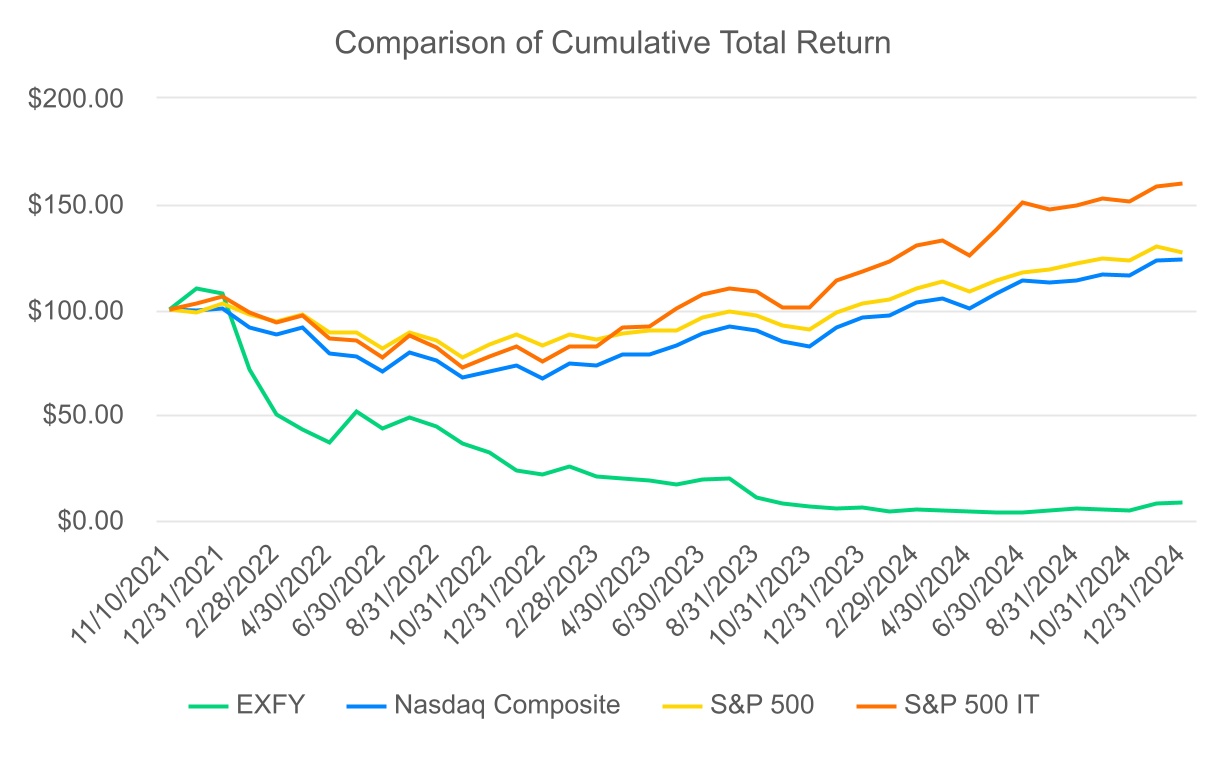
Item 6. [Reserved.]
71
Item 7. Management's Discussion and Analysis of Financial Condition and Results of Operations
The following discussion and analysis of our financial condition and results of operations should be read together with our audited consolidated financial statements and related notes included elsewhere in this Annual Report on Form 10-K. This discussion contains forward-looking statements based upon current plans, expectations and beliefs involving risks and uncertainties. Our actual results may differ materially from those anticipated in these forward-looking statements as a result of various factors, including those set forth under “Risk Factors” and in other parts of this Annual Report on Form 10-K.
The following discussion and analysis of our financial condition and results of operations generally discusses 2024 and 2023 items and year-to-year comparisons between 2024 and 2023. A discussion of 2022 items and year-to-year comparisons between 2023 and 2022 can be found in "Management’s Discussion and Analysis of Financial Condition and Results of Operations" in Part II, Item 7 of our Annual Report on Form 10-K for the year ended December 31, 2023, filed with the SEC on February 26, 2024.
OVERVIEW
Expensify is a cloud-based expense management software platform that helps the smallest to the largest businesses simplify the way they manage money. Every day, people from all walks of life in organizations around the world use Expensify to scan and reimburse receipts from flights, hotels, coffee shops, office supplies and ride shares. Since our founding in 2008, we have added over 15 million members to our community and processed and automated over 1.7 billion expense transactions on our platform as of December 31, 2024, freeing people to spend less time managing expenses and more time doing the things they love. For the year ended December 31, 2024, an average of 687,000 paid members across an average of 47,600 companies and over 200 countries and territories used Expensify to make money easy.
OUR BUSINESS MODEL
Our employee-centric product strategy, viral and bottom-up business model, word-of-mouth adoption and unique company culture come together to drive value for our members and a competitive advantage for us. We believe that if we remain hyper-focused on our end-user members, and build great products, our members will continue to drive adoption.
We primarily generate revenue from annual subscriptions to our cloud-based platform, driven by the number of paid members active on a monthly basis. Individuals or companies pay for subscriptions on behalf of themselves, their employees and contractors, who we collectively refer to as members. We define a customer as any member who pays for themselves and zero or more other members, grouped into one or more "expense policies." This might be an individual, an entire company, or a department of a larger company. The definition of customer inherently excludes sole proprietors on Track or Submit plans.
We monetize transactions from the Expensify Card by receiving a percentage of the interchange for all spend on the card. As we expand our platform, we continue to increase the number of integrations and to more actively promote the Expensify Card with complementary use cases beyond expense management to both new and existing customers to drive increased adoption.
We monetize bookings via Expensify Travel by charging a booking fee on each booking. We intend to continue to develop complimentary features to Expensify Travel to increase the number of existing companies using Expensify Travel and to attract new customers.
72
Key Factors Affecting Our Performance
Our performance depends on many factors, including the following:
INVESTING IN PRODUCT-LED GROWTH
We continue to focus on growing the number of paid members on our platform. Relative to other software companies, we invest more in product development and less in sales. This investment in product allows us to develop easy-to-use but powerful features that encourage adoption of our platform. Our ability to grow our paid members depends on our viral, bottom-up adoption cycle that starts with an individual employee. After downloading our free app to submit expenses and realizing the benefits of Expensify, our enthusiastic members champion our platform internally, spread it via word-of-mouth or invites to other employees and often convince decision makers to adopt Expensify company-wide. In order to continue to grow, we believe we must continue prioritizing investments in our platform to delight our members and drive viral expansion.
CONVERTING FREE MEMBERS
Our success depends on converting users who try the free aspects of the Expensify platform into paid members. While our viral model means that employees or contractors often introduce Expensify into small and medium-sized businesses (“SMBs"), companies subscribe and pay for the majority of our paid members.
INVESTING TO MAINTAIN MARKET CONSENSUS
Our viral and word-of-mouth adoption model is effective in part because we have established ourselves as a recognized leader in expense management for SMBs. We deploy large scale brand advertising to promote our platform strength and create market consensus that Expensify is a category leader for expense management software. Additionally, in 2023 we hosted our third ExpensiCon, an invite-only, all-expenses paid industry conference, with the goal of increasing our market consensus among our Approved! Accounting partners and increasing adoption of our platform. We believe investing in market consensus enables us to focus on creating great viral features for our members rather than relying on low-margin, unscalable activities of traditional sales and marketing to drive customer acquisition. In 2024 we invested in a promotional marketing opportunity to have Expensify heavily featured in Apple's biggest budget film, F1, which is scheduled to be released in theaters on June 27, 2025. Our goal is that this will increase our brand awareness and support our bottom-up, word of mouth marketing.
RETAINING EXISTING CUSTOMERS
Expense management touches many functions across a company. To provide a seamless experience for our customers, we integrate with accounting, ERP and travel software used by SMBs and their employees every day. We also have frictionless integrations with many of the technology providers that generate the most receipts for our members, such as Uber and Lyft. Expensify delivers an expense management platform that we believe customers like, and that embeds us within organizations. Because of these two factors, we have historically enjoyed high customer retention rates that often outperform enterprise retention rates. We believe an additional factor that drives our retention rates is that SMBs generally re-evaluate their technology solutions less frequently, and as such, there is rarely a conscious choice around whether to choose to continue using Expensify for another year.
Gross logo retention and net seat retention are important indicators of customer satisfaction and usage of our platform. We calculate our gross logo retention rate as of the end of a period by using (a) the number of distinct companies who have ever had five or more paid members paying for a subscription during the period ending one year prior as the denominator and (b) the number of those same companies that are still paying for at least one subscription during the more recent period as the numerator. In 2024 and 2023, our annual gross logo retention was 81% and 74%, respectively. We calculate our net seat retention rate as of the end of a period by using (a) the number of paid member seats from companies who have
73
ever had five or more paid members paying for a subscription during the period ending one year prior as the denominator and (b) the number of paid member seats at those same companies during the more recent period as the numerator. In 2024 and 2023, our net seat retention was 86% and 99%, respectively. Our growth will depend on our ability to retain existing customers.
INTRODUCING FEATURES TO EXPAND OUR RELATIONSHIP WITH EXISTING CUSTOMERS
We fully launched the Expensify Card in 2020 and we intend to actively promote the Expensify Card to both new and existing customers to drive increased adoption. In 2024, we launched our travel platform, Expensify Travel, as a natural extension of our expense management product. Many companies look for combined travel and expenses solutions in order to streamline the booking to reimbursement flow. Outside of the Expensify Card and Expensify Travel, we have invested, and will continue to invest, in developing features complementary and adjacent to expense management. At most companies, not every employee generates expenses that would be submitted via an expense report on a monthly basis. As we add additional features that are used by all employers, we have the potential to monetize the segment of our customers’ employees that are not submitting expense reports.
MACROECONOMIC TRENDS
Our business and the operations of our customers, the majority of which are SMBs, depend on the overall state of the economy, and we and they could be negatively impacted by slower economic growth and a potential for a recession. Although certain indicators have suggested that inflation has made downward progress, the economy continues to be impacted by elevated inflation rates and faces further inflation risk. Tariff and trade issues also continue to cause overall uncertainty with respect to the economy. See the section titled "Risk Factors" in this Annual Report on Form 10-K for further discussion of the possible impact of such macroeconomic trends on our business. Additionally, other potential challenging macroeconomic conditions, and the resulting impact on business continuity and travel, could negatively impact our business.
74
Components of Results of Operations
Revenue
We generate revenue from subscription fees based on the usage of our cloud-based expense management software platform under arrangements paid monthly in arrears that are either (i) month-to-month and can be terminated by either party without penalty at any time or (ii) annual arrangements based on a minimum number of monthly members. Annual subscription customers who wish to terminate their contracts before the end of the term are required to pay the remaining obligation in full plus any fees or penalties set forth in the agreement. We charge our customers subscription fees for access to our platform based on the number of monthly active members and level of service. The contractual price is based on either negotiated fees or rates published on our website. We generate most of our revenue from customers who have a credit card or debit card on file with us that is automatically charged each month. Virtually all of our customers have a standard terms of service contract, with the few exceptions for customers on bespoke service contracts.
Our contracts with our customers include two performance obligations: access to the hosted software service, inclusive of all features available within the platform, and the related customer support. We account for the platform access and the support as a combined performance obligation because they have the same pattern of transfer over the same period and are therefore delivered concurrently. We satisfy our performance obligation over time each month as we provide platform access and support services to customers and as such recognize revenue over time. We recognize revenue net of applicable taxes imposed on the related transaction.
During the year ended December 31, 2024, the Expensify Card consisted of two card programs operating concurrently: the "Legacy Card Program," which was the original program when the Expensify Card launched in 2020, and the "Updated Card Program," which launched in February 2024. All new Expensify Cards issued subsequent to the launch of the Updated Card Program operate under that program. As of December 31, 2024, our transition of cardholders from the Legacy Card Program to the Updated Card Program was substantially complete.
Under the Updated Card Program, we generate revenue from the authorization and settlement of Expensify Card transactions and are contractually entitled to all interchange generated on Expensify Card transactions based on our agreement with the issuing bank. Under the Updated Card Program, we are the principal in the transaction and recognize interchange as revenue on a gross basis within Revenue on the accompanying Consolidated Statements of Operations. Interchange revenue was $9.2 million for the year ended December 31, 2024.
We offer a cashback rewards program to all customers on the Updated Card Program based on volume of Expensify Card transactions. Cashback rewards are earned on a monthly basis and are applied against outstanding customer receivables or are paid out the following month. We consider our cashback rewards as consideration payable to a customer, and it is recorded as contra revenue within Revenue on the Consolidated Statements of Operations. Cashback rewards applied against outstanding customer receivables are reflected as a reduction to Accounts receivable, net on the Consolidated Balance Sheets. Cashback rewards liability is recorded within Accrued expenses and other liabilities on the Consolidated Balance Sheets. The cashback rewards fluctuate over time as customers meet eligibility requirements and timing of payments made to customers.
Cost of Revenue, Net
Cost of revenue, net primarily consists of expenses related to hosting our service, including the costs of data center capacity, credit card processing fees, third-party software license fees, outsourcing engineering costs to maintain our platform, outsourcing costs to support customer service and outsourcing costs to support our patented scanning technology SmartScan, net of consideration from a vendor for monetizing Expensify Card activities. Additional costs include amortization of finance right-of-use assets, amortization expense on capitalized software development costs and personnel-related
75
expenses, including stock-based compensation and employee costs attributable to supporting our customers and maintenance of our platform.
Consideration from a vendor is related to the Expensify Card under the Legacy Card Program, where we use a third-party vendor to issue Expensify Cards and process the related transactions. The vendor is contractually entitled to the interchange through its relationships with the card network and card issuing bank. The vendor keeps a portion of the interchange for their services, and our agreement with the vendor results in us receiving the remainder of the interchange (our remainder portion, "Expensify interchange amount"). The vendor also charges us fees ("vendor fees") for the services it provides to us. Due to the nature of the vendor agreement, we do not record the Expensify interchange amount as revenue under the Legacy Card Program. Instead, the net of the Expensify interchange amount and vendor fees are paid to us, which we record as "Consideration from a vendor, net," a contra expense in Cost of revenue, net on the Consolidated Statements of Operations. The following summarizes these various amounts for each of the periods presented:
| Year ended December 31, | |||||||||||
| 2024 | 2023 | ||||||||||
| (in thousands) | |||||||||||
| Expensify interchange amount | $ | 8,014 | $ | 11,144 | |||||||
| Vendor fees | (821) | (1,009) | |||||||||
| Consideration from a vendor, net | $ | 7,193 | $ | 10,135 | |||||||
OPERATING EXPENSES
Research and Development
Research and development expenses consist primarily of personnel-related expenses, including stock-based compensation, and external contributor costs incurred related to the planning and preliminary project stage of new products or enhancing existing products or services. We capitalize certain software development costs that are attributable to developing or adding significant functionality to our internal-use software during the application development stage of the projects. All research and development expenses, excluding capitalized software development costs, are expensed as incurred.
We believe delivering new functionality is critical to attract new customers and expand our relationships with existing customers. We expect to continue to make investments in and expand our product and service offerings to enhance our customers’ experience and satisfaction and to attract new customers. We expect research and development expenses will increase as we expand our research and development team to develop new products and product enhancements.
General and Administrative
General and administrative expenses primarily consist of personnel-related expenses, including stock-based compensation, for any employee time allocated to administrative functions, including finance and accounting, legal and compliance, and human resources. In addition to personnel-related expenses, general and administrative expenses consist of business insurance, rent, utilities, depreciation on property and equipment, amortization of operating lease right-of-use assets, information technology and external professional services, including finance and accounting, audit, tax, legal and compliance, and human resources. We expect that general and administrative expenses will remain consistent as it relates to costs associated with being a publicly traded company, including legal, audit, business insurance and consulting fees.
76
Sales and Marketing
Sales and marketing expenses primarily consist of personnel-related expenses, including stock-based compensation, advertising expenses, depreciation on property and equipment, outsourcing costs for sales and product demos, branding and public relations expenses, referral fees for strategic partners and other benefits that we provide to our referral and affiliate partners. We expect sales and marketing expenses will increase as we expand our brand marketing.
Interest and Other Expenses, Net
Interest and other expenses, net, consist primarily of interest paid under our credit facilities with Canadian Imperial Bank of Commerce ("CIBC"). It also includes the results of operations of our Fifth & Harvey, LLC subsidiary, which holds title to and manages operations of the operating lease for lots in Portland, Oregon that are currently used to host multiple portable food vendors open to the general public, realized gains and losses on foreign currency transactions and foreign currency remeasurement. We expect interest and other expenses, net will decrease as all outstanding debt has been paid off as of December 31, 2024.
Provision for Income Taxes
Income taxes primarily consist of income taxes in the United States, United Kingdom, Australia, Netherlands and Canada, as well as states in the United States in which we do business.
77
Results of Operations
The results of operations presented below should be reviewed in conjunction with the consolidated financial statements and notes included elsewhere in this Annual Report on Form 10-K.
The following table sets forth our results of operations for the periods presented:
| Year ended December 31, | |||||||||||
| 2024 | 2023 | ||||||||||
| (in thousands, except per share data) | |||||||||||
| Revenue | $ | 139,236 | $ | 150,687 | |||||||
Cost of revenue, net(1) | 64,239 | 66,888 | |||||||||
| Gross margin | 74,997 | 83,799 | |||||||||
| Operating expenses: | |||||||||||
Research and development(1) | 24,638 | 23,368 | |||||||||
General and administrative(1) | 38,382 | 49,228 | |||||||||
Sales and marketing(1) | 12,797 | 44,352 | |||||||||
| Total operating expenses | 75,817 | 116,948 | |||||||||
| Loss from operations | (820) | (33,149) | |||||||||
| Interest and other expenses, net | (1,572) | (5,327) | |||||||||
| Loss before income taxes | (2,392) | (38,476) | |||||||||
| Provision for income taxes | (7,663) | (2,980) | |||||||||
| Net loss | $ | (10,055) | $ | (41,456) | |||||||
| Net loss per share: | |||||||||||
| Basic and diluted | $ | (0.12) | $ | (0.50) | |||||||
| Weighted average shares of common stock used to compute net loss per share: | |||||||||||
| Basic and diluted | 87,380,708 | 82,493,226 | |||||||||
| Net loss margin | (7) | % | (28) | % | |||||||
(1)Includes stock-based compensation expense as follows:
| Year ended December 31, | |||||||||||
| 2024 | 2023 | ||||||||||
| (in thousands) | |||||||||||
| Cost of revenue, net | $ | 12,506 | $ | 13,868 | |||||||
| Research and development | 11,900 | 10,870 | |||||||||
| General and administrative | 6,815 | 9,842 | |||||||||
| Sales and marketing | 2,316 | 6,632 | |||||||||
| Total stock-based compensation expense | $ | 33,537 | $ | 41,212 | |||||||
78
COMPARISON OF THE YEARS ENDED DECEMBER 31, 2024 AND 2023
Revenue
| Year ended December 31, | Change | ||||||||||||||||||||||
| 2024 | 2023 | Amount | % | ||||||||||||||||||||
| (in thousands, except percentages) | |||||||||||||||||||||||
| Revenue | $ | 139,236 | $ | 150,687 | $ | (11,451) | (8) | % | |||||||||||||||
Revenue decreased $11.5 million, or 8%, for the year ended December, 31, 2024 compared to the same period in 2023, primarily due to (i) a decrease in billable activity across our user base, including a decrease in pay-per-use billable activity which has a higher average fee per member than our annual members, and (ii) an increase in contra revenue related to cashback payments driven by the increased adoption and spend captured from members using the Expensify Card. These decreases were partially offset by an increase in interchange revenue driven primarily by a shift in cardholder spend from the Legacy Card Program to the Updated Card Program.
Cost of Revenue, Net and Gross Margin
| Year ended December 31, | Change | ||||||||||||||||||||||
| 2024 | 2023 | Amount | % | ||||||||||||||||||||
| (in thousands, except percentages) | |||||||||||||||||||||||
| Cost of revenue, net | $ | 64,239 | $ | 66,888 | $ | (2,649) | (4) | % | |||||||||||||||
| Gross margin | $ | 74,997 | $ | 83,799 | $ | (8,802) | (11) | % | |||||||||||||||
| Gross margin % | 54 | % | 56 | % | |||||||||||||||||||
Cost of revenue, net decreased by $2.6 million, or 4%, for the year ended December 31, 2024 compared to the same period in 2023. Cost of revenue, net decreased primarily due to (i) a decrease in outsourcing activities related to maintaining our platform, and (ii) a decrease in total employee and employee related expenses subject to allocation. These were partially offset by a decrease in Consideration from a vendor, net driven primarily by a shift in cardholder spend from the Legacy Card Program to the Updated Card Program.
Gross margin decreased to 54% in 2024 compared to 56% in the same period in 2023 due to the factors described in the preceding paragraphs for Revenue and Cost of revenue, net.
Research and Development
| Year ended December 31, | Change | ||||||||||||||||||||||
| 2024 | 2023 | Amount | % | ||||||||||||||||||||
| (in thousands, except percentages) | |||||||||||||||||||||||
| Research and development | $ | 24,638 | $ | 23,368 | $ | 1,270 | 5 | % | |||||||||||||||
Research and development expenses increased by $1.3 million, or 5%, for the year ended December 31, 2024 compared to the same period in 2023, primarily due to an increase in employee time spent on project initiatives and new product features, partially offset by a decrease in total employee and employee related expenses subject to allocation.
79
General and Administrative
| Year ended December 31, | Change | ||||||||||||||||||||||
| 2024 | 2023 | Amount | % | ||||||||||||||||||||
| (in thousands, except percentages) | |||||||||||||||||||||||
| General and administrative | $ | 38,382 | $ | 49,228 | $ | (10,846) | (22) | % | |||||||||||||||
General and administrative expenses decreased $10.8 million, or 22%, for the year ended December 31, 2024 compared to the same period in 2023, primarily due to (i) a decrease in total employee related expenses subject to allocation, (ii) a decrease in settlement losses, and (iii) a decrease in business insurance expense.
Sales and Marketing
| Year ended December 31, | Change | ||||||||||||||||||||||
| 2024 | 2023 | Amount | % | ||||||||||||||||||||
| (in thousands, except percentages) | |||||||||||||||||||||||
| Sales and marketing | $ | 12,797 | $ | 44,352 | $ | (31,555) | (71) | % | |||||||||||||||
Sales and marketing expenses decreased $31.6 million, or 71%, for the year ended December 31, 2024 compared to the same period in 2023, primarily due to (i) a decrease in outsourcing activities related to sales and product demos, (ii) a decrease in total employee and employee related expenses subject to allocation and a decrease in time spent on sales and marketing activities, (iii) a decrease in advertising spend, and (iv) a decrease in marketing event spend.
Interest and Other Expenses, Net
| Year ended December 31, | Change | ||||||||||||||||||||||
| 2024 | 2023 | Amount | % | ||||||||||||||||||||
| (in thousands, except percentages) | |||||||||||||||||||||||
| Interest and other expenses, net | $ | (1,572) | $ | (5,327) | $ | 3,755 | (70) | % | |||||||||||||||
Interest and other expenses, net decreased by $3.8 million, or 70%, for the year ended December 31, 2024 compared to the same period in 2023 primarily due to a decrease in interest expense incurred due to the repayments of the term loan component of the 2021 Amended Loan and Security Agreement (as defined below), the revolving line of credit and the amortizing term mortgage.
Provision for Income Taxes
| Year ended December 31, | Change | ||||||||||||||||||||||
| 2024 | 2023 | Amount | % | ||||||||||||||||||||
| (in thousands, except percentages) | |||||||||||||||||||||||
Provision for income taxes | $ | (7,663) | $ | (2,980) | $ | (4,683) | 157 | % | |||||||||||||||
We recorded a provision for income taxes of $7.7 million for the year ended December 31, 2024 compared to a $3.0 million provision for income taxes for the year ended December 31, 2023. We follow the asset and liability method of accounting for income taxes, whereby we recognize deferred income taxes for the tax consequences of temporary differences between the financial statement carrying amounts and the tax
80
basis of the assets and liabilities. Valuation allowances are recorded to reduce deferred tax assets when it is more likely than not that a tax benefit will not be realized. During the years ended December 31, 2024 and 2023, we recorded an incremental valuation allowance of $0.9 million and $3.7 million, respectively. The provision for income taxes reflects taxable income earned and taxed in U.S. federal and state, and non-U.S. jurisdictions.
Our effective income tax rate was (320.4)% and (7.7)%, for the years ended December 31, 2024 and 2023, respectively. The effective income tax rate differs from the statutory rate in 2024 primarily due to nondeductible stock-based compensation, the compensation limitations imposed by Internal Revenue Code ("IRC") Section 162(m), and the change in the valuation allowance. The effective income tax rate differs from the statutory rate in 2023 primarily due to nondeductible stock-based compensation, the change in the valuation allowance, and the compensation limitations imposed by IRC Section 162(m).
Liquidity and Capital Resources
Since our inception, we have financed our operations primarily through our cash flow from operations, sales of our equity securities and borrowings under our credit facilities. As of December 31, 2024, we had $48.8 million in cash and cash equivalents with no outstanding indebtedness and $24.0 million of capacity available for borrowings under the revolving line of credit.
Our future capital requirements will depend on many factors, including revenue growth and costs incurred to support growth in our business and our need to respond to business opportunities, challenges or unforeseen circumstances. We believe that our existing cash resources will be sufficient to finance our continued operations and growth strategy for the next 12 months and the foreseeable future.
CASH FLOWS
The following table summarizes our cash flows for the periods indicated:
| Year ended December 31, | |||||||||||
| 2024 | 2023 | ||||||||||
| (in thousands) | |||||||||||
| Net cash provided by operating activities | $ | 23,877 | $ | 1,559 | |||||||
| Net cash used in investing activities | (7,628) | (7,294) | |||||||||
Net cash used in financing activities | (22,073) | (45,317) | |||||||||
Net decrease in cash and cash equivalents and restricted cash | $ | (5,824) | $ | (51,052) | |||||||
CASH FLOWS FROM OPERATING ACTIVITIES
Net cash provided by operating activities was $23.9 million for the year ended December 31, 2024 as compared to $1.6 million for the same period in 2023. The increase is primarily due to a decrease in marketing and advertising spend and a decrease in outsourcing activities related to sales and product demos, partially offset by a decrease in revenue.
CASH FLOWS FROM INVESTING ACTIVITIES
During the year ended December 31, 2024, net cash used in investing activities was $7.6 million, primarily consisting of software development costs.
Net cash used in investing activities increased for the year ended December 31, 2024 compared to the same period in 2023, primarily due to an increase in employee and external contributor software development costs offset by a decrease in the purchase of property and equipment.
81
CASH FLOWS FROM FINANCING ACTIVITIES
During the year ended December 31, 2024, net cash used in financing activities was $22.1 million, primarily consisting of the repayment of the revolving line of credit and the amortizing term mortgage, and the repurchase and retirement of common stock, which was partially offset by proceeds from common stock purchased under our 2021 Stock Purchase and Matching Plan ("Matching Plan").
During the year ended December 31, 2023, net cash used in financing activities was $45.3 million, primarily consisting of principal payments on the term loan, the repurchase and retirement of common stock, and payment for employees taxes withheld from stock-based awards, which was partially offset by proceeds from common stock purchased under the Matching Plan.
Share Repurchase Program
On May 10, 2022, the Executive Committee approved a share repurchase program with authorization to purchase up to $50.0 million of shares of Class A common stock ("2022 Share Repurchase Program"). We may repurchase shares from time to time through open market purchases, in privately negotiated transactions or by other means, including the use of trading plans intended to qualify under Rule 10b5-1 of the Exchange Act, in accordance with applicable securities laws and other restrictions. The actual timing, manner, price and total amount of future repurchases will depend on a variety of factors, including business, economic and market conditions, corporate and regulatory requirements, prevailing stock prices, restrictions under the terms of loan agreements and other considerations. The 2022 Share Repurchase Program does not obligate us to acquire any particular amount of Class A common stock, and the program may be suspended or terminated by us at any time at our discretion without prior notice. As of December 31, 2024, there was approximately $39.5 million remaining under the share repurchase authorization.
The 2022 Share Repurchase Program was scheduled to expire on March 31, 2025. On February 25, 2025, the Executive Committee approved a new share repurchase program with authorization to purchase up to $50.0 million of shares of Class A common stock ("2025 Share Repurchase Program") that replaces the 2022 Share Repurchase Program. Pursuant to the 2025 Share Repurchase Program, we may repurchase shares from time to time through open market purchases, in privately negotiated transactions or by other means, including the use of trading plans intended to qualify under Rule 10b5-1 of the Exchange Act, in accordance with applicable securities laws and other restrictions. The actual timing, manner, price and total amount of future repurchases will depend on a variety of factors, including business, economic and market conditions, corporate and regulatory requirements, prevailing stock prices, restrictions under the terms of loan agreements and other considerations. The 2025 Share Repurchase Program does not obligate us to acquire any particular amount of Class A common stock, and the program may be suspended or terminated by us at any time at our discretion without prior notice.
See Note 8 to our consolidated financial statements included elsewhere in this Annual Report on Form 10-K for further information.
CREDIT FACILITIES
Amortizing Term Mortgage
In August 2019, we entered into an $8.3 million amortizing term mortgage agreement with CIBC for our commercial building located in Portland, Oregon. The agreement required principal and interest payments due each month over a five-year period. Interest accrued at a fixed rate of 5.00% per year until August 2024, at which point the remaining outstanding principal balance on the amortizing term mortgage was due in full. The borrowings were secured by the building. On August 29, 2024, we repaid in full the then-outstanding balance of $7.6 million and an immaterial amount of accrued interest and terminated the associated mortgage agreement with CIBC and secured promissory note. See Note 7 to our condensed consolidated financial statements included elsewhere in this Annual Report on Form 10-K for further information.
82
2021 Loan and Security Agreement
In September 2021, we amended and restated our loan and security agreement with CIBC (the "2021 Amended Loan and Security Agreement") which consisted of a $45.0 million initial term loan, the option to enter into an additional $30.0 million delayed term loan that expired in March 2023, and a monthly revolving line of credit of $25.0 million. Under the 2021 Amended Loan and Security Agreement, the initial term loan of $45.0 million was payable over a 60-month period with principal and accrued interest payments due each quarter, commencing on September 30, 2021. The term loan amortized in equal quarterly installments of $0.1 million through September 30, 2024, $0.2 million beginning October 1, 2024 and $0.6 million beginning October 1, 2025, with any remaining principal balance due and payable on maturity in September 2026. The amounts borrowed accrued interest at the bank’s reference rate plus 2.25% beginning on September 30, 2021 and continued on a quarterly basis through maturity of the term loan. The borrowings were secured by substantially all our assets. The then-outstanding balance of $36.0 million and $0.1 million of accrued interest on the term loan were repaid in full on October 12, 2023.
2024 Loan and Security Agreement
In February 2024, we entered into a Second Amended and Restated Loan and Security Agreement (as amended by the amendments described below, and as may be further amended from time to time, the "2024 Amended Loan and Security Agreement") with CIBC. The 2024 Amended Loan and Security Agreement amended and restated the 2021 Amended Loan and Security Agreement in its entirety, to extend the maturity date of the revolving line of credit from September 2024 to September 2025, remove certain provisions related to the term loan that was repaid in full in October 2023, and make certain changes to the positive and negative covenants intended to better align with our operations. The 2024 Amended Loan and Security Agreement provides for a $25.0 million revolving credit facility. Borrowings under the revolving line of credit accrue interest at CIBC’s reference rate plus 1.00% and are secured by substantially all our assets.
We incurred an immaterial amount of costs in connection with entering into the 2024 Amended Loan and Security Agreement. These debt issuance costs are reflected as a deferred asset within Other current assets on the Consolidated Balance Sheets and are being amortized to interest expense on a straight-line basis over the term of the agreement.
On April 24, 2024, we entered into an irrevocable standby letter of credit (the "Letter of Credit") issued under the 2024 Amended Loan and Security Agreement to reduce cash collateral requirements in connection with the Updated Card Program. The Letter of Credit was issued in the amount of $1.0 million for the benefit of The Bancorp Bank, N.A. and expires on March 20, 2025. No amounts have been drawn on the Letter of Credit as of December 31, 2024.
In May 2024, we entered into a First Amendment to the 2024 Amended Loan and Security Agreement, which amended the covenant restricting the amount of repurchases of common stock to allow for certain additional repurchase activity and provided a waiver for our non-compliance during prior periods with the previous version of such covenant.
The then-outstanding balance of $15.0 million and an immaterial amount of accrued interest on the revolving line of credit were repaid in full on July 10, 2024.
Upon full repayment of the amortizing term mortgage on August 29, 2024, we entered into a Second Amendment to the 2024 Amended Loan and Security Agreement, which permits our wholly-owned subsidiary, 401 SW 5th Ave LLC, to remain an excluded subsidiary provided that the subsidiary does not engage in any operations or activities except to maintain legal existence and ownership of the real property or any related activities thereto, does not hold assets other than real estate assets, and does not incur any indebtedness except for intercompany liabilities permitted under the agreement or grant any liens.
In February 2025, we entered into a Third Amendment to the 2024 Amended Loan and Security Agreement, which amended the covenant restricting the amount of repurchases of common stock, which
83
includes net share settlements of stock-based awards, to allow for certain additional net share settlement activity and provided a waiver for our non-compliance of this covenant as of December 31, 2024 with the previous version of such covenant.
See Note 7 to our consolidated financial statements included elsewhere in this Annual Report on Form 10-K for further information.
Certain Covenants
We are subject to customary covenants under the 2024 Amended Loan and Security Agreement, which, unless waived by CIBC, restrict our and our subsidiaries' ability to, among other things, incur additional indebtedness, create or incur liens, permit a change of control, merge or consolidate with other companies, sell or transfer assets, pay dividends or make distributions, make acquisitions, investments or loans, or payments and prepayments of subordinated indebtedness, subject to certain exceptions. We must also maintain certain financial covenants: a total liquidity ratio, as defined in the 2024 Amended Loan and Security Agreement, tested each quarter, of not less than 1.10 to 1.00 from the quarter ending March 31, 2024, not less than 1.20 to 1.00 from the quarter ending June 30, 2024 and each quarter thereafter, and a total EBITDA net leverage ratio, as defined in the 2024 Amended Loan and Security Agreement, tested each quarter, of not less than 2.50 to 1.00 from the quarter ended March 31, 2025 and each quarter thereafter.
Upon full repayment of the amortizing term mortgage on August 29, 2024, we entered into a second amendment to the 2024 Amended Loan and Security Agreement, which permits our wholly-owned subsidiary, 401 SW 5th Ave LLC, to remain an excluded subsidiary provided that the subsidiary does not engage in any operations or activities except to maintain legal existence and ownership of the real property or any related activities thereto, does not hold assets other than real estate assets, and does not incur any indebtedness except for intercompany liabilities permitted under the agreement or grant any liens.
If we fail to perform our obligations under these and other covenants, CIBC's credit commitments could be terminated and any outstanding borrowings, together with accrued interest, under the credit or loan agreements could be declared immediately due and payable.
As of December 31, 2024, we were not in compliance with all debt covenants under the 2024 Amended Loan and Security Agreement, specifically the covenant restricting the amount of repurchases of common stock, which includes net share settlements of stock-based awards. As described above, in February 2025, we entered into the Third Amendment to the 2024 Amended Loan and Security Agreement, which included a waiver for our non-compliance of this covenant as of December 31, 2024. We do not believe non-compliance with this covenant had any material impact on our operations.
Key Business Metrics and Non-GAAP Financial Measures
We supplement the reporting of our financial information determined under U.S. generally accepted accounting principles ("GAAP") with certain business metrics and non-GAAP financial measures which we regularly review to evaluate our business, measure our performance, identify trends affecting our business, formulate business plans and make strategic decisions. Accordingly, we believe that these key business metrics and non-GAAP financial measures provide useful information to investors and others in understanding and evaluating our results of operations in the same manner as our management team. These key business metrics and non-GAAP financial measures are presented for supplemental informational purposes only, should not be considered a substitute for our financial information presented in accordance with GAAP and may be different from similarly titled metrics or measures presented by other companies.
84
KEY BUSINESS METRICS
Paid Members
We believe that our ability to increase the number of paid members on our platform will drive our success as a business. Our customers pay for subscriptions on behalf of employees and contractors who use the platform, whom we refer to as paid members. We define paid members as the average number of users (employees, contractors, volunteers, team members, etc.) who are billed on Collect or Control plans during any particular quarter. For SMBs or sole proprietors with only one employee, the business owner may also be the only paid member.
The following table sets forth the average number of paid members for the quarters ended March 31, 2023 through December 31, 2024 (in thousands):
| Quarter ended | Paid members | |||||||
| March 31, 2023 | 747 | |||||||
| June 30, 2023 | 742 | |||||||
| September 30, 2023 | 719 | |||||||
| December 31, 2023 | 719 | |||||||
| March 31, 2024 | 688 | |||||||
| June 30, 2024 | 684 | |||||||
| September 30, 2024 | 684 | |||||||
| December 31, 2024 | 687 | |||||||
NON-GAAP FINANCIAL MEASURES
Limitations of Non-GAAP Financial Measures
Non-GAAP financial measures have limitations as analytical tools and should not be considered in isolation or as substitutes for financial information presented under GAAP. There are a number of limitations related to the use of non-GAAP financial measures versus comparable financial measures determined under GAAP. For example, other companies in our industry may calculate these non-GAAP financial measures differently or may use other measures to evaluate their performance. All of these limitations could reduce the usefulness of these non-GAAP financial measures as analytical tools. Investors are encouraged to review the related GAAP financial measures and the reconciliations of these non-GAAP financial measures to their most directly comparable GAAP financial measures and to not rely on any single financial measure to evaluate our business.
Adjusted EBITDA and Adjusted EBITDA Margin
We define adjusted EBITDA as net loss from operations excluding provision for income taxes, interest and other expenses, net, depreciation and amortization and stock-based compensation. We define adjusted EBITDA margin as adjusted EBITDA divided by total revenue for the same period. We are focused on profitable growth and we consider adjusted EBITDA to be an important measure because it helps
85
illustrate underlying trends in our business that could otherwise be masked by the effect of the income or expenses that are not indicative of the core operating performance of our business.
| Year ended December 31, | |||||||||||
| 2024 | 2023 | ||||||||||
| (in thousands, except percentages) | |||||||||||
| Adjusted EBITDA | $ | 39,372 | $ | 13,174 | |||||||
| Adjusted EBITDA margin | 28 | % | 9 | % | |||||||
Non-GAAP Net Income and Non-GAAP Net Income Margin
We define non-GAAP net income as net loss from operations in accordance with GAAP excluding stock-based compensation. We define non-GAAP net income margin as non-GAAP net income divided by total revenue for the same period. We are focused on profitable growth and we consider non-GAAP net income to be an important measure because it helps illustrate underlying trends in our business that could
86
otherwise be masked by the effect of stock-based compensation, which is not considered indicative of the core operating performance of our business.
| Year ended December 31, | |||||||||||
| 2024 | 2023 | ||||||||||
| (in thousands, except percentages) | |||||||||||
| Non-GAAP net income (loss) | $ | 23,482 | $ | (244) | |||||||
| Non-GAAP net income (loss) margin | 17 | % | — | % | |||||||
Free Cash Flow
We define free cash flow as net cash provided by operating activities excluding changes in settlement assets and settlement liabilities, which represent funds held for customers and customer funds in transit, respectively, reduced by the purchases of property and equipment and software development costs.
| Year ended December 31, | |||||||||||
| 2024 | 2023 | ||||||||||
| (in thousands, except percentages) | |||||||||||
Free cash flow | $ | 23,863 | $ | 555 | |||||||
Free cash flow margin | 17 | % | — | % | |||||||
Reconciliations of Non-GAAP Financial Measures
The following tables reconcile the most directly comparable GAAP financial measure to each of these non-GAAP financial measures.
Adjusted EBITDA and Adjusted EBITDA Margin
| Year ended December 31, | |||||||||||
| 2024 | 2023 | ||||||||||
| (in thousands, except percentages) | |||||||||||
| Net loss | $ | (10,055) | $ | (41,456) | |||||||
| Net loss margin | (7) | % | (28) | % | |||||||
| Add: | |||||||||||
Provision for income taxes | 7,663 | 2,980 | |||||||||
| Interest and other expenses, net | 1,572 | 5,327 | |||||||||
| Depreciation and amortization | 6,655 | 5,111 | |||||||||
Stock-based compensation expense | 33,537 | 41,212 | |||||||||
| Adjusted EBITDA | $ | 39,372 | $ | 13,174 | |||||||
| Adjusted EBITDA margin | 28 | % | 9 | % | |||||||
87
Non-GAAP net income and non-GAAP net income margin
| Year ended December 31, | |||||||||||
| 2024 | 2023 | ||||||||||
| (in thousands, except percentages) | |||||||||||
| Net loss | $ | (10,055) | $ | (41,456) | |||||||
| Net loss margin | (7) | % | (28) | % | |||||||
| Add: | |||||||||||
Stock-based compensation expense | 33,537 | 41,212 | |||||||||
| Non-GAAP net income (loss) | $ | 23,482 | $ | (244) | |||||||
| Non-GAAP net income (loss) margin | 17 | % | — | % | |||||||
Adjusted Operating Cash Flow and Free Cash Flow
| Year ended December 31, | |||||||||||
| 2024 | 2023 | ||||||||||
| (in thousands, except percentages) | |||||||||||
Net cash provided by operating activities | $ | 23,877 | $ | 1,559 | |||||||
Operating cash flow margin | 17 | % | 1 | % | |||||||
(Increase) decrease in changes in assets and liabilities: | |||||||||||
| Settlement assets, net | 2,469 | 6,398 | |||||||||
| Settlement liabilities | 5,145 | (108) | |||||||||
| Adjusted operating cash flow | 31,491 | 7,849 | |||||||||
| Less: | |||||||||||
| Purchase of property and equipment | — | (1,384) | |||||||||
| Software development costs | (7,628) | (5,910) | |||||||||
| Free cash flow | $ | 23,863 | $ | 555 | |||||||
Free cash flow margin | 17 | % | — | % | |||||||
88
Contractual Obligations and Commitments
The following table summarizes our contractual obligations and commitments as of December 31, 2024:
| Payments due by period | |||||||||||||||||||||||
| (in thousands) | |||||||||||||||||||||||
| Less than 1 year | 1-3 years | More than 3 years | Total | ||||||||||||||||||||
| Finance lease commitments | $ | 153 | $ | 102 | $ | — | $ | 255 | |||||||||||||||
| Operating lease commitments | 1,079 | 3,114 | 4,499 | 8,692 | |||||||||||||||||||
| Total | $ | 1,232 | $ | 3,216 | $ | 4,499 | $ | 8,947 | |||||||||||||||
Indemnification Agreements
In the ordinary course of business, we enter into agreements of varying scope and terms whereby we agree to indemnify customers, issuing banks, card networks, vendors and other parties with respect to certain matters, including, but not limited to, losses arising out of the breach of such agreements, services to be provided by us or from intellectual property infringement claims made by third parties. In addition, we have entered into indemnification agreements with our directors and certain officers and employees that will require us, among other things, to indemnify them against certain liabilities that may arise by reason of their status or service as directors, officers or employees. No demands have been made upon us to provide indemnification under such agreements and there are no claims that we are aware of that could have a material effect on our Consolidated Balance Sheets, Consolidated Statements of Operations, Consolidated Statements of Changes in Stockholders' Equity, or Consolidated Statements of Cash Flows.
Off-Balance Sheet Arrangements
During the periods presented, we did not have, and we do not currently have, any off-balance sheet financing arrangements or any relationships with unconsolidated entities or financial partnerships, including entities sometimes referred to as structured finance or special purpose entities, that were established for the purpose of facilitating off-balance sheet arrangements or other contractually narrow or limited purposes.
Critical Accounting Policies and Estimates
Our consolidated financial statements included elsewhere herein have been prepared in accordance with GAAP. The preparation of our financial statements requires us to make estimates and judgments that affect our reported amounts of assets, liabilities, revenues and expenses. We base our estimates on historical experience and on various other assumptions that we believe are reasonable under the circumstances. Actual results may differ from these estimates under different assumptions or conditions. For our accounting policies, see Note 2 to our consolidated financial statements contained elsewhere herein for a description of our significant accounting policies.
EMPLOYEE AND EMPLOYEE-RELATED EXPENSES
Allocating our employee and employee-related expenses, which consist of contractor costs, employee salary and wages, stock-based compensation and travel and other employee-related costs, to their appropriate financial statement line items on the Consolidated Statements of Operations, requires us to make estimates and judgments as a result of our generalist model and organizational structure. We base our estimates for allocating employee and employee related expenses on our internal productivity and team management tools. Management reviews the estimates each reporting period to evaluate the
89
amounts allocated to Cost of revenue, net, Research and development, General and administrative, and Sales and marketing on the Consolidated Statements of Operations.
REVENUE RECOGNITION
We generate revenue from subscription fees paid by our customers to access and use our hosted software services, as well as standard customer support.
Revenue is recognized when control of the promised goods or services is transferred to customers, in an amount that reflects the consideration we expect to be entitled to in exchange for those goods or services.
Our contracts are either month-to-month arrangements billed monthly in arrears based on a specified number of members or annual arrangements billed monthly in arrears based on a minimum number of monthly members. Month-to-month contracts can be terminated by either party at any time without penalty. Annual subscription customers who wish to terminate their contracts before the end of the term are required to pay the remaining obligation in full plus any fees or penalties set forth in the agreement.
We charge customers subscription fees for access to our platform based on the number of monthly members and level of service. The contractual price per member is based on either negotiated fees or rates published on our website. Our contracts with customers include two performance obligations: access to the hosted software service ("SaaS"), inclusive of all features available within the platform and related customer support. The SaaS and the support are accounted for as a combined performance obligation because they have the same pattern of transfer over the same period and, therefore, are delivered concurrently. We satisfy our performance obligation over time each month as it provides the SaaS and support services to customers and as such generally recognizes revenue monthly based on the number of monthly members and contractual rate per member.
Certain annual contracts provide the customer the option to increase the minimum number of members and extend the contract term on a prospective basis or to purchase members beyond the minimum contracted number of members at a higher rate for a particular month. These options are accounted for when the customer exercises the option as they do not represent a material right and are accounted for as a contract modification.
Revenue is recognized net of applicable taxes imposed on the related transaction. We charge customers on a monthly basis, in arrears, with typical payment terms being 30 days. Since our performance obligation is satisfied monthly, at any reporting period, we have no unsatisfied, or partially unsatisfied, performance obligations.
Under the Updated Card Program, we generate revenue from the authorization and settlement of Expensify Card transactions. We partner with an issuing bank to issue Expensify Cards to customers as a feature of the Company’s SaaS. Our agreement with the issuing bank allows for card transactions to be authorized and settled on the Visa network. We are contractually entitled to all interchange generated on Expensify Card transactions based on our agreement with the issuing bank. Based on our agreements with the payment processor and issuing bank, we are the principal in the transaction. As such, we recognize interchange as revenue on a gross basis within Revenue on the accompanying Consolidated Statements of Operations.
Recent Accounting Pronouncements
See Note 2 to our consolidated financial statements in this Annual Report on Form 10-K for recently issued and adopted accounting pronouncements.
90
Item 7A. Quantitative and Qualitative Disclosures About Market Risk
FOREIGN CURRENCY EXCHANGE RISK
We report our results in U.S. dollars, which is our reporting currency. For our foreign operations, the majority of our revenues and expenses are denominated in other currencies, such as the British pound and the Australian dollar. Foreign currency assets and liabilities are remeasured into the U.S. dollar at end-of-period exchange rates except for prepaid expenses, property and equipment and related depreciation and amortization and lease right-of-use assets and related amortization, which are remeasured at historical exchange rates. Revenues and expenses are remeasured at average exchange rates in effect during each period. Gains or losses from foreign currency transactions are included in the Consolidated Statements of Operations.
If the value of the U.S. dollar weakens relative to foreign currencies, this may have an unfavorable impact on our cash flows and operating results. We do not believe that a 10% change in the relative value of the U.S. dollar to other foreign currencies would have a material effect on our cash flows and operating results.
INTEREST RATE RISK
We are subject to interest rate risk in connection with borrowings under our amortizing term mortgage, our monthly revolving line of credit and our amortizing term loan. Interest rate changes generally impact the amount of our interest payments and, therefore, our future profitability and cash flows. Assuming the amounts outstanding under these borrowing facilities are fully drawn, a hypothetical 10% change in interest rates would not have a material impact on our consolidated financial statements.
INFLATION RISK
We do not believe that inflation has had a material impact on our business, results of operations or financial condition. Nonetheless, if our costs were to become subject to significant inflationary pressures, we may not be able to fully offset such higher costs through price increases. Our inability or failure to do so could harm our business, results of operations or financial condition.
91
Item 8. Financial Statements and Supplementary Data
| Index to Consolidated Financial Statements | |||||
Consolidated Financial Statements | |||||
92
Report of Independent Registered Public Accounting Firm
To the Stockholders and the Board of Directors of Expensify, Inc.
Opinion on the Financial Statements
We have audited the accompanying consolidated balance sheets of Expensify, Inc. (the Company) as of December 31, 2024 and 2023, the related consolidated statements of operations, changes in stockholders’ equity and cash flows for each of the three years in the period ended December 31, 2024, and the related notes (collectively referred to as the “consolidated financial statements”). In our opinion, the consolidated financial statements present fairly, in all material respects, the financial position of the Company at December 31, 2024 and 2023, and the results of its operations and its cash flows for each of the three years in the period ended December 31, 2024, in conformity with U.S. generally accepted accounting principles.
We also have audited, in accordance with the standards of the Public Company Accounting Oversight Board (United States) (PCAOB), the Company's internal control over financial reporting as of December 31, 2024, based on criteria established in Internal Control-Integrated Framework issued by the Committee of Sponsoring Organizations of the Treadway Commission (2013 framework) and our report dated February 27, 2025 expressed an unqualified opinion thereon.
Basis for Opinion
These financial statements are the responsibility of the Company's management. Our responsibility is to express an opinion on the Company’s financial statements based on our audits. We are a public accounting firm registered with the PCAOB and are required to be independent with respect to the Company in accordance with the U.S. federal securities laws and the applicable rules and regulations of the Securities and Exchange Commission and the PCAOB.
We conducted our audits in accordance with the standards of the PCAOB. Those standards require that we plan and perform the audit to obtain reasonable assurance about whether the financial statements are free of material misstatement, whether due to error or fraud. Our audits included performing procedures to assess the risks of material misstatement of the financial statements, whether due to error or fraud, and performing procedures that respond to those risks. Such procedures included examining, on a test basis, evidence regarding the amounts and disclosures in the financial statements. Our audits also included evaluating the accounting principles used and significant estimates made by management, as well as evaluating the overall presentation of the financial statements. We believe that our audits provide a reasonable basis for our opinion.
Critical Audit Matter
The critical audit matter communicated below is a matter arising from the current period audit of the financial statements that was communicated or required to be communicated to the audit committee and that: (1) relates to accounts or disclosures that are material to the financial statements and (2) involved our especially challenging, subjective or complex judgments. The communication of the critical audit matter does not alter in any way our opinion on the consolidated financial statements, taken as a whole, and we are not, by communicating the critical audit matter below, providing a separate opinion on the critical audit matter or on the accounts or disclosures to which it relates.
93
Subscription Revenue | ||||||||
| Description of the Matter | As described in Note 2 to the consolidated financial statements, the Company primarily generates revenue from subscription fees that are based on the number of monthly members accessing and using the Company’s hosted software services. Subscription revenue is generally recognized monthly based on the number of monthly members and contractual rate per member. Given the process is highly automated and is dependent on the effective design and operation of certain systems which are specifically designed for the Company’s business, auditing the Company's calculation of subscription revenue required significant audit effort and a high degree of auditor judgment to evaluate the relevance and reliability of audit evidence. | |||||||
| How We Addressed the Matter in Our Audit | We obtained an understanding, evaluated the design, and tested the operating effectiveness of internal controls over the Company's calculation of subscription revenue. For example, with the assistance of IT professionals, we tested the controls over the initiation of subscriptions, the determination of monthly members and the calculation of billings. We also tested controls related to interfaces between the Company’s relevant systems as well as the relevant information technology general controls over those systems. To test the Company's subscription revenue, we performed substantive audit procedures that included, among others, extracting data from the relevant systems to evaluate the completeness and accuracy of recorded revenue amounts through data analytics, recalculating billings, and tracing a sample of billings to cash receipts. | |||||||
/s/ | ||
| We have served as the Company’s auditor since 2020. | ||
| February 27, 2025 | ||
94
Report of Independent Registered Public Accounting Firm
To the Stockholders and the Board of Directors of Expensify, Inc.
Opinion on Internal Control Over Financial Reporting
We have audited Expensify, Inc.’s internal control over financial reporting as of December 31, 2024, based on criteria established in Internal Control—Integrated Framework issued by the Committee of Sponsoring Organizations of the Treadway Commission (2013 framework) (the COSO criteria). In our opinion, Expensify, Inc. (the Company) maintained, in all material respects, effective internal control over financial reporting as of December 31, 2024, based on the COSO criteria.
We also have audited, in accordance with the standards of the Public Company Accounting Oversight Board (United States) (PCAOB), the 2024 consolidated financial statements of the Company and our report dated February 27, 2025 expressed an unqualified opinion thereon.
Basis for Opinion
The Company’s management is responsible for maintaining effective internal control over financial reporting and for its assessment of the effectiveness of internal control over financial reporting included in the accompanying Management's Annual Report on Internal Control Over Financial Reporting. Our responsibility is to express an opinion on the Company’s internal control over financial reporting based on our audit. We are a public accounting firm registered with the PCAOB and are required to be independent with respect to the Company in accordance with the U.S. federal securities laws and the applicable rules and regulations of the Securities and Exchange Commission and the PCAOB.
We conducted our audit in accordance with the standards of the PCAOB. Those standards require that we plan and perform the audit to obtain reasonable assurance about whether effective internal control over financial reporting was maintained in all material respects.
Our audit included obtaining an understanding of internal control over financial reporting, assessing the risk that a material weakness exists, testing and evaluating the design and operating effectiveness of internal control based on the assessed risk, and performing such other procedures as we considered necessary in the circumstances. We believe that our audit provides a reasonable basis for our opinion.
Definition and Limitations of Internal Control Over Financial Reporting
A company’s internal control over financial reporting is a process designed to provide reasonable assurance regarding the reliability of financial reporting and the preparation of financial statements for external purposes in accordance with generally accepted accounting principles. A company’s internal control over financial reporting includes those policies and procedures that (1) pertain to the maintenance of records that, in reasonable detail, accurately and fairly reflect the transactions and dispositions of the assets of the company; (2) provide reasonable assurance that transactions are recorded as necessary to permit preparation of financial statements in accordance with generally accepted accounting principles, and that receipts and expenditures of the company are being made only in accordance with authorizations of management and directors of the company; and (3) provide reasonable assurance regarding prevention or timely detection of unauthorized acquisition, use, or disposition of the company’s assets that could have a material effect on the financial statements.
Because of its inherent limitations, internal control over financial reporting may not prevent or detect misstatements. Also, projections of any evaluation of effectiveness to future periods are subject to the risk that controls may become inadequate because of changes in conditions, or that the degree of compliance with the policies or procedures may deteriorate.
95
/s/ | ||
| San Francisco, California | ||
| February 27, 2025 | ||
96
Expensify, Inc.
Consolidated Balance Sheets
(in thousands, except share and per share data)
| As of December 31, | |||||||||||
| 2024 | 2023 | ||||||||||
| Assets | |||||||||||
| Cash and cash equivalents | $ | $ | |||||||||
| Accounts receivable, net | |||||||||||
| Settlement assets, net | |||||||||||
| Prepaid expenses | |||||||||||
| Other current assets | |||||||||||
| Total current assets | |||||||||||
| Capitalized software, net | |||||||||||
| Property and equipment, net | |||||||||||
| Lease right-of-use assets | |||||||||||
| Deferred tax assets, net | |||||||||||
| Other assets | |||||||||||
| Total assets | $ | $ | |||||||||
| Liabilities and stockholders' equity | |||||||||||
| Accounts payable | $ | $ | |||||||||
| Accrued expenses and other liabilities | |||||||||||
| Borrowings under line of credit | |||||||||||
Current portion of long-term debt, net of original issue discount and debt issuance costs | |||||||||||
| Lease liabilities, current | |||||||||||
| Settlement liabilities | |||||||||||
| Total current liabilities | |||||||||||
| Lease liabilities, non-current | |||||||||||
| Other liabilities | |||||||||||
| Total liabilities | |||||||||||
Commitments and contingencies (Note 12) | |||||||||||
| Stockholders' equity: | |||||||||||
Preferred stock, par value $ | |||||||||||
Common stock, par value $ | |||||||||||
| Additional paid-in capital | |||||||||||
| Accumulated deficit | ( | ( | |||||||||
| Total stockholders' equity | |||||||||||
| Total liabilities and stockholders' equity | $ | $ | |||||||||
97 | ||||||||
| The accompanying notes are an integral part of these consolidated financial statements. | ||||||||
Expensify, Inc.
Consolidated Statements of Operations
(in thousands, except share and per share data)
| Year ended December 31, | |||||||||||||||||
| 2024 | 2023 | 2022 | |||||||||||||||
| Revenue | $ | $ | $ | ||||||||||||||
| Cost of revenue, net | |||||||||||||||||
| Gross margin | |||||||||||||||||
| Operating expenses: | |||||||||||||||||
| Research and development | |||||||||||||||||
| General and administrative | |||||||||||||||||
| Sales and marketing | |||||||||||||||||
| Total operating expenses | |||||||||||||||||
| Loss from operations | ( | ( | ( | ||||||||||||||
| Interest and other expenses, net | ( | ( | ( | ||||||||||||||
| Loss before income taxes | ( | ( | ( | ||||||||||||||
| Provision for income taxes | ( | ( | ( | ||||||||||||||
| Net loss | $ | ( | $ | ( | $ | ( | |||||||||||
| Net loss per share: | |||||||||||||||||
| Basic and diluted | $ | ( | $ | ( | $ | ( | |||||||||||
| Weighted average shares of common stock used to compute net loss per share: | |||||||||||||||||
| Basic and diluted | |||||||||||||||||
98 | ||||||||
| The accompanying notes are an integral part of these consolidated financial statements. | ||||||||
Expensify, Inc.
Consolidated Statements of Changes in Stockholders’ Equity
(in thousands, except share and per share data)
(in thousands, except share and per share data)
| Preferred stock | Common stock | Additional paid-in capital | Accumulated deficit | Total stockholders' equity | ||||||||||||||||||||||||||||||||||||||||
| Shares | Amount | Shares | Amount | |||||||||||||||||||||||||||||||||||||||||
| Balance at December 31, 2021 | $ | $ | $ | $ | ( | $ | ||||||||||||||||||||||||||||||||||||||
| Issuance of common stock upon exercise of stock options | — | — | — | — | ||||||||||||||||||||||||||||||||||||||||
| Vesting of early exercised stock options | — | — | — | — | — | |||||||||||||||||||||||||||||||||||||||
| Issuance of restricted stock units | — | — | — | — | ||||||||||||||||||||||||||||||||||||||||
| Repurchases of early exercised stock options | — | — | ( | — | ( | — | ( | |||||||||||||||||||||||||||||||||||||
| Issuance of common stock under Matching Plan | — | — | — | — | ||||||||||||||||||||||||||||||||||||||||
| Issuance of common stock in connection with restricted stock units vesting | — | — | ( | — | — | |||||||||||||||||||||||||||||||||||||||
| Shares withheld from common stock issued to pay employee payroll taxes | — | — | ( | — | ( | — | ( | |||||||||||||||||||||||||||||||||||||
| Repurchase and retirement of common stock | — | — | ( | — | ( | ( | ( | |||||||||||||||||||||||||||||||||||||
| Stock-based compensation | — | — | — | — | — | |||||||||||||||||||||||||||||||||||||||
| Net loss | — | — | — | — | — | ( | ( | |||||||||||||||||||||||||||||||||||||
| Balance at December 31, 2022 | $ | $ | $ | $ | ( | $ | ||||||||||||||||||||||||||||||||||||||
| Issuance of common stock upon exercise of stock options | — | — | — | — | ||||||||||||||||||||||||||||||||||||||||
| Vesting of early exercised stock options | — | — | — | — | — | |||||||||||||||||||||||||||||||||||||||
| Issuance of restricted stock units | — | — | — | — | ||||||||||||||||||||||||||||||||||||||||
| Repurchases of early exercised stock options | — | — | ( | — | — | — | — | |||||||||||||||||||||||||||||||||||||
| Issuance of common stuck under Matching Plan | — | — | — | |||||||||||||||||||||||||||||||||||||||||
| Issuance of common stock in connection with restricted stock units vesting | — | — | — | — | — | — | ||||||||||||||||||||||||||||||||||||||
| Shares withheld from common stock issued to pay employee payroll taxes | — | — | ( | — | ( | — | ( | |||||||||||||||||||||||||||||||||||||
99 | ||||||||
| The accompanying notes are an integral part of these consolidated financial statements. | ||||||||
| Repurchase and retirement of common stock | — | — | ( | — | ( | ( | ( | |||||||||||||||||||||||||||||||||||||
| Stock-based compensation | — | — | — | — | — | |||||||||||||||||||||||||||||||||||||||
| Net loss | — | — | — | — | — | ( | ( | |||||||||||||||||||||||||||||||||||||
| Balance at December 31, 2023 | $ | $ | $ | $ | ( | $ | ||||||||||||||||||||||||||||||||||||||
| Issuance of common stock upon exercise of stock options, net of shares exchanged for payment | — | — | — | — | ||||||||||||||||||||||||||||||||||||||||
| Vesting of early exercised stock options | — | — | — | — | — | |||||||||||||||||||||||||||||||||||||||
| Issuance of restricted stock units | — | — | — | — | ||||||||||||||||||||||||||||||||||||||||
| Repurchases of early exercised stock options | — | — | ( | — | — | — | — | |||||||||||||||||||||||||||||||||||||
| Issuance of common stock under Matching Plan | — | — | — | |||||||||||||||||||||||||||||||||||||||||
| Issuance of common stock in connection with restricted stock units vesting | — | — | — | — | — | — | ||||||||||||||||||||||||||||||||||||||
| Shares withheld from common stock issued to pay employee payroll taxes | — | — | ( | — | ( | — | ( | |||||||||||||||||||||||||||||||||||||
| Repurchase and retirement of common stock | — | — | ( | — | ( | — | ( | |||||||||||||||||||||||||||||||||||||
| Stock-based compensation | — | — | — | — | — | |||||||||||||||||||||||||||||||||||||||
| Net loss | — | — | — | — | — | ( | ( | |||||||||||||||||||||||||||||||||||||
| Balance at December 31, 2024 | $ | $ | $ | $ | ( | $ | ||||||||||||||||||||||||||||||||||||||
100 | ||||||||
| The accompanying notes are an integral part of these consolidated financial statements. | ||||||||
| Year Ended December 31, | |||||||||||||||||
| 2024 | 2023 | 2022 | |||||||||||||||
| Cash flows from operating activities: | |||||||||||||||||
| Net loss | $ | ( | $ | ( | $ | ( | |||||||||||
| Adjustments to reconcile net loss to cash provided by operating activities: | |||||||||||||||||
| Depreciation and amortization | |||||||||||||||||
| Reduction of operating lease right-of-use assets | |||||||||||||||||
| Loss on impairment, receivables and sale or disposal of equipment | |||||||||||||||||
| Stock-based compensation | |||||||||||||||||
| Amortization of original issue discount and debt issuance costs | |||||||||||||||||
| Deferred tax assets | ( | ( | |||||||||||||||
| Changes in assets and liabilities: | |||||||||||||||||
| Accounts receivable, net | ( | ||||||||||||||||
| Settlement assets, net | ( | ( | ( | ||||||||||||||
| Prepaid expenses | ( | ( | |||||||||||||||
| Related party loan receivable | |||||||||||||||||
| Other current assets | ( | ||||||||||||||||
| Other assets | ( | ( | ( | ||||||||||||||
| Accounts payable | ( | ( | |||||||||||||||
| Accrued expenses and other liabilities | ( | ( | |||||||||||||||
| Operating lease liabilities | ( | ( | |||||||||||||||
| Settlement liabilities | ( | ||||||||||||||||
| Other liabilities | |||||||||||||||||
| Net cash provided by operating activities | |||||||||||||||||
| Cash flows from investing activities: | |||||||||||||||||
| Purchase of property and equipment | ( | ( | |||||||||||||||
| Proceeds from sale or disposal of property and equipment | |||||||||||||||||
| Software development costs | ( | ( | ( | ||||||||||||||
| Net cash used in investing activities | ( | ( | ( | ||||||||||||||
| Cash flows from financing activities: | |||||||||||||||||
| Principal payments of finance leases | ( | ( | ( | ||||||||||||||
| Principal payments of outstanding debt | ( | ( | ( | ||||||||||||||
| Repurchases of early exercises of common stock | ( | ( | ( | ||||||||||||||
| Proceeds from common stock purchased under Matching Plan | |||||||||||||||||
| Proceeds from issuance of common stock on exercise of stock options | |||||||||||||||||
| Payments for debt issuance costs | ( | ||||||||||||||||
| Payments for employee taxes withheld from stock-based awards | ( | ( | ( | ||||||||||||||
| Repurchase and retirement of common stock | ( | ( | ( | ||||||||||||||
Net cash used in financing activities | ( | ( | ( | ||||||||||||||
101 | ||||||||
| The accompanying notes are an integral part of these consolidated financial statements. | ||||||||
| Net (decrease) increase in cash and cash equivalents and restricted cash | ( | ( | |||||||||||||||
| Cash and cash equivalents and restricted cash, beginning of period | |||||||||||||||||
| Cash and cash equivalents and restricted cash, end of period | $ | $ | $ | ||||||||||||||
| Supplemental disclosure of cash flow information: | |||||||||||||||||
| Cash paid for interest | $ | $ | $ | ||||||||||||||
| Cash paid for income taxes | $ | $ | $ | ||||||||||||||
| Noncash investing and financing items: | |||||||||||||||||
| Stock-based compensation capitalized as software development costs | $ | $ | $ | ||||||||||||||
| Purchases of property and equipment and capitalized software in accounts payable and accrued expenses | $ | $ | $ | ||||||||||||||
| Right-of-use assets acquired through operating leases | $ | $ | $ | ||||||||||||||
| Right-of-use assets acquired through finance leases | $ | $ | $ | ||||||||||||||
| Cashless exercise of stock options | $ | $ | $ | ||||||||||||||
| Reconciliation of cash and cash equivalents and restricted cash to the Consolidated Balance Sheets: | |||||||||||||||||
| Cash and cash equivalents | $ | $ | $ | ||||||||||||||
| Restricted cash included in other current assets | |||||||||||||||||
| Restricted cash included in settlement assets, net | |||||||||||||||||
| Total cash and cash equivalents and restricted cash | $ | $ | $ | ||||||||||||||
102 | ||||||||
| The accompanying notes are an integral part of these consolidated financial statements. | ||||||||
NOTE 1 – DESCRIPTION OF BUSINESS AND BASIS OF PRESENTATION
Description of the Business
Expensify, Inc. ("Expensify") was incorporated in Delaware on April 29, 2009. Expensify offers a comprehensive expense management platform that integrates with a variety of third-party accounting applications, including QuickBooks Desktop, QuickBooks Online, Xero, NetSuite, Intacct, Sage, Microsoft Dynamics, MYOB and others. Expensify's product simplifies the way that employees and vendors manage and submit expense receipts and bills and provides efficiencies to companies for the payment of those bills. Expensify delivers its services over the internet to corporations and individuals under a license arrangement and offers unique pricing options for small and midsized businesses and enterprises on a per-active-member basis. Expensify has subsidiaries in the United States ("U.S."), Australia, Canada, Netherlands and United Kingdom ("UK").
Expensify also offers an Expensify charge card ("Expensify Card"), which is primarily distributed to corporate customers in the U.S. that subsequently distribute the card to their employees for business use. The Expensify Card allows customers to have real-time control over their employees' spending and compliance with spending limits in addition to eReceipt reporting on purchases.
During the year ended December 31, 2024, the Expensify Card consisted of two card programs operating concurrently. Under the original Expensify Card program launched in 2020 (the “Legacy Card Program”), Expensify has an agreement with the payment processor, Marqeta, Inc. ("Marqeta"), and relies on Marqeta to manage the relationship with the issuing bank, Sutton Bank, and the card network, Visa, in authorizing and settling transactions. In October 2023, Expensify augmented the Expensify Card program by entering into an agreement with a new issuing bank, The Bancorp Bank, N.A. ("Bancorp"), to issue Expensify Cards to customers and authorize and settle transactions on the Visa card network (the “Updated Card Program”). The Updated Card Program launched in February 2024 and all new Expensify Cards issued subsequent to the launch of the Updated Card Program operate under that program. As of December 31, 2024, the transition of cardholders from the Legacy Card Program to the Updated Card Program was substantially complete.
Basis of Presentation and Principles of Consolidation
The accompanying consolidated financial statements include the accounts of Expensify and its wholly-owned subsidiaries, and Expensify.org (collectively, the "Company") and have been prepared in accordance with U.S. generally accepted accounting principles ("GAAP"). All intercompany transactions and balances have been eliminated in consolidation.
Reclassification Presentation
Certain prior period amounts have been reclassified for consistency with the current period presentation. These reclassifications had no effect on the reported results of financial position, operations and cash flows.
NOTE 2 – SUMMARY OF SIGNIFICANT ACCOUNTING POLICIES
Use of Estimates
The preparation of consolidated financial statements in conformity with GAAP requires management to make estimates and assumptions that affect the reported amounts of assets and liabilities at the date of the consolidated financial statements and the reported amounts of revenues and expenses during the
103
reporting period. Estimates and judgments are based on historical experience, forecasted events and various other assumptions that the Company believes to be reasonable under the circumstances. Estimates and judgments may differ under different assumptions or conditions. Estimates and judgments are evaluated on an ongoing basis. Actual results could differ from those estimates. Changes in estimates are recorded in the period in which they become known.
Estimates and assumptions by management affect the Company’s classification of employee and employee-related expenses, the useful lives and recoverability of long-lived assets and deferred contract acquisition costs, income taxes, capitalization of internal-use software costs, stock-based compensation and the Company's incremental borrowing rate utilized to measure its lease right-of-use ("ROU") assets and lease liabilities.
Foreign Currency
The Company uses the U.S. dollar as its functional currency. Foreign currency assets and liabilities are remeasured into the U.S. dollar at the end-of-period exchange rates except for prepaid expenses, property and equipment and related depreciation and amortization, and lease ROU assets and related amortization, which are remeasured at the historical exchange rates. Revenues and expenses are remeasured at average exchange rates in effect during each period. Gains or losses from foreign currency transactions are included within Interest and other expenses, net on the Consolidated Statements of Operations .
Cash and Cash Equivalents
Cash consists of funds deposited with banks. The Company considers all highly liquid investments with an original maturity of three months or less at the date of purchase to be cash equivalents. The recorded carrying amount of cash equivalents, which is cost plus accrued interest, if any, approximates fair value. As of December 31, 2024 and 2023, the Company had no cash equivalents.
Restricted Cash
Restricted cash primarily includes Expensify Card collateral for funds held for customers, cash held by Expensify.org for social justice and equity efforts of Expensify.org, and earned interchange held for the benefit of the Company until released by the issuing bank. Refer to Note 6 for the breakout of these amounts within Other current assets as of December 31, 2024 and 2023.
Restricted cash also includes amounts within Settlement assets, net for funds held for customers that are deposited into a commercial bank account held by the Company for the benefit of the customers until remitted to the customer's members. Refer to the Settlement assets, net and liabilities policy note below for further detail.
Accounts Receivable and Allowance for Expected Credit Losses
Concentrations of Credit Risk
Financial instruments that potentially subject the Company to credit risk consist primarily of cash and cash equivalents and accounts receivable. Cash and cash equivalents are deposited with federally insured commercial banks in the United States that may at times exceed federally insured limits. Management believes that these financial institutions are financially sound, and the Company has not experienced
104
Settlement Assets, Net and Liabilities and Allowance for Expected Credit Losses
Upon an approved request for expense reimbursement from customers, the Company initiates a transaction facilitated by a third-party vendor to collect funds from customers that are deposited into a commercial bank account held by the Company for the benefit of the customers until remitted to the customer’s members after a clearing period of up to three business days. The Company records a settlement receivable upon approval of the expense reimbursement until funds are cleared in the Company’s commercial bank account. A corresponding liability is recorded upon approval of the expense reimbursement until funds are remitted from the Company’s commercial bank account to the customer’s members.
For customer transactions incurred through the Expensify Card, the Company initiates a transaction facilitated by a third-party vendor to collect funds from customers that are deposited into a commercial bank account held by the Company until remitted to the issuing bank the next business day. The majority of customers settle Expensify Card transactions on a daily basis while certain customers settle Expensify Card transactions on a monthly basis. The Company records a settlement receivable for Expensify Card transactions until funds are cleared in the Company’s commercial bank account. A corresponding liability is recorded until funds are remitted from the Company’s commercial bank account to the issuing bank.
Leases
The Company determines if an arrangement is or contains a lease at inception by evaluating whether there is an identified asset and whether the Company controls the use of the identified asset throughout the period of use. The Company determines the classification of the lease, whether operating or financing, at the lease commencement date, which is the date the leased assets are made available for use.
Operating and finance leases are included in Lease right-of-use assets, Lease liabilities, current and Lease liabilities, non-current on the Consolidated Balance Sheets. Right-of-use ("ROU") assets represent the Company’s right to use an underlying asset for the lease term and lease liabilities represent the Company’s obligation to make lease payments arising from the lease. Operating and finance lease ROU assets and liabilities are recognized at commencement date based on the present value of future minimum lease payments over the lease term. The Company uses rates implicit in the lease, or if not readily available, its incremental borrowing rate, to calculate its ROU assets and liabilities. The operating and finance lease ROU assets also include any lease payments made before commencement and exclude lease incentives.
The Company’s lease terms may include options to extend or terminate the lease, and the Company includes those options in the lease terms when it is reasonably certain it will exercise them. Lease expense for operating lease payments is recognized on a straight-line basis over the lease term. Lease
105
expense for finance lease payments is recognized on a straight-line basis over the lesser of the lease term or the estimated useful life of the asset. The Company made the policy election to account for short-term leases by recognizing the lease payments in the Consolidated Statements of Operations on a straight-line basis over the lease term rather than recognizing these leases on the Company’s Consolidated Balance Sheets. Variable lease payments are recognized in the Consolidated Statements of Operations in the period in which the obligation for those payments is incurred. The Company has real estate and data center equipment lease agreements with lease and non-lease components for which the Company has made the accounting policy election to account for these agreements as a single lease component. Modifications are assessed to determine whether incremental differences result in new contract terms to be accounted for as a new lease or whether the additional right-of-use should be included in the original lease and continue to be accounted with the remaining ROU asset.
Property and Equipment, Net
Property and equipment, net are stated at cost, less accumulated depreciation and amortization. Depreciation and amortization are computed using the straight-line method over the estimated useful lives of the respective assets, typically three years for computer equipment, five years for furniture and fixtures and thirty years for buildings. Land has an indefinite useful life and is not depreciated. Leasehold improvements are amortized over the lesser of the lease term or the estimated useful life of the asset. Expenditures for repairs and maintenance are charged to expense as incurred. Upon disposal, the cost and related accumulated depreciation and amortization are removed from the Consolidated Balance Sheets and the resulting gain or loss is reflected in the Consolidated Statements of Operations. Gains or losses from disposition of property and equipment for each of the years ended December 31, 2024, 2023 and 2022 have been immaterial.
Construction in progress is stated at cost, which includes the cost of construction and other direct costs attributable to the construction. No depreciation is recorded for construction in progress until the relevant assets are completed and put into use. Construction in progress as of December 31, 2024 and 2023 represents leasehold improvements under installation.
Capitalized Software Development Costs, Net
Long-Lived Assets
Long-lived assets, primarily capitalized software development costs, property and equipment and lease right-of-use assets, are evaluated for impairment when events or changes in circumstances indicate that the carrying amount of the asset may not be recoverable. When indications of impairment are present and the estimated undiscounted future cash flows from the use of the asset are less than the asset's carrying value, the related asset will be written down to fair value. Any impairment losses are included in the same financial statement caption as the related depreciation and amortization for the respective asset class on the Consolidated Statements of Operations. Impairment losses on long-lived assets were immaterial for each of the years ended December 31, 2024, 2023 and 2022.
106
Revenue Recognition
The Company generates revenue from subscription fees paid by its customers to access and use the Company’s hosted software services, as well as standard customer support. Revenue is recognized when control of the promised goods or services is transferred to customers in an amount that reflects the consideration the Company expects to be entitled to receive in exchange for those goods or services. Revenue is recognized net of applicable taxes imposed on the related transaction.
The Company’s contracts are either month-to-month arrangements billed monthly in arrears based on a specified number of members or annual arrangements billed monthly in arrears based on a minimum number of monthly members, with typical payment terms being 30 days. Month-to-month contracts can be terminated by either party at any time without penalty. Annual subscription customers who wish to terminate their contracts before the end of the term are required to pay the remaining obligation in full plus any fees or penalties set forth in the agreement.
The Company charges its customers subscription fees for access to its platform based on the number of monthly members and level of service. The contractual price per member is based on either negotiated fees or rates published on the Company’s website. The Company’s contracts with customers include two performance obligations: access to the hosted software service ("SaaS"), inclusive of all features available within the platform, and related customer support. The SaaS and the support are accounted for as a combined performance obligation because they have the same pattern of transfer over the same period and, therefore, are delivered concurrently. The Company satisfies its performance obligation over time each month as it provides the SaaS and support services to customers and, as such, generally recognizes revenue monthly based on the number of monthly members and contractual rate per member.
Certain annual contracts provide the customer the option to increase the minimum number of members and extend the contract term on a prospective basis or to purchase members beyond the minimum contracted number of members at a higher rate for a particular month. These options are accounted for when the customer exercises the option as they do not represent a material right and are accounted for as a contract modification.
Under the Updated Card Program, the Company generates revenue from the authorization and settlement of Expensify Card transactions and is contractually entitled to all interchange generated on Expensify Card transactions based on its agreement with the issuing bank. The Company has a stand-ready performance obligation to customers to provide card program management services as part of its SaaS offering, which includes card transaction authorization and settlement services. Interchange fees earned by the Company represent variable consideration. The Company satisfies its performance obligation daily as transactions are authorized and settled, with customers simultaneously receiving and consuming the benefits of these services. Accordingly, interchange fees earned for transactions settled on a given day are recognized as revenue on that day. Based on the Company's agreements with the payment processor and issuing bank, the Company controls the services provided to customers and is the principal in the transaction. As such, the Company recognizes interchange as revenue on a gross basis within Revenue on the accompanying Consolidated Statements of Operations. Interchange revenue was $9.2 million for the year ended December 31, 2024.
Deferred Contract Acquisition Costs
Sales commissions that are incremental costs of the acquisition of contracts with customers are capitalized. These costs are recorded as deferred contract acquisition costs within Other current assets and Other assets on the Consolidated Balance Sheets. The Company determines whether costs should be deferred when the costs are incremental and would not have occurred if the customer contract had not been obtained. The deferred commission amounts are recoverable through future revenue from our customer contracts, all of which are non-cancelable. The Company started paying sales commissions during the year ended December 31, 2023.
107
The following table presents the change in deferred contract acquisition costs (in thousands):
| 2024 | 2023 | ||||||||||
| Balance as of January 1 | $ | $ | |||||||||
| Added during the year | |||||||||||
| Amortized during the year | ( | ( | |||||||||
| Balance as of December 31 | $ | $ | |||||||||
Cashback Rewards
In August 2021, the Company began offering a cashback rewards program to all customers based on volume of Expensify Card transactions. Cashback rewards are earned on a monthly basis and are applied against outstanding customer receivables or are paid out the following month. The Company considers cashback rewards as consideration payable to a customer and it is recorded as contra revenue within Revenue on the Consolidated Statements of Operations. Cashback rewards are impacted over time by the volume of customer spend. Cashback rewards liability was $0.5 million and $0.9 million as of December 31, 2024 and 2023, respectively, and is recorded within Accrued expenses and other liabilities on the Consolidated Balance Sheets. Cashback rewards offset against outstanding customer receivables were $0.3 million and $0.2 million as of December 31, 2024 and 2023, respectively, and are reflected as a reduction to Accounts receivable, net on the Consolidated Balance Sheets. The cashback rewards cost was $8.9 million, $7.0 million and $2.8 million for the years ended December 31, 2024, 2023 and 2022, respectively.
Stock-Based Compensation
The Company accounts for stock-based compensation under the fair value recognition and measurement provisions of GAAP. Those provisions require all stock-based awards granted to employees, including stock options and restricted stock units, to be measured based on fair value at the date of grant, with the resulting expense generally recognized in the Consolidated Statements of Operations over the period during which the employee is required to perform service in exchange for the award.
The Company utilizes the Black-Scholes option pricing model to determine the estimated fair value of stock options. The Company recognizes stock-based compensation costs on a straight-line basis over the requisite service period of the award, which is generally the option vesting term of four years . Forfeitures are recorded as they occur.
The fair value of the Company’s underlying common stock is determined by the closing price, on the date of grant, of its Class A common stock, which is traded on the Nasdaq Global Select Market. All restricted stock units ("RSUs") granted to employees, consultants and directors (collectively, "Service Providers") are recognized on a straight-line basis over the requisite service period of the award. The Company will grant RSUs to non-employee directors on an annual basis at each annual stockholders' meeting that will be recognized on a straight-line basis over the requisite service period of the award, which is one year . Furthermore, RSUs will be granted to non-employee directors on a quarterly basis as a retainer for their
108
services, which will be recognized on a straight-line basis over the requisite service period of the award, which is three months .
Employee and Employee-Related Expenses
Allocating employee and employee-related expenses, which consist of contractor costs, employee salary and wages, stock-based compensation and travel and other employee-related costs, to their appropriate financial statement line items on the Consolidated Statements of Operations, requires the Company to make estimates and judgments as a result of a generalist model and organizational structure. The Company bases the estimates for allocating employee and employee related expenses on internal productivity and team management tools. Management reviews the estimates each reporting period to evaluate the amounts allocated to Cost of revenue, net, Research and development, General and administrative, and Sales and marketing on the Consolidated Statements of Operations.
Cost of Revenue, Net
Research and Development
Research and development expenses consist primarily of personnel-related expenses, including stock-based compensation, and external contributor expenses incurred in the planning and preliminary project stage of new products or enhancing existing products or services. The Company capitalizes certain software development costs that are attributable to developing or adding significant functionality to our internal-use software during the application development stage of the projects. All research and development expenses, excluding capitalized software development costs, are expensed as incurred.
General and Administrative
General and administrative expenses primarily consist of personnel-related expenses, including stock-based compensation, for any employee time allocated to administrative functions, including finance and accounting, legal and compliance, and human resources. In addition to personnel-related expenses, general and administrative expenses consist of business insurance, rent, utilities, depreciation on property and equipment, amortization of operating lease right-of-use assets, information technology and external professional services, including finance and accounting, audit, tax, legal and compliance, and human resources. General and administrative expenses are expensed as incurred.
Sales and Marketing
Sales and marketing expenses primarily consist of personnel-related expenses, including stock-based compensation, advertising expenses, depreciation on property and equipment, outsourcing costs for sales and product demos, branding and public relations expenses, referral fees for strategic partners and other benefits that the Company provides to its referral and affiliate partners. In general, the Company expenses the costs of sales and marketing, including promotional expenses, as incurred. For media advertising
109
arrangements, the Company expenses the costs related to producing advertisements as incurred, and the costs related to communicating the advertisement when the advertisement first takes place or is released.
Advertising costs were $2.5 million, $10.4 million, and $30.9 million for the years ended December 31, 2024, 2023 and 2022, respectively.
Interest and Other Expenses, net
Interest and other expenses, net, primarily consist of interest paid under the Company's credit facilities with Canadian Imperial Bank of Commerce ("CIBC"). It also includes the results of operations of our Fifth & Harvey, LLC subsidiary, realized gains and losses on foreign currency transactions and foreign currency remeasurement.
Income Taxes
The Company is subject to income taxes in the U.S. and several foreign jurisdictions. The Company records a provision for income taxes utilizing the asset and liability method. Deferred tax assets and liabilities are recognized for the expected future tax consequences of temporary differences between financial statement carrying amounts and the tax basis of assets and liabilities, as well as net operating losses ("NOL") and tax credit carryforwards. Valuation allowances are established when necessary to reduce deferred tax assets to the amounts more likely than not expected to be realized.
The Company accounts for uncertainty in income taxes using a two-step approach to recognizing and measuring uncertain tax positions. The first step is to evaluate the tax position for recognition by determining if the weight of available evidence indicates that it is more likely than not that the position will be sustained on examination, including resolution of related appeals or litigation processes, if any. The second step is to measure the tax benefit as the largest amount that is more than 50% likely of being realized upon settlement. The Company classifies any liabilities for unrecognized tax benefits as current to the extent that the Company anticipates payment (or receipt) of cash within one year. Interest and penalties related to uncertain tax positions are recognized in the provision for income taxes.
The Company is subject to the global intangible low-taxed income ("GILTI") provisions of the Tax Cuts and Jobs Act ("TCJA") due to its foreign operations. The Company's accounting policy with respect to GILTI is to account for it as a period cost.
The Company's provision for income taxes does not include provisions for foreign withholding taxes associated with the repatriation of undistributed earnings of certain foreign subsidiaries that the Company intends to reinvest indefinitely in its foreign subsidiaries.
Net Loss Per Share
Basic net loss per share is computed by dividing net loss for the period by the weighted average number of outstanding shares of common stock during the period, less weighted average shares subject to repurchase. Diluted net loss per share is computed by dividing net loss for the period by the weighted average number of outstanding shares of common stock and, when dilutive, potential shares of common stock outstanding during the period using the more dilutive of the treasury stock method or if-converted method, as applicable. For periods in which the Company reports net losses, diluted net loss per share is the same as basic net loss per share, because potentially dilutive common shares are anti-dilutive.
Share Repurchases
When common stock is repurchased for retirement, the Company's policy is to allocate the excess of the repurchase price over the par value of shares acquired to both accumulated deficit and additional paid-in capital. The Company estimates the additional paid-in capital carrying value per common stock by dividing the Additional paid-in capital balance from our most recent quarterly financial statements preceding the repurchase by the number of common shares issued and outstanding from our most recent
110
quarterly financial statements preceding the repurchase. The calculated additional paid-in capital carrying value per share is then applied to the number of shares to be retired to determine the portion to be allocated to additional paid-in capital.
Segment Reporting
The table below provides the Company’s total revenue by geographic region based on the currency of the subscription (in thousands). No other individual country outside of the United States accounted for more than 10% of total revenue.
| Year ended December 31, | |||||||||||||||||
| 2024 | 2023 | 2022 | |||||||||||||||
| Revenue by Customers' Geographic Locations | |||||||||||||||||
| United States | $ | $ | $ | ||||||||||||||
| All other locations | |||||||||||||||||
| Total revenue | $ | $ | $ | ||||||||||||||
Recently Issued Accounting Pronouncements
In October 2023, the FASB issued ASU 2023-06, Disclosure Improvements - Codification Amendments in Responses to the SEC's Disclosure Update and Simplification Initiative. The amendments clarify or improve disclosure and presentation requirements on various disclosure areas, including the statement of cash flows, earnings per share, debt, and equity. The amendments will align the requirements in the FASB ASC with the SEC's regulations. The amendments in this ASU will be effective on the date the related disclosures are removed from Regulation S-X or Regulation S-K by the SEC, and will not be effective if the SEC has not removed the applicable disclosure requirement by June 30, 2027. Early adoption is prohibited. The guidance is effective for the Company no later than June 30, 2027 and is not expected to have a material impact on the Company's Consolidated Financial Statements or disclosures.
In December 2023, the FASB issued ASU 2023-09, Improvements to Income Tax Disclosures, which requires disclosure of disaggregated income taxes paid, prescribes standard categories for the components of the effective tax rate reconciliation, and modifies other income tax-related disclosures. The ASU is effective for annual periods beginning after December 15, 2024 and is not expected to have a material impact on the Company's consolidated financial statements or related disclosures.
In November 2024, the FASB issued ASU 2024-03, Income Statement - Reporting Comprehensive Income - Expense Disaggregation Disclosures (Subtopic 220-40): Disaggregation of Income Statement Expenses, which requires the disaggregation, in the notes to the financial statements, of certain cost and expense captions presented on the face of the Company's Consolidated Statements of Income to provide enhanced transparency to investors. The ASU is effective for fiscal years beginning after December 15,
111
2026 and interim periods within fiscal years beginning after December 15, 2027 and allows for adoption on a prospective or retrospective basis. Early adoption is permitted. The Company is currently evaluating the impact of this update on its consolidated financial statements and related disclosures.
Recently Adopted Accounting Pronouncements
NOTE 3 – CAPITALIZED SOFTWARE, NET
Capitalized software, net consisted of the following (in thousands):
| As of December 31, | |||||||||||
| 2024 | 2023 | ||||||||||
| Capitalized software development costs | $ | $ | |||||||||
| Less: accumulated amortization | ( | ( | |||||||||
| Capitalized software, net | $ | $ | |||||||||
112
NOTE 4 – PROPERTY AND EQUIPMENT, NET
Property and equipment, net consisted of the following (in thousands):
| As of December 31, | |||||||||||
| 2024 | 2023 | ||||||||||
| Computers and equipment | $ | $ | |||||||||
| Furniture and fixtures | |||||||||||
| Leasehold improvements | |||||||||||
| Commercial building | |||||||||||
| Land | |||||||||||
| Construction in progress | |||||||||||
| Total property and equipment | |||||||||||
| Less: accumulated depreciation | ( | ( | |||||||||
| Property and equipment, net | $ | $ | |||||||||
Depreciation expense related to property and equipment is recorded in General and administrative, Sales and marketing, and Interest and other expenses, net on the Consolidated Statements of Operations. Depreciation expense related to property and equipment for the years ended December 31, 2024, 2023 and 2022 was $0.8 million, $1.4 million and $2.0 million, respectively.
NOTE 5 – LEASES
The Company has operating leases for real estate and a finance lease for data center equipment. The operating and finance leases contain options to extend or terminate the leases. However, these were not included in the original accounting treatment of the leases as the Company is not reasonably certain to exercise these options.
During the year ended December 31, 2024, the Company did not enter into any new operating or finance lease agreements. During the year ended December 31, 2023, the Company entered into four operating lease agreements and renewed its finance lease. There were no new operating or finance lease agreements entered into during the year ended December 31, 2022.
113
The components of lease cost reflected on the Consolidated Statements of Operations were as follows (in thousands):
| Year ended December 31, | |||||||||||||||||
| 2024 | 2023 | 2022 | |||||||||||||||
| Finance lease cost: | |||||||||||||||||
| Amortization of ROU assets | $ | $ | $ | ||||||||||||||
| Interest on lease liabilities | |||||||||||||||||
| Total finance lease cost | |||||||||||||||||
| Operating lease cost | |||||||||||||||||
| Short-term lease cost | |||||||||||||||||
| Total lease cost | $ | $ | $ | ||||||||||||||
Other information related to leases was as follows (in thousands, except as noted within):
| As of December 31, | |||||||||||
| 2024 | 2023 | ||||||||||
| $ | $ | ||||||||||
| $ | $ | ||||||||||
| Weighted average remaining lease term (in years): | |||||||||||
| Finance leases | |||||||||||
| Operating leases | |||||||||||
| Weighted average discount rate: | |||||||||||
| Finance leases | % | % | |||||||||
| Operating leases | % | % | |||||||||
Supplemental cash flow information related to leases was as follows (in thousands):
| Year ended December 31, | |||||||||||||||||
| 2024 | 2023 | 2022 | |||||||||||||||
| Cash paid for amounts included in the measurement of lease liabilities: | |||||||||||||||||
| Operating cash flows from operating leases | $ | ( | $ | ( | $ | ( | |||||||||||
| Operating cash flows from finance leases | $ | ( | $ | ( | $ | ( | |||||||||||
| Financing cash flows from finance leases | $ | ( | $ | ( | $ | ( | |||||||||||
| ROU assets obtained in exchange for finance lease liabilities | $ | $ | $ | ||||||||||||||
| ROU assets obtained in exchange for operating lease liabilities | $ | $ | $ | ||||||||||||||
114
To calculate the ROU assets and liabilities, the Company uses the discount rate implicit in lease agreements when available. When the implicit discount rates are not readily determinable, the Company uses the incremental borrowing rate. For lease agreements entered into or renewed during the year ended December 31, 2023, the Company determined the incremental borrowing rate from a corporate yield curve corresponding with the lease term using information available on the commencement date.
Maturities of lease liabilities as of December 31, 2024 were as follows (in thousands):
| Finance leases | Operating leases | ||||||||||
| For the year ending: | |||||||||||
| 2025 | $ | $ | |||||||||
| 2026 | |||||||||||
| 2027 | |||||||||||
| 2028 | |||||||||||
| 2029 | |||||||||||
| Thereafter | |||||||||||
| Total future lease payments | |||||||||||
| Less: imputed interest | ( | ( | |||||||||
| ( | ( | ||||||||||
| $ | $ | ||||||||||
NOTE 6 – SIGNIFICANT BALANCE SHEET COMPONENTS
Other Current Assets
Other current assets consisted of the following (in thousands):
| As of December 31, | |||||||||||
| 2024 | 2023 | ||||||||||
| Expensify Card posted collateral for funds held for customers | $ | $ | |||||||||
| Expensify.org restricted cash | |||||||||||
| Earned interchange restricted cash | |||||||||||
| Deferred contract acquisition costs | |||||||||||
| Income tax receivable | |||||||||||
| Other restricted cash | |||||||||||
| Expensify Payments LLC restricted cash | |||||||||||
| Other | |||||||||||
| Other current assets | $ | $ | |||||||||
115
Accrued Expenses and Other Liabilities
Accrued expenses and other liabilities consisted of the following (in thousands):
| As of December 31, | |||||||||||
| 2024 | 2023 | ||||||||||
| Sales, payroll and other taxes payable | $ | $ | |||||||||
| Professional fees | |||||||||||
| Partner payouts and advertising fees | |||||||||||
| Income taxes payable | |||||||||||
| Cashback rewards | |||||||||||
| Credit card processing fees | |||||||||||
Matching Plan payroll liability | |||||||||||
| Accrued expense reports | |||||||||||
| Restricted common stock liability for early stock option exercises | |||||||||||
| Commissions payable | |||||||||||
| Hosting and license fees | |||||||||||
| Interest payable | |||||||||||
| Other | |||||||||||
| Accrued expenses and other liabilities | $ | $ | |||||||||
NOTE 7 – FINANCING ARRANGEMENTS
Amortizing Term Mortgage
In August 2019, the Company entered into an $8.3 million amortizing term mortgage agreement with CIBC for the Company's commercial building located in Portland, Oregon. The agreement required principal and interest payments to be made each month over a five-year period. Interest accrued at a fixed rate of 5.00 % per year until August 2024, at which point the remaining outstanding principal balance on the amortizing term mortgage was due in full. The borrowings were secured by the building. The outstanding balance of the amortizing term mortgage was $7.7 million as of December 31, 2023. The then-outstanding balance of $7.6 million was repaid in full on August 29, 2024.
116
2021 Loan and Security Agreement
In September 2021, the Company amended and restated its loan and security agreement with CIBC (the "2021 Amended Loan and Security Agreement") which consisted of a $45.0 million initial term loan, the option to enter into an additional $30.0 million delayed term loan that expired in March 2023, and a monthly revolving line of credit of $25.0 million. Under the 2021 Amended Loan and Security Agreement, the initial term loan of $45.0 million was payable over a 60-month period with principal and accrued interest payments due each quarter, commencing on September 30, 2021. The 2021 Amended Loan and Security Agreement amortized in equal quarterly installments of $0.1 million through September 30, 2024, $0.2 million beginning October 1, 2024 and $0.6 million beginning October 1, 2025, with any remaining principal balance due and payable on maturity in September 2026. The amounts borrowed accrued interest at the bank’s reference rate plus 2.25 % beginning on September 30, 2021 and continued on a quarterly basis through maturity of the term loan. The borrowings were secured by substantially all the Company’s assets. The then-outstanding balance of $36.0 million and $0.1 million of accrued interest on the term loan were repaid in full on October 12, 2023.
2024 Loan and Security Agreement
In February 2024, the Company entered into a Second Amended and Restated Loan and Security Agreement (as amended by the amendments described below, and as may be further amended from time to time, the "2024 Amended Loan and Security Agreement") with CIBC. The 2024 Amended Loan and Security Agreement amends and restates the 2021 Amended Loan and Security Agreement in its entirety, to extend the maturity date of the revolving line of credit from September 2024 to September 2025, remove certain provisions related to the term loan that was repaid in full in October 2023 and make certain changes to the positive and negative covenants intended to better align with the operations of the Company. The 2024 Amended Loan and Security Agreement provides for a $25.0 million revolving credit facility. Borrowings under the revolving line of credit accrue interest at CIBC's reference rate plus 1.00 % and are secured by substantially all of the Company's assets.
The Company incurred an immaterial amount of costs in connection with entering into the 2024 Amended Loan and Security Agreement. These debt issuance costs are reflected as a deferred asset within Other current assets on the Consolidated Balance Sheets and are being amortized to interest expense on a straight-line basis over the term of the agreement.
On April 24, 2024, the Company entered into an irrevocable standby letter of credit (the "Letter of Credit") issued under the 2024 Amended Loan and Security Agreement to reduce cash collateral requirements in connection with the Updated Card Program. The Letter of Credit was issued in the amount of $1.0 million for the benefit of Bancorp and expires on March 20, 2025. No amounts have been drawn on the Letter of Credit as of December 31, 2024.
In May 2024, the Company entered into a First Amendment to the 2024 Amended Loan and Security Agreement, which amended the covenant restricting the amount of repurchases of common stock to allow for certain additional repurchase activity and provided a waiver for the Company's non-compliance during prior periods with the previous version of such covenant.
Upon repayment of the amortizing term mortgage on August 29, 2024, the Company entered into a Second Amendment to the 2024 Amended Loan and Security Agreement, which permits the Company's wholly-owned subsidiary, 401 SW 5th Ave LLC, to remain an excluded subsidiary provided that the subsidiary does not engage in any operations or activities except to maintain legal existence and ownership of the real property or any related activities thereto, does not hold assets other than real estate assets, and does not incur any indebtedness except for intercompany liabilities permitted under the agreement or grant any liens.
In February 2025, the Company entered into a Third Amendment to the 2024 Amended Loan and Security Agreement, which amended the covenant restricting the amount of repurchases of common stock, which
117
includes net share settlements of stock-based awards, to allow for certain additional net share settlement activity and provided a waiver for the Company's non-compliance of this covenant as of December 31, 2024 with the previous version of such covenant.
As of December 31, 2023, there were $15.0 million of borrowings under the revolving line of credit. Borrowings under the line of credit bear interest at CIBC’s reference rate plus 1.00 % (9.50 % as of December 31, 2023) and are secured by substantially all of the Company’s assets. The then-outstanding balance of $15.0 million and an immaterial amount of accrued interest on the revolving line of credit were repaid in full on July 10, 2024. As of December 31, 2024, there was $24.0 million of capacity available for additional borrowings. Interest expense included within Interest and other expense, net on the Consolidated Statements of Operations for the years ended December 31, 2024, 2023 and 2022 was $1.1 million, $5.2 million and $4.5 million, respectively.
The Company is subject to customary covenants under the 2024 Amended Loan and Security Agreement, which unless waived by CIBC, restrict its and its subsidiaries' ability to, among other things, incur additional indebtedness, create or incur liens, permit a change of control or merge or consolidate with other companies, sell or transfer assets, pay dividends or make distributions, make acquisitions, investments or loans, or payments and prepayments of subordinated indebtedness, subject to certain exceptions. If the Company fails to perform its obligations under these and other covenants, CIBC’s credit commitments could be terminated and any outstanding borrowings, together with accrued interest, under the credit or loan agreements could be declared immediately due and payable.
As of December 31, 2024, the Company was not in compliance with all debt covenants under the 2024 Amended Loan and Security Agreement, specifically the covenant restricting the amount of repurchases of common stock, which includes net share settlements of stock-based awards. In February 2025, the Company entered into the Third Amendment to the 2024 Amended Loan and Security Agreement, which included a waiver for the Company's non-compliance of this covenant as of December 31, 2024. The Company does not believe non-compliance with this covenant had any material impact on the Company or its operations.
NOTE 8 – PREFERRED STOCK AND STOCKHOLDERS’ EQUITY
Share Repurchase Program
On May 10, 2022, the Executive Committee of our Board of Directors approved a share repurchase program with authorization to purchase up to $50.0 million of shares of Class A common stock ("2022 Share Repurchase Program"). The Company may repurchase shares from time to time through open market purchases, in privately negotiated transactions or by other means, including the use of trading plans intended to qualify under Rule 10b5-1 of the Securities Exchange Act of 1934 ("Exchange Act"), in accordance with applicable securities laws and other restrictions. The actual timing, manner, price and total amount of future repurchases will depend on a variety of factors, including business, economic and market conditions, corporate and regulatory requirements, prevailing stock prices, restrictions under the terms of loan agreements and other considerations. The 2022 Share Repurchase Program does not obligate the Company to acquire any particular amount of Class A common stock, and the program may be suspended or terminated by the Company at any time at its discretion without prior notice.
During the year ended December 31, 2024, the Company repurchased 645,938 shares of Class A common stock at a total cost of $1.5 million. These shares were repurchased from the Company's Chief Executive Officer, David Barrett, at a price of $2.34 per share, which represents a weighted average price for the Class A Common Stock of the Company for the three trading-day period ended August 27, 2024 as reported by Nasdaq. As of December 31, 2024, the Company had approximately $39.5 million remaining under the share repurchase authorization, not including amounts used for net share settlement of vested equity incentive awards.
118
During the years ended December 31, 2023 and 2022, the Company repurchased 504,493 shares of Class A common stock at a total cost of $3.0 million and 599,080 shares of Class A common stock at a total cost of $6.0 million, respectively.
The 2022 Share Repurchase Program was scheduled to expire on March 31, 2025. On February 25, 2025, the Executive Committee of our Board of Directors approved a new share repurchase program with authorization to purchase up to $50.0 million of shares of Class A common stock ("2025 Share Repurchase Program") that replaces the 2022 Share Repurchase Program. Pursuant to the 2025 Share Repurchase Program, the Company may repurchase shares from time to time through open market purchases, in privately negotiated transactions or by other means, including the use of trading plans intended to qualify under Rule 10b5-1 of the Exchange Act, in accordance with applicable securities laws and other restrictions. The actual timing, manner, price and total amount of future repurchases will depend on a variety of factors, including business, economic and market conditions, corporate and regulatory requirements, prevailing stock prices, restrictions under the terms of loan agreements and other considerations. The 2025 Share Repurchase Program does not obligate the Company to acquire any particular amount of Class A common stock, and the program may be suspended or terminated by the Company at any time at its discretion without prior notice.
NOTE 9 – STOCK INCENTIVE PLANS
2009 and 2019 Stock Plans
In 2009, the Board of Directors approved the 2009 Stock Plan ("2009 Stock Plan"). As amended in 2015, the 2009 Stock Plan permitted the Company to grant up to 16,495,150 shares of common stock. In January 2018, the Company increased the number of shares of common stock reserved under the 2009 Stock Plan by 535,130 shares to 17,030,280 shares. In April 2019, the Board of Directors approved the adoption of the 2019 Stock Plan ("2019 Stock Plan", and together with the 2009 Stock Plan, "Stock Plans"). The 2019 Stock Plan permitted the Company to grant up to 8,173,970 additional shares, increasing the overall common stock reserved for grant under the Stock Plans to 25,204,250 shares. In September 2021, under the 2019 Stock Plan, the Board of Directors approved the grant of 8,679,380 restricted stock units under the 2019 Stock Plan, which consisted of an aggregate of 4,339,690 16,856,770
The Stock Plans will continue to govern the terms and conditions of the outstanding awards granted under the Stock Plans. Upon the expiration, forfeiture, cancellation, withholding of shares upon exercise or settlement of an award to satisfy the exercise price or tax withholding, or repurchase of any shares of Class A common stock underlying outstanding stock-based awards granted under the 2009 Stock Plan or of Class A or LT50 common stock underlying outstanding stock-based awards granted under the 2019 Stock Plan, an equal number of shares of Class A common stock will become available for grant under the 2021 Incentive Award Plan ("2021 Plan") and the Company's Stock Purchase and Matching Plan ("Matching Plan" and together with the 2021 Plan, "2021 Incentive Plans").
2021 Incentive Plans
In November 2021, the Company's Board of Directors adopted, and its stockholders approved, the 2021 Incentive Plans, which both became effective immediately before the effectiveness of the IPO Registration Statement and use a combined share reserve. Under the 2021 Incentive Plans, 11,676,932 shares of Class A common stock were initially reserved for issuance pursuant to a variety of stock-based awards, including incentive stock options, nonqualified stock options, stock appreciation rights, restricted stock awards, restricted stock units ("RSUs") and other forms of equity and cash compensation under the 2021 Plan and purchase rights and matching awards under the Matching Plan. The number of shares initially
119
reserved for issuance or transfer pursuant to awards under the 2021 Incentive Plans will be increased upon the expiration, forfeiture, cancellation, withholding of shares upon exercise or settlement of an award to satisfy the exercise price or tax withholding, or repurchase of any shares of Class A common stock underlying outstanding stock-based awards granted under the 2009 Stock Plan or of Class A or LT50 common stock underlying outstanding stock-based awards granted under the 2019 Stock Plan. The number of shares of Class A common stock reserved and available for issuance under the 2021 Incentive Plans as of December 31, 2024 and 2023 was 20,879,081 shares and 19,712,910 shares, respectively. The number of shares reserved for issuance under the 2021 Incentive Plans will automatically increase each subsequent January 1 through January 1, 2031, by the lesser of (A) 6 % of the aggregate number of shares of all classes of common stock outstanding on the immediately preceding calendar year, or (B) such lesser number of shares as determined by the Company’s Board of Directors or compensation committee; provided, however, that no more than 87,576,990 shares of Class A common stock may be issued upon the exercise of incentive stock options.
Stock Purchase and Matching Plan
The Matching Plan operates using consecutive three-month offering periods that commenced on March 15, 2022. Service Providers of the Company can participate in the Matching Plan by electing to contribute compensation through deductions from payroll or fee payments, or by receiving discretionary awards under the plan. On the last day of the offering period, the contributions made during the offering period are used to purchase shares of Class A common stock.
The price at which Class A common stock is purchased under the Matching Plan equals the average of the high and low trading price of a share of Class A common stock as of the last trading day of the offering period. At the end of each offering period, the Company may provide a discretionary match up to 1/10 of a share of Class A common stock for each share of Class A common stock purchased by or issued to a service provider under the Matching Plan that is retained through the end of the applicable offering period. No fractional shares will be issued by the Company. The Company will round to the nearest full share for shares purchased or matched shares issued to a Service Provider under the Matching Plan. The match rate applicable to each offering period shall be limited to 1.50 % of the shares of any class of capital stock outstanding as of the exercise date applicable to such offering period. The Company estimates the fair value of matched shares provided under the Matching Plan using the closing stock price on the date of grant. The Company recognizes stock-based compensation expense related to the matched shares pursuant to its Matching Plan on a straight-line basis over the applicable three-month offering period.
Service Providers who participated in the Matching Plan during 2024 purchased a total of 1,922,139 in Class A common shares, based on an average purchase price of $2.13 , resulting in gross cash proceeds to the Company of $4.1 million.
Service Providers who participated in the Matching Plan during 2023 purchased a total of 1,010,412 in Class A common shares, based on an average purchase price of $4.21 , resulting in gross cash proceeds to the Company of $4.3 million.
Service Providers who participated in the Matching Plan during 2022 purchased a total of 272,196 in Class A common shares, based on an average purchase price of $13.49 , resulting in gross cash proceeds to the Company of $3.7 million.
The Company has historically elected to match each share of Class A common stock purchased or issued under the Matching Plan with 1/20 of a share of Class A common stock. During 2024, the Company granted a total of 638,850 shares of Class A common stock under the Matching Plan with no shares withheld for taxes. During 2023, the Company granted 147,109 shares of Class A common stock under the Matching Plan, net of 15,871 shares withheld for taxes. During 2022, the Company granted 22,201 shares of Class A common stock under the Matching Plan.
120
The Company has made discretionary contributions under the Matching Plan to eligible Service Providers. During 2024, the Company granted a total of 1,523,525 shares of Class A common stock as discretionary contributions under the Matching Plan with no shares withheld for taxes. During 2023, the Company granted a total of 1,050,969 shares of Class A common stock as discretionary contributions under the Matching Plan with 64,411 shares withheld for taxes. There were no discretionary contributions under the Matching Plan during the year ended December 31, 2022.
Restricted Stock Units
The 2019 Stock Plan and the 2021 Plan authorize the grant of RSUs. In September 2021, under the 2019 Stock Plan, the Company's Board of Directors approved and authorized 8,679,380 restricted stock units to be granted, which consisted of an aggregate of 4,339,690 2,980,260 RSUs, comprised of 1,490,130 shares of each of Class A and LT50 common stock were considered granted for accounting purposes in September 2021 to the Company's named executive officers and certain members of management as the Company and these certain Service Providers had a mutual understanding of the key terms and conditions of the award on the board approval date, which occurred on September 24, 2021. RSUs granted to Service Providers in September 2021 vest upon the satisfaction of both a performance and service condition. The performance condition was satisfied immediately prior to the effectiveness of the IPO Registration Statement. The service condition for these awards is satisfied over eight years with a cliff vest for 1/8 of the grant on September 15, 2022 and quarterly vesting of 1/32 of the grant every December 15, March 15, June 15 and September 15 thereafter until fully vested. All remaining stock-based compensation for these awards will be recognized over the remaining service period using the accelerated graded method.
In November 2021, the Company granted 5,666,260 RSUs, comprised of 2,833,130
On March 28, 2022, the Company granted a Service Provider 43,060 Class A common stock RSUs at a grant date fair value of $18.93 per share. These RSUs only have a service condition, which is satisfied over approximately eight years with a cliff vest for 1/8 of the grant on September 15, 2022 and quarterly vesting of 1/32 of the grant every December 15, March 15, June 15 and September 15 thereafter until fully vested.
On December 2, 2024 the Company granted Service Providers 400,675 RSUs, net of 159,841 shares withheld for taxes, comprised fully of Class A common stock at a grant date fair value of $3.40 per share. These RSUs have no future service requirement and were fully vested on the grant date.
Pursuant to the Company's Non-Employee Director Compensation Program, which was adopted under the 2021 Incentive Plans, the Company granted 230,064 Class A common stock RSUs during the year ended December 31, 2024. A total of 64,992 Class A common stock RSUs vested during the year ended December 31, 2024 related to previously-granted RSU awards as the quarterly service conditions were satisfied.
The Company granted 27,780 Class A common stock RSUs to members of the Company's Audit Committee during November 2021 in connection with each member's initial appointment to the Board of Directors and the consummation of the IPO. For accounting purposes, the grant date was considered to be November 12, 2021, as this was the date the Company filed its final prospectus pursuant to Rule 424(b)(4) related to the pricing of the IPO. The IPO price was a key determination of the number of RSUs awarded to members of the Audit Committee and therefore on this date the Company and each Audit Committee member had a mutual understanding of the key terms and conditions of the awards granted.
121
The RSUs granted were fully vested as of December 31, 2024 upon satisfaction of the three year service condition.
During the year ended December 31, 2024, RSU activity was as follows:
| Class A Common Stock | LT50 Common Stock | Weighted average grant date fair value per share | |||||||||||||||
Outstanding at December 31, 2023 | $ | ||||||||||||||||
| RSUs granted | $ | ||||||||||||||||
| RSUs vested | ( | ( | $ | ||||||||||||||
| RSUs cancelled/forfeited/expired | ( | ( | $ | ||||||||||||||
Outstanding at December 31, 2024 | $ | ||||||||||||||||
The fair value of RSUs vested during the years ended December 31, 2024, 2023 and 2022, was $3.9 million, $5.1 million, and $19.1 million, respectively. The weighted average grant date fair value per share of RSUs granted during the years ended December 31, 2024, 2023 and 2022, was $2.82 , $8.17 , and $18.21 , respectively.
As of December 31, 2024, there was $100.6 million of unamortized stock-based compensation cost related to unvested RSUs, which is expected to be recognized over the remaining weighted average life of 4.47 years.
Stock Options
The Stock Plans and the 2021 Plan provide for the grant of incentive and nonstatutory stock options to employees, non-employee directors and consultants of the Company. Under the Stock Plans and the 2021 Plan, the exercise price of incentive stock options must be equal to at least 110 % of the fair market value of the common stock on the grant date for a “ten-percent holder” or 100 % of the fair market value of the common stock on the grant date for any other participant. The exercise price of nonstatutory options granted must be equal to at least 100 % of the fair market value of the Company’s common stock on the date of grant.
The Company has only granted options under the Stock Plans. Options typically vest over four years and are exercisable at any time after the grant date, provided that Service Providers exercising unvested options receive restricted common stock that is subject to repurchase at the original exercise price upon termination of service. The repurchase right lapses in accordance with the vesting schedule of the exercised option. Early exercises of options prior to vesting are not deemed to be substantive exercises for accounting purposes and accordingly, amounts received for early exercises of unvested options are recorded as a liability. These repurchase terms are considered to be a forfeiture provision and do not result in variable accounting. During each of the years ended December 31, 2024, 2023 and 2022, the Company repurchased an immaterial amount of exercised restricted common stock.
As of December 31, 2024 and 2023, there were 92,230 and 393,251 shares subject to repurchase, respectively, related to unvested stock options that had been early exercised. As of December 31, 2024 and 2023, the Company recorded a liability related to shares subject to repurchase of $0.1 million and $0.6 million, respectively, which is included within Accrued expenses and other liabilities in the accompanying Consolidated Balance Sheets. These amounts are reclassified to common stock and additional paid in capital as the underlying shares vest.
122
A summary of the Company's stock option activity was as follows:
| Shares | Weighted average exercise price per share | Weighted average remaining contractual life (in years) | |||||||||||||||
Outstanding at December 31, 2023 | $ | ||||||||||||||||
| Options exercised | ( | $ | |||||||||||||||
| Options cancelled/forfeited/expired | ( | $ | |||||||||||||||
Outstanding at December 31, 2024 | $ | ||||||||||||||||
Exercisable at December 31, 2024 | $ | ||||||||||||||||
The total pretax intrinsic value of options exercised during the years ended December 31, 2024, 2023 and 2022 was $5.6 million, $1.3 million and $10.9 million, respectively. The total pretax intrinsic value of options outstanding and exercisable at December 31, 2024 and 2023, was $7.4 8.9
The total grant date fair value of options vested during the years ended December 31, 2024, 2023 and 2022, was $2.8 million, $3.4 million, and $3.9 million, respectively.
As of December 31, 2024, there was $1.0 million of unrecognized stock-based compensation cost related to unvested stock options, which is expected to be recognized over a weighted average period of 0.30 years.
Cash received from option exercises and purchases of shares under the Stock Plans for the years ended December 31, 2024, 2023 and 2022 was $0.4 million, $0.3 million and $0.8 million, respectively.
During the year ended December 31, 2024, 98,403 shares were withheld for the cashless exercise of stock options. During the years ended December 31, 2023 and 2022, there were no
Stock-Based Compensation
The following table summarizes the stock-based compensation expense recognized for awards granted under the Company's authorized stock incentive plans (in thousands):
| Year ended December 31, | |||||||||||||||||
| 2024 | 2023 | 2022 | |||||||||||||||
Matching Plan shares | $ | $ | $ | ||||||||||||||
| Restricted stock units | |||||||||||||||||
| Stock options | |||||||||||||||||
| Total stock-based compensation | |||||||||||||||||
| Less: stock-based compensation capitalized as software development costs | ( | ( | ( | ||||||||||||||
| Total stock-based compensation expense | $ | $ | $ | ||||||||||||||
123
Stock-based compensation expense is allocated based on the cost center to which the award holder spent time during the reported periods. Stock-based compensation is included in the following components of expenses on the accompanying Consolidated Statements of Operations (in thousands):
| Year ended December 31, | |||||||||||||||||
| 2024 | 2023 | 2022 | |||||||||||||||
| Cost of revenue, net | $ | $ | $ | ||||||||||||||
| Research and development | |||||||||||||||||
| General and administrative | |||||||||||||||||
| Sales and marketing | |||||||||||||||||
| Total stock-based compensation expense | $ | $ | $ | ||||||||||||||
NOTE 10 – INCOME TAXES
The components of the Company's loss before taxes consisted of the following (in thousands):
| Year ended December 31, | |||||||||||||||||
| 2024 | 2023 | 2022 | |||||||||||||||
| Domestic | $ | ( | $ | ( | $ | ( | |||||||||||
| Foreign | |||||||||||||||||
| Total loss before taxes | $ | ( | $ | ( | $ | ( | |||||||||||
The components of the Company’s provision for income taxes are as follows (in thousands):
| Year ended December 31, | |||||||||||||||||
| 2024 | 2023 | 2022 | |||||||||||||||
| Current: | |||||||||||||||||
| Federal | $ | ( | $ | ( | $ | ( | |||||||||||
| State | ( | ( | ( | ||||||||||||||
| Foreign | ( | ( | ( | ||||||||||||||
| ( | ( | ( | |||||||||||||||
| Deferred: | |||||||||||||||||
| Foreign | ( | ||||||||||||||||
| ( | |||||||||||||||||
| Total provision for income taxes | $ | ( | $ | ( | $ | ( | |||||||||||
124
A reconciliation of the U.S. statutory federal income tax rate to the Company's effective income tax rate is as follows:
| Year ended December 31, | |||||||||||||||||
| 2024 | 2023 | 2022 | |||||||||||||||
| Statutory rate | % | % | % | ||||||||||||||
| State tax | ( | ( | |||||||||||||||
| Research and development credit | |||||||||||||||||
| GILTI | ( | ( | ( | ||||||||||||||
| Foreign tax credit | |||||||||||||||||
| Rate differentials for controlled foreign corporations and charitable organizations | ( | ( | |||||||||||||||
| Permanent items and others | ( | ||||||||||||||||
| Stock-based compensation | ( | ( | ( | ||||||||||||||
| Change in valuation allowance | ( | ( | ( | ||||||||||||||
| 162(m) limitation | ( | ( | ( | ||||||||||||||
| Effective income tax rate | ( | % | ( | % | ( | % | |||||||||||
125
Significant components of the Company's deferred tax assets and liabilities are as follows (in thousands):
| As December 31, | |||||||||||
| 2024 | 2023 | ||||||||||
| Deferred tax assets: | |||||||||||
| Net operating loss carryforwards | $ | $ | |||||||||
| Tax credit carryforwards | |||||||||||
| Accruals and reserves | |||||||||||
| Stock-based compensation | |||||||||||
| Interest expense limitation | |||||||||||
| Lease liabilities | |||||||||||
| Charitable contributions | |||||||||||
| Property and equipment | |||||||||||
| Capitalized research and development | |||||||||||
| Total deferred tax assets | |||||||||||
| Less: valuation allowance | ( | ( | |||||||||
| Deferred tax assets net of valuation allowance | |||||||||||
| Deferred tax liabilities: | |||||||||||
| Capitalized software development costs | ( | ( | |||||||||
| Operating lease right-of-use assets | ( | ( | |||||||||
| Capitalized commissions | ( | ( | |||||||||
| Total deferred tax liabilities | ( | ( | |||||||||
| Deferred tax assets, net | $ | $ | |||||||||
The TCJA requires taxpayers to capitalize and amortize research and experimental ("R&D") expenditures under Internal Revenue Code Section 174 for tax years beginning after December 31, 2021. This rule became effective for the Company during the year ended December 31, 2022 and resulted in the capitalization of R&D costs of $17.7 million and $21.3 million during the years ended December 31, 2024 and 2023, respectively, and are offset by a valuation allowance as of December 31, 2024 and 2023. The Company will amortize these costs for tax purposes over five years for R&D performed in the U.S. and over 15 years for R&D performed outside of the U.S.
Under the provisions of ASC 740, Income Taxes, the Company assessed its ability to realize the benefits of its deferred tax assets by evaluating all available positive and negative evidence, objective and subjective in nature, including cumulative results of operations in recent years, sources of recent pre-tax income, projected reversals of existing taxable temporary differences, and estimates of future taxable income. As of December 31, 2024, the Company concluded it is more likely than not that the Company will not have the ability to realize the benefits of its domestic deferred tax assets in excess of existing taxable temporary differences and therefore recorded a valuation allowance on the remaining domestic deferred tax assets.
As of December 31, 2024 and 2023, the Company had $1.5 million and $1.3 million available NOL carryforwards for state tax purposes, respectively, which expire in 2043. As of December 31, 2024 and
126
2023, the Company had state research and development tax credit carryforwards of $0.8 million and $1.1 million, respectively. The state tax credits do not expire and will carry forward indefinitely until utilized.
The Company follows the provisions of ASC 740-10, Accounting for Uncertainty in Income Taxes. ASC 740-10 prescribes a comprehensive model for the recognition, measurement, presentation and disclosure in financial statements of uncertain tax positions that have been taken or expected to be taken on a tax return. As of December 31, 2024 and 2023, the Company recorded an uncertain tax position liability of $1.5
Approximately $1.5 A reconciliation of the amount of unrecognized tax benefits is as follows (in thousands):
| Year ended December 31, | |||||||||||||||||
| 2024 | 2023 | 2022 | |||||||||||||||
| Balance as of January 1 | $ | $ | $ | ||||||||||||||
| Additions based on tax positions related to current year | |||||||||||||||||
| Additions based on tax positions of prior year | |||||||||||||||||
Reductions based on tax positions of prior year | ( | ( | |||||||||||||||
Expiration of the statute of limitations | ( | ||||||||||||||||
| Balance as of December 31 | $ | $ | $ | ||||||||||||||
The Company recognizes penalties and interest expense related to income taxes as a component of tax expense. There are immaterial amounts of interest and penalties recorded in the Consolidated Statements of Operations for each of the years ended December 31, 2024, 2023 and 2022 and in the Consolidated Balance Sheets as of December 31, 2024 and 2023. The Company anticipates that it is reasonably possible its unrecognized benefits will decrease by $0.2 million, exclusive of interest and penalties, within 2025 mainly due to the expiration of the statute of limitations.
The Company's federal and state returns for the tax years ended from December 2018 to December 2024 remain open to examination.
An examination of the Company's 2021 federal tax return by the Internal Revenue Service ("IRS") commenced in Q4 2024.
127
NOTE 11 – NET LOSS PER SHARE
The following table sets forth the computation of basic and diluted net loss per share (in thousands, except share and per share data):
| Year ended December 31, | |||||||||||||||||
| 2024 | 2023 | 2022 | |||||||||||||||
| Numerator | |||||||||||||||||
| Net loss, basic and diluted | $ | ( | $ | ( | $ | ( | |||||||||||
| Denominator | |||||||||||||||||
| Weighted average shares of common stock used to compute net loss per share, basic and diluted | |||||||||||||||||
| Net loss per share, basic and diluted | $ | ( | $ | ( | $ | ( | |||||||||||
The rights, including the liquidation and dividend rights, of the holders of Class A, LT10 and LT50 common stock are identical, except with respect to voting, conversion and transfer rights. Each share of Class A common stock is entitled to one vote per share, each share of LT10 common stock is entitled to ten votes per share and each share of LT50 common stock is entitled to 50 votes per share. Each share of LT10 and LT50 common stock is convertible into one share of Class A common stock voluntarily at the option of the holder after the satisfaction of certain requirements, which includes a -month notice period for LT10 common stock and a 50 -month notice period for LT50 common stock to convert to Class A common stock, or automatically upon certain events. The Class A common stock has no conversion rights. As the liquidation and dividend rights are identical for Class A, LT10 and LT50 common stock, the undistributed earnings are allocated on a proportional basis based on the number of weighted average shares within each class of common stock during the period and the resulting net loss per share will be the same for the Class A, LT10 and LT50 common stock on an individual or combined basis.
The following potentially dilutive shares were not included in the calculation of diluted shares outstanding as the effect would have been anti-dilutive:
| Year ended December 31, | |||||||||||||||||
| 2024 | 2023 | 2022 | |||||||||||||||
| Weighted average stock options | |||||||||||||||||
| Matching shares | |||||||||||||||||
| Total | |||||||||||||||||
NOTE 12 – COMMITMENTS AND CONTINGENCIES
Litigation
From time to time in the normal course of business, the Company may be involved in claims, proceedings and litigation. In the case of any litigation, the Company records a provision for a liability when management believes that it is both probable that a liability has been incurred and the amount of the loss can be reasonably estimated. The Company reviews these provisions at least quarterly and adjusts provisions to reflect the impact of negotiations, settlements, rulings, advice of legal counsel and other information and events pertaining to a particular case.
128
As of December 31, 2024 and 2023, there were no legal contingency matters, either individually or in aggregate, that would have a material adverse effect on the Company's financial position, results of operations or cash flows.
Indemnification Agreements
In the ordinary course of business, the Company enters into agreements of varying scope and terms whereby the Company agrees to indemnify customers, issuing banks, card networks, vendors and other parties with respect to certain matters, including, but not limited to, losses arising out of the breach of such agreements, services to be provided by the Company or from intellectual property infringement claims made by third parties. In addition, the Company has entered into indemnification agreements with directors and certain officers and employees that will require the Company, among other things, to indemnify them against certain liabilities that may arise by reason of their status or service as directors, officers or employees. No demands have been made upon the Company to provide indemnification under such agreements and there are no claims that the Company is aware of that could have a material effect on the Consolidated Balance Sheets, Consolidated Statements of Operations, Consolidated Statements of Changes in Stockholders' Equity, or Consolidated Statements of Cash Flows.
NOTE 13 – EMPLOYEE BENEFIT PLANS
401(k) Plan
In fiscal 2009, the Company sponsored a U.S. 401(k) defined contribution plan covering eligible employees who elect to participate. The Company is allowed to make discretionary profit sharing and 401(k) matching contributions as defined in the plan and as approved by the Board of Directors. Effective January 1, 2018, the Company matches up to 4.50 % of each participant’s eligible compensation. No 0.8 million, $0.9 million and $0.8 million, respectively.
In accordance with local laws and customs of the UK, the Company sponsors a UK pension plan covering eligible employees who elect to participate. The Company is allowed to make discretionary profit sharing and matching contributions as defined in the plan and as approved by the Board of Directors. The Company matches up to 4.50 % of each participant's eligible compensation. No 0.1 million, $0.2 million and $0.1 million, respectively.
NOTE 14 – RELATED PARTY TRANSACTIONS
Expensify, Inc. made no contributions during the year ended December 31, 2024, and contributions of $0.3 million and $2.4 million during the years ended December 31, 2023 and 2022, respectively, to its established standalone entity, Expensify.org. There were no
129
Item 9. Changes in and Disagreements With Accountants on Accounting and Financial Disclosure
None.
Item 9A. Controls and Procedures
EVALUATION OF DISCLOSURE CONTROLS AND PROCEDURES
Our management, with the participation of our chief executive officer and chief financial officer, evaluated the effectiveness of our disclosure controls and procedures (as defined in Rules 13a-15(e) and 15d-15(e) under the Exchange Act), as of the end of the period covered by this Annual Report on Form 10-K. Our disclosure controls and procedures are designed to provide reasonable assurance that information we are required to disclose in the reports we file or submit under the Exchange Act is accumulated and communicated to our management, including our chief executive officer and chief financial officer, as appropriate, to allow timely decisions regarding required disclosures, and is recorded, processed, summarized and reported within the time periods specified in the SEC’s rules and forms. Based on such evaluation, our chief executive officer and chief financial officer have concluded that as of December 31, 2024, our disclosure controls and procedures were effective at a reasonable assurance level.
MANAGEMENT'S ANNUAL REPORT ON INTERNAL CONTROL OVER FINANCIAL REPORTING
Our management is responsible for establishing and maintaining adequate internal control over financial reporting (as defined in Rules 13a-15(f) and 15d-15(f) under the Exchange Act). Our internal control over financial reporting is a process designed to provide reasonable assurance regarding the reliability of financial reporting and the preparation of financial statements for external purposes in accordance with GAAP.
Our management, under the supervision of our chief executive officer and our chief financial officer, conducted an evaluation of the effectiveness of our internal control over financial reporting as of December 31, 2024 based on the framework in Internal Control-Integrated Framework (2013), issued by the Committee of Sponsoring Organizations of the Treadway Commission. Based on this evaluation, management, including our chief executive officer and chief financial officer, concluded that our internal control over financial reporting was effective as of December 31, 2024.
REPORT OF INDEPENDENT REGISTERED PUBLIC ACCOUNTING FIRM
The effectiveness of our internal control over financial reporting as of December 31, 2024 has been audited by Ernst & Young LLP, an independent registered public accounting firm, as stated in its report included in Item 8 of this Annual Report on Form 10-K.
CHANGES IN INTERNAL CONTROL OVER FINANCIAL REPORTING
There were no changes in our internal control over financial reporting identified in connection with the evaluation required by Rules 13a-15(d) and 15d-15(d) of the Exchange Act that occurred during the quarter ended December 31, 2024 that has materially affected, or is reasonably likely to materially affect, our internal control over financial reporting.
LIMITATIONS OF EFFECTIVENESS OF CONTROLS AND PROCEDURES
In designing and evaluating our disclosure controls and procedures, management recognizes that any controls and procedures, no matter how well designed and operated, can provide only reasonable assurance of achieving their objectives and management necessarily applies its judgment in evaluating the cost-benefit relationship of possible controls and procedures.
149
Item 9B. Other Information
Insider Trading Arrangements
Trading Arrangement | |||||||||||||||||||||||||||||||||||
Action | Date | Rule 10b5-1(1) | Non-Rule 10b5-1(2) | Total Shares to be Sold | Expiration Date | ||||||||||||||||||||||||||||||
X | |||||||||||||||||||||||||||||||||||
X | |||||||||||||||||||||||||||||||||||
(1)Intended to satisfy the affirmative defense of Rule 10b5-1(c).
(2)Not intended to satisfy the affirmative defense of Rule 10b5-1(c).
Item 9C. Disclosure Regarding Foreign Jurisdictions that Prevent Inspections
Not applicable.
150
Part III
Item 10. Directors, Executive Officers and Corporate Governance
The following information with respect to our board of directors and executive officers is presented as of February 27, 2025:
Name | Age | Position at Expensify | Principal Employment | |||||||||||||||||
| David Barrett | 48 | Chief Executive Officer and Director | Chief Executive Officer of Expensify | |||||||||||||||||
| Ryan Schaffer | 38 | Chief Financial Officer and Director | Chief Financial Officer of Expensify | |||||||||||||||||
| Anuradha Muralidharan | 41 | Chief Operating Officer and Director | Chief Operating Officer of Expensify | |||||||||||||||||
| Jason Mills | 43 | Chief Product Officer and Director | Chief Product Officer of Expensify | |||||||||||||||||
| Daniel Vidal | 36 | Chief Strategy Officer and Director | Chief Strategy Officer of Expensify | |||||||||||||||||
| Timothy Christen | 66 | Director | Chairman of the Board at Mayville Engineering Company, a value-added manufacturer providing prototyping and tooling, production fabrication, coating, assembly, and aftermarket services across diverse industries | |||||||||||||||||
| Ellen Pao | 55 | Director | Cofounder and Chief Executive Officer of Project Include, a nonprofit advocating for diversity, equity and inclusion in technology companies | |||||||||||||||||
| Ying (Vivian) Liu | 49 | Director | Former President, Chief Operating Officer, and Chief Financial Officer of ContextLogic, Inc. (d/b/a Wish), a mobile e-commerce platform | |||||||||||||||||
We have adopted an insider trading policy that governs the purchase, sale, and/or other dispositions of our securities by officers, directors, contractors, consultants and employees that is reasonably designed to promote compliance with insider trading laws, rules and regulations, and the listing requirements of Nasdaq. A copy of our insider trading policy is filed as Exhibit 19.1 to this Annual Report on Form 10-K.
The other information required by this Item will be set forth in, and is incorporated by reference to, our 2025 Proxy Statement (the “2025 Proxy Statement”) to be filed with the SEC within 120 days after December 31, 2024.
151
Item 11. Executive Compensation
The information required by this Item will be set forth in, and is incorporated by reference to, the 2025 Proxy Statement to be filed with the SEC within 120 days after December 31, 2024.
Item 12. Security Ownership of Certain Beneficial Owners and Management and Related Stockholder Matters
The information required by this Item will be set forth in, and is incorporated by reference to, the 2025 Proxy Statement to be filed with the SEC within 120 days after December 31, 2024.
Item 13. Certain Relationships and Related Transactions, and Director Independence
The information required by this Item will be set forth in, and is incorporated by reference to, the 2025 Proxy Statement to be filed with the SEC within 120 days after December 31, 2024.
Item 14. Principal Accountant Fees and Services
The information required by this Item will be set forth in, and is incorporated by reference to, the 2025 Proxy Statement to be filed with the SEC within 120 days after December 31, 2024.
152
Part IV
Item 15. Exhibit and Financial Statement Schedules
(a) The following documents are refiled as part of this report:
1.Financial Statements
See Index to Financial Statements in Item 8 of this report.
2.Financial Statement Schedules
All financial statement schedules have been omitted as the information is not required under the related instructions or is not applicable or because the information required is already included in the financial statements or the notes to those financial statements.
3.Exhibits
The documents set forth below are filed herewith or incorporated herein by reference to the location indicated.
| Incorporated by Reference | |||||||||||||||||||||||
| Exhibit No. | Name | Form | File No. | Exhibit | Filing Date | ||||||||||||||||||
3.1 | 10-Q | 001-41043 | 3.1 | November 8 ,2024 | |||||||||||||||||||
| 3.2 | 8-K | 001-41043 | 3.2 | November 15, 2021 | |||||||||||||||||||
| 4.1 | S-1/A | 333-260297 | 4.1 | November 01, 2021 | |||||||||||||||||||
| 4.2 | S-1/A | 333-260297 | 4.2 | October 18, 2021 | |||||||||||||||||||
4.3* | |||||||||||||||||||||||
| 9.1 | 10-K | 001-41043 | 9.1 | March 31, 2022 | |||||||||||||||||||
10.1* | |||||||||||||||||||||||
10.2 | 10-Q | 001-41043 | 10.2 | May 9, 2024 | |||||||||||||||||||
10.3 | 10-Q | 001-41043 | 10.1 | November 8 ,2024 | |||||||||||||||||||
153
10.4* | |||||||||||||||||||||||
10.5† | S-1/A | 333-260297 | 10.3 | October 18, 2021 | |||||||||||||||||||
10.6† | S-1/A | 333-260297 | 10.4 | October 18, 2021 | |||||||||||||||||||
10.7† | S-1/A | 333-260297 | 10.5 | October 18, 2021 | |||||||||||||||||||
10.8† | S-1/A | 333-260297 | 10.6 | November 01, 2021 | |||||||||||||||||||
10.9† | S-1/A | 333-260297 | 10.7 | November 01, 2021 | |||||||||||||||||||
10.10† | S-1/A | 333-260297 | 10.8 | November 01, 2021 | |||||||||||||||||||
10.11† | S-1/A | 333-260297 | 10.9 | November 01, 2021 | |||||||||||||||||||
10.12† | S-1/A | 333-260297 | 10.10 | November 01, 2021 | |||||||||||||||||||
10.13† | S-1/A | 333-260297 | 10.11 | November 01, 2021 | |||||||||||||||||||
10.14† | S-1/A | 333-260297 | 10.12 | November 01, 2021 | |||||||||||||||||||
10.15† | S-1/A | 333-260297 | 10.13 | November 01, 2021 | |||||||||||||||||||
10.16† | S-1/A | 333-260297 | 10.14 | November 01, 2021 | |||||||||||||||||||
10.17† | S-1/A | 333-260297 | 10.15 | November 01, 2021 | |||||||||||||||||||
10.18† | S-1/A | 333-260297 | 10.16 | November 01, 2021 | |||||||||||||||||||
10.19† | S-1/A | 333-260297 | 10.17 | November 01, 2021 | |||||||||||||||||||
10.20† | S-1/A | 333-260297 | 10.18 | November 01, 2021 | |||||||||||||||||||
10.21† | S-1/A | 333-260297 | 10.20 | November 01, 2021 | |||||||||||||||||||
10.22† | S-1/A | 333-260297 | 10.21 | November 01, 2021 | |||||||||||||||||||
10.23† | 10-K | 001-41043 | 10.19 | March 31, 2022 | |||||||||||||||||||
10.24† | S-1/A | 333-260297 | 10.22 | November 01, 2021 | |||||||||||||||||||
154
10.25† | S-1/A | 333-260297 | 10.23 | November 01, 2021 | |||||||||||||||||||
19.1* | |||||||||||||||||||||||
21.1* | |||||||||||||||||||||||
23.1* | |||||||||||||||||||||||
31.1* | |||||||||||||||||||||||
31.2* | |||||||||||||||||||||||
32.1** | |||||||||||||||||||||||
32.2** | |||||||||||||||||||||||
97.1 | 10-K | 001-41043 | 97.1 | February 26, 2024 | |||||||||||||||||||
101.INS* | Inline XBRL Instance Document. | ||||||||||||||||||||||
101.SCH* | Inline XBRL Taxonomy Extension Schema Document. | ||||||||||||||||||||||
101.CAL* | Inline XBRL Taxonomy Extension Calculation Linkbase Document. | ||||||||||||||||||||||
101.DEF* | Inline XBRL Taxonomy Extension Definition Linkbase Document. | ||||||||||||||||||||||
101.PRE* | Inline XBRL Taxonomy Extension Presentation Linkable Document. | ||||||||||||||||||||||
104* | Cover Page Interactive Data File (embedded within the Inline XBRL document). | ||||||||||||||||||||||
| * | Filed herewith. | ||||
| † | Indicates a management contract or compensatory plan or arrangement. | ||||
| ** | Furnished herewith. The certifications attached as Exhibits 32.1 and 32.2 that accompany this Annual Report on Form 10-K are deemed furnished and not filed with the SEC and are not to be incorporated by reference into any filing of the Company under the Securities Act or the Exchange Act, whether made before or after the date of this Annual Report on Form 10-K, irrespective of any general incorporation language contained in such filing. | ||||
Item 16. Form 10-K Summary
None.
155
Signatures
Pursuant to the requirements of Section 13 or 15(d) of the Securities Exchange Act of 1934, the registrant has duly caused this report to be signed on its behalf by the undersigned, thereunto duly authorized.
EXPENSIFY, INC. | |||||||||||
By: | /s/ David Barrett | ||||||||||
David Barrett | |||||||||||
Chief Executive Officer | |||||||||||
Date: February 27, 2025 | |||||||||||
Pursuant to the requirements of the Securities Exchange Act of 1934, this report has been signed below by the following persons on behalf of the registrant and in the capacities and on the dates indicated.
Signature | Title | Date | ||||||||||||
| /s/ David Barrett | Chief Executive Officer and Director (Principal Executive Officer) | February 27, 2025 | ||||||||||||
David Barrett | ||||||||||||||
| /s/ Ryan Schaffer | Chief Financial Officer and Director (Principal Financial and Accounting Officer) | February 27, 2025 | ||||||||||||
Ryan Schaffer | ||||||||||||||
| /s/ Anuradha Muralidharan | Director | February 27, 2025 | ||||||||||||
Anuradha Muralidharan | ||||||||||||||
| /s/ Daniel Vidal | Director | February 27, 2025 | ||||||||||||
Daniel Vidal | ||||||||||||||
| /s/ Jason Mills | Director | February 27, 2025 | ||||||||||||
Jason Mills | ||||||||||||||
| /s/ Tim Christen | Director | February 27, 2025 | ||||||||||||
Tim Christen | ||||||||||||||
| /s/ Ellen Pao | Director | February 27, 2025 | ||||||||||||
Ellen Pao | ||||||||||||||
| /s/ Ying (Vivian) Liu | Director | February 27, 2025 | ||||||||||||
Ying (Vivian) Liu | ||||||||||||||
Exhibit 4.3
DESCRIPTION OF THE REGISTRANT’S SECURITIES
REGISTERED PURSUANT TO SECTION 12 OF THE
SECURITIES EXCHANGE ACT OF 1934
The following summary describes the capital stock of Expensify, Inc. (the “company,” “we,” “us,” and “our”). Because the following is only a summary, it does not contain all of the information that may be important to you and is qualified in its entirety by reference to the applicable provisions of the Delaware General Corporation Law (the “DGCL”) and by the full text of our amended and restated certificate of incorporation and amended and restated bylaws, copies of which have been filed as exhibits to our Annual Report on Form 10-K for the fiscal year ended December 31, 2024.
General
The total number of shares of all classes of stock we are authorized to issue is 1,056,838,311, consisting of:
•1,000,000,000 shares of Class A common stock, par value $0.0001 per share;
•21,871,197 shares of LT10 common stock, par value $0.0001 per share;
•24,967,114 shares of LT50 common stock, par value $0.0001 per share; and
•10,000,000 shares of preferred stock, par value $0.0001 per share.
Common Stock
We have three classes of authorized common stock: Class A common stock, LT10 common stock and LT50 common stock. The rights of the holders of Class A common stock, LT10 common stock and LT50 common stock are identical, except with respect to voting, conversion and transfer rights.
Voting
Each holder of our Class A common stock is entitled to one vote per share, each holder of our LT10 common stock is entitled to 10 votes per share and each holder of our LT50 common stock is entitled to 50 votes per share on all matters submitted to a vote of the stockholders. The holders of our common stock will generally vote together as a single class on all matters submitted to a vote of our stockholders, unless otherwise required by Delaware law or our amended and restated certificate of incorporation. Delaware law could require holders of our Class A, LT10 or LT50 common stock to vote separately as a single class in the following circumstances:
•if we were to seek to amend our amended and restated certificate of incorporation to increase or decrease the par value of a class of our capital stock, then that class would be required to vote separately to approve the proposed amendment; and
•if we were to seek to amend our amended and restated certificate of incorporation in a manner that alters or changes the powers, preferences or special rights of a class of our capital stock so as to affect them adversely, the holders of that class would be required to vote separately to approve the proposed amendment; provided that if the amendment adversely affects one or more series of the class but does not adversely affect all of the series of the class, then the only holders of the series that are adversely affected, voting together as a class, would be required to separately approve the amendment.
Our amended and restated certificate of incorporation does not provide for cumulative voting for the election of directors.
Dividend Rights
The holders of our Class A, LT10 and LT50 common stock are entitled to receive dividends if, as and when declared from time to time by our board of directors out of legally available funds. Subject to applicable law and the rights, if any, of the holders of any outstanding series of our preferred stock or any class or series having a preference over or
the right to participate with the Class A, LT10 or LT50 common stock with respect to the payment of dividends in cash, our property or our shares of capital stock, dividends may be declared and paid on the shares of Class A, LT10 or LT50 common stock out of any assets of ours legally available therefore at such time and in such amounts as our board of directors shall determine; provided that if a dividend or distribution is paid in the form of Class A common stock, LT10 common stock or LT50 common stock, respectively (or in rights to acquire, or securities convertible into or exchangeable for, such shares), then holders of Class A common stock shall be entitled to receive shares of Class A common stock (or rights to acquire, or securities convertible into or exchangeable for, such shares), holders of LT10 common stock shall be entitled to receive shares of LT10 common stock (or rights to acquire, or securities convertible into or exchangeable for, such shares), and holders of LT50 common stock shall be entitled to receive shares of LT50 common stock (or rights to acquire, or securities convertible into or exchangeable for, such shares), with holders of shares of Class A, LT10 and LT50 common stock receiving, on a per share basis, an identical number of shares of Class A, LT10 or LT50 common stock (or rights to acquire, or securities convertible into or exchangeable for, such shares, as the case may be), as applicable. Notwithstanding the foregoing, our board of directors may declare and we may pay a disparate dividend per share of Class A, LT10 or LT50 common stock (whether the disparity shall be in the amount of such dividend payable per share, the form in which such dividend is payable (whether it shall be payable in cash, shares of our capital stock, other of our securities or any combination of the foregoing), the timing of the payment or otherwise).
Conversion and Transfer
Shares of our Class A common stock are not convertible. Each share of Class A common stock is freely transferable, subject to compliance with any applicable lock-up, vesting requirements under our equity plans, laws, rules and regulations, and our insider trading policy.
Each share of our LT10 and LT50 common stock is convertible into one share of our Class A common stock at the option of the holder solely upon the satisfaction of and subject to certain requirements described in our amended and restated certificate of incorporation. Shares of LT10 and LT50 common stock may be sold or transferred only upon satisfaction of and subject to certain requirements described in our amended and restated certificate of incorporation. Each share of LT10 or LT50 common stock will automatically convert into one share of Class A common stock upon the occurrence of a transfer in accordance with such requirements unless such transfer is a "Non-Converting Transfer." A "Non-Converting Transfer" means a transfer (i) to the Voting Trust (as defined below), (ii) in an LT Exchange (as defined below) or (iii) approved by the affirmative vote of a majority of the members of our board of directors. Our amended and restated certificate of incorporation also permits a majority of the members of our board of directors to waive other requirements applicable to transfer or conversion of LT10 and LT50 common stock, including the notice period described below. Additionally, our amended and restated certificate of incorporation provides that upon the death of a holder of LT10 and/or LT50 common stock, the transfer of the decedent's shares of LT10 and/or LT50 common stock to the decedent's estate will not be deemed a "transfer," and so will not be subject to the transfer requirements described in our amended and restated certificate of incorporation, and such shares will remain shares of LT10 and/or LT50 common stock. Any transfer of shares of LT10 or LT50 common stock not made in accordance with the requirements set forth in our amended and restated certificate of incorporation, unless such requirements are waived by the board of directors, will be void, and we will not treat the transferee in such a transaction as a holder of such shares for any purpose.
If a holder proposes to convert or transfer any shares of LT10 or LT50 common stock, the holder (or the beneficial holder if such shares are held in the Voting Trust) must first provide written notice to us and a copy of such notice to the Trustees (as defined below) (the “Notice”). The notice period following delivery and receipt of the Notice for each share of LT10 and LT50 common stock shall be 10 months and 50 months, respectively. During the applicable notice period, the Trustees will attempt to identify a holder of shares of Class A common stock who is currently an employee of or other service provider to our company or one of our subsidiaries (a "Class A Transferor") interested in exchanging shares of Class A common stock held by the Class A Transferor for the shares of LT10, or LT50 common stock subject to the Notice, on a one-for-one basis (each, an “LT Exchange”). If a Class A Transferor is identified, the Trustees will provide written notice to the holder of shares of LT10 and/or LT50 common stock who is seeking to convert or transfer the shares of LT common stock specified in the Notice, the Class A Transferor and
us, specifying the participants in the LT Exchange, the date on which the applicable notice period expires (the "notice Expiration Date"), and any applicable instructions to facilitate the LT Exchange. If the Class A Transferor is not a party to the Voting Trust Agreement, the Class A Transferor must become a party to the Voting Trust Agreement and the shares of LT10 and/or LT50 common stock subject to the LT Exchange will remain in the Voting Trust, and will not convert into shares of Class A common stock. The LT Exchange will be deemed effective immediately prior to the close of business on the first business day following the Notice Expiration Date, subject to extension by us of up to five days if necessary to effectuate the Exchange. If the Trustees are unable to identify a Class A Transferor to participate in an LT Exchange prior to the Notice Expiration Date, then the shares of LT10 or LT50 common stock subject to the Notice will be converted into shares of Class A common stock on a one-for-one basis immediately following the Notice Expiration Date, as set forth in the amended and restated certificate of incorporation. In the event of a sale or transfer, such shares of Class A common stock received in an LT Exchange or conversion will be the subject of such sale or transfer.
Our amended and restated certificate of incorporation provides that, from and after the time that a holder of shares of LT10 or LT50 common stock is no longer an employee of or service provider to Expensify, we will have the right to submit a written notice of conversion on such former employee or service provider's behalf, such that the shares of LT10 or LT50 common stock held by such former employee or service provider will be the subject of an LT Exchange or will convert into shares of Class A common stock following the applicable notice period.
When all of the then-outstanding shares of LT10 and LT50 common stock represent, in the aggregate, less than 2% of all then-outstanding shares of common stock, each outstanding share of LT10 and LT50 common stock will automatically convert into one share of Class A common stock.
Once converted into Class A common stock, the LT10 or LT50 common stock will not be reissued. Except for the issuance of shares of LT10 or LT50 common stock issuable in respect of any restricted stock unit outstanding at the time of our initial public offering, a dividend payable in shares of LT10 or LT50 common stock as permitted by the amended and restated certificate of incorporation, or a reclassification, subdivision, or combination of such shares, we are not permitted at any time to issue any additional shares of LT10 or LT50 common stock.
Liquidation, Dissolution and Winding Up
Upon our dissolution or liquidation, after payment in full of all amounts required to be paid to creditors and to the holders of preferred stock having liquidation preferences, if any, the holders of shares of our common stock will be entitled to receive pro rata our remaining assets available for distribution for distribution to stockholders.
No Preemptive or Similar Rights
Holders of shares of our common stock do not have preemptive, subscription or redemption rights, and our common stock is not subject to redemption or sinking fund provisions.
Fully Paid and Non-Assessable
All of the outstanding shares of our Class A, LT10 and LT50 common stock are fully paid and non-assessable.
Preferred Stock
No shares of our preferred stock are currently outstanding. Pursuant to our amended and restated certificate of incorporation, our board of directors has the authority, without further action by our stockholders, to issue up to 10,000,000 shares of preferred stock in one or more series and to fix the rights, powers, preferences, privileges and qualification, limitations and restrictions thereof. These rights, preferences and privileges could include, without limitation, dividend rights, conversion rights, voting rights, terms of redemption, liquidation preferences, sinking fund terms and the number of shares constituting, or the designation of, such series, any or all of which may be greater than the rights of our common stock. The issuance of our preferred stock could adversely affect the voting power of holders of common stock and the likelihood that such holders will receive dividend payments and
payments upon our liquidation. In addition, the issuance of preferred stock could have the effect of delaying, deferring, or preventing a change in control of our company or other corporate action.
The Voting Trust
Upon issuance, all outstanding shares of our LT10 and LT50 common stock were immediately deposited into a voting trust (the “Voting Trust”) formed pursuant to a voting trust agreement (the “Voting Trust Agreement”). The Voting Trust Agreement is intended to maintain a centralized decision-making process centered around our employees, encourage our employees to hold our common stock for the long-term and provide an orderly process for the conversion and transfer of our LT10 and LT50 common stock pursuant to our amended and restated certificate of incorporation. From time to time, employees and other service providers may deposit additional voting securities of the company in the Voting Trust, including Class A common stock, and will enter into a joinder agreement to become a party to the Voting Trust Agreement if such employee is not then a party. In the event of an LT Exchange, or other Non-Converting Transfer, the shares of LT10 or LT50 common stock involved in such transfer will remain in the Voting Trust, and a transferee who is not already a party to the Voting Trust Agreement will become a party pursuant to a joinder agreement, unless the requirement to become a party is expressly waived in writing by a majority of the trustees of the Voting Trust (the “Trustees”). A holder may not withdraw shares of LT10 or LT50 common stock from the Voting Trust. A holder who beneficially owns shares of Class A common stock held in the Voting Trust may withdraw some or all of such shares of Class A common stock upon 30 days' prior written notice to the Trustees, provided, however, that (i) any shares of Class A common stock received in connection with an LT Exchange that are held in the Voting Trust at the time of the LT Exchange may be immediately withdrawn from the Voting Trust, and (ii) Class A common stock resulting from the conversion of LT10 or LT50 common stock in accordance with our amended and restated certificate of incorporation shall be deemed withdrawn from the Voting Trust automatically at the time of conversion.
As of February 27, 2025, the Trustees of the Voting Trust are David Barrett, our Chief Executive Officer, Garrett Knight, our Director of Sales, and Jason Mills, our Chief Product Officer. If at any time a Trustee (i) is unable or unwilling to serve as a Trustee by reason of death, incapacity or otherwise, (ii) ceases to be an Expensify employee or other service provider to Expensify, or (iii) is no longer one of the three holders of voting securities with the highest voting power held by the Voting Trust, unless the holder or holders with higher voting power have rejected the opportunity to serve as Trustee or are otherwise unable or unwilling to serve as Trustee, then such Trustee shall resign or be removed. Successor Trustees will be appointed by majority vote of the remaining Trustees, or if there are no remaining Trustees, by our board of directors. The policy of the Trustees with respect to appointment of each successor Trustee shall be to offer the opportunity to serve as such Trustee to the holder of voting securities held by the Voting Trust who is then an employee of or service provider to Expensify and beneficially owns voting securities with the highest voting power (other than the then-existing Trustees). The policy of the Trustees shall be to first offer the opportunity to serve as successor Trustee to the Expensify employee or service provider holder holding voting securities with the next-highest voting power held by the Voting Trust. If such holder does not accept this offer within ten days, then the Trustees will offer the opportunity to serve as successor Trustee to the Expensify employee or service provider holder holding voting securities with the next-highest voting power, and so on, until a holder accepts the offer to serve as Trustee. When calculating "voting power" in connection with Trustee service, if Notice has been given with respect to any shares held by the current or potential Trustee, then the number of votes attributed to each LT10 or LT50 share held by such individual shall be proportionately reduced by the amount of time that has passed under the applicable notice period (i.e., a one-vote reduction for each one month that has passed since Notice was given).
Under the Voting Trust Agreement, the Trustees make all decisions with respect to the voting (but not the disposition) of the shares of common stock contributed to the Voting Trust in their sole and absolute discretion (including in his or her own interest as a holder of Expensify voting securities), and shall incur no responsibility under the Voting Trust Agreement as a stockholder, trustee or otherwise, except for his or her own individual malfeasance. The acting Trustees will have the power to vote all securities held by the Voting Trust in their sole and absolute discretion as determined by a majority of the Trustees. Although the Voting Trust Agreement does not require the Trustees to use specific criteria when determining how to vote the securities held by the Voting Trust, the
qualifications required for an individual to serve as a Trustee are intended to provide alignment with the interests of the other beneficial holders. The three Trustees will at all times be employees or other service providers of the company, and will be among the largest holders of our restricted LT10 and LT50 common stock. We believe that these qualifications will result in the Trustees making decisions based on the long-term interests of the company, its employees and service providers. Although it contains certain arbitration provisions, nothing in the Voting Trust Agreement will preclude stockholders' rights to pursue claims under the United States federal securities laws. The Voting Trust is irrevocable and terminates upon the earlier of the written agreement between us and the Trustees and the date on which all shares of LT10 and LT50 common stock automatically convert into shares of Class A common stock in accordance with the terms of our amended and restated certificate of incorporation.
Registration Rights
We are party to an investors’ rights agreement (the “Investors’ Rights Agreement”) that provides certain holders of our capital stock, including certain holders of at least 5% of our capital stock with certain registration rights. The registration of shares of our common stock by the exercise of registration rights described below would enable the holders to sell these shares without restrictions under the Securities Act of 1933, as amended (the “Securities Act”) when the applicable registration statement is declared effective. We will pay the registration expenses, other than underwriting discounts and commissions, of the shares registered by the demand, piggyback and Form S-3 registrations described below.
Generally in an underwritten offering, the managing underwriter, if any, has the right, subject to specified conditions, to limit the number of shares such holders may include. The demand, piggyback and Form S-3 registration rights described below will expire upon the earliest to occur of: (a) November 15, 2026 or (b) with respect to any particular stockholder, such time as (i) such holder can sell all of its shares under Rule 144 of the Securities Act, or (ii) such stockholder holds less than 1% of our then-outstanding common stock and such stockholder can sell all of its shares under Rule 144 under the Securities Act during any three-month period.
Demand Registration Rights
Under the terms of the Investors’ Rights Agreement, the holders of registrable shares are entitled to demand registration rights may request that we register all or a portion of their registrable shares for sale under the Securities Act. Such holders are entitled to registration rights, on not more than two occasions, provided that such request for registration must cover shares with an anticipated aggregate offering price, net of underwriting discounts and commissions, of at least $10 million.
Piggyback Registration Rights
In the event that we propose to register any of our securities under the Securities Act, either for our own account or for the account of other security holders, the holders of registrable securities will be entitled to certain piggyback registration rights allowing such holders to include their shares in such registration, subject to certain marketing and other limitations. As a result, whenever we propose to file a registration statement under the Securities Act, subject to certain exceptions, the holders of these shares are entitled to notice of the registration and have the right to include their shares in the registration, subject to limitations that the underwriters may impose on the number of shares included in the offering.
Form S-3 Registration Rights
The holders of registrable shares are also entitled to certain Form S-3 registration rights. If we are eligible to file a registration statement on Form S-3, these holders have the right, upon written request from holders of at least 20% of such shares as are then outstanding, to have such shares registered by us if the anticipated aggregate offering price of such shares, net of underwriting discounts and commissions, is at least $3 million, subject to exceptions set forth in the Investors’ Rights Agreement.
Forum Selection
Our amended and restated certificate of incorporation provides that: (i) unless we consent in writing to the selection of an alternative forum, the Court of Chancery of the State of Delaware (or, if such court does not have subject matter jurisdiction thereof, the federal district court of the State of Delaware) will, to the fullest extent permitted by law, be the sole and exclusive forum for: (A) any derivative action or proceeding brought on behalf of the company, (B) any action asserting a claim for or based on a breach of a fiduciary duty owed by any of our current or former directors, officers, other employees, agents or stockholders to the company or our stockholders, including without limitation a claim alleging the aiding and abetting of such a breach of fiduciary duty, (C) any action asserting a claim against the company or any of our current or former directors, officers, employees, agents or stockholders arising pursuant to any provision of the Delaware General Corporation Law or our certificate of incorporation or bylaws (as each may be amended from time to time) or as to which the Delaware General Corporation Law confers jurisdiction on the Court of Chancery of the State of Delaware, or (D) any action asserting a claim related to or involving the company that is governed by the internal affairs doctrine; (ii) the federal district courts of the United States will, to the fullest extent permitted by law, be the sole and exclusive forum for the resolution of any complaint asserting a cause of action arising under the Securities Act; and (iii) any person or entity purchasing or otherwise acquiring or holding any interest in shares of capital stock of the company will be deemed to have notice of and consented to these provisions. Nothing in our current certificate of incorporation or bylaws or our amended and restated certificate of incorporation or amended and restated bylaws precludes stockholders that assert claims under the Exchange Act, from bringing such claims in federal court to the extent that the Exchange Act confers exclusive federal jurisdiction over such claims, subject to applicable law.
Although our amended and restated certificate of incorporation contain the choice of forum provision described above, it is possible that a court could find that such a provision is inapplicable for a particular claim or action or that such provision is unenforceable. For example, Section 22 of the Securities Act creates concurrent jurisdiction for federal and state courts over all suits brought to enforce any duty or liability created by the Securities Act or the rules and regulations thereunder. Accordingly, there is uncertainty as to whether a court would enforce such a forum selection provision as written in connection with claims arising under the Securities Act.
Anti-Takeover Provisions
Our amended and restated certificate of incorporation and amended and restated bylaws contain provisions that may delay, defer or discourage another party from acquiring control of us. These provisions may have the effect of discouraging coercive takeover practices or inadequate takeover bids. These provisions are also designed to encourage persons seeking to acquire control of us to first negotiate with our board of directors, which we believe may result in an improvement of the terms of any such acquisition in favor of our stockholders. However, they also give our board of directors the power to discourage acquisitions that some stockholders may favor.
Section 203 of the DGCL
We are governed by the provisions of Section 203 of the DGCL. In general, Section 203 prohibits a public Delaware corporation from engaging in a “business combination” with an “interested stockholder” for a period of three years after the date of the transaction in which the person became an interested stockholder, unless the business combination is approved in a prescribed manner. A “business combination” includes mergers, asset sales, or other transactions resulting in a financial benefit to the interested stockholder. In general, an “interested stockholder” is a person who, together with affiliates and associates, owns 15% or more of the corporation’s outstanding voting stock. These provisions may have the effect of delaying, deferring, or preventing a change in our control.
Multi-Series Stock
As described above in the subsection titled “Common Stock—Voting,” our amended and restated certificate of incorporation provides for a multi-class stock structure, which provides our executive officers, employees and the Trustees with significant influence over all matters requiring stockholder approval, including the election of directors and significant corporate transactions, such as a merger or other sale of our company or its assets.
Undesignated Preferred Stock
The ability to authorize undesignated preferred stock makes it possible for our board of directors to issue preferred stock with voting or other rights or preferences that could impede the success of any attempt to effect a change in control of our company. These and other provisions may have the effect of deterring hostile takeovers or delaying changes in control or management of our company.
Stockholder Action; Special Meeting of Stockholders.
Our amended and restated certificate of incorporation provides that from and after the date the Voting Trust holds less than a majority of the voting power of our capital stock, no action may be taken by our stockholders by consent. Our amended and restated certificate of incorporation also provides that a special meeting of stockholders may only be called by our board of directors, the chairperson of our board of directors, our chief executive officer or, for so long as the Voting Trust holds at least a majority of the voting power of our capital stock, the holders of a majority of the total voting power of the outstanding shares of our capital stock, thus limiting the ability of a stockholder to call a special meeting.
Advance Notice Requirements for Stockholder Proposals and Director Nominations
Our amended and restated bylaws establish advance notice procedures with respect to stockholder proposals and the nomination of candidates for election as directors, other than nominations made by or at the direction of the board of directors or a committee of the board of directors.
Election and Removal of Directors; Filling Vacancies
Because our stockholders do not have cumulative voting rights, our stockholders holding a majority of the voting power of the then outstanding capital stock are able to elect all of our directors. Our amended and restated certificate of incorporation provides for the removal of any of our directors at any time, with or without cause, by a stockholder vote by the holders of a majority of the voting power of the then outstanding capital stock. Furthermore, our board of directors has the exclusive right to set the size of the board of directors, and any vacancy on our board of directors, however occurring, including a vacancy resulting from an increase in the size of the board, may only be filled by a resolution of the board of directors unless the board of directors determines that such vacancies will be filled by the stockholders. This system of electing and removing directors and filling vacancies may discourage a third party from making a tender offer or otherwise attempting to obtain control of us because it generally makes it more difficult for stockholders to replace a majority of the directors.
Amendment of Certificate of Incorporation or Bylaws
The DGCL provides generally that the affirmative vote of the holders of a majority in voting power of the shares entitled to vote is required to amend a corporation’s certificate of incorporation, unless a corporation’s certificate of incorporation requires a greater percentage. Our bylaws may be amended or repealed by our board of directors or by the affirmative vote of the holders a majority in voting power of the outstanding shares of stock entitled to vote generally in the election of directors.
Transfer Agent and Registrar
The transfer agent and registrar for our common stock is Computershare Trust Company, N.A. The transfer agent and registrar’s address is 150 Royall Street, Canton, Massachusetts 02021.
Listing
Our Class A common stock is listed on the Nasdaq Global Select Market under the symbol “EXFY.”
Exhibit 10.1
SECOND AMENDED AND RESTATED LOAN AND SECURITY AGREEMENT
This SECOND AMENDED AND RESTATED LOAN AND SECURITY AGREEMENT (as amended, restated, supplemented or otherwise modified from time to time, this “Agreement”) dated as of February 21, 2024 (the “Effective Date”) is entered into among EXPENSIFY, INC., a Delaware corporation (in its capacity as borrower representative, “Borrower Representative”, and together with each Person party hereto as a borrower from time to time, collectively, “Borrowers”, and each, a “Borrower”), the several banks and financial institutions or entities from time to time party hereto (each, a “Lender”, and collectively, “Lenders”), Canadian Imperial Bank of Commerce (in its individual capacity, “CIBC”, and in its capacity as administrative agent and collateral agent for the lenders party hereto “Agent”). This Agreement amends and restates in its entirety that certain Amended and Restated Loan and Security Agreement, dated as of September 21, 2021, by and among Borrower Representative and CIBC, as amended through the Effective Date.
AGREEMENT
The parties hereto hereby agree as follows:
1.ACCOUNTING AND OTHER TERMS
Accounting terms not defined in this Agreement shall be construed in accordance with GAAP, and calculations and determinations shall be made following GAAP, consistently applied . For purposes of calculations made pursuant to the terms hereof, or otherwise for purposes of compliance herewith, GAAP shall be deemed to treat operating leases and capital lease obligations in a manner consistent with the treatment thereof under GAAP as in effect on December 31, 2021, notwithstanding any modifications or interpretive changes thereto that have occurred. Capitalized terms not otherwise defined in this Agreement shall have the meanings set forth on Exhibit A. All other terms contained in this Agreement, unless otherwise indicated, shall have the meaning provided by the Code to the extent such terms are defined therein. As used in the Loan Documents, the word “shall” is mandatory, the word “may” is permissive, the word “or” is not exclusive, the words “includes” and “including” are not limiting, the singular includes the plural, and numbers denoting amounts that are set off in brackets are negative. Unless otherwise specified, all references in this Agreement or any Annex or Schedule hereto to a “Section,” “subsection,” “Exhibit,” “Annex,” or “Schedule” shall refer to the corresponding Section, subsection, Exhibit, Annex, or Schedule in or to this Agreement. For purposes of the Loan Documents, whenever a representation or warranty is made to a Person’s knowledge or awareness, knowledge or awareness means the actual knowledge, after reasonable investigation, of any Responsible Officer of such Person.
2.LOAN AND TERMS OF PAYMENT
2.1.Promise to Pay. Each Borrower hereby unconditionally promises to pay to Agent, for the ratable benefit of Lenders, the outstanding principal amount of all Credit Extensions, accrued and unpaid interest, fees and charges thereon and all other amounts owing hereunder as and when due in accordance with this Agreement.
2.2.Revolving Loan Facility.
(a)Availability. Subject to the terms and conditions of this Agreement, each Revolving Lender severally agrees to make to Borrowers, Revolving Loans from time to time in an aggregate amount outstanding at any time outstanding which, when added to the applicable aggregate Bank Services Utilization Amount, does not exceed such Lender’s Revolving Loan Commitment. The aggregate outstanding Revolving Loans together with the aggregate Bank Services Utilization Amount shall not exceed the Total Revolving Loan Commitments. To request a Revolving Loan, Borrower Representative shall submit a Loan Request to Agent by email not later than 1:00 p.m., Toronto, Ontario time, one (1) Business Day before the date of the proposed Revolving Loan. Revolving Loans shall be made no more frequently than three times per month and in increments of One Hundred Thousand Dollars ($100,000). As part of the Revolving Loan Facility, Borrower Representative may request, and any Revolving Lender that is a Bank Services Provider may provide, Bank Services, as a sublimit under such Revolving Lender’s Revolving Loan Commitment, provided that the availability under the Revolving Loan Commitment with respect to such Revolving Lender shall be deemed reduced by the applicable Bank Services Utilization Amount, from time to time.
(b)Termination; Repayment. The Revolving Commitments terminate on the Revolving Loan Maturity Date, when the principal amount of all Revolving Loans, the unpaid interest thereon, and all other Obligations relating to the Revolving Loan Facility shall be immediately due and payable. Borrowers may repay and reborrow amounts under the Revolving Loan Facility from time to time through the Revolving Loan Maturity Date.
2.3.[Reserved].
1
Exhibit 10.1
2.4.Funding of Loans. Upon receipt of a Loan Request in accordance with Section 2.2 or 2.3, Agent shall promptly notify each appliable Lender thereof, and each Lender shall make the amount of its pro rata share of such borrowing available to Agent for the account of Borrowers in funds immediately available to Agent. Such borrowing will then be made available by Agent to Borrowers as specified in the Loan Request, by crediting such Collateral Account as is designated in writing to Agent in accordance with Section 2.7.
2.5.Payment of Interest on the Loans.
(a)Interest Rate. Subject to Section 2.5(b), the outstanding principal amount of each Loan shall accrue interest from and after its Funding Date, at the Applicable Interest Rate.
(b)Default Rate. Immediately upon the occurrence and during the continuance of an Event of Default, the Obligations shall bear interest at a rate that is 5.0% higher than the Applicable Interest Rate (the “Default Rate”). Fees and expenses which are required to be paid by Borrowers pursuant to the Loan Documents (including, without limitation, Secured Party Expenses) but are not paid when due shall bear interest until paid at a rate equal to the highest rate applicable to the Obligations. Payment or acceptance of the increased interest rate provided in this Section 2.5(b) is not a permitted alternative to timely payment and shall not constitute a waiver of any Event of Default or otherwise prejudice or limit any rights or remedies of the Secured Parties hereunder.
(c)Payment; Interest Computation. Borrowers shall pay interest quarterly in arrears on each Payment Date, commencing with the first Payment Date after the applicable Funding Date with respect to each Loan. Interest shall be computed on the basis of a 365/366-day year for the actual number of days elapsed. In computing interest, (i) all payments received after 12:00 p.m. Ontario time on any day shall be deemed received at the opening of business on the next Business Day, and (ii) the date of the making of any Credit Extension shall be included and the date of payment shall be excluded.
(d)Maximum Interest. Notwithstanding any provision in this Agreement or any other Loan Document, it is the parties’ intent not to contract for, charge or receive interest at a rate that is greater than the maximum rate permissible by law that a court of competent jurisdiction shall deem applicable hereto (the “Maximum Rate”). If a court of competent jurisdiction shall finally determine that a Borrower has actually paid to any Secured Party an amount of interest in excess of the amount that would have been payable if all of the Obligations had at all times borne interest at the Maximum Rate, then such excess interest actually paid by Borrowers shall be applied to the reduction of outstanding principal, and thereafter to any other Obligations outstanding ratably (other than interest in excess of the Maximum Rate).
(e)Adjustment to Interest Rate. Changes to the interest rate applicable to the Loans based on changes to the Prime Rate shall be effective on the effective date of any change to the Prime Rate and to the extent of any such change.
2.6.Fees and Charges.
(a)Fees. Borrowers shall pay the following fees to Agent:
(i)Revolving Loan Facility Commitment Extension Fee. In respect of the Revolving Loan Commitments, a commitment extension fee to in an amount equal to 0.10% of the Total Revolving Loan Commitments, for the ratable benefit of the Revolving Lenders, due on the Effective Date;
(ii)Unused Line Fee. An unused fee in an amount equal to 0.25% per annum of the Average Unused Revolving Loan Amount, payable quarterly in arrears on each Payment Date, provided that for any month in which the outstanding balance under the Revolving Loan Facility is equal to or greater than $5,000,000 at all times, the unused fee shall be waived with respect to such month;
(b)Secured Party Expenses. Borrowers shall pay to Secured Parties, all Secured Party Expenses (including reasonable attorneys’ fees and expenses for documentation and negotiation of this Agreement and the other Loan Documents) incurred through and after the Effective Date, when due (or, if no stated due date, within three (3) Business Days after written demand by Agent).
(c)Fees Fully Earned. Unless otherwise provided in this Agreement or any other Loan Document, the fees and charges specified in clause (b) above are fully earned as of the Effective Date, and in no event shall any Borrower be entitled to any credit, rebate, refund, reduction, proration or repayment of any fees or charges earned by any Secured Party pursuant to this Agreement or the other Loan Documents notwithstanding any
2
Exhibit 10.1
termination of this Agreement or the suspension or termination of Commitments hereunder and notwithstanding the required payment date for such fees or charges.
2.7.Payments; Application of Payments.
(a)All payments to be made by Borrowers under any Loan Document, including payments of principal and interest and all fees, charges, expenses, indemnities and reimbursements, shall be made in immediately available funds in Dollars, without setoff, recoupment or counterclaim, before 12:00 p.m. Pacific time on the date when due. Payments of principal and/or interest received after 12:00 p.m. Pacific time are considered received at the opening of business on the next Business Day. When a payment is due on a day that is not a Business Day, the payment shall be due the next Business Day, and additional fees or interest, as applicable, shall continue to accrue until paid. Unless otherwise notified by Agent in writing, Agent shall initiate debit entries to any Deposit Accounts as authorized on the Debit Authorization for principal and interest payments or any other amounts Borrowers owe Secured Parties when due, for the ratable benefit of Secured Parties. These debits shall not constitute a set-off. If the Debit Authorization arrangement is terminated for any reason, Borrowers shall promptly deliver a new Debit Authorization with respect to another Deposit Account of a Borrower and until such new Debit Authorization is effective, shall make all payments due to Agent at Agent’s address specified in Section 10, or as otherwise notified by Agent in writing. Except to the extent otherwise requested in writing by Borrower Representative, including pursuant to any disbursement letter or other Loan Request, any amounts to be funded by any Agent (including on behalf of any Lender) to a Borrower may be credited in accordance with the Credit Authorization.
(b)Unless Agent shall have been notified in writing by any Lender prior to the proposed date of any borrowing that such Lender will not make the amount that would constitute its share of such borrowing available to Agent, Agent may assume that such Lender has made such amount available to Agent on such date in accordance with Section 2.4, and Agent may, in reliance upon such assumption, make available to Borrowers a corresponding amount. If such amount is not in fact made available to Agent by the required time on the requested funding date, such Lender and each Borrower severally agree to pay to Agent forthwith, on written demand, such corresponding amount with interest thereon, for each day from and including the date on which such amount is made available to Borrowers but excluding the date of payment to Agent, at (i) in the case of a payment to be made by such Lender, a rate equal to the greater of (A) the federal funds effective rate and (B) a rate determined by Agent in accordance with banking industry rules on interbank compensation, and (ii) in the case of a payment to be made by a Borrower, the rate per annum applicable to Loans under the relevant facility. If a Borrower and such Lender shall pay such interest to Agent for the same or an overlapping period, Agent shall promptly remit to Borrower Representative the amount of such interest paid by a Borrower for such period. If such Lender pays its share of the applicable borrowing to Agent, then the amount so paid shall constitute such Lender’s Loan included in such borrowing. Any payment by a Borrower shall be without prejudice to any claim the Borrower may have against a Lender that shall have failed to make such payment to Agent.
(c)If any Lender makes available to Agent funds for any Loan to be made by such Lender as provided in the foregoing provisions of this Section 2.4, and such funds are not made available to Borrowers by Agent because the conditions to the applicable extension of credit set forth in Section 3.1 or 3.2 are not satisfied or waived in accordance with the terms hereof, Agent shall return such funds (in like funds as received from such Lender) to such Lender, without interest.
(d)The obligations of Lenders hereunder to fund their respective Commitments or make any other reimbursement or indemnity payments to Agent hereunder, are several and not joint. The failure of any Lender to make any such Loan, to fund any such participation or to make any such payment on any date required hereunder shall not relieve any other Lender of its corresponding obligation to do so on such date, and no Lender shall be responsible for the failure of any other Lender to so make its Loan or to make such payment.
(e)So long as no Application Event has occurred and is continuing and except as otherwise provided herein, all principal and interest payments received by Agent shall be apportioned ratably among Lenders (according to the unpaid principal balance of the Obligations to which such payments relate held by each Lender), to pay outstanding principal balance thereof, and all payments of fees and expenses received by Agent (other than fees or expenses that are for Agent’s separate account) shall be apportioned ratably among the Lenders according to each Lender’s pro rata share of the type of Commitment or Obligation to which a particular fee or expense relates.
(f)At any time that an Application Event has occurred and is continuing and except as otherwise provided herein, all payments remitted to Agent and all proceeds of Collateral received by Agent shall be applied as follows:
(i)to pay any Secured Party Expenses (including cost or expense reimbursements), indemnities, fees or other amounts then due to Agent, in its capacity as such, under the Loan Documents, until paid in full,
3
Exhibit 10.1
(ii)to pay interest due in respect of any protective advances, until paid in full,
(iii)to pay the principal of any protective advances, until paid in full,
(iv)ratably, to pay any Secured Party Expenses (including cost or expense reimbursements) or indemnities then due to any Lenders under the Loan Documents, until paid in full,
(v)ratably, to pay any fees or premiums then due to any Lenders under the Loan Documents, until paid in full,
(vi)ratably, to pay interest accrued in respect of the Revolving Loans, until paid in full,
(vii)ratably
a)to pay the principal of all Revolving Loans until paid in full,
b)to pay or cash collateralize Bank Services provided under the Revolving Loan Facility,
(viii)to pay any other Obligations other than Obligations owed to Defaulting Lender,
(ix)ratably to pay any Obligations owed to Defaulting Lenders; and
(x)to Borrowers or such other Person entitled thereto under applicable law.
(g)Agent promptly shall distribute to each Lender, pursuant to the applicable wire instructions received from each Lender in writing, such funds as it may be entitled to receive.
(h)In each instance, so long as no Application Event has occurred and is continuing, Section 2.7(f)(ii) shall not apply to any payment made by Borrowers to Agent and specified by Borrowers to be for the payment of specific Obligations then due and payable (or prepayable) under any provision of this Agreement or any other Loan Document.
(i)For purposes of Section 2.7(f)(iii), “paid in full” of a type of Obligation means payment in cash or immediately available funds of all amounts owing on account of such type of Obligation, including interest accrued after the commencement of any Insolvency Proceeding, default interest, interest on interest, and expense reimbursements, irrespective of whether any of the foregoing would be or is allowed or disallowed in whole or in part in any Insolvency Proceeding.
(j)In the event of a direct conflict between the priority provisions of this Section 2.7 and any other provision contained in this Agreement or any other Loan Document, it is the intention of the parties hereto that such provisions be read together and construed, to the fullest extent possible, to be in concert with each other.
(k)If any Lender shall obtain any payment (whether voluntary, involuntary, through the exercise of any right of set-off, or otherwise) on account of the principal of or interest on any Loan made by it, such Lender shall (i) notify Agent of the receipt of such payment, and (ii) within five (5) Business Days of such receipt purchase (for cash at face value) from the other applicable Lenders (through Agent), without recourse, such participations in the Loans made by them or held by them, as applicable, or make such other adjustments as shall be equitable, as shall be necessary to cause such purchasing Lender to share the excess payment ratably with each of the other Lenders in accordance with their respective Applicable Percentages; provided, however, that if any such participations are purchased and all or any portion of the payment giving rise thereto is recovered, such participations shall be rescinded and the purchase price restored to the extent of such recovery, without interest. Each Borrower agrees that any Lender so purchasing a participation from another Lender pursuant to this subsection may exercise all its rights of payment (including the right of set-off) with respect to such participation as fully as if such Lender were the direct creditor of such Borrower in the amount of such participation. No documentation other than notices and the like referred to in this subsection shall be required to implement the terms hereof. Agent shall keep records (which shall be conclusive and binding in the absence of manifest error) of participations purchased pursuant hereto and shall in each case notify the applicable Lenders, following any such purchase.
4
Exhibit 10.1
2.8.Defaulting Lenders.
(a)Defaulting Lender Adjustments. Notwithstanding anything to the contrary contained in this Agreement, if any Lender becomes a Defaulting Lender, then, until such time as such Lender is no longer a Defaulting Lender, to the extent permitted by applicable law:
(i)Waivers and Amendments. Such Defaulting Lender’s right to approve or disapprove any amendment, waiver or consent with respect to this Agreement shall be restricted as set forth in Section 12.8.
(ii)Defaulting Lender Waterfall. Any payment of principal, interest, fees or other amounts received by Agent for the account of a Defaulting Lender shall be applied in accordance with Section 2.7.
(iii)Certain Fees. Except as expressly set forth herein, no Defaulting Lender shall be entitled to any portion of any fees paid in accordance with Section 2.6.
(b)Defaulting Lender Cure. If Borrowers, Agent and Required Lenders agree in writing that a Lender is no longer a Defaulting Lender, Agent shall so notify the parties hereto, whereupon as of the effective date specified in such notice and subject to any conditions set forth therein, such Lender will, to the extent applicable, purchase at par that portion of outstanding Loans of the other Lenders or take such other actions as Agent may determine to be necessary to cause the Loans to be held on a pro rata basis by Lenders in accordance with their respective Applicable Percentages, whereupon such Lender will cease to be a Defaulting Lender; provided that no adjustments will be made retroactively with respect to fees accrued or payments made by or on behalf of the Borrower while such Lender was a Defaulting Lender; and provided further that, except to the extent otherwise expressly agreed by the affected parties, no change hereunder from Defaulting Lender to Lender will constitute a waiver or release of any claim of any party hereunder arising from such Lender having been a Defaulting Lender.
(c)Termination of Defaulting Lender. Borrower Representative may terminate the unused amount of any Commitment of any Lender that is a Defaulting Lender upon not less than ten (10) Business Days’ prior notice to Agent (which shall promptly notify Lenders thereof); provided that (i) no Event of Default shall have occurred and be continuing, and (ii) such termination shall not be deemed to be a waiver or release of any claim of Borrowers, Agent, or any other Lender may have against such Defaulting Lender.
3.CONDITIONS OF LOANS
3.1.Conditions Precedent to Effectiveness. The effectiveness of this Agreement and the Commitments hereunder are subject to the condition precedent that Agent shall have received, in form and substance satisfactory to Required Lenders, such agreements, documents and certificates, duly executed by the parties thereto, and in case of a Borrower; by a Responsible Officer, or as applicable, the conditions shall have been satisfied, in each case, as set forth on Schedule 2.
3.2.Conditions Precedent to all Credit Extensions. Lenders’ obligations to make each Credit Extension is subject to the following conditions precedent:
(a)the representations and warranties in this Agreement and the other Loan Documents shall be true, accurate, and complete in all material respects on the date of each Credit Extension; provided, however, that such materiality qualifier shall not be applicable to any representations and warranties that already are qualified or modified by materiality in the text thereof; and provided, further that those representations and warranties expressly referring to a specific date shall be true, accurate and complete in all material respects as of such date,
(b)no Default or Event of Default shall have occurred and be continuing or result from the Credit Extension;
(c)Agent has received a duly executed Loan Request, including calculations in form satisfactory to Agent demonstrating pro forma compliance with applicable financial covenants after giving effect to the requested Loan; and
(d)there has not been any event or circumstance that has had or could reasonably be expected to have a Material Adverse Effect, or any material adverse deviation by Borrowers from the most recent business plan of Borrowers presented to and accepted by Required Lenders, as determined by Required Lenders in their discretion.
3.3.Covenant to Deliver.
5
Exhibit 10.1
(a)Borrowers agree to deliver to Agent each item required to be delivered to Agent under this Agreement as a condition precedent to any Credit Extension. Borrowers expressly agree that a Credit Extension made prior to the receipt by Agent of any such item shall not constitute a waiver of a Borrower’s obligation to deliver such item, and the making of any Credit Extension in the absence of a required item shall be in the discretion of Required Lenders.
(b)Borrower agrees to deliver the items set forth on Schedule 3 hereto within the timeframe set forth therein (or by such other date as Required Lenders may approve in writing), in each case, in form and substance reasonably acceptable to Required Lenders.
4.CREATION OF SECURITY INTEREST
4.1.Grant of Security Interest. Each Borrower hereby grants Agent, for the ratable benefit of Lenders, to secure the payment and performance in full of all of the Obligations, a continuing security interest in, and pledges to Agent, for the ratable benefit of Lenders, the Collateral, wherever located, whether now owned or hereafter acquired or arising, and all proceeds and products thereof. If this Agreement is terminated, Agent’s Lien in the Collateral shall continue until the Obligations (other than contingent indemnification obligations as to which no claim has been asserted or is known to exist) are repaid in full in cash. Upon payment in full in cash of the Obligations (other than contingent indemnification obligations as to which no claim has been asserted or is known to exist) and at such time as all Commitments have terminated, Agent shall, at Borrowers’ sole cost and expense, release its Liens in the Collateral and all rights therein shall revert to the applicable Borrower.
4.2.Priority of Security Interest. Each Borrower represents, warrants, and covenants that the security interest granted herein is and shall at all times continue to be a first priority perfected security interest in the Collateral (subject only to Permitted Liens that are permitted pursuant to the terms of this Agreement to have superior priority to Agent’s Lien under this Agreement). If a Borrower shall acquire a commercial tort claim with a potential recovery in excess of One Hundred Thousand Dollars ($100,000), Borrowers shall promptly notify Agent in writing and deliver such other documents as Agent may require to grant Agent a perfected security interest in such commercial tort claim. If a Borrower shall acquire a certificate with respect to Shares or any instrument, such Borrower shall promptly notify Agent and deliver the same together with a stock power or instrument of transfer and any necessary endorsement, all in form satisfactory to Agent.
4.3.Authorization to File Financing Statements. Each Borrower hereby authorizes Agent to file at any time financing statements, continuation statements and amendments thereto with all appropriate jurisdictions to perfect or protect Agent’s interest or rights hereunder. Such financing statements may describe the Collateral as all assets of such Borrower.
4.4.Pledge of Collateral. Each Borrower hereby pledges, assigns and grants to Agent a security interest in all the Equity Interests in which such Borrower has any interest, including the Shares, together with all proceeds and substitutions thereof, all cash, stock and other moneys and property paid thereon, all rights to subscribe for securities declared or granted in connection therewith, and all other cash and noncash proceeds of the foregoing, as security for the performance of the Obligations. On the Effective Date or as required pursuant to Section 6.11, the certificate or certificates for such Equity Interests, to the extent certificated, will be delivered to Agent, accompanied by a stock power or other appropriate instrument of assignment duly executed in blank. To the extent required by the terms and conditions governing the Equity Interests in which a Borrower has an interest, such Borrower shall cause the books of each Person whose Equity Interests are part of the Collateral and any transfer agent to reflect the pledge of the Equity Interests. Upon the occurrence and during the continuance of an Event of Default hereunder, Agent may effect the transfer of any securities included in the Collateral (including but not limited to the Equity Interests) into the name of Agent and cause new certificates representing such securities to be issued in the name of Agent or its transferee. Each Borrower will execute and deliver such documents, and take or cause to be taken such actions, as Agent may reasonably request to perfect or continue the perfection of Agent’s security interest in the Equity Interests. Unless an Event of Default shall have occurred and be continuing, each Borrower shall be entitled to exercise any voting rights with respect to the Equity Interests in which it has an interest and to give consents, waivers and ratifications in respect thereof, provided that: no such notice shall be required if a Borrower has commenced an Insolvency Proceeding and, in any event, no vote shall be cast or consent, waiver or ratification given or action taken which would be inconsistent with any of the terms of this Agreement or which would constitute or create any violation of any of such terms. All such rights to vote and give consents, waivers and ratifications shall terminate upon the occurrence and during the continuance of an Event of Default.
6
Exhibit 10.1
5.REPRESENTATIONS AND WARRANTIES
5.1.Each Borrower represents and warrants as follows:
5.1.Due Organization, Authorization; Power and Authority.
(a)Each Loan Party and each of its Subsidiaries are duly existing and in good standing as a Registered Organization in their respective jurisdictions of formation and are qualified and licensed to do business and are in good standing in any other jurisdiction in which the conduct of their respective business or ownership of property require that they be qualified except where the failure to do so could not reasonably be expected to have a Material Adverse Effect. In connection with this Agreement, Borrower Representative has delivered to Agent a completed certificate signed by Borrower Representative entitled “Perfection Certificate”. Except to the extent Borrower Representative has provided notice of a legal name change to Agent in accordance with Section 7.2, (i) each Loan Party’s exact legal name is that indicated on the Perfection Certificate and on the signature page hereof; (ii) each Loan Party is an organization of the type and is organized in the jurisdiction set forth in the Perfection Certificate; (iii) the Perfection Certificate accurately sets forth each Loan Party’s organizational identification number or accurately states that such Loan Party has none; (iv) the Perfection Certificate accurately sets forth each Loan Party’s place of business, or, if more than one, its chief executive office as well as such Loan Party’s mailing address (if different than its chief executive office); (v) except as set forth in the Perfection Certificate, each Loan Party (and each of its predecessors) has not, in the past five (5) years, changed its jurisdiction of formation, organizational structure or type, or any organizational number assigned by its jurisdiction; (vi) each Subsidiary that is an MSB Subsidiary is designated as such in the Perfection Certificate; and (vii) all other information set forth on the Perfection Certificate pertaining to each Loan Party and each of its Subsidiaries is accurate and complete in all material respects (it being understood and agreed that such Loan Party may from time to time update certain information in the Perfection Certificate after the Closing Date to the extent permitted by one or more specific provisions in this Agreement).
(b)The execution, delivery and performance by each Loan Party of the Loan Documents to which it is a party have been duly authorized, and do not (i) conflict with such Loan Party’s Operating Documents or other organizational documents, (ii) contravene, conflict with, constitute a default under or violate any material Requirement of Law, (iii) contravene, conflict or violate any applicable order, writ, judgment, injunction, decree, determination or award of any Governmental Authority by which such Loan Party or any of its Subsidiaries or any of their property or assets may be bound or affected, (iv) require any action by, filing, registration, or qualification with, or Governmental Approval from, any Governmental Authority (except such Governmental Approvals which have already been obtained and are in full force and effect) or (v) conflict with, contravene, constitute a default or breach under, or result in or permit the termination or acceleration of, any material agreement by which such Loan Party is bound. No Loan Party is in default under any agreement to which it is a party or by which it is bound in which the default could reasonably be expected to have a Material Adverse Effect. No Subsidiary which is not a Loan Party owns any material Intellectual Property.
5.2.Collateral.
(a)Each Loan Party has good title to, rights in, and the power to transfer each item of the Collateral upon which it purports to grant a Lien hereunder, free and clear of any and all Liens except Permitted Liens.
(b)Except for the Collateral Accounts described in the Perfection Certificate or in a notice timely delivered pursuant to Section 6.6, no Loan Party has any Collateral Accounts at or with any bank, broker or other financial institution, and each Loan Party has taken such actions as are necessary to give Agent a perfected security interest therein as required pursuant to the terms of Section 6.6(b). The Accounts are bona fide, existing obligations of the Account Debtors.
(c)The Collateral (other than mobile Equipment such as laptop computers in the possession of a Borrower’s employees or agents) is located only at the locations identified in the Perfection Certificate and other Permitted Locations. The Collateral is not in the possession of any third party bailee (such as a warehouse) except as otherwise provided in the Perfection Certificate or as disclosed in writing pursuant to Section 6.12.
(d)Each Loan Parties is the sole owners of the Intellectual Property which it owns or purports to own except for (i) licenses constituting “Permitted Transfers”, (ii) open-source software, (iii) over-the-counter software that is commercially available to the public, (iv) material Intellectual Property licensed to such Loan Party and noted on the Perfection Certificate or as disclosed pursuant to Section 6.7(b), and (v) immaterial Intellectual Property licensed to such Loan Party. Each Patent (other than patent applications) which it owns or purports to own and which is material to such Loan Party’s business is valid and enforceable, and no part of the Intellectual Property which a Loan Party owns or purports to own and which is material to the Loan Parties’ business has been judged invalid or unenforceable, in whole or in part. To the best of each Borrower’s knowledge,
7
Exhibit 10.1
no claim has been made that any part of the Intellectual Property violates the rights of any third party except to the extent such claim could not reasonably be expected to have a Material Adverse Effect. Except as noted on the Perfection Certificate or as disclosed pursuant to Section 6.7(b), no Loan Party is a party to, nor is it bound by, any Restricted License.
(e)As of the Effective Date, no Collateral consisting of promissory notes is evidenced by an original instrument, and except for the Shares of Subsidiaries, no Investments consisting of equity interests of a third person are evidenced by certificates. Except as permitted to be delivered post-closing in accordance with Section 3.3(b), all Collateral consisting of certificated securities or instruments has been delivered to Agent to be held as possessory collateral with such powers or allonges as Agent may require.
(f)All sales and other transactions underlying or giving rise to Recurring Revenue shall comply in all material respects with all applicable laws and governmental rules and regulations. To the best of Borrower’s knowledge, all signatures and endorsements on all documents, instruments, and agreements relating to all customer Accounts are genuine, and all such documents, instruments and agreements are legally enforceable in accordance with their terms. Borrower is the owner of and has the legal right to grant a security interest in each customer contract, and, there are no defenses, offsets, counterclaims or agreements for which the customer may claim any deduction or discount.
5.3.Accounts; Material Agreements. The Accounts are bona fide existing obligations. The property or services giving rise to such Accounts have been delivered or rendered. No Borrower has received any written notice of actual or imminent insolvency of an account debtor. The material licenses and agreements to which any Loan Party or any of its Subsidiaries is a party is in good standing and in full force and effect and no Loan Party is in material breach with respect thereto. No material customer or supplier has terminated, significantly reduced or communicated its intent to do so to any Loan Party or any of its Subsidiaries.
5.4.Litigation and Proceedings. Except as set forth in the Perfection Certificate or as disclosed in writing pursuant to Section 6.2, there are no actions, suits, litigations or proceedings, at law or in equity, pending, or, to the knowledge of any Responsible Officer, threatened in writing, by or against any Loan Party, any of its Subsidiaries or any officers or directors of the foregoing involving more than, individually or in the aggregate for all related proceedings, Two Hundred Fifty Thousand Dollars ($250,000) or in which any adverse decision has had or could reasonably be expected to have any Material Adverse Effect.
5.5.Financial Statements; Financial Condition. All consolidated and consolidating financial statements for the Loan Parties and each of their Subsidiaries delivered to Agent fairly present in all material respects the consolidated and consolidating financial condition and results of operations of the Loan Parties and each of their Subsidiaries as of the respective dates and for the respective periods then ended, and there are no material liabilities (including any contingent liabilities) which are not reflected in such financial statements. There has not been any material deterioration in the consolidated and consolidating financial condition of the Loan Parties and each of its Subsidiaries or the Collateral since the date of the most recent financial statements submitted to Agent.
5.6.Solvency. The fair salable value of the assets (including goodwill minus disposition costs) of the Loan Parties and each of their Subsidiaries, on a consolidated basis, exceeds the fair value of liabilities of the Loan Parties’ and each of their Subsidiaries, on a consolidated basis; no Loan Party is left with unreasonably small capital after the transactions in this Agreement; and each Loan Party is able to pay its debts (including trade debts) as they mature.
5.7.Consents; Approvals. Each Loan Party and each of its Subsidiaries have obtained all third party or governmental consents, licenses, approvals, waivers of any, made all declarations or filings with, and given all notices to, all Governmental Authorities that are necessary (i) to enter into the Loan Documents and consummate the transactions contemplated thereby, and (ii) to continue their respective businesses as currently conducted, except (with respect to this clause (ii)) where failure to do so could not reasonably be expected to result in a Material Adverse Effect.
5.8.Subsidiaries; Investments. No Loan Party has any Subsidiaries, except as noted on the Perfection Certificate or as disclosed to Agent pursuant to Section 6.11 below. No Loan Party owns any stock, partnership, or other ownership interest or other Equity Interests except for Permitted Investments.
5.9.Tax Returns and Payments. Each Loan Party and each of its Subsidiaries have timely filed all required tax returns and reports (or appropriate extensions therefor), and such Loan Party and each of its Subsidiary has timely paid all foreign, federal, state and local taxes, assessments, deposits and contributions owed such Subsidiary or such Subsidiary, as applicable, except (a) to the extent such taxes are being contested in good faith by appropriate proceedings promptly instituted and diligently conducted, so long as such reserve or other appropriate provision, if any, as shall be required in conformity with GAAP shall have been made therefor, or (b) if such taxes, assessments, deposits and contributions do not, individually or in the aggregate, exceed Ten Thousand Dollars
8
Exhibit 10.1
($10,000). No Borrower is aware of any claims or adjustments proposed for any prior tax years of any Borrower or any of its Subsidiaries which could result in a material amount of additional taxes becoming due and payable by a Borrower or any of its Subsidiary.
5.10.Shares. Such Borrower has full power and authority to create a first lien on the Shares and no disability or contractual obligation exists that would prohibit such Borrower from pledging the Shares pursuant to this Agreement. There are no subscriptions, warrants, rights of first refusal or other restrictions on transfer relative to, or options exercisable with respect to the Shares. The Shares have been and will be duly authorized and validly issued, and are fully paid and non-assessable. The Shares are not the subject of any present or threatened suit, action, arbitration, administrative or other proceeding, and such Borrower knows of no reasonable grounds for the institution of any such proceedings.
5.11.Compliance with Laws.
(a)No Loan Party or Subsidiary of Loan Party is an “investment company” or an “affiliated person” of, or “promoter” or “principal underwriter” for, an “investment company”, as such terms are defined in the Investment Company Act of 1940 as amended.
(b)No Loan Party or Subsidiary of a Loan Party is engaged, nor will it engage, principally or as one of its important activities, in the business of extending credit for the purpose of “purchasing” or “carrying” any “margin security” as such terms are defined in Regulation U of the Federal Reserve Board as now and from time to time hereafter in effect (such securities being referred to herein as “Margin Stock”). None of the proceeds of the Credit Extensions or other extensions of credit under this Agreement have been (or will be) used, directly or indirectly, for the purpose of purchasing or carrying any Margin Stock, for the purpose of reducing or retiring any Indebtedness which was originally incurred to purchase or carry any Margin Stock or for any other purpose which might cause any of the Credit Extensions or other extensions of credit under this Agreement to be considered a “purpose credit” within the meaning of Regulation T, U or X of the Federal Reserve Board. None of the proceeds of the Credit Extensions or other extensions of credit under this Agreement have been (or will be) used to fund Investments in Expensify Payments.
(c)No Loan Party has taken or permitted to be taken any action which might cause any Loan Document to violate any regulation of the Federal Reserve Board. Neither the making of the Credit Extensions by the Lenders hereunder nor Borrowers’ use of the proceeds thereof will violate the Trading with the Enemy Act, as amended, or any of the foreign assets control regulations of the United States Treasury Department (31 CFR, Subtitle B, Chapter V, as amended) or any enabling legislation or executive order relating thereto. No Loan Party, nor any of its Subsidiaries, nor any Affiliate of any Loan Party or of any Subsidiary, nor any present holder of Equity Interests of any of the foregoing (i) is, or will become, a Person described or designated in the Specially Designated Nationals and Blocked Persons List of the Office of Foreign Assets Control of the United States Department of Treasury (“OFAC”) or in Section 1 of the Anti-Terrorism Order or similar sanctions laws of any other Governmental Authority (“Sanctions”), (ii) is, or will become, a citizen or resident of any country that is subject to embargo or trade sanctions enforced by OFAC, (iii) is, or will become, a Person whose property or interest in property is blocked or subject to blocking pursuant to applicable Sanctions, or (iv) engages or will engage in any dealings or transactions, or is or will be otherwise associated, with any such Person. Each Loan Party and its Subsidiaries are in compliance, in all material respects, with the USA Patriot Act, and any applicable laws or regulations in any jurisdiction in which any Loan Party or any of its Subsidiaries or Affiliates is located or is doing business that relates to money laundering, any predicate crime to money laundering, or any financial record keeping and reporting requirements related thereto (“Anti-Money Laundering Laws”). No part of the proceeds from the Credit Extensions made hereunder has been (or will be) used, directly or indirectly, for any payments to any governmental official or employee, political party, official of a political party, candidate for political office, or anyone else acting in an official capacity, in order to obtain, retain or direct business or obtain any improper advantage, in violation of applicable Anti-Corruption Laws. Borrower Representative and each applicable Subsidiary has implemented policies and procedures (including know-your-customer verifications) reasonably designed to ensure compliance with applicable Sanctions, Anti-Money Laundering Laws and Anti-Corruption Laws.
(d)No Reportable Event or Prohibited Transaction, as defined in ERISA has occurred or is reasonably expected to occur, and no Loan Party has failed to meet the minimum funding requirements of ERISA. No Loan Party has violated any applicable environmental laws in any material respect, maintains any properties or assets which have been designated in any manner pursuant to any environmental protection statute as a hazardous materials disposal site, or has received any notice, summons, citation or directive from the Environmental Protection Agency or any other similar Governmental Authority.
5.12.Broker. No Person has any agreement or option to provide financial advisory services to any Loan Party or any of its Subsidiaries or to receive any finder’s fee or similar fee with respect to this Agreement or any other debt or equity transaction entered into by a Loan Party.
9
Exhibit 10.1
5.13.Full Disclosure. No written representation, warranty or other statement of a Loan Party or any of its Subsidiaries in any certificate or written statement given to Agent by or on behalf of a Loan Party or any of its Subsidiaries, as of the date such representation, warranty, or other statement was made, taken together with all such written certificates and written statements given to, contains any untrue statement of a material fact or omits to state a material fact necessary to make the statements contained in the certificates or statements not misleading in light of the circumstances under which they were made (it being recognized that the projections and forecasts provided by any Loan Party in good faith and based upon reasonable assumptions are not viewed as facts and that actual results during the period or periods covered by such projections and forecasts may differ from the projected or forecasted results).
6.AFFIRMATIVE COVENANTS
Each Borrower shall, and shall cause each Loan Party to, do all of the following:
6.1.Government Compliance. Maintain its and all its Subsidiaries’ legal existence and good standing in their respective jurisdictions of formation and maintain qualification in each jurisdiction in which the failure to so qualify could reasonably be expected to have a Material Adverse Effect; comply, and cause each Subsidiary to comply, with all laws, ordinances and regulations to which it is subject except where a failure to do so could not reasonably be expected to have a Material Adverse Effect; obtain all of the Governmental Approvals required in connection with such Loan Party’s business and for the performance by each Loan Party of its obligations under the Loan Documents to which it is a party and the grant of a security interest to Agent in all of its property, and comply with all terms and conditions with respect to such Governmental Approvals.
6.2.Financial Statements, Reports, Certificates. Provide Agent with the following:
(a)[Reserved]
(b)Quarterly Compliance Certificate. Within forty five (45) days after the last day of each fiscal quarter and together with the quarterly financial statements, a duly completed Compliance Certificate signed by a Responsible Officer, certifying that as of the end of such fiscal quarter, the Loan Parties were in full compliance with all of the terms and conditions of this Agreement, and, if applicable, setting forth calculations showing compliance with the financial covenants set forth in this Agreement and such other information as Agent may reasonably request (including at the direction of Required Lenders).
(c)Quarterly Financial Statements. Within forty-five (45) days after the last day of each fiscal quarter, a company prepared consolidated and consolidating balance sheet, income statement and statement of cash flows covering the Loan Parties and each of their Subsidiaries’ operations for such fiscal quarter, in form acceptable to Agent, certified by a Responsible Officer as having been prepared in accordance with GAAP, consistently applied, except for the absence of footnotes, and subject to normal year-end adjustments.
(d)Annual Operating Budget and Financial Projections. Within sixty (60) days after the end of each fiscal year of Borrower Representative (and promptly and within five (5) days of any material modification thereto), an annual operating budgets, on a consolidating basis (including income statements, balance sheets and cash flow statements, by month) for the upcoming fiscal year of Borrower Representative, as approved by Borrower Representative’s Board, together with any related business forecasts used in the preparation of such annual financial projections.
(e)Annual Audited Financial Statements. As soon as provided to Borrower Representative’s lead investor, but in no event later than one hundred twenty (120) days after the last day of Borrower Representative’s fiscal year, audited consolidated financial statements prepared in accordance with GAAP, consistently applied, together with an unqualified opinion on the financial statements from an independent certified public accounting firm reasonably acceptable to Agent, together with any management letter with respect thereto.
(f)Other Statements. Within five (5) days of delivery, copies of all statements, reports and notices generally made available to all Borrower Representative’s Equity Interest holders or to all holders of Borrower Representative’s preferred stock or to any holders of Subordinated Debt.
(g)SEC Filings. In the event that Borrower Representative becomes subject to the reporting requirements under the Exchange Act within five (5) days of filing, copies of all periodic and other reports, proxy statements and other materials filed by Borrower Representative with the Securities and Exchange Commission.
(h)Legal Action Notice and Updates. A prompt report of any legal actions pending or threatened in writing against any Loan Party or any of its Subsidiaries that could result in damages or costs to any Loan Party or any of its Subsidiaries of, individually or in the aggregate for all related proceedings, Two Hundred
10
Exhibit 10.1
Fifty Thousand Dollars ($250,000) or more, or of any Loan Party or any of its Subsidiaries taking or threatening legal action against any third person with respect to a material claim, and with respect to any pending action or threatened action, a prompt report of any material development with respect thereto.
(i)[Reserved]
(j)[Reserved]
(k)Intellectual Property Report. Together with the Compliance Certificate delivered at the end of each calendar quarter, a report in form reasonably acceptable to Agent, listing any applications or registrations that any Loan Party or any of its Subsidiaries has made or filed in respect of any Patents, Copyrights or Trademarks and the status of any outstanding applications or registrations, as well as any material change in any Loan Party or any of its Subsidiaries’ Intellectual Property.
(l)Other Reports and Information. Together with the quarterly financial reports, reports as to the following, in form acceptable to Agent: accounts receivable and accounts payable aging, general ledger, and any other information related to the financial or business condition of any Loan Party as and when reasonably requested by Agent (including at the direction of Required Lenders).
(m)Bank Account Balances. At the end of each fiscal quarter, a report in form reasonably satisfactory to Agent, of all bank balances for each Collateral Account maintained by Borrower Representative and each of its Subsidiaries, which report shall indicate for each Collateral Account if an Account Control Agreement is in effect with respect thereto and for any Collateral Account of a Loan Party that is not subject to an Account Control Agreement, the basis for exemption, together with, at Agent’s request, a copy of associated account statements, with transaction detail.
6.3.Equipment; Inventory; Returns. Keep all Equipment in good operating condition and in a state of good maintenance and repair subject to the usual wear and tear; and keep all Inventory in good marketable condition, free from material defects. Returns and allowances between a Loan Party and its Account Debtors shall follow such Loan Party’s customary practices as they exist at the Closing Date. Borrower Representative shall promptly notify Agent of all returns, recoveries, disputes and claims that involve more than Two Hundred Fifty Thousand Dollars ($250,000).
6.4.Taxes; Pensions. Timely file, and cause each of its Subsidiaries to timely file, all required tax returns and reports and timely pay, and require each of its Subsidiaries to timely pay, all foreign, federal, state and local taxes, assessments, deposits and contributions owed by such Loan Party and each of its Subsidiaries, except for deferred payment of any taxes contested pursuant to the terms of Section 5.8, and shall deliver to Agent, on demand, appropriate certificates attesting to such payments, and pay all amounts necessary to fund all present pension, profit sharing and deferred compensation plans in accordance with their terms.
6.5.Insurance.
(a)Keep, and cause each Subsidiary to keep, its business and the Collateral insured for risks and in amounts standard for companies in the Loan Parties’ industry and location and as Required Lenders may reasonably request. Insurance policies shall be in a form, with financially sound and reputable insurance companies that are not Affiliates of any Loan Party, and in amounts that are reasonably satisfactory to Required Lenders.
(b)Ensure that proceeds payable under any property policy with respect to Collateral or key man insurance are, at Agent’s option, payable to Agent, for the ratable benefit of Lenders, on account of the Obligations. To that end, all property policies shall have a lender’s loss payable endorsement showing Agent as lender loss payee, all liability policies shall show, or have endorsements showing, Agent as an additional insured, in each case, in form satisfactory to Agent and as set forth on Exhibit D.
(c)Notwithstanding the foregoing, (a) so long as no Default or Event of Default has occurred and is continuing, the Loan Parties shall have the option of applying the proceeds of any casualty policy up to Five Hundred Thousand Dollars ($500,000), in the aggregate per fiscal year, toward the prompt replacement or repair of destroyed or damaged property; provided that any such replaced or repaired property shall be deemed Collateral in which Agent has been granted a first priority security interest and (b) after the occurrence and during the continuance of an Event of Default, all such proceeds shall, at the option of Required Lenders, be payable to Agent, for the ratable benefit of Lenders, on account of the Obligations.
(d)At Agent’s request, Borrower Representative shall deliver certified copies of insurance policies and evidence of all premium payments. Each provider of any such insurance required under this Section 6.5 shall agree, by endorsement upon the policy or policies issued by it or by independent instruments furnished to
11
Exhibit 10.1
Agent, that it will give Agent thirty (30) days prior written notice before any such policy or policies shall be canceled (or ten (10) days’ notice for cancellation for non-payment of premiums).
(e)If any Loan Party fails to obtain insurance as required under this Section 6.5 or to pay any amount or furnish any required proof of payment to third persons and Agent, Agent may make all or part of such payment or obtain such insurance policies required in this Section 6.5, and take any action under the policies Agent deems prudent, or as Required Lenders may direct.
6.6.Deposit and Securities Accounts.
(a)Maintain, and cause each Subsidiary to maintain, (i) at all times through and including June 29, 2024, 45%, and from June 30, 2024 and (ii) at all times thereafter, 65%, of all unrestricted cash and Cash Equivalents of Borrower Representative and its Subsidiaries, with CIBC or CIBC USA, and maintain Collateral Accounts only as set forth on the Perfection Certificate, or as disclosed pursuant to a notice timely delivered pursuant to subsection (b) below. Notwithstanding the foregoing, balances constituting funds held for the benefit of customers, and balances maintained in accordance with clauses (e)(i) and (ii) of the defined term “Permitted Investments” shall be disregarded for purposes of the above percentage calculation.
(b)For each Collateral Account that any Loan Party at any time maintains, Borrowers shall cause such Collateral Account to be subject to an Account Control Agreement, which Account Control Agreement may not be terminated without the prior written consent of Agent, provided that the Account Control Agreements specified on Schedule 3 hereto may be delivered following the Effective Date within the timeframe specified therein. Notwithstanding the foregoing, the requirement to maintain Account Control Agreements shall not apply to
(i)Collateral Accounts designated as excluded to Agent in writing from time to time, provided that the aggregate balance of such Collateral Accounts, (x) with respect to Collateral Accounts maintained in Australia or United Kingdom, shall not exceed $3,000,000, and (y) with respect to Collateral Accounts maintained in any other jurisdiction, shall not exceed $500,000, in each case, at any time;
(ii)Collateral Accounts used exclusively to maintain Permitted Cash Collateral;
(iii)Collateral Accounts used exclusively to maintain balances invested in accordance with clause (e) of the defined term “Permitted Investments; and
(iv)Collateral Accounts used exclusively to maintain funds in trust for customers, including in connection with expense reimbursement processing services provided to customers, in each case, which accounts have been identified as such to Agent in writing as such,
(c)Notwithstanding anything to the contrary set forth herein, Borrowers shall not permit any CIBC Collateral Account to be used for third party payment processing activity or any other MSB Subsidiary activity, and to the extent necessary to comply with this clause (c), any MSB Subsidiary shall be permitted to maintain Collateral Accounts with other depository institutions.
6.7.Intellectual Property.
(a)Protect, defend and maintain the validity and enforceability of its Intellectual Property material to its business; promptly advise Agent in writing of material infringements or any other event that could reasonably be expected to materially and adversely affect the value of its Intellectual Property material to its business; not suffer any material claim of infringement that could reasonably be expected to have a Material Adverse Effect unless such claim is dismissed within thirty days from initiation thereof or Borrowers have demonstrated to the satisfaction of Required Lenders that such proceedings are without merit and adequate reserves have been taken; and not allow any Intellectual Property material to the Loan Parties’ business to be abandoned, forfeited or dedicated to the public without written consent of Required Lenders.
(b)If any Loan Party (i) obtains any Patent, registered Trademark, registered Copyright, registered mask work, or any pending application for any of the foregoing, whether as owner or licensee, or (ii) applies for any Patent or the registration of any Trademark, then Borrower Representative shall promptly provide written notice thereof to Agent and shall execute such intellectual property security agreements and other documents and take such other actions as Agent may request to perfect and maintain a first priority perfected security interest in favor of Agent in such property. If a Loan Party decides to register any Copyrights or mask works in the United States Copyright Office, Borrower Representative shall: (x) provide Agent with at least fifteen (15) days prior
12
Exhibit 10.1
written notice of such Loan Party’s intent to register such Copyrights or mask works together with a copy of the application it intends to file with the United States Copyright Office (excluding exhibits thereto); (y) execute an intellectual property security agreement and such other documents and take such other actions as Agent may request to perfect and maintain a first priority perfected security interest in favor of Agent in the Copyrights or mask works intended to be registered with the United States Copyright Office; and (z) record such intellectual property security agreement with the United States Copyright Office contemporaneously with filing the Copyright or mask work application(s) with the United States Copyright Office. Borrower Representative shall promptly provide to Agent copies of all applications that it files for Patents or for the registration of Trademarks, Copyrights or mask works, together with evidence of the recording of the intellectual property security agreement required for Agent to perfect and maintain a first priority perfected security interest in such property.
(c)Provide written notice to Agent within ten (10) days of any Loan Party entering or becoming bound by any Restricted License (other than off the shelf software and services that are commercially available to the public). Each Borrower shall, and shall cause each Loan Party to, take such steps as Agent requests to obtain the consent of, or waiver by, any person whose consent or waiver is necessary for (i) any Restricted License to be deemed “Collateral” and for Agent to have a security interest in it that might otherwise be restricted or prohibited by law or by the terms of any such Restricted License, whether now existing or entered into in the future, and (ii) Agent to have the ability in the event of a liquidation of any Collateral to dispose of such Collateral in accordance with Agent’s rights and remedies under this Agreement and the other Loan Documents.
6.8.Litigation Cooperation. From the Closing Date and continuing through the termination of this Agreement, make available to any Secured Party, without expense to such Secured Party, each Loan Party and its officers, employees and agents and each Loan Party’s books and records, to the extent that such Secured Party may deem them reasonably necessary to prosecute or defend any third-party suit or proceeding instituted by or against such Secured Party with respect to any Collateral or relating to such Loan Party.
6.9.Access to Collateral; Books and Records. Allow Agent, or its agents, to inspect the Collateral and audit and copy such Loan Party’s Books in accordance with Section 6.13. Such inspections or audits shall occur during Borrower’s usual business hours and upon at least five (5) business days’ prior written notice and be conducted no more often than once every twelve (12) months, unless an Event of Default has occurred and is continuing in which case such inspections and audits shall occur as often and at such times as Agent shall determine is necessary. The foregoing inspections and audits shall be at Borrowers’ expense.
6.10.Financial Covenants.
(a)From the Effective Date to but excluding March 31, 2025, the following financial covenants shall apply: The Liquidity Coverage Ratio shall at all times be no less than (i) for the period commencing on the Effective Date through and including June 29, 2024, 1.10 to 1.00, and (ii) from June 30, 2024 through but excluding March 31, 2025, 1.20 to 1.00, in each case, tested on the last day of each fiscal quarter.
(i)From and including March 31, 2025 and at all times thereafter, the following financial covenants shall apply: Total EBITDA Net Leverage Ratio shall not exceed 2.50 to 1.00, tested on the last day of each fiscal quarter;
6.11.Subsidiary Matters.
(a)No later than thirty (30) days after such time as (a) a Loan Party or any of its Subsidiaries forms or acquires any direct or indirect Subsidiary (other than an MSB Subsidiary), or if any Subsidiary ceases to qualify as an Excluded Subsidiary pursuant to clause (c) of the defined term “Excluded Subsidiary”, Borrower Representative shall notify Agent thereof, and shall provide such details as Agent may reasonably request, and at the request of Agent, shall cause such Subsidiary to (x) enter into a joinder to this Agreement to become a co-borrower hereunder, or enter into a Guaranty with respect to the Obligations, together with such collateral security documents and related filings, all in form and substance satisfactory to Agent and sufficient to grant Agent a first priority Lien (subject to Permitted Liens) in and to all assets of such Subsidiary, (y) promptly, and in any event within five (5) days of the formation or acquisition or Agent’s request, provide certified copies of the Operating Documents for such Subsidiary and (z) provide to Agent all other documentation in form and substance satisfactory to Agent, including one or more opinions of counsel satisfactory to Agent, which in its opinion is appropriate with respect to the execution and delivery of such joinder, guaranty or security documents. Any document, agreement, or instrument executed or issued pursuant to this Section 6.11 shall be a Loan Document. Notwithstanding the foregoing, any Excluded Subsidiary shall not be required to become a Loan Party pursuant to the foregoing, subject to any conditions applicable thereto set forth in the defined term “Excluded Subsidiary”.
(b)Not permit Subsidiaries which are not Loan Parties (including all MSB Subsidiaries), together, (i) to maintain cash and other assets having an aggregate value in excess of ten percent (10.0%) of consolidated assets of Borrower Representative, and its Subsidiaries, on a consolidated basis (provided that for the
13
Exhibit 10.1
period through and including June 29, 2024, the foregoing limit shall be increased to twenty percent (20%)), and each such Subsidiary, individually, to maintain cash and other assets having an aggregate value in excess of five percent (5.0%) of consolidated assets of Borrower Representative, and its Subsidiaries, on a consolidated basis (provided that for the period through and including June 29, 2024, the foregoing limit shall be increased, with respect to Expensify Ltd. to ten (10%)), in each case, tested as of the last day of each fiscal quarter, provided that, for purposes of the foregoing, (x) the assets of the Real Estate SPV, (y) with respect to MSB Subsidiaries, any customer held funds, funds held by FBO customers and any funds held in trust as required by banking partners shall be disregarded, and (z) any assets or liabilities constituting intercompany loans or balances shall be disregarded, (ii) to contribute more than ten percent (10.0%) to consolidated revenue of Borrower Representative and its Subsidiaries consolidated revenue or EBITDA, and each such Subsidiary, individually, not contribute more than five percent (5.0%) to consolidated revenue of Borrower Representative and its Subsidiaries consolidated revenue or EBITDA, in each case, tested on a quarterly basis for the then-most recent quarter, provided that for purposes of this clause (ii), revenue arising from intercompany transactions shall be disregarded, or (iii) to own any Intellectual Property that is material to the business of Borrower Representative and its Subsidiaries as a whole.
(c)Cause each MSB Subsidiary to (i) not conduct any business or have any operations except as necessary to maintain legal existence, maintain money transmitter licenses and other activities ancillary thereto (including, but not limited to, the transmission of funds on behalf of Borrower or its customers), (ii) have no material assets except for (x) proceeds from Investments made in accordance with Section 7.12 and clause (d) in the defined term “Permitted Investments”, which are maintained as restricted cash in connection with money transmitter licenses, or funds held in a trust account on behalf of customers, and (y) money transmitter licenses, (iv) not have any revenue, provided that the foregoing shall not restrict such MSB Subsidiary from contributing to revenue generation by a Borrower and (v) not have any Subsidiaries. No Loan Party shall guaranty or otherwise be liable for or provide collateral security or other credit support for Indebtedness of an MSB Subsidiary, and no MSB Subsidiary shall guaranty or otherwise be liable for or provide collateral security or other credit support for Indebtedness of a Loan Party, in each case, directly or indirectly. At Agent’s request, Borrower Representative shall provide evidence and supporting calculations satisfactory to Agent demonstrating compliance with the foregoing.
6.12.Property Locations.
(a)Provide to Agent at least ten (10) days’ prior written notice before adding any new offices or business or Collateral locations, including warehouses (unless such new offices or business or Collateral locations qualify as Excluded Locations).
(b)With respect to any property or assets of a Loan Party located with a third party, including a bailee, datacenter or warehouse (other than Excluded Locations), Borrowers shall cause such third party to execute and deliver a Collateral Access Agreement for such location, including an acknowledgment from each of the third parties that it is holding or will hold such property for the benefit of Agent. Borrowers shall deliver to Agent each warehouse receipt, where negotiable, covering any such property.
(c)With respect to any property or assets of a Loan Party located on leased premises (other than Excluded Locations), Borrowers shall cause such third party to execute and deliver a Collateral Access Agreement for such location.
6.13.[Reserved]
6.14.Sanctions; Anti-Corruption Laws; Anti-Money Laundering Laws. Comply and cause each of its Subsidiaries to comply with all applicable Sanctions, Anti-Corruption Laws and Anti-Money Laundering Laws. Each of the Loan Parties and its Subsidiaries shall implement and maintain in effect policies and procedures (including know-your-customer verifications) designed to ensure compliance by the Loan Parties and their Subsidiaries and their respective directors, officers, employees, agents and Affiliates with all Sanctions, Anti-Corruption Laws and Anti-Money Laundering Laws.
6.15.Further Assurances. Execute any further instruments and take further action as Agent reasonably requests to perfect or continue Agent’s Lien in the Collateral or to effect the purposes of this Agreement.
7.NEGATIVE COVENANTS
No Borrower shall, or shall cause or permit any of its Subsidiaries to, do any of the following:
7.1.Dispositions. Convey, sell, lease, transfer, assign, or otherwise dispose of (collectively, “Transfer”) all or any part of its business or property, except for Permitted Transfers.
14
Exhibit 10.1
7.2.Changes in Business, Management, Ownership, or Business Locations. (a) Engage in any business in any material respect other than the businesses currently engaged in by such Person, as applicable, or reasonably related or complementary thereto, except that Borrower shall cease any portion of its business related to Investments in other companies; (b) cease doing business, or liquidate or dissolve; or (c) fail to provide notice to Agent of any Key Person departing from or ceasing to be employed by Borrower within ten (10) days after such departure or change; (d) permit or suffer a Change in Control, (e) without at least ten (10) days prior written notice to Agent, add any new offices or business locations, including warehouses (unless such new offices or business locations already qualifies as a Permitted Location), (f) without at least ten (10) days prior written notice to Agent (i) change its jurisdiction of organization, (ii) change its organizational structure or type, (iii) change its legal name, or (iv) change its organizational number (if any) assigned by its jurisdiction of organization or (g) without at least thirty (30) days prior written notice to Agent, permit any Loan Party to become an MSB Subsidiary.
7.3.Mergers or Acquisitions. Merge or consolidate to merge or consolidate, with any other Person, or acquire, or permit any of its Subsidiaries to acquire, all or substantially all of the capital stock or property of another Person (including, without limitation, by the formation of any Subsidiary) or enter into any agreement to do any of the same, provided, that a Subsidiary may merge or consolidate into another Subsidiary or into a Borrower.
7.4.Indebtedness. Create, incur, assume, or be liable for any Indebtedness, other than Permitted Indebtedness.
7.5.Encumbrance. Create, incur, allow, or suffer any Lien on any of its property, or assign or convey any right to receive income, including the sale of any Accounts, or permit any of its Subsidiaries to do so, except for Permitted Liens permitted to have priority over the security interest granted to Agent hereunder, permit any Collateral not to be subject to the first priority security interest granted herein.
7.6.Maintenance of Collateral Accounts. Maintain any Collateral Account except pursuant to the terms of Section 6.6(b) or permit the aggregate balance of Collateral Accounts not subject to Account Control Agreements to exceed the amounts permitted by Section 6.6.
7.7.Distributions; Investments.
(a)Pay any dividends or make any distribution or payment or redeem, retire or purchase any Equity Interests provided that
(i)Borrower Representative may convert any of its convertible Equity Interests (including warrants) into other Equity Interests issued by Borrower Representative pursuant to the terms of such convertible securities or otherwise in exchange thereof,
(ii)Borrower Representative may convert Subordinated Debt issued by Borrower Representative into Equity Interests issued by Borrower Representative pursuant to the terms of such Subordinated Debt and to the extent permitted under the terms of the applicable subordination or intercreditor agreement with Agent;
(iii)Borrower Representative may pay dividends solely in Equity Interests of Borrower Representative,
(iv)Borrower Representative may make cash payments in lieu of fractional shares;
(v)Borrower Representative may repurchase the Equity Interests issued by Borrower Representative pursuant to stock repurchase agreements approved by Borrower Representative’s Board, provided that, (i) no Default or Event of Default shall exist at the time of such repurchase and result therefrom, (ii) the aggregate amount of all such repurchases does not exceed the Permitted Repurchase Amount; (iii) Borrower Representative shall have delivered calculations certified by a Responsible Officer demonstrating pro forma financial covenant compliance after giving effect to the proposed repurchase and confirming the Permitted Repurchase Amount, (iv) each Loan Party shall be solvent after giving effect to such repurchase, and (v) any such repurchase shall be made in accordance with applicable laws.
(vi)Borrower Representative may retire certain shares of its common stock otherwise issuable (A) upon conversion of restricted stock unit awards and (B) pursuant to its stock purchase and matching plan, in an aggregate amount of $2,500,000 for any
15
Exhibit 10.1
consecutive twelve (12) month period to satisfy certain tax obligations with respect to such restricted stock unit awards or shares owing by the applicable employee, provided that no Default or Event of Default shall exist or result from such retirement of shares and subject to pro forma financial covenant compliance, as confirmed by calculations certified by a Responsible Officer and delivered concurrently with such repurchase, or
(b)directly or indirectly make or solicit any Investment (including, without limitation, by the formation of any Subsidiary), other than Permitted Investments.
7.8.Transactions with Affiliates. Directly or indirectly enter into or permit to exist any material transaction with any Affiliate of a Loan Party, except for (a) transactions that are in the Ordinary Course of Business and on fair and reasonable terms that are no less favorable to such Person than would be obtained in an arm’s length transaction with a non-affiliated Person; (b) bona fide rounds of Subordinated Debt or equity financing by investors in Borrower Representative for capital raising purposes, and (c) reasonable and customary director, officer and employee compensation and other customary benefits including retirement, health, stock option and other benefit plans and indemnification arrangements approved by Borrower Representative’s Board.
7.9.Subordinated Debt. (a) Make or permit any payment on any Subordinated Debt, except under the terms of the subordination, intercreditor, or other similar agreement to which such Subordinated Debt is subject, or (b) amend any provision in any document relating to the Subordinated Debt which would increase the amount thereof, provide for earlier or greater principal, interest, or other payments thereon, or adversely affect the subordination thereof to the Obligations.
7.10.Reserved.
7.11.Compliance; Use of Proceeds.
(a)Become an “investment company” or a company controlled by an “investment company”, under the Investment Company Act of 1940, as amended, or undertake as one of its important activities extending credit to purchase or carry margin stock (as defined in Regulation U of the Board of Governors of the Federal Reserve System), or use the proceeds of any Credit Extension for that purpose; fail to meet the minimum funding requirements of ERISA, permit a Reportable Event or Prohibited Transaction, as defined in ERISA, to occur; fail to comply with the Federal Fair Labor Standards Act or violate any other law or regulation, if the violation could reasonably be expected to have a Material Adverse Effect, or permit any of its Subsidiaries to do so; withdraw or permit any Subsidiary to withdraw from participation in, permit partial or complete termination of, or permit the occurrence of any other event with respect to, any present pension, profit sharing and deferred compensation plan which could reasonably be expected to result in any liability of a Loan Party or any of its Subsidiaries, including any liability to the Pension Benefit Guaranty Corporation or its successors or any other governmental agency.
(b)Use the proceeds of the Credit Extensions, directly or indirectly, to fund any MSB Subsidiary.
8.EVENTS OF DEFAULT
Any one of the following shall constitute an event of default (an “Event of Default”) under this Agreement:
8.1.Payment Default. Any Loan Party fails to pay any Obligations after such Obligations are due and payable.
8.2.Covenant Default.
(a)A Borrower fails or neglects to perform any obligation in Section 3.3(b), Section 4.2, Section 6, or violates any covenant in Section 7; or
(b)A Loan Party fails or neglects to perform, keep, or observe any other term, provision, condition, covenant or agreement contained in this Agreement or any Loan Documents, and as to any default (other than those specified in this Section 8) under such other term, provision, condition, covenant or agreement that can be cured, has failed to cure the default within fifteen (15) days after the occurrence thereof.
8.3.Material Adverse Effect. An event or circumstance has occurred which could reasonably be expected to have a Material Adverse Effect.
16
Exhibit 10.1
8.4.Attachment; Levy; Restraint on Business.
(a)(i) The service of process seeking to attach, by trustee or similar process, any funds of a Loan Party or of any of its Subsidiaries, or (ii) a notice of Lien or levy is filed against the assets of any Loan Party or any of its Subsidiaries by any Governmental Authority, and the same under clauses (i) and (ii) hereof are not, within ten (10) days after the occurrence thereof, discharged or stayed (whether through the posting of a bond or otherwise); provided, however, no Credit Extensions shall be made during any ten (10) day cure period; or
(b)(i) any material portion of the assets of a Loan Party or any of its Subsidiaries is attached, seized, levied on, or comes into possession of a trustee or receiver, or (ii) any court order enjoins, restrains, or prevents a Loan Party or any of its Subsidiaries from conducting all or any material part of its business.
8.5.Insolvency. (a) A Loan Party or any of its Subsidiaries, as a whole, is unable to pay its debts (including trade debts) as they become due, the realizable value of the Loan Parties’ assets is less than the aggregate sum of its liabilities, or the Loan Parties otherwise become insolvent; (b) a Loan Party or any of its Subsidiaries begins an Insolvency Proceeding; or (c) an Insolvency Proceeding is begun against a Loan Party or any of its Subsidiaries and is not dismissed or stayed within forty-five (45) days (but no Credit Extensions shall be made while any of the conditions described in clause (a) exist and/or until any Insolvency Proceeding is dismissed).
8.6.Other Agreements. There is, under any agreement to which a Loan Party or any of its Subsidiaries is a party with a third party or parties, (a) any default resulting in a right by such third party or parties, whether or not exercised, to accelerate the maturity of any Indebtedness in an amount individually or in the aggregate in excess of One Hundred Thousand Dollars ($100,000) (except if such third party is restricted from accelerating the maturity of such Indebtedness, including pursuant to the terms of a subordination or similar agreement in favor of Agent); or (b) any breach or default by a Loan Party or a Subsidiary of such Loan Party, the result of which could have a Material Adverse Effect. Notwithstanding the foregoing, if there is a non-monetary default under the Real Estate Loan Facility or any documents entered into pursuant thereto, such non-monetary default shall not entitle Agent to exercise its remedies under the Agreement with respect to such non-monetary default, unless the same also constitutes an Event of Default under the Agreement.
8.7.Judgments; Penalties. One or more fines, penalties or final judgments, orders or decrees for the payment of money in an amount, individually or in the aggregate, of at least Five Hundred Thousand Dollars ($500,000) shall be rendered against a Loan Party or any of its Subsidiaries by any Governmental Authority, and the same are not, within ten (10) days after the entry, assessment or issuance thereof, vacated, or after execution thereof, stayed or bonded pending appeal, or such judgments are not vacated prior to the expiration of any such stay (provided that no Credit Extensions will be made prior to the such judgment, order or degree being vacated, stayed or bonded).
8.8.Misrepresentations. Any Loan Party or any Person acting for such Loan Party makes any representation, warranty, or other statement now or later in this Agreement, any Loan Document or in any writing delivered to Agent or any other Secured Party or to induce any Secured Party to enter this Agreement or any Loan Document, and such representation, warranty, or other statement is incorrect in any material respect when made.
8.9.Subordinated Debt. Any Subordination Agreement governing any Subordinated Debt shall for any reason be revoked or invalidated or otherwise cease to be in full force and effect, any Person shall be in breach thereof or contest in any manner the validity or enforceability thereof or deny that it has any further obligation thereunder, or the Obligations shall for any reason not have the priority contemplated by this Agreement.
8.10.Guaranty. (a) Any guaranty of any Obligations terminates or ceases for any reason to be in full force and effect; (b) any Guarantor does not perform any obligation or covenant under any guaranty of the Obligations; (c) any circumstance described in Sections 8.4, 8.5, 8.6, 8.7, or 8.8 of this Agreement occurs with respect to any Guarantor, (d) the death, liquidation, winding up, or termination of existence of any Guarantor; or (e) a material impairment in the perfection or priority of Agent’s Lien in the collateral provided by Guarantor or in the value of such collateral;
8.11.Governmental Approval. Any Governmental Approval shall have been revoked, rescinded, suspended, modified in an adverse manner or not renewed for a full term, and such revocation, rescission, suspension, modification or non-renewal has, or could have, a Material Adverse Effect.
17
Exhibit 10.1
9.RIGHTS AND REMEDIES
9.1.Rights and Remedies. Upon the occurrence and during the continuance of an Event of Default, Agent may, or at the direction of Required Lenders, shall, without notice or demand, do any or all of the following:
(a)declare all Obligations immediately due and payable (but if an Event of Default described in Section 8.5 occurs all Obligations are immediately due and payable without any action by Agent or any other Secured Party);
(b)stop advancing money or extending credit for any Borrower’s benefit under this Agreement;
(c)verify the amount of, demand payment of and performance under, and collect any Accounts and General Intangibles, settle or adjust disputes and claims directly with Account Debtors for amounts on terms and in any order that Agent considers advisable, and notify any Person owing a Borrower money of Agent’s security interest in such funds;
(d)make any payments and do any acts it considers necessary or reasonable to protect the Collateral and/or its security interest in the Collateral. Borrowers shall assemble the Collateral if Agent requests and make it available as Agent designates. Agent may enter premises where the Collateral is located, take and maintain possession of any part of the Collateral, and pay, purchase, contest, or compromise any Lien which appears to be prior or superior to its security interest and pay all expenses incurred. Each Borrower grants Agent a license to enter and occupy any of its premises, without charge, to exercise any of Agent’s rights or remedies;
(e)ship, reclaim, recover, store, finish, maintain, repair, prepare for sale, advertise for sale, and sell the Collateral. Agent is hereby granted a non-exclusive, royalty-free license or other right to use, without charge, a Borrower’s labels, Patents, Copyrights, mask works, rights of use of any name, trade secrets, trade names, Trademarks, and advertising matter, or any similar property as it pertains to the Collateral, in completing production of, advertising for sale, and selling any Collateral and, in connection with Agent’s exercise of its rights under this Section, a Borrower’s rights under all licenses and all franchise agreements inure to Agent’s benefit;
(f)deliver a notice of exclusive control, any entitlement order, or other directions or instructions pursuant to any Account Control Agreement or similar agreements providing control of any Collateral;
(g)demand and receive possession of any Borrower’s Books; and
(h)exercise all rights and remedies available to Agent under the Loan Documents or at law or equity, including all remedies provided under the Code (including disposal of the Collateral pursuant to the terms thereof).
9.2.Power of Attorney. Each Borrower hereby irrevocably appoints Agent (and any of Agent’s partners, managers, officers, agents or employees) as its lawful attorney-in-fact, with full power of substitution, exercisable upon the occurrence and during the continuance of an Event of Default, to: (a) send requests for verification of Accounts or notify Account Debtors of Agent’s security interest and Liens in the Collateral; (b) endorse such Borrower’s name on any checks or other forms of payment or security; (c) sign such Borrower’s name on any invoice or bill of lading for any Account or drafts against Account Debtors schedules and assignments of Accounts, verifications of Accounts, and notices to Account Debtors; (d) settle and adjust disputes and claims about the Accounts directly with Account Debtors, for amounts and on terms Agent determines reasonable; (e) make, settle, and adjust all claims under such Borrower’s insurance policies; (f) pay, contest or settle any Lien, charge, encumbrance, security interest, and adverse claim in or to the Collateral, or any judgment based thereon, or otherwise take any action to terminate or discharge the same; (g) transfer the Collateral into the name of Agent or a third party as the Code permits; and (h) dispose of the Collateral. Each Borrower further hereby appoints Agent (and any of Agent’s partners, managers, officers, agents or employees) as its lawful attorney-in-fact, with full power of substitution, regardless of whether or not an Event of Default has occurred or is continuing to: (i) sign such Borrower’s name on any documents and other Security Instruments necessary to perfect or continue the perfection of, or maintain the priority of, Agent’s security interest in the Collateral, (ii) execute and do all such assurances, acts and things which such Borrower is required, but fails to do under the covenants and provisions of the Loan Documents; (iii) take any and all such actions as Agent may reasonably determine to be necessary or advisable for the purpose of maintaining, preserving or protecting the Collateral or any of the rights, remedies, powers or privileges of Agent under this Agreement or the other Loan Documents. Agent’s foregoing appointment as each Borrower’s attorney in fact, and all of Agent’s rights and powers, coupled with an interest, are irrevocable until all Obligations (other than contingent indemnification obligations as to which no claim has been asserted or is known to exist) have been fully repaid, in cash, and otherwise fully performed and all Commitments have been terminated.
18
Exhibit 10.1
9.3.Protective Payments. If a Borrower fails to obtain the insurance called for by Section 6.5 or fails to pay any premium thereon or fails to pay any other amount which such Borrower is obligated to pay under this Agreement or any other Loan Document or which may be required to preserve the Collateral, Agent may obtain such insurance or make such payment, and all amounts so paid by Agent are protective advances and immediately due and payable, bearing interest at the then highest rate applicable to the Obligations, and secured by the Collateral. Agent will make reasonable efforts to provide Borrower Representative with notice of Agent obtaining such insurance at the time it is obtained or within a reasonable time thereafter. No payments by Agent are deemed an agreement to make similar payments in the future or shall constitute a waiver of any Event of Default.
9.4.[Reserved.]
9.5.Agent’s Liability for Collateral. So long as Agent complies with reasonable secured lender practices regarding the safekeeping of the Collateral in the possession or under the control of Agent, Agent shall not be liable or responsible for: (a) the safekeeping of the Collateral; (b) any loss or damage to the Collateral; (c) any diminution in the value of the Collateral; or (d) any act or default of any carrier, warehouseman, bailee, or other Person. Borrowers bear all risk of loss, damage or destruction of the Collateral.
9.6.No Waiver; Remedies Cumulative. Any failure on the part of Agent or any other Secured Party, at any time or times, to require strict performance by each Borrower of any provision of this Agreement or any other Loan Document shall not waive, affect, or diminish any right of Secured Parties thereafter to demand strict performance and compliance herewith or therewith. No waiver hereunder shall be effective unless signed by the party granting the waiver and then is only effective for the specific instance and purpose for which it is given. The rights and remedies of Secured Parties under this Agreement and the other Loan Documents are cumulative. Agent has all rights and remedies as secured party provided under the Code, by law, or in equity. Any exercise of one right or remedy is not an election and shall not preclude Agent or any Secured Party from exercising any other remedy under this Agreement or other remedy available at law or in equity, and any waiver of any Event of Default is not a continuing waiver. Any delay in exercising any remedy on the part of any Secured Party is not a waiver, election, or acquiescence.
9.7.Demand Waiver. Each Borrower waives demand, notice of default or dishonor, notice of payment and nonpayment, notice of any default, nonpayment at maturity, release, compromise, settlement, extension, or renewal of accounts, documents, instruments or chattel paper.
10.NOTICES
All notices, consents, requests, approvals, demands, or other communication by any party to this Agreement or any other Loan Document must be in writing and shall be deemed to have been validly served, given, or delivered: (a) upon the earlier of actual receipt and three (3) Business Days after deposit in the U.S. mail, first class, registered or certified mail return receipt requested, with proper postage prepaid; (b) upon confirmation of receipt, when sent by electronic mail transmission; (c) one (1) Business Day after deposit with a reputable overnight courier with all charges prepaid; or (d) when delivered, if hand-delivered by messenger, all of which shall be addressed to the party to be notified and sent to the address, or email address indicated below. Each party may change their respective mailing or electronic mail addresses by giving the other party written notice thereof in accordance with the terms of this Section 10.
19
Exhibit 10.1
| If to Borrower: | Expensify, Inc. 401 SW 5th Avenue Portland, OR 97204 Attn: Ryan Schaffer, Chief Financial Officer Email: | ||||
| With a copy, not constituting notice, to: | Silicon Legal Strategy 201 Mission Street, Suite 800 San Francisco, California 94105 Attn: Andre Gharakhanian Email: | ||||
| If to Agent: | |||||
| for any borrowing request: | Canadian Imperial Bank of Commerce Credit Processing Services 595 Bay Street, 7th floor Toronto, Ontario M5G 2C2 e-mail: | ||||
| for all other notices: | Canadian Imperial Bank of Commerce 81 Bay Street, 10th Floor Toronto, Ontario M5J 0E7 e-mail: | ||||
| With a copy, not constituting notice, to: | Sidley Austin LLP 1001 Page Mill Road, Building 1 Palo Alto, CA 94304 Attn: Cynthia Bai Email: | ||||
11.CHOICE OF LAW, VENUE, JURY TRIAL WAIVER, AND JUDICIAL REFERENCE
Except as otherwise expressly provided in any of the Loan Documents, this Agreement and the other Loan Documents shall be governed by, and construed in accordance with, the laws of the State of New York without regard to principles of conflicts of law. Each Borrower hereby submits to the exclusive jurisdiction of the State and Federal courts in New York County, City of New York, New York; provided, however, that nothing in this Agreement shall be deemed to operate to preclude any Secured Party from bringing suit or taking other legal action in any other jurisdiction to realize on the Collateral or any other security for the Obligations, or to enforce a judgment or other court order in favor of Agent or any Secured Party. Each Borrower expressly submits and consents in advance to such jurisdiction in any action or suit commenced in any such court, and each Borrower hereby waives any objection that it may have based upon lack of personal jurisdiction, improper venue, or forum non conveniens and hereby consents to the granting of such legal or equitable relief as is deemed appropriate by such court. Each Borrower hereby waives personal service of the summons, complaints, and other process issued in such action or suit and agrees that service of such summons, complaints, and other process may be made by registered or certified mail addressed to such Borrower at the address set forth in, or subsequently provided by such Borrower in accordance with, Section 10 and that service so made shall be deemed completed upon the earlier to occur of Borrowers’ actual receipt thereof or three (3) days after deposit in the U.S. mails, proper postage prepaid. Each Borrower hereby expressly waives any claim to assert that the laws of any other jurisdiction govern this Agreement.
TO THE FULLEST EXTENT PERMITTED BY APPLICABLE LAW, EACH PARTY HERETO WAIVES ITS RIGHT TO A JURY TRIAL OF ANY CLAIM OR CAUSE OF ACTION ARISING OUT OF OR BASED UPON THIS AGREEMENT, THE LOAN DOCUMENTS OR ANY CONTEMPLATED TRANSACTION, INCLUDING CONTRACT, TORT, BREACH OF DUTY AND ALL OTHER CLAIMS. THIS WAIVER IS A MATERIAL INDUCEMENT FOR THE PARTIES TO ENTER INTO THIS AGREEMENT. NOTWITHSTANDING ANYTHING TO THE CONTRARY CONTAINED IN THIS AGREEMENT OR ANYWHERE ELSE, EACH BORROWER AGREES THAT IT SHALL NOT SEEK FROM ANY SECURED PARTY UNDER ANY THEORY OF LIABILITY (INCLUDING ANY THEORY
20
Exhibit 10.1
IN TORTS), ANY SPECIAL, INDIRECT, CONSEQUENTIAL OR PUNITIVE DAMAGES. EACH PARTY HAS REVIEWED THIS WAIVER WITH ITS COUNSEL.
WITHOUT INTENDING IN ANY WAY TO LIMIT THE PARTIES’ AGREEMENT TO WAIVE THEIR RESPECTIVE RIGHT TO A TRIAL BY JURY, if the above waiver of the right to a trial by jury is not enforceable, including to the extent any Secured Party seeks to enforce any judgment or takes any legal action in any other jurisdiction to realize upon the Collateral, the parties hereto agree that, with respect to any actions and proceedings with respect to which the above jury trial waiver is not enforceable, such disputes shall be decided by a reference to a private judge, mutually selected by the parties, including, including, if applicable, in accordance with the provisions of California Code of Civil Procedure §§ 638 through 645.1, inclusive. This Section 11 shall survive the termination of this Agreement.
12.GENERAL PROVISIONS
12.1.Termination Prior to Maturity Date; Survival. All covenants, representations and warranties made in this Agreement continue in full force until this Agreement has terminated pursuant to its terms and all Obligations (other than contingent indemnification obligations as to which no claim has been asserted or is known to exist and any other obligations which, by their terms, are to survive the termination of this Agreement) have been satisfied in full, in cash and all Commitments shall have been terminated. So long as Borrowers have satisfied the Obligations (other than contingent indemnification obligations as to which no claim has been asserted or is known to exist and any other obligations which, by their terms, are to survive the termination of this Agreement), this Agreement may be terminated prior to the maturity date of the Credit Extensions by Borrowers, effective three (3) Business Days after written notice of termination is given to Agent. Those obligations that are expressly specified in this Agreement as surviving this Agreement’s termination shall continue to survive notwithstanding this Agreement’s termination.
12.2.Successors and Assigns.
(a)Subject to the conditions set forth in clause (b)(ii) below, any Lender may assign and delegate all or any portion of its rights and duties under the Loan Documents (including the Obligations owed to it and its Commitments) to one or more assignees so long as such prospective assignee is an Eligible Transferee (each, an “Assignee”), with the prior written consent (such consent not be unreasonably withheld or delayed) of Agent.
(b)Assignments shall be subject to the following additional conditions:
(i)no assignment may be made to a natural person,
(ii)no assignment may be made to a Loan Party or an Affiliate of a Loan Party,
(iii)the amount of the Commitments and the other rights and obligations of the assigning Lender hereunder and under the other Loan Documents subject to each such assignment (determined as of the date the Assignment and Acceptance with respect to such assignment is delivered to Agent) shall be in a minimum amount (unless waived by Agent) of $5,000,000 (except such minimum amount shall not apply to (I) an assignment or delegation by any Lender to any other Lender, an Affiliate of any Lender, or a Related Fund of such Lender, or (II) a group of new Lenders, each of which is an Affiliate of each other or a Related Fund of such new Lender to the extent that the aggregate amount to be assigned to all such new Lenders is at least $5,000,000),
(iv)each partial assignment shall be made as an assignment of a proportionate part of all the assigning Lender’s rights and obligations under this Agreement,
(v)the parties to each assignment shall execute and deliver to Agent an Assignment and Acceptance; provided, that Borrowers and Agent may continue to deal solely and directly with the assigning Lender in connection with the interest so assigned to an Assignee until written notice of such assignment, together with payment instructions, addresses, and related information with respect to the Assignee, have been given to Borrowers and Agent by such Lender and the Assignee,
(vi)unless waived by Agent, the assigning Lender or Assignee has paid to Agent, for Agent’s separate account, a processing fee in the amount of $3,500, and
21
Exhibit 10.1
(vii)the assignee, if it is not a Lender, shall deliver to Agent an Administrative Questionnaire in a form approved by Agent (the “Administrative Questionnaire”).
(c)From and after the date that Agent receives the executed Assignment and Acceptance and, if applicable, payment of the required processing fee, (i) the Assignee thereunder shall be a party hereto and, to the extent that rights and obligations hereunder have been assigned to it pursuant to such Assignment and Acceptance, shall be a “Lender” and shall have the rights and obligations of a Lender under the Loan Documents, and (ii) the assigning Lender shall, to the extent that rights and obligations hereunder and under the other Loan Documents have been assigned by it pursuant to such Assignment and Acceptance, relinquish its rights (except with respect to Section 12.3) and be released from any future obligations under this Agreement (and in the case of an Assignment and Acceptance covering all or the remaining portion of an assigning Lender’s rights and obligations under this Agreement and the other Loan Documents, such Lender shall cease to be a party hereto and thereto); provided, that nothing contained herein shall release any assigning Lender from obligations that survive the termination of this Agreement, including such assigning Lender’s obligations under Section 12.3 and Section 14.
(d)By executing and delivering an Assignment and Acceptance, the assigning Lender thereunder and the Assignee thereunder confirm to and agree with each other and the other parties hereto as follows: (i) other than as provided in such Assignment and Acceptance, such assigning Lender makes no representation or warranty and assumes no responsibility with respect to any statements, warranties or representations made in or in connection with this Agreement or the execution, legality, validity, enforceability, genuineness, sufficiency or value of this Agreement or any other Loan Document furnished pursuant hereto, (ii) such assigning Lender makes no representation or warranty and assumes no responsibility with respect to the financial condition of any Loan Party or the performance or observance by any Loan Party of any of its obligations under this Agreement or any other Loan Document furnished pursuant hereto, (iii) such Assignee confirms that it has received a copy of this Agreement, together with such other documents and information as it has deemed appropriate to make its own credit analysis and decision to enter into such Assignment and Acceptance, (iv) such Assignee will, independently and without reliance upon Agent, such assigning Lender or any other Lender, and based on such documents and information as it shall deem appropriate at the time, continue to make its own credit decisions in taking or not taking action under this Agreement, (v) such Assignee appoints and authorizes Agent to take such actions and to exercise such powers under this Agreement and the other Loan Documents as are delegated to Agent, by the terms hereof and thereof, together with such powers as are reasonably incidental thereto, and (vi) such Assignee agrees that it will perform all of the obligations which by the terms of this Agreement are required to be performed by it as a Lender.
(e)Immediately upon Agent’s receipt of the required processing fee, if applicable, and delivery of notice to the assigning Lender pursuant to Section 12.2(c), this Agreement shall be deemed to be amended to the extent, but only to the extent, necessary to reflect the addition of the Assignee and the resulting adjustment of the Commitments arising therefrom. The Commitment allocated to each Assignee shall reduce such Commitments of the assigning Lender pro tanto.
(f)Any Lender may at any time sell to one or more commercial banks, financial institutions, or other Persons (a “Participant”) participating interests in all or any portion of its Obligations, its Commitment, and the other rights and interests of that Lender (the “Originating Lender”) hereunder and under the other Loan Documents; provided, that (i) the Originating Lender shall remain a “Lender” for all purposes of this Agreement and the other Loan Documents and the Participant receiving the participating interest in the Obligations, the Commitments, and the other rights and interests of the Originating Lender hereunder shall not constitute a “Lender” hereunder or under the other Loan Documents and the Originating Lender’s obligations under this Agreement shall remain unchanged, (ii) the Originating Lender shall remain solely responsible for the performance of such obligations, (iii) Borrowers, Agent, and the Lenders shall continue to deal solely and directly with the Originating Lender in connection with the Originating Lender’s rights and obligations under this Agreement and the other Loan Documents, (iv) no Lender shall transfer or grant any participating interest under which the Participant has the right to approve any amendment to, or any consent or waiver with respect to, this Agreement or any other Loan Document, except to the extent such amendment to, or consent or waiver with respect to this Agreement or of any other Loan Document would (A) extend the final maturity date of the Obligations hereunder in which such Participant is participating, (B) reduce the interest rate applicable to the Obligations hereunder in which such Participant is participating, (C) release all or substantially all of the Collateral or guaranties (except to the extent expressly provided herein or in any of the Loan Documents) supporting the Obligations hereunder in which such Participant is participating, (D) postpone the payment of, or reduce the amount of, the interest or fees payable to such Participant through such Lender (other than a waiver of default interest), or (E) decreases the amount or postpones the due dates of scheduled principal repayments or prepayments or premiums payable to such Participant through such Lender, (v) no participation shall be sold to a natural person, (vi) no participation shall be sold to a Loan Party or an Affiliate of a Loan Party, and (vii) all amounts payable by Borrowers hereunder shall be determined as if such Lender had not sold such participation, except that, if amounts outstanding under this Agreement are due and unpaid, or shall have been declared or shall have become due and payable upon the occurrence of an Event of Default, each Participant shall be deemed to have the right of set off in respect of its participating interest in amounts owing under this Agreement to the same extent as if the amount of its participating
22
Exhibit 10.1
interest were owing directly to it as a Lender under this Agreement. The rights of any Participant only shall be derivative through the Originating Lender with whom such Participant participates and no Participant shall have any rights under this Agreement or the other Loan Documents or any direct rights as to the other Lenders, Agent, Borrowers, the Collateral, or otherwise in respect of the Obligations. No Participant shall have the right to participate directly in the making of decisions by the Lenders among themselves.
(g)In connection with any such assignment or participation or proposed assignment or participation or any grant of a security interest in, or pledge of, its rights under and interest in this Agreement, a Lender may disclose all documents and information which it now or hereafter may have relating to any Loan Party and its Subsidiaries and their respective businesses.
(h)Any other provision in this Agreement notwithstanding, any Lender may at any time create a security interest in, or pledge, all or any portion of its rights under and interest in this Agreement to secure obligations of such Lender, including any pledge in favor of any Federal Reserve Bank in accordance with Regulation A of the Federal Reserve Bank or U.S. Treasury Regulation 31 CFR §203.24, and such Federal Reserve Bank may enforce such pledge or security interest in any manner permitted under applicable law; provided, that no such pledge shall release such Lender from any of its obligations hereunder or substitute any such pledgee or assignee for such Lender as a party hereto.
(i)Agent (as a non-fiduciary agent on behalf of Borrowers) shall maintain, or cause to be maintained, a register (the “Register”) on which it enters the name and address of each Lender as the registered owner of the Revolving Loan (and the principal amount thereof and stated interest thereon) held by such Lender (each, a “Registered Loan”). Other than in connection with an assignment by a Lender of all or any portion of its portion of the Revolving Loan to an Affiliate of such Lender or a Related Fund of such Lender (i) a Registered Loan (and the registered note, if any, evidencing the same) may be assigned or sold in whole or in part only by registration of such assignment or sale on the Register (and each registered note shall expressly so provide) and (ii) any assignment or sale of all or part of such Registered Loan (and the registered note, if any, evidencing the same) may be effected only by registration of such assignment or sale on the Register, together with the surrender of the registered note, if any, evidencing the same duly endorsed by (or accompanied by a written instrument of assignment or sale duly executed by) the holder of such registered note, whereupon, at the request of the designated assignee(s) or transferee(s), one or more new registered notes in the same aggregate principal amount shall be issued to the designated assignee(s) or transferee(s). Prior to the registration of assignment or sale of any Registered Loan (and the registered note, if any evidencing the same), Borrowers shall treat the Person in whose name such Registered Loan (and the registered note, if any, evidencing the same) is registered as the owner thereof for the purpose of receiving all payments thereon and for all other purposes, notwithstanding notice to the contrary. In the case of any assignment by a Lender of all or any portion of its Revolving Loan to an Affiliate of such Lender or a Related Fund of such Lender, and which assignment is not recorded in the Register, the assigning Lender, on behalf of Borrowers, shall maintain a register comparable to the Register.
(j)In the event that a Lender sells participations in the Registered Loan, such Lender, as a non-fiduciary agent on behalf of Borrowers, shall maintain (or cause to be maintained) a register on which it enters the name of all participants in the Registered Loans held by it (and the principal amount (and stated interest thereon) of the portion of such Registered Loans that is subject to such participations) (the “Participant Register”). A Registered Loan may be participated in whole or in part only by registration of such participation on the Participant Register (and each registered note shall expressly so provide). Any participation of such Registered Loan (and the registered note, if any, evidencing the same) may be effected only by the registration of such participation on the Participant Register. No Lender shall have any obligation to disclose all or any portion of the Participant Register (including the identity of any Participant or any information relating to a Participant’s interest in any commitments, loans, letters of credit or its other obligations under any Loan Document) to any Person except to the extent that such disclosure is necessary to establish that such commitment, loan, letter of credit or other obligation is in registered form under Section 5f.103-1(c) of the United States Treasury Regulations. The entries in the Participant Register shall be conclusive absent manifest error, and such Lender shall treat each person whose name is recorded in the Participant Register as the owner of such participation for all purposes of this Agreement notwithstanding any notice to the contrary. For the avoidance of doubt, the Agent (in its capacity as Agent) shall have no responsibility for maintaining a Participant Register.
(k)Agent shall make a copy of the Register (and each Lender shall make a copy of its Participant Register to the extent it has one) available for review by Borrowers from time to time as Borrowers may reasonably request.
12.3.Indemnification. Each Borrower agrees to indemnify, defend and hold Secured Party and its directors, officers, employees, agents, attorneys, or any other Person affiliated with or representing such Secured Party (each, an “Indemnified Person”) harmless against: (i) all obligations, demands, claims, and liabilities (including such claims, costs, expenses, damages and liabilities based on liability in tort, including strict liability in tort) (collectively, “Claims”) claimed or asserted by any other party in connection with the transactions
23
Exhibit 10.1
contemplated by the Loan Documents; and (ii) all losses or expenses (including Secured Party Expenses) in any way suffered, incurred, or paid by such Indemnified Person as a result of, following from, consequential to, or arising from transactions among any Secured Party and Borrowers (including reasonable attorneys’ fees and expenses), except for Claims and/or losses to the extent directly caused by such Indemnified Person’s gross negligence or willful misconduct. Each Borrower agrees to pay, and to save each Indemnified Person harmless from, any and all liabilities with respect to, or resulting from any delay in paying, any and all excise, sales or other similar taxes (excluding Taxes other than Indemnified Taxes) that may be payable or determined to be payable with respect to any of the Collateral or this Agreement. This Section 12.3 shall survive until all statutes of limitation with respect to the Claims, losses, and expenses for which indemnity is given shall have run.
12.4.Borrower Liability.
(a)Each Borrower is accepting joint and several liability hereunder and under the other Loan Documents in consideration of the financial accommodations to be provided by the Lenders under this Agreement, for the mutual benefit, directly and indirectly, of each Borrower and in consideration of the undertakings of the other Borrowers to accept joint and several liability for the Obligations.
(b)Each Borrower, jointly and severally, hereby irrevocably and unconditionally accepts, not merely as a surety but also as a co-debtor, joint and several liability with the other Borrowers, with respect to the payment and performance of all of the Obligations (including any Obligations arising under this Section 12.4), it being the intention of the parties hereto that all the Obligations shall be the joint and several obligations of each Borrower without preferences or distinction among them.
(c)If and to the extent that any Borrower shall fail to make any payment with respect to any of the Obligations as and when due or to perform any of the Obligations in accordance with the terms thereof, then in each such event the other Borrowers will make such payment with respect to, or perform, such Obligations.
(d)The Obligations of each Borrower under the provisions of this Section 12.4 constitute the absolute and unconditional, full recourse Obligations of each Borrower enforceable against each Borrower to the full extent of its properties and assets, irrespective of the validity, regularity or enforceability of this Agreement or any other circumstances whatsoever.
(e)Except as otherwise expressly provided in this Agreement, each Borrower hereby waives notice of acceptance of its joint and several liability, notice of any Loans made or Letters of Credit issued under or pursuant to this Agreement, notice of the occurrence of any Default, Event of Default, or of any demand for any payment under this Agreement, notice of any action at any time taken or omitted by Agent or Lenders under or in respect of any of the Obligations, any requirement of diligence or to mitigate damages and, generally, to the extent permitted by applicable law, all demands, notices and other formalities of every kind in connection with this Agreement (except as otherwise provided in this Agreement). Each Borrower hereby assents to, and waives notice of, any extension or postponement of the time for the payment of any of the Obligations, the acceptance of any payment of any of the Obligations, the acceptance of any partial payment thereon, any waiver, consent or other action or acquiescence by Agent or Lenders at any time or times in respect of any default by any Borrower in the performance or satisfaction of any term, covenant, condition or provision of this Agreement, any and all other indulgences whatsoever by Agent or Lenders in respect of any of the Obligations, and the taking, addition, substitution or release, in whole or in part, at any time or times, of any security for any of the Obligations or the addition, substitution or release, in whole or in part, of any Borrower. Without limiting the generality of the foregoing, each Borrower assents to any other action or delay in acting or failure to act on the part of Agent or Lender with respect to the failure by any Borrower to comply with any of its respective Obligations, including, without limitation, any failure strictly or diligently to assert any right or to pursue any remedy or to comply fully with applicable laws or regulations thereunder, which might, but for the provisions of this Section 12.4 afford grounds for terminating, discharging or relieving any Borrower, in whole or in part, from any of its Obligations under this Section 12.4, it being the intention of each Borrower that, so long as any of the Obligations hereunder remain unsatisfied, the Obligations of each Borrower under this Section 12.4 shall not be discharged except by performance and then only to the extent of such performance. The Obligations of each Borrower under this Section 12.4 shall not be diminished or rendered unenforceable by any winding up, reorganization, arrangement, liquidation, reconstruction or similar proceeding with respect to any Borrower, Agent or any Lender.
(f)Each Borrower represents and warrants to Agent and Lenders that such Borrower is currently informed of the financial condition of the Borrowers and of all other circumstances which a diligent inquiry would reveal and which bear upon the risk of nonpayment of the Obligations. Each Borrower further represents and warrants to Agent and Lenders that such Borrower has read and understands the terms and conditions of the Loan Documents. Each Borrower hereby covenants that such Borrower will continue to keep informed of the Borrowers’ financial condition, the financial condition of other guarantors, if any, and of all other circumstances which bear upon the risk of nonpayment or nonperformance of the Obligations.
24
Exhibit 10.1
(g)Each Borrower waives all rights and defenses (i) arising out of an election of remedies by Agent or any Lender, even though that election of remedies, such as a nonjudicial foreclosure with respect to security for a guaranteed obligation, has destroyed such Borrower’s rights of subrogation and reimbursement against any applicable Loan Party, and (ii) relating to any suretyship defenses available to it under the Uniform Commercial Code or any other applicable law,.
(h)Each Borrower waives all rights and defenses that such Borrower may have because the Obligations are secured by real property at any time. This means, among other things:
(i)Agent and Lenders may collect from such Borrower without first foreclosing on any real or personal property Collateral pledged by the Borrowers.
(j)The provisions of this Section 12.4 are made for the benefit of Agent, the Lenders, and their respective successors and assigns, and may be enforced by it or them from time to time against any or all the Borrowers as often as occasion therefor may arise and without requirement on the part of Agent, any Lender, any successor or any assign first to marshal any of its or their claims or to exercise any of its or their rights against any Borrower or to exhaust any remedies available to it or them against any Borrower or to resort to any other source or means of obtaining payment of any of the Obligations hereunder or to elect any other remedy. The provisions of this Section 12.4 shall remain in effect until all of the Obligations shall have been paid in full or otherwise fully satisfied. If at any time, any payment, or any part thereof, made in respect of any of the Obligations, is rescinded or must otherwise be restored or returned by Agent or any Lender upon the insolvency, bankruptcy or reorganization of any Borrower, or otherwise, the provisions of this Section 12.4 will forthwith be reinstated in effect, as though such payment had not been made.
(k)Each Borrower hereby agrees that it will not enforce any of its rights of contribution or subrogation against any other Borrower with respect to any liability incurred by it hereunder or under any of the other Loan Documents, any payments made by it to Agent or Lenders with respect to any of the Obligations or any collateral security therefor until such time as all of the Obligations have been paid in full in cash. Any claim which any Borrower may have against any other Borrower with respect to any payments to Agent or Lender hereunder or under any other Loan Documents are hereby expressly made subordinate and junior in right of payment, without limitation as to any increases in the Obligations arising hereunder or thereunder, to the prior payment in full in cash of the Obligations and, in the event of any insolvency, bankruptcy, receivership, liquidation, reorganization or other similar proceeding under the laws of any jurisdiction relating to any Borrower, its debts or its assets, whether voluntary or involuntary, all such Obligations shall be paid in full in cash before any payment or distribution of any character, whether in cash, securities or other property, shall be made to any other Borrower therefor. Notwithstanding anything to the contrary contained in this Section 12.4, no Borrower shall exercise any rights of subrogation, contribution, indemnity, reimbursement or other similar rights against, and shall not proceed or seek recourse against or with respect to any property or asset of, any other Borrower (the “Foreclosed Borrower”), including after payment in full of the Obligations, if all or any portion of the Obligations have been satisfied in connection with an exercise of remedies in respect of the Equity Interests of such Foreclosed Borrower whether pursuant to the Security Documents or otherwise.
(l)Each Borrower hereby agrees that, after the occurrence and during the continuance of any Default or Event of Default, the payment of any amounts due with respect to the indebtedness owing by any Borrower to any other Borrower is hereby subordinated to the prior payment in full in cash of the Obligations. Each Borrower hereby agrees that after the occurrence and during the continuance of any Default or Event of Default, such Borrower will not demand, for or otherwise attempt to collect any indebtedness of any other Borrower owing to such Borrower until the Obligations shall have been paid in full in cash. If, notwithstanding the foregoing sentence, such Borrower shall collect, enforce or receive any amounts in respect of such indebtedness, such amounts shall be collected, enforced and received by such Borrower as trustee for Agent, and such Borrower shall deliver any such amounts to Agent for application to the Obligations in accordance with the terms of this Agreement.
(m)Subject to the foregoing, to the extent that any Borrower shall, under this Agreement as a joint and several obligor, repay any of the Obligations made to another Borrower hereunder or other Obligations incurred directly and primarily by any other Borrower (an “Accommodation Payment”), then the Borrower making such Accommodation Payment shall be entitled to contribution and indemnification from, and be reimbursed by, each other Borrower in an amount, for each of such other Borrower, equal to a fraction of such Accommodation Payment, the numerator of which fraction is such other Borrower’s Allocable Amount and the denominator of which is the sum of the Allocable Amounts of all of the Borrowers. As of any date of determination, the “Allocable Amount” of each Borrower shall be equal to the maximum amount of liability for Accommodation Payments which could be asserted against such Borrower hereunder without (a) rendering such Borrower “insolvent” within the meaning of Section 101(31) of the Bankruptcy Code, Section 2 of the Uniform Fraudulent Transfer Act (“UFTA”) or Section 2 of the Uniform Fraudulent Conveyance Act (“UFCA”), (b) leaving such Borrower with unreasonably small capital or assets, within the meaning of Section 548 of the Bankruptcy Code, Section 4 of the UFTA, or
25
Exhibit 10.1
Section 5 of the UFCA, or (c) leaving such Borrower unable to pay its debts as they become due within the meaning of Section 548 of the Bankruptcy Code or Section 4 of the UFTA, or Section 5 of the UFCA.
12.5.Time of Essence. Time is of the essence for the performance of all Obligations in this Agreement.
12.6.Severability of Provisions. Each provision of this Agreement is severable from every other provision in determining the enforceability of any provision.
12.7.Correction of Loan Documents. Agent may correct patent errors and fill in any blanks in the Loan Documents consistent with the agreement of the parties.
12.8.Amendments. No amendment, waiver or other modification of any provision of this Agreement or any other Loan Document, and no consent with respect to any departure by any Loan Party therefrom, shall be effective unless the same shall be in writing and signed by the Required Lenders (or by Agent at the written request of the Required Lenders) and the Loan Parties that are party thereto and then any such waiver or consent shall be effective, but only in the specific instance and for the specific purpose for which given; provided, that no such waiver, amendment, or consent shall, unless in writing and signed by all of the Lenders directly affected thereby and all of the Loan Parties that are party thereto, do any of the following:
(a)increase the amount of or extend the expiration date of any Commitment of any Lender or amend, modify any provision regarding the ratable application of payments or Collateral proceeds to Obligations owing to Lenders;
(b)postpone or delay any date fixed by this Agreement or any other Loan Document for any payment of principal, interest, fees, or other amounts due hereunder or under any other Loan Document,
(c)reduce the principal of, or the rate of interest on, any loan or other extension of credit hereunder, or reduce any fees or other amounts payable hereunder or under any other Loan Document, except in connection with a waiver of applicability of the Default Rate (which waiver shall be effective with the written consent of the Required Lenders),
(d)amend, modify, or eliminate this Section or any provision of this Agreement providing for consent or other action by all Lenders,
(e)release or contractually subordinated Agent’s Lien in and to any of the Collateral,
(f)amend, modify, or eliminate the definitions of “Required Lenders”, or
(g)other than in connection with a merger, liquidation, dissolution or sale of such Person expressly permitted by the terms hereof or the other Loan Documents, release any Borrower or any Guarantor from any obligation for the payment of money or consent to the assignment or transfer by any Borrower or any Guarantor of any of its rights or duties under this Agreement or the other Loan Documents.
(h)No amendment, waiver, modification, or consent shall amend, modify, waive, or eliminate, any provision of Section 13 pertaining to Agent, or any other rights or duties of Agent under this Agreement or the other Loan Documents, without the written consent of Agent, Borrower Representative, and the Required Lenders;
(i)Anything in this Section 12.8 to the contrary notwithstanding, (i) any amendment, modification, elimination, waiver, consent, termination, or release of, or with respect to, any provision of this Agreement or any other Loan Document that relates only to the relationship of the Lenders among themselves, and that does not affect the rights or obligations of any Loan Party, shall not require consent by or the agreement of any Loan Party, and (ii) any amendment, waiver, modification, elimination, or consent of or with respect to any provision of this Agreement or any other Loan Document may be entered into without the consent of, or over the objection of, any Defaulting Lender.
12.9.Counterparts; Electronic Execution of Documents. This Agreement may be executed in any number of counterparts and by different parties on separate counterparts, each of which, when executed and delivered, is an original, and all taken together, constitute one Agreement. The words “execution,” “signed,” “signature” and words of like import in any Loan Document shall be deemed to include electronic signatures or the keeping of records in electronic form, each of which shall be of the same legal effect, validity and enforceability as a manually executed signature or the use of a paper-based recordkeeping systems, as the case may be, to the extent and as provided for in any applicable law, including, without limitation, any state law based on the Uniform Electronic Transactions Act. Delivery of an executed counterpart of a signature page of any Loan Document by
26
Exhibit 10.1
electronic means including by email delivery of a “.pdf” format data file shall be effective as delivery of an original executed counterpart of such Loan Document.
12.10.Confidentiality. In handling any confidential information, each Secured Party shall exercise the same degree of care that it exercises for its own proprietary information, but disclosure of information may be made: (a) to such Secured Party’s Subsidiaries or Affiliates (such Subsidiaries and Affiliates, together with Secured Party, collectively, “Secured Party Entities”); (b) to prospective transferees or purchasers of any interest in the Credit Extensions (provided, however, each Secured Party shall use its best efforts to obtain any prospective transferee’s or purchaser’s agreement to the terms of this provision); (c) as required by law, regulation, subpoena, or other order and in connection with reporting obligations applicable to a Secured Party, including pursuant to the Securities Exchange Act of 1934, as amended; (d) to a Secured Party’s regulators or as otherwise required in connection with such Secured Party’s examination or audit; (e) as a Secured Party considers appropriate in exercising remedies under the Loan Documents; and (f) to third-party service providers of a Secured Party so long as such service providers have executed a confidentiality agreement with such Secured Party with terms no less restrictive than those contained herein. Confidential information does not include information that is either: (i) in the public domain or in a Secured Party’s possession when disclosed to such Secured Party, or becomes part of the public domain (other than as a result of its disclosure by Secured Party Entities in violation of this Agreement) after disclosure to a Secured Party; or (ii) disclosed to a Secured Party by a third party, if a Secured Party does not know that the third party is prohibited from disclosing the information.
12.11.Attorneys’ Fees, Costs and Expenses. In any action or proceeding among Borrowers and Secured Party arising out of or relating to the Loan Documents, the prevailing party shall be entitled to recover its reasonable attorneys’ fees and other costs and expenses incurred, in addition to any other relief to which it may be entitled.
12.12.Borrower Representative. Each of the Borrowers hereby appoints Borrower Representative to act as its exclusive agent for all purposes under the Loan Documents (including, without limitation, with respect to all matters related to the borrowing and repayment of any Credit Extension). Each of the Borrowers acknowledges and agrees that (a) Borrower Representative may execute such documents on behalf of any Borrower as Borrower Representative deems appropriate in its sole discretion and each Borrower shall be bound by and obligated by all of the terms of any such document executed by Borrower Representative on its behalf, (b) any notice or other communication delivered by Secured Party hereunder to Borrower Representative shall be deemed to have been delivered to each Borrower and (c) each Secured Party shall accept (and shall be permitted to rely on) any document or agreement executed by Borrower Representative on behalf of Borrowers (or any of them). Borrower must act through the Borrower Representative for all purposes under this Agreement and the other Loan Documents. Notwithstanding anything contained herein to the contrary, to the extent any provision in this Agreement requires any Borrower to interact in any manner with any Secured Party, such Borrower shall do so through Borrower Representative.
12.13.Captions. The headings used in this Agreement are for convenience only and shall not affect the interpretation of this Agreement.
12.14.Construction of Agreement. The parties mutually acknowledge that they and their attorneys have participated in the preparation and negotiation of this Agreement. In cases of uncertainty this Agreement shall be construed without regard to which of the parties caused the uncertainty to exist.
12.15.Relationship. The relationship of the parties to this Agreement is determined solely by the provisions of this Agreement. The parties do not intend to create any agency, partnership, joint venture, trust, fiduciary or other relationship with duties or incidents different from those of parties to an arm’s-length contract.
12.16.Publicity; Press Releases. Borrowers agree that CIBC may issue a press release announcing the financing pursuant to this Agreement and may display any Borrower’s logo on its website and other marketing materials consistent with CIBC’s practices with respect to its loan portfolio.
12.17.Third Parties. Nothing in this Agreement, whether express or implied, is intended to: (a) confer any benefits, rights or remedies under or by reason of this Agreement on any persons other than the express parties to it and their respective permitted successors and assigns; (b) relieve or discharge the obligation or liability of any person not an express party to this Agreement; or (c) give any person not an express party to this Agreement any right of subrogation or action against any party to this Agreement.
12.18.Amendment and Restatement. The parties to this Agreement agree that, on the Effective Date, the terms and provisions of the Existing Loan Agreement shall be and hereby are amended, superseded and restated in their entirety by the terms and provisions of this Agreement. This Agreement is not intended to be, and shall not constitute, a novation, and the security interest granted pursuant to the Existing Loan Agreement to secure the Obligations shall continue from the date of its original grant, held by Agent for the ratable benefit of Lenders. All
27
Exhibit 10.1
Credit Extensions made, and Obligations outstanding under the Existing Credit Agreement which continue to be outstanding on the Effective Date shall continue under (and shall be governed by the terms of) this Agreement and the other Loan Documents. Without limiting the foregoing, upon the effectiveness of the Agreement on the Effective Date, all references in the “Loan Documents” (as defined in the Existing Loan Agreement) to the “Loan Agreement” or “Agreement” and the “Loan Documents” shall be deemed to refer to this Agreement and the Loan Documents.
12.19.Waiver. Any Event of Default arising prior to the Restatement Date due to (i) any transfers to Borrowers’ Collateral Account maintained with Sutton Bank (used for deposits to cover five (5) days of transaction volume on Expensify Cards) in excess of the amounts permitted by the Existing Agreement, (ii) maintenance of balances in Collateral Accounts not subject to Account Control Agreements in excess of amounts permitted by the Existing Agreement , (iii) any failure to maintain the required Fixed Charge Coverage Ratio (as defined in the Existing Agreement) for the period ended December 31, 2023, and (iv) failure to comply with the asset or revenue limitations applicable pursuant to Section 6.11 prior to the Effective Date, are hereby waived. The foregoing waiver shall be limited precisely as written, shall not establish any course of dealing or otherwise obligate Agent or any Lender to waive any other breach or Event of Default.
12.20.Acknowledgement and Consent to Bail-In of EEA Financial Institutions. Notwithstanding anything to the contrary in any Loan Document or in any other agreement, arrangement or understanding among any such parties, each party hereto acknowledges that any liability of any EEA Financial Institution arising under any Loan Document, to the extent such liability is unsecured, may be subject to the write-down and conversion powers of an EEA Resolution Authority and agrees and consents to, and acknowledges and agrees to be bound by:
(a)the application of any Write-Down and Conversion Powers by an EEA Resolution Authority to any such liabilities arising hereunder which may be payable to it by any party hereto that is an EEA Financial Institution; and
(b)the effects of any Bail-in Action on any such liability, including, if applicable:
(i)a reduction in full or in part or cancellation of any such liability;
(ii)a conversion of all, or a portion of, such liability into shares or other instruments of ownership in such EEA Financial Institution, its parent undertaking, or a bridge institution that may be issued to it or otherwise conferred on it, and that such shares or other instruments of ownership will be accepted by it in lieu of any rights with respect to any such liability under this Agreement or any other Loan Document; or
(iii)the variation of the terms of such liability in connection with the exercise of the write-down and conversion powers of any EEA Resolution Authority.
13.APPOINTMENT OF AGENT
13.1.Appointment and Authorization of Agent. Each Lender hereby designates and appoints CIBC to act as administrative agent and collateral agent on its behalf under this Agreement and the other Loan Documents and each Lender hereby irrevocably authorizes Agent to execute and deliver each of the other Loan Documents on its behalf, hold the security interest for its ratable benefit to secure the Obligations, and to take such other action on its behalf under the provisions of this Agreement and each other Loan Document and to exercise such powers and perform such duties as are expressly delegated to Agent by the terms of this Agreement or any other Loan Document, together with such powers as are reasonably incidental thereto. Agent agrees to act as administrative agent and collateral agent for and on behalf of Lenders on the terms and conditions contained in this Section 13. Agent shall not have any duties or responsibilities, except those expressly set forth herein or in the other Loan Documents, nor shall Agent have or be deemed to have any fiduciary relationship with any Lender, and no implied covenants, functions, responsibilities, duties, obligations or liabilities shall be read into this Agreement or any other Loan Document or otherwise exist against Agent. Without limiting the generality of the foregoing, the use of the term “agent” in this Agreement or the other Loan Documents with reference to Agent is not intended to connote any fiduciary or other implied (or express) obligations arising under agency doctrine of any applicable law. Instead, such term is used merely as a matter of market custom, and is intended to create or reflect only a representative relationship between independent contracting parties. Each Lender hereby further authorizes Agent to act as the secured party under each of the Loan Documents that create a Lien on any item of Collateral. Except as expressly otherwise provided in this Agreement, Agent shall have and may use its sole discretion with respect to exercising or refraining from exercising any discretionary rights or taking or refraining from taking any actions that Agent expressly is entitled to take or assert under or pursuant to this Agreement and the other Loan Documents. Without limiting the generality of the foregoing, or of any other provision of the Loan Documents that provides rights or powers to Agent, Lenders agree that Agent shall have the right to exercise the following powers as long as this Agreement remains in effect: (a) maintain, in accordance with its customary business practices, ledgers and records
28
Exhibit 10.1
reflecting the status of the Obligations, the Collateral, payments and proceeds of Collateral, and related matters, (b) execute or file any and all financing or similar statements or notices, amendments, renewals, supplements, documents, instruments, proofs of claim, notices and other written agreements with respect to the Loan Documents, or to take any other action with respect to any Collateral or Loan Documents which may be necessary to perfect, and maintain perfected, the security interests and Liens upon Collateral pursuant to the Loan Documents, (c) make Revolving Loans, for itself or on behalf of Lenders, as provided in the Loan Documents, (d) exclusively receive, apply, and distribute payments and proceeds of the Collateral as provided in the Loan Documents, (e) open and maintain such bank accounts and cash management arrangements as Agent deems necessary and appropriate in accordance with the Loan Documents for the foregoing purposes, (f) perform, exercise, and enforce any and all other rights and remedies of the Secured Parties with respect to any Loan Party or its Subsidiaries, the Obligations, the Collateral, or otherwise related to any of same as provided in the Loan Documents, and (g) incur and pay such Secured Party Expenses as Agent may deem necessary or appropriate for the performance and fulfillment of its functions and powers pursuant to the Loan Documents.
13.2.Delegation of Duties. Agent may execute any of its duties under this Agreement or any other Loan Document by or through agents, employees or attorneys in fact and shall be entitled to advice of counsel concerning all matters pertaining to such duties. Agent shall not be responsible for the negligence or misconduct of any agent or attorney in fact that it selects as long as such selection was made without gross negligence or willful misconduct.
13.3.Liability of Agent. None of the Agent-Related Persons shall (a) be liable for any action taken or omitted to be taken by any of them under or in connection with this Agreement or any other Loan Document or the transactions contemplated hereby (except for its own gross negligence or willful misconduct), or (b) be responsible in any manner to any of the Lenders for any recital, statement, representation or warranty made by any Loan Party or any of its Subsidiaries or Affiliates, or any officer or director thereof, contained in this Agreement or in any other Loan Document, or in any certificate, report, statement or other document referred to or provided for in, or received by Agent under or in connection with, this Agreement or any other Loan Document, or the validity, effectiveness, genuineness, enforceability or sufficiency of this Agreement or any other Loan Document, or for any failure of any Loan Party or its Subsidiaries or any other party to any Loan Document to perform its obligations hereunder or thereunder. No Agent-Related Person shall be under any obligation to any Lenders to ascertain or to inquire as to the observance or performance of any of the agreements contained in, or conditions of, this Agreement or any other Loan Document, or to inspect the books and records or properties of any Loan Party or its Subsidiaries. No Agent-Related Person shall have any liability to any Lender, and Loan Party or any of their respective Affiliates if any request for a Loan, Letter of Credit or other extension of credit was not authorized by the applicable Borrower. Agent shall not be required to take any action that, in its opinion or in the opinion of its counsel, may expose it to liability or that is contrary to any Loan Document or applicable law or regulation.
13.4.Reliance by Agent. Agent shall be entitled to rely, and shall be fully protected in relying, upon any writing, resolution, notice, consent, certificate, affidavit, letter, telegram, telefacsimile or other electronic method of transmission, telex or telephone message, statement or other document or conversation believed by it to be genuine and correct and to have been signed, sent, or made by the proper Person or Persons, and upon advice and statements of legal counsel (including counsel to Borrowers or counsel to any Lender), independent accountants and other experts selected by Agent. Agent shall be fully justified in failing or refusing to take any action under this Agreement or any other Loan Document unless Agent shall first receive such advice or concurrence of the Lenders as it deems appropriate and until such instructions are received, Agent shall act, or refrain from acting, as it deems advisable. If Agent so requests, it shall first be indemnified to its reasonable satisfaction by the Lenders against any and all liability and expense that may be incurred by it by reason of taking or continuing to take any such action. Agent shall in all cases be fully protected in acting, or in refraining from acting, under this Agreement or any other Loan Document in accordance with a request or consent of the Required Lenders and such request and any action taken or failure to act pursuant thereto shall be binding upon all of the Lenders.
13.5.Notice of Default or Event of Default. Agent shall not be deemed to have knowledge or notice of the occurrence of any Default or Event of Default, except with respect to defaults in the payment of principal, interest, fees, and expenses required to be paid to Agent for the account of the Lenders and, except with respect to Events of Default of which Agent has actual knowledge, unless Agent shall have received written notice from a Lender or Borrowers referring to this Agreement, describing such Default or Event of Default, and stating that such notice is a “notice of default.” Agent promptly will notify the Lenders of its receipt of any such notice or of any Event of Default of which Agent has actual knowledge. If any Lender obtains actual knowledge of any Event of Default, such Lender promptly shall notify the other Lenders and Agent of such Event of Default. Each Lender shall be solely responsible for giving any notices to its Participants, if any. Subject to Section 13.4, Agent shall take such action with respect to such Default or Event of Default as may be requested by the Required Lenders in accordance with Section 9; provided, that unless and until Agent has received any such request, Agent may (but shall not be obligated to) take such action, or refrain from taking such action, with respect to such Default or Event of Default as it shall deem advisable.
29
Exhibit 10.1
13.6.Credit Decision. Each Lender acknowledges that none of the Agent-Related Persons has made any representation or warranty to it, and that no act by Agent hereinafter taken, including any review of the affairs of any Loan Party and its Subsidiaries or Affiliates, shall be deemed to constitute any representation or warranty by any Agent-Related Person to any Lender. Each Lender represents to Agent that it has, independently and without reliance upon any Agent-Related Person and based on such due diligence, documents and information as it has deemed appropriate, made its own appraisal of, and investigation into, the business, prospects, operations, property, financial and other condition and creditworthiness of each Borrower or any other Person party to a Loan Document, and all applicable bank regulatory laws relating to the transactions contemplated hereby, and made its own decision to enter into this Agreement and to extend credit to Borrowers. Each Lender also represents that it will, independently and without reliance upon any Agent-Related Person and based on such documents and information as it shall deem appropriate at the time, continue to make its own credit analysis, appraisals and decisions in taking or not taking action under this Agreement and the other Loan Documents, and to make such investigations as it deems necessary to inform itself as to the business, prospects, operations, property, financial and other condition and creditworthiness of each Borrower or any other Person party to a Loan Document. Except for notices, reports, and other documents expressly herein required to be furnished to the Lenders by Agent, Agent shall not have any duty or responsibility to provide any Lender with any credit or other information concerning the business, prospects, operations, property, financial and other condition or creditworthiness of any Borrower or any other Person party to a Loan Document that may come into the possession of any of the Agent-Related Persons. Each Lender acknowledges that Agent does not have any duty or responsibility, either initially or on a continuing basis (except to the extent, if any, that is expressly specified herein) to provide such Lender with any credit or other information with respect to any Borrower, its Affiliates or any of their respective business, legal, financial or other affairs, and irrespective of whether such information came into Agent’s or its Affiliates’ or representatives’ possession before or after the date on which such Lender became a party to this Agreement.
13.7.Costs and Expenses; Indemnification. Agent may incur and pay Lender Group Expenses to the extent Agent reasonably deems necessary or appropriate for the performance and fulfillment of its functions, powers, and obligations pursuant to the Loan Documents, including court costs, attorneys’ fees and expenses, fees and expenses of financial accountants, advisors, consultants, and appraisers, costs of collection by outside collection agencies, auctioneer fees and expenses, and costs of security guards or insurance premiums paid to maintain the Collateral, whether or not Borrowers are obligated to reimburse Agent or Lenders for such expenses pursuant to this Agreement or otherwise. Agent is authorized and directed to deduct and retain sufficient amounts from payments or proceeds of the Collateral received by Agent to reimburse Agent for such out-of-pocket costs and expenses prior to the distribution of any amounts to Lenders. In the event Agent is not reimbursed for such costs and expenses by the Loan Parties and their Subsidiaries, each Lender hereby agrees that it is and shall be obligated to pay to Agent such Lender’s ratable thereof. Whether or not the transactions contemplated hereby are consummated, each of the Lenders, on a ratable basis, shall indemnify and defend the Agent-Related Persons (to the extent not reimbursed by or on behalf of Borrowers and without limiting the obligation of Borrowers to do so) from and against any and all Indemnified Liabilities; provided, that no Lender shall be liable for the payment to any Agent-Related Person of any portion of such Indemnified Liabilities resulting solely from such Person’s gross negligence or willful misconduct nor shall any Lender be liable for the obligations of any Defaulting Lender in failing to make a Revolving Loan or other extension of credit hereunder. Without limitation of the foregoing, each Lender shall reimburse Agent upon demand for such Lender’s ratable share of any costs or out of pocket expenses (including attorneys, accountants, advisors, and consultants fees and expenses) incurred by Agent in connection with the preparation, execution, delivery, administration, modification, amendment, or enforcement (whether through negotiations, legal proceedings or otherwise) of, or legal advice in respect of rights or responsibilities under, this Agreement or any other Loan Document to the extent that Agent is not reimbursed for such expenses by or on behalf of Borrowers. The undertaking in this Section shall survive the payment of all Obligations hereunder and the resignation or replacement of Agent.
13.8.Agent in Individual Capacity. CIBC and its Affiliates may make loans to, issue letters of credit for the account of, accept deposits from, provide Bank Services to, acquire Equity Interests in, and generally engage in any kind of banking, trust, financial advisory, underwriting, or other business with any Loan Party and its Subsidiaries and Affiliates and any other Person party to any Loan Document as though CIBC were not Agent hereunder, and, in each case, without notice to or consent of any other Lender. Each of the Lenders acknowledge that, pursuant to such activities, CIBC or its Affiliates may receive information regarding a Loan Party or its Affiliates or any other Person party to any Loan Documents that is subject to confidentiality obligations in favor of such Loan Party or such other Person and that prohibit the disclosure of such information to the Lenders, and the Lenders acknowledge that, in such circumstances (and in the absence of a waiver of such confidentiality obligations, which waiver Agent will use its reasonable best efforts to obtain), Agent shall not be under any obligation to provide such information to them. The terms “Lender” and “Lenders” include CIBC in its individual capacity.
13.9.Successor Agent. Agent may resign as Agent upon 30 days (ten days if an Event of Default has occurred and is continuing) prior written notice to the Lenders (unless such notice is waived by the Required Lenders) and Borrowers (unless such notice is waived by Borrowers or a Default or Event of Default has occurred and is continuing). If Agent resigns under this Agreement, the Required Lenders shall be entitled, with (so long as no Event of Default has occurred and is continuing) the consent of Borrowers (such consent not to be unreasonably
30
Exhibit 10.1
withheld, delayed, or conditioned), appoint a successor Agent for the Lenders. If no successor Agent is appointed prior to the effective date of the resignation of Agent, Agent may appoint, after consulting with the Lenders and Borrowers, a successor Agent. If Agent has materially breached or failed to perform any material provision of this Agreement or of applicable law, the Required Lenders may agree in writing to remove and replace Agent with a successor Agent from among the Lenders with (so long as no Event of Default has occurred and is continuing) the consent of Borrowers (such consent not to be unreasonably withheld, delayed, or conditioned). In any such event, upon the acceptance of its appointment as successor Agent hereunder, such successor Agent shall succeed to all the rights, powers, and duties of the retiring Agent and the term “Agent” shall mean such successor Agent and the retiring Agent’s appointment, powers, and duties as Agent shall be terminated. After any retiring Agent’s resignation hereunder as Agent, the provisions of this Section 13.9 shall inure to its benefit as to any actions taken or omitted to be taken by it while it was Agent under this Agreement. If no successor Agent has accepted appointment as Agent by the date which is 30 days following a retiring Agent’s notice of resignation, the retiring Agent’s resignation shall nevertheless thereupon become effective and the Lenders shall perform all of the duties of Agent hereunder until such time, if any, as the Lenders appoint a successor Agent as provided for above.
13.10.Lender in Individual Capacity. Any Lender and its respective Affiliates may make loans to, issue letters of credit for the account of, accept deposits from, provide Bank Services to, acquire Equity Interests in and generally engage in any kind of banking, trust, financial advisory, underwriting, or other business with any Loan Party and its Subsidiaries and Affiliates and any other Person party to any Loan Documents as though such Lender were not a Lender hereunder without notice to or consent of any other Lender. Each other Lender acknowledge that, pursuant to such activities, such Lender and its respective Affiliates may receive information regarding a Loan Party or its Affiliates or any other Person party to any Loan Documents that is subject to confidentiality obligations in favor of such Loan Party or such other Person and that prohibit the disclosure of such information to the Lenders, and the Lenders acknowledge that, in such circumstances (and in the absence of a waiver of such confidentiality obligations, which waiver such Lender will use its reasonable best efforts to obtain), such Lender shall not be under any obligation to provide such information to them.
13.11.Collateral Matters.
(a)The Lenders hereby irrevocably authorize Agent to release any Lien on any Collateral (i) upon the termination of the Commitments and payment and satisfaction in full by the Loan Parties and their Subsidiaries of all of the Obligations, (ii) constituting property being sold or disposed of if a release is required or desirable in connection therewith and if Borrowers certify to Agent that the sale or disposition is permitted under Section 6.4 (and Agent may rely conclusively on any such certificate, without further inquiry), (iii) constituting property in which no Loan Party or any of its Subsidiaries owned any interest at the time Agent’s Lien was granted nor at any time thereafter, (iv) constituting property leased or licensed to a Loan Party or its Subsidiaries under a lease or license that has expired or is terminated in a transaction permitted under this Agreement, or (v) in connection with a credit bid or purchase authorized under this Section 13.11. The Loan Parties and the Lenders hereby irrevocably authorize Agent, based upon the instruction of the Required Lenders, to (a) consent to the sale of, credit bid, or purchase (either directly or indirectly through one or more entities) all or any portion of the Collateral at any sale thereof conducted under the provisions of the Bankruptcy Code, including Section 363 of the Bankruptcy Code, (b) credit bid or purchase (either directly or indirectly through one or more entities) all or any portion of the Collateral at any sale or other disposition thereof conducted under the provisions of the Code, including pursuant to Sections 9-610 or 9-620 of the Code, or (c) credit bid or purchase (either directly or indirectly through one or more entities) all or any portion of the Collateral at any other sale or foreclosure conducted or consented to by Agent in accordance with applicable law in any judicial action or proceeding or by the exercise of any legal or equitable remedy. In connection with any such credit bid or purchase, Agent, based upon the instruction of the Required Lenders, may accept non-cash consideration, including debt and equity securities issued by any entities used to consummate such credit bid or purchase and in connection therewith Agent may reduce the Obligations owed to Lenders based upon the value of such non-cash consideration.
(b)Agent shall have no obligation whatsoever to any of the Lenders (i) to verify or assure that the Collateral exists or is owned by a Loan Party or any of its Subsidiaries or is cared for, protected, or insured or has been encumbered, (ii) to verify or assure that Agent’s Liens have been properly or sufficiently or lawfully created, perfected, protected, or enforced or are entitled to any particular priority, (iii) to impose, maintain, increase, reduce, implement, or eliminate any particular reserve hereunder or to determine whether the amount of any reserve is appropriate or not, or (iv) to exercise at all or in any particular manner or under any duty of care, disclosure or fidelity, or to continue exercising, any of the rights, authorities and powers granted or available to Agent pursuant to any of the Loan Documents, it being understood and agreed that in respect of the Collateral, or any act, omission, or event related thereto, subject to the terms and conditions contained herein, Agent may act in any manner it may deem appropriate, in its sole discretion given Agent’s own interest in the Collateral in its capacity as one of the Lenders and that Agent shall have no other duty or liability whatsoever to any Lender as to any of the foregoing, except as otherwise expressly provided herein.
13.12.Restrictions on Actions by Lenders; Sharing of Payments.
31
Exhibit 10.1
(a)Each of the Lenders agrees that it shall not, without the express written consent of Agent, and that it shall, to the extent it is lawfully entitled to do so, upon the written request of Agent, set off against the Obligations, any amounts owing by such Lender to any Loan Party or its Subsidiaries or any deposit accounts of any Loan Party or its Subsidiaries now or hereafter maintained with such Lender. Each of the Lenders further agrees that it shall not, unless specifically requested to do so in writing by Agent, take or cause to be taken any action, including, the commencement of any legal or equitable proceedings to enforce any Loan Document against any Borrower or any Guarantor or to foreclose any Lien on, or otherwise enforce any security interest in, any of the Collateral.
(b)If, at any time or times any Lender shall receive (i) by payment, foreclosure, setoff, or otherwise, any proceeds of Collateral or any payments with respect to the Obligations, except for any such proceeds or payments received by such Lender from Agent pursuant to the terms of this Agreement, or (ii) payments from Agent in excess of such Lender’s pro rata share of all such distributions by Agent, such Lender promptly shall (A) turn the same over to Agent, in kind, and with such endorsements as may be required to negotiate the same to Agent, or in immediately available funds, as applicable, for the account of all of the Lenders and for application to the Obligations in accordance with the applicable provisions of this Agreement, or (B) purchase, without recourse or warranty, an undivided interest and participation in the Obligations owed to the other Lenders so that such excess payment received shall be applied ratably as among the Lenders in accordance with their pro rata shares; provided, that to the extent that such excess payment received by the purchasing party is thereafter recovered from it, those purchases of participations shall be rescinded in whole or in part, as applicable, and the applicable portion of the purchase price paid therefor shall be returned to such purchasing party, but without interest except to the extent that such purchasing party is required to pay interest in connection with the recovery of the excess payment.
13.13.Agency for Perfection. Agent hereby appoints each other Lender as its agent (and each Lender hereby accepts such appointment) for the purpose of perfecting Agent’s Liens in assets which, in accordance with Article 8 or Article 9, as applicable, of the Code can be perfected by possession or control. Should any Lender obtain possession or control of any such Collateral, such Lender shall notify Agent thereof, and, promptly upon Agent’s request therefor shall deliver possession or control of such Collateral to Agent or in accordance with Agent’s instructions.
13.14.Payments by Agent to the Lenders. All payments to be made by Agent to the Lenders shall be made by bank wire transfer of immediately available funds pursuant to such wire transfer instructions as each party may designate for itself by written notice to Agent. Concurrently with each such payment, Agent shall identify whether such payment (or any portion thereof) represents principal, premium, fees, or interest of the Obligations.
13.15.Concerning the Collateral and Related Loan Documents. Each of the Lenders authorizes and directs Agent to enter into this Agreement and the other Loan Documents. Each Lender agrees that any action taken by Agent in accordance with the terms of this Agreement or the other Loan Documents relating to the Collateral and the exercise by Agent of its powers set forth therein or herein, together with such other powers that are reasonably incidental thereto, shall be binding upon each Lender.
14.WITHHOLDING TAXES.
14.1.Payments. All payments made by any Loan Party under any Loan Document will be made free and clear of, and without deduction or withholding for, any Taxes, except as otherwise required by applicable law, and in the event any deduction or withholding of Taxes is required, the applicable Loan Party shall make the requisite withholding, promptly pay over to the applicable Governmental Authority the withheld tax, and furnish to Agent as promptly as possible after the date the payment of any such Tax is due pursuant to applicable law, certified copies of tax receipts evidencing such payment by the Loan Parties. Furthermore, if any such Tax is an Indemnified Taxes or an Indemnified Tax is so levied or imposed, the Loan Parties agree to pay the full amount of such Indemnified Taxes and such additional amounts as may be necessary so that every payment of all amounts due under this Agreement, any note, or Loan Document, including any amount paid pursuant to this Section 14.1 after withholding or deduction for or on account of any Indemnified Taxes, will not be less than the amount provided for herein. The Loan Parties will promptly pay any Other Taxes or reimburse Agent for such Other Taxes upon Agent’s demand. The Loan Parties shall jointly and severally indemnify each Indemnified Person (collectively a “Tax Indemnitee”) for the full amount of Indemnified Taxes arising in connection with this Agreement or any other Loan Document or breach thereof by any Loan Party (including, without limitation, any Indemnified Taxes imposed or asserted on, or attributable to, amounts payable under this Section 14) imposed on, or paid by, such Tax Indemnitee and all reasonable costs and expenses related thereto (including fees and disbursements of attorneys and other tax professionals), as and when they are incurred and irrespective of whether suit is brought, whether or not such Indemnified Taxes were correctly or legally imposed or asserted by the relevant Governmental Authority (other than Indemnified Taxes and additional amounts that a court of competent jurisdiction finally determines to have resulted from the gross negligence or willful misconduct of such Tax Indemnitee). The obligations of the Loan Parties under this Section 14 shall survive the termination of this Agreement, the resignation and replacement of the Agent, and the repayment of the Obligations.
32
Exhibit 10.1
14.2.Exemptions.
(a)If a Lender or Participant is entitled to claim an exemption or reduction from United States withholding tax, such Lender or Participant agrees with and in favor of Agent, to deliver to Agent (or, in the case of a Participant, to the Lender granting the participation only) and the Borrower Representative on behalf of all Borrowers one of the following before receiving its first payment under this Agreement:
(i)if such Lender or Participant is entitled to claim an exemption from United States withholding tax pursuant to the portfolio interest exception, (A) a statement of the Lender or Participant, signed under penalty of perjury, that it is not a (I) a “bank” as described in Section 881(c)(3)(A) of the IRC, (II) a 10% shareholder of Borrower Representative (within the meaning of Section 871(h)(3)(B) of the IRC), or (III) a controlled foreign corporation related to Borrowers within the meaning of Section 864(d)(4) of the IRC, and (B) a properly completed and executed IRS Form W-8BEN, Form W-8BEN-E or Form W-8IMY (with proper attachments as applicable);
(ii)if such Lender or Participant is entitled to claim an exemption from, or a reduction of, withholding tax under a United States tax treaty, a properly completed and executed copy of IRS Form W-8BEN or Form W-8BEN-E, as applicable;
(iii)if such Lender or Participant is entitled to claim that interest paid under this Agreement is exempt from United States withholding tax because it is effectively connected with a United States trade or business of such Lender, a properly completed and executed copy of IRS Form W-8ECI;
(iv)if such Lender or Participant is entitled to claim that interest paid under this Agreement is exempt from United States withholding tax because such Lender or Participant serves as an intermediary, a properly completed and executed copy of IRS Form W-8IMY (including a withholding statement and copies of the tax certification documentation for its beneficial owner(s) of the income paid to the intermediary, if required based on its status provided on the Form W-8IMY); or
(v)a properly completed and executed copy of any other form or forms, including IRS Form W-9, as may be required under the IRC or other laws of the United States as a condition to exemption from, or reduction of, United States withholding or backup withholding tax.
(b)Each Lender or Participant shall provide new forms (or successor forms) upon the expiration or obsolescence of any previously delivered forms and to promptly notify Agent and Borrower Representative (or, in the case of a Participant, to the Lender granting the participation only) of any change in circumstances which would modify or render invalid any claimed exemption or reduction.
(c)If a Lender or Participant claims an exemption from withholding tax in a jurisdiction other than the United States, such Lender or such Participant agrees with and in favor of Agent and Borrowers, to deliver to Agent and Borrower Representative (or, in the case of a Participant, to the Lender granting the participation only) any such form or forms, as may be required under the laws of such jurisdiction as a condition to exemption from, or reduction of, foreign withholding or backup withholding tax before receiving its first payment under this Agreement, but only if such Lender or such Participant is legally able to deliver such forms, or the providing of or delivery of such forms in the Lender’s reasonable judgment would not subject such Lender to any material unreimbursed cost or expense or materially prejudice the legal or commercial position of such Lender (or its Affiliates); provided, further, that nothing in this Section 14.2(c) shall require a Lender or Participant to disclose any information that it deems to be confidential (including without limitation, its tax returns). Each Lender and each Participant shall provide new forms (or successor forms) upon the expiration or obsolescence of any previously delivered forms and to promptly notify Agent and Borrower Representative (or, in the case of a Participant, to the Lender granting the participation only) of any change in circumstances which would modify or render invalid any claimed exemption or reduction.
(d)If a Lender or Participant claims exemption from, or reduction of, withholding tax and such Lender or Participant sells, assigns, grants a participation in, or otherwise transfers all or part of the Obligations of Borrowers to such Lender or Participant, such Lender or Participant agrees to notify Agent and Borrower Representative (or, in the case of a sale of a participation interest, to the Lender granting the participation only) of the percentage amount in which it is no longer the beneficial owner of Obligations of Borrowers to such Lender or Participant. To the extent of such percentage amount, Agent and Borrower Representative will treat such Lender’s or such Participant’s documentation provided pursuant to Section 14.2(a) or 14.2(c) as no longer valid. With respect to such percentage amount, such Participant or Assignee may provide new documentation, pursuant to Section
33
Exhibit 10.1
14.2(a) or 14.2(c), if applicable. Borrowers agree that each Participant shall be entitled to the benefits of this Section 14 with respect to its participation in any portion of the Commitments and the Obligations so long as such Participant complies with the obligations set forth in this Section 14 with respect thereto.
(e)If a payment made to a Lender under any Loan Document would be subject to U.S. federal withholding tax imposed by FATCA if such Lender were to fail to comply with the applicable due diligence and reporting requirements of FATCA (including those contained in Section 1471(b) or 1472(b) of the IRC, as applicable), such Lender shall deliver to Agent (or, in the case of a Participant, to the Lender granting the participation only) at the time or times prescribed by law and at such time or times reasonably requested by Agent (or, in the case of a Participant, the Lender granting the participation) such documentation prescribed by applicable law (including as prescribed by Section 1471(b)(3)(C)(i) of the IRC) and such additional documentation reasonably requested by Agent (or, in the case of a Participant, the Lender granting the participation) as may be necessary for Agent or Borrowers to comply with their obligations under FATCA and to determine that such Lender has complied with such Lender’s obligations under FATCA or to determine the amount to deduct and withhold from such payment. Solely for purposes of this clause (e), “FATCA” shall include any amendments made to FATCA after the date of this Agreement.
14.3.Reductions.
(a)If a Lender or a Participant is subject to an applicable withholding tax, Agent (or, in the case of a Participant, the Lender granting the participation) may withhold from any payment to such Lender or such Participant an amount equivalent to the applicable withholding tax. If the forms or other documentation required by Section 14.2(a) or 14.2(c) are not delivered to Agent (or, in the case of a Participant, to the Lender granting the participation), then Agent (or, in the case of a Participant, to the Lender granting the participation) may withhold from any payment to such Lender or such Participant not providing such forms or other documentation an amount equivalent to the applicable withholding tax.
(b)If the IRS or any other Governmental Authority of the United States or other jurisdiction asserts a claim that Agent (or, in the case of a Participant, to the Lender granting the participation) did not properly withhold tax from amounts paid to or for the account of any Lender or any Participant due to a failure on the part of the Lender or any Participant (because the appropriate form was not delivered, was not properly executed, or because such Lender failed to notify Agent (or such Participant failed to notify the Lender granting the participation) of a change in circumstances which rendered the exemption from, or reduction of, withholding tax ineffective, or for any other reason) such Lender shall indemnify and hold Agent harmless (or, in the case of a Participant, such Participant shall indemnify and hold the Lender granting the participation harmless) for all amounts paid, directly or indirectly, by Agent (or, in the case of a Participant, to the Lender granting the participation), as tax or otherwise, including penalties and interest, and including any taxes imposed by any jurisdiction on the amounts payable to Agent (or, in the case of a Participant, to the Lender granting the participation only) under this Section 14, together with all costs and expenses (including attorneys’ fees and expenses). The obligation of the Lenders and the Participants under this subsection shall survive the payment of all Obligations and the resignation or replacement of Agent.
If Agent or a Lender determines, in its sole discretion, that it has received a refund of any Indemnified Taxes to which the Loan Parties have paid additional amounts pursuant to this Section 14, so long as no Default or Event of Default has occurred and is continuing, it shall pay over such refund to the Borrower Representative on behalf of the Loan Parties (but only to the extent of payments made, or additional amounts paid, by the Loan Parties under this Section 14 with respect to Indemnified Taxes giving rise to such a refund), net of all out-of-pocket expenses of Agent or such Lender and without interest (other than any interest paid by the applicable Governmental Authority with respect to such a refund); provided, that the Loan Parties, upon the request of Agent or such Lender, agrees to repay the amount paid over to the Loan Parties (plus any penalties, interest or other charges, imposed by the applicable Governmental Authority, other than such penalties, interest or other charges imposed as a result of the willful misconduct or gross negligence of Agent or Lender hereunder as finally determined by a court of competent jurisdiction) to Agent or such Lender in the event Agent or such Lender is required to repay such refund to such Governmental Authority. Notwithstanding anything in this Agreement to the contrary, this Section 14 shall not be construed to require Agent or any Lender to make available its tax returns (or any other information which it deems confidential) to Loan Parties or any other Person or require Agent or any Lender to pay any amount to an indemnifying party pursuant to Section 14.4, the payment of which would place Agent or such Lender (or their Affiliates) in a less favorable net after-Tax position than such Person would have been in if the Tax subject to indemnification and giving rise to such refund had not been deducted, withheld or otherwise imposed and the indemnification payments or additional amounts with respect to such Tax had never been paid.
[REMAINDER OF PAGE INTENTIONALLY LEFT BLANK]
34
Exhibit 10.1
[SIGNATURE PAGE TO SECOND AMENDED AND RESTATED LOAN AND SECURITY AGREEMENT]
IN WITNESS WHEREOF, the parties hereto have caused this Agreement to be executed as of the Effective Date.
| BORROWER | |||||
EXPENSIFY, INC. By: /s/ Ryan Schaffer Name: Ryan Schaffer Title: Chief Financial Officer | |||||
4858-6000-9114v.4
Exhibit 10.1
[SIGNATURE PAGE TO SECOND AMENDED AND RESTATED LOAN AND SECURITY AGREEMENT]
IN WITNESS WHEREOF, the parties hereto have caused this Agreement to be executed as of the Effective Date.
AGENT: CANADIAN IMPERIAL BANK OF COMMERCE By /s/ Ian Curry Name: Ian Curry Title: Authorized Signatory By /s/ Joshua Tam Name: Joshua Tam Title: Authorized Signatory | |||||
LENDER CANADIAN IMPERIAL BANK OF COMMERCE By /s/ Ian Curry Name: Ian Curry Title: Authorized Signatory By /s/ Joshua Tam Name: Joshua Tam Title: Authorized Signatory | |||||
4858-6000-9114v.4
Exhibit 10.1
EXHIBIT A
DEFINITIONS
As used in this Agreement, the following capitalized terms have the following meanings:
“Account” means any “account” as defined in the Code with such additions to such term as may hereafter be made, and includes, without limitation, all accounts receivable and other sums owing to a Borrower.
“Account Control Agreement” means any control agreement entered into among the depository institution at which a Loan Party maintains a Deposit Account or the securities intermediary or commodity intermediary at which a Borrower or any other Loan Party maintains a Securities Account or a Commodity Account, a Loan Party, and Lender pursuant to which Lender obtains control (within the meaning of the Code) over such Deposit Account, Securities Account, or Commodity Account.
“Account Debtor” means any “account debtor” as defined in the Code with such additions to such term as may hereafter be made.
“Affiliate” means, with respect to any Person, each other Person that owns or controls, directly or indirectly the Person, any Person that controls or is controlled by or is under common control with the Person, and each of that Person’s senior executive officers, directors, partners and, for any Person that is a limited liability company, that Person’s managers and members.
“Agent” has the meaning set forth in the preamble hereto.
“Agent-Related Persons” means Agent, together with its Affiliates, officers, directors, employees, attorneys, and agents.
“Agreement” has the meaning set forth in the preamble of this Agreement.
“Anti-Corruption Laws” means the FCPA, the U.K. Bribery Act of 2010, as amended, and all other applicable laws and regulations or ordinances concerning or relating to bribery, money laundering or corruption in any jurisdiction in which any Loan Party or any of its Subsidiaries or Affiliates is located or is doing business.
“Anti-Money Laundering Laws” has the meaning set forth in Section 5.11(c).
“Anti-Terrorism Order” means Executive Order No. 13,224 as of September 24, 2001, Blocking Property and Prohibiting Transactions with Persons Who Commit, Threaten to Commit or Support Terrorism, 66 U.S. Fed. Reg. 49,079 (2001), as amended.
“Applicable Interest Rate” means a floating annual rate of the Prime Rate plus 1.00%,
“Applicable Percentage” means, as of any date of determination, with respect to each Lender, the percentage which such Lender’s Revolving Loan Commitment then constitutes of the Total Revolving Loan Commitment, or at any time after the Revolving Loan Commitments shall have expired or terminated, the percentage which the aggregate principal amount of such Lender’s Revolving Loans then outstanding constitutes of the aggregate principal amount of all Revolving Loans then outstanding.
“Application Event” means the date that an Event of Default has occurred and Agent or Required Lenders have required that payments or proceeds of Collateral be applied pursuant to Section 2.7(f).
“Assignment and Acceptance” means an Assignment and Acceptance Agreement substantially in the form of Exhibit F to this Agreement.
“Average Unused Revolving Loan Amount” means, for each quarter measurement period, the Total Revolving Loan Commitments, less the average Bank Services Utilization Amount for such period, less the average closing balance of the Revolving Loans outstanding for each day in such period, as determined by Agent.
“Bail-In Action” means the exercise of any Write-Down and Conversion Powers by the applicable EEA Resolution Authority in respect of any liability of an EEA Financial Institution.
A-1
Exhibit 10.1
“Bail-In Legislation” means with respect to any EEA Member Country implementing Article 55 of Directive 2014/59/EU of the European Parliament and of the Council of the European Union, the implementing law for such EEA Member Country from time to time which is described in the EU Bail-In Legislation Schedule.
“Bank Services” means, any products, credit services, and/or financial accommodations provided to a Borrower or any of its Subsidiaries at the request of Borrower Representative, including without limitation, any Letters of Credit, cash management services (including, without limitation, merchant services, direct deposit of payroll, business credit cards, and check cashing services), interest rate swap arrangements, and foreign exchange services as any such products or services may be identified in various bank services agreements related thereto.
“Bank Services Provider” means CIBC, or such other Revolving Lender as agreed from time to time among Agent, CIBC and Borrower Representative.
“Bank Services Utilization Amount” means, as of any date of determination, the sum of (i) the committed amount of any cash management services (including, without limitation, merchant services, direct deposit of payroll, business credit cards, and check cashing services) made available under the Revolving Loan Facility and any associated reserves, and (ii) the aggregate face amount of outstanding Letters of Credit (including drawn but unreimbursed amounts).
“Board” means, with respect to any Person, the board of directors, board of managers, managers or other similar bodies or authorities performing similar governing functions for such Person.
“Borrower” and “Borrowers” has the meaning set forth in the preamble hereof.
“Borrower Representative” has the meaning set forth in the preamble hereof.
“Borrowers’ Books” are all of each Borrower’s books and records including ledgers, federal and state tax returns, records regarding such Borrower’s assets or liabilities, the Collateral, business operations or financial condition, and all computer programs or storage or any equipment containing such information.
“Business Day” means any day that is not a Saturday, Sunday or a day on which commercial banks in the State of California are required or permitted to be closed.
“Cash Equivalents” means (a) marketable direct obligations issued or unconditionally guaranteed by the United States or any agency or any State thereof having maturities of not more than one (1) year from the date of acquisition; (b) commercial paper maturing no more than one (1) year after its creation and having the highest rating from either Standard & Poor’s Ratings Group or Moody’s Investors Service, Inc.; (c) certificates of deposit issued by any bank with assets of at least $500,000,000 maturing no more than one year from the date of investment therein; and (d) money market funds at least ninety-five percent (95%) of the assets of which constitute Cash Equivalents of the kinds described in clauses (a) through (c) of this definition.
“Change in Control” means any of the following (or any combination of the following) whether arising from any single transaction event or series of related transactions or events that, individually or in the aggregate, result in: (a) any “person” or “group” (within the meaning of Section 13(d) and 14(d)(2) of the Securities Exchange Act of 1934) becoming the “beneficial owner” (as defined in Rule 13d-3 under the Securities Exchange Act of 1934), directly or indirectly, of a sufficient number of Equity Interests of Borrower Representative ordinarily entitled to vote in the election of directors, empowering such “person” or “group” to elect a majority of the members of the Board of Borrower Representative, who did not have such power before such transaction; or (b) the Transfer of all or substantially all assets of Borrowers or of a material business line of Borrowers; or (c) Borrower Representative ceasing to own and control, (other than in connection with the dissolution of a Subsidiary of Borrower Representative pursuant to which all assets of such Subsidiary are transferred to a Borrower), free and clear of any Liens (other than Permitted Liens), directly or indirectly, all of the Equity Interests in each of its Subsidiaries or failing to have the power to direct or cause the direction of the management and policies of each such Subsidiary.
“Change in Law” means the occurrence after the date of this Agreement of: (a) the adoption or effectiveness of any law, rule, regulation, judicial ruling, judgment or treaty, (b) any change in any law, rule, regulation, judicial ruling, judgment or treaty or in the administration, interpretation, implementation or application by any Governmental Authority of any law, rule, regulation, guideline or treaty, or (c) the making or issuance by any Governmental Authority of any request, rule, guideline or directive, whether or not having the force of law; provided, that notwithstanding anything in this Agreement to the contrary, (i) the Dodd-Frank Wall Street Reform and Consumer Protection Act and all requests, rules, guidelines or directives thereunder or issued in connection
A-2
Exhibit 10.1
therewith, and (ii) all requests, rules, guidelines or directives concerning capital adequacy promulgated by the Bank for International Settlements, the Basel Committee on Banking Supervision (or any successor or similar authority) or the United States or foreign regulatory authorities shall, in each case, be deemed to be a “Change in Law,” regardless of the date enacted, adopted or issued.
“CIBC” has the meaning set forth in the preamble hereto.
“CIBC USA” means CIBC Bank USA.
“Claims” has the meaning set forth in Section 12.3.
“Closing Date” means May 24, 2018.
“Code” means the Uniform Commercial Code, as the same may, from time to time, be enacted and in effect in the State of California; provided, that, to the extent that the Code is used to define any term herein or in any Loan Document and such term is defined differently in different Articles or Divisions of the Code, the definition of such term contained in Article or Division 9 shall govern; provided further, that in the event that, by reason of mandatory provisions of law, any or all of the attachment, perfection, or priority of, or remedies with respect to, Agent’s Lien on any Collateral is governed by the Uniform Commercial Code in effect in a jurisdiction other than the State of California, the term “Code” shall mean the Uniform Commercial Code as enacted and in effect in such other jurisdiction solely for purposes of the provisions thereof relating to such attachment, perfection, priority, or remedies and for purposes of definitions relating to such provisions.
“Collateral” means any and all properties, rights and assets of Borrower described on Exhibit B, and any collateral securing the Obligations pursuant to any guaranty or pursuant to any other Loan Document.
“Collateral Access Agreement” means an agreement with respect to a Loan Party’s leased location or bailee location, in each case in form and substance reasonably satisfactory to Agent.
“Collateral Account” means any Deposit Account, Securities Account, or Commodity Account of a Loan Party.
“Commitments” means, collectively, the Revolving Loan Commitments, and “Commitment” shall mean each of them.
“Commodity Account” means any “commodity account” as defined in the Code with such additions to such term as may hereafter be made.
“Compliance Certificate” means that certain certificate in the form attached hereto as Exhibit C.
“Contingent Obligation” means, for any Person, any direct or indirect liability, contingent or not, of that Person for (a) any indebtedness, lease, dividend, letter of credit or other obligation of another such as an obligation, in each case, directly or indirectly guaranteed, endorsed, co-made, discounted or sold with recourse by that Person, or for which that Person is directly or indirectly liable; (b) any obligations for undrawn letters of credit for the account of that Person; and (c) all obligations from any interest rate, currency or commodity swap agreement, interest rate cap or collar agreement, or other agreement or arrangement designated to protect a Person against fluctuation in interest rates, currency exchange rates or commodity prices. The amount of a Contingent Obligation is the stated or determined amount of the primary obligation for which the Contingent Obligation is made or, if not determinable, the maximum reasonably anticipated liability for it determined by the Person in good faith; but the amount may not exceed the maximum of the obligations under any guarantee or other support arrangement.
“Copyrights” means any and all copyright rights, copyright applications, copyright registrations and like protections of a Person in each work of authorship and derivative work thereof, whether published or unpublished and whether or not the same also constitutes a trade secret.
“Credit Authorization” means an authorization to credit a Collateral Account of a Borrower with CIBC USA in the form attached hereto as Exhibit E-2.
“Credit Extension” means the Revolving Loans or any other extension of credit hereunder for Borrowers’ benefit.
A-3
Exhibit 10.1
“Debit Authorization” means an authorization to debit a Collateral Account of a Borrower with CIBC USA in the form attached hereto as Exhibit E-1
“Default” means any circumstance, event or condition that constitutes an Event of Default or that, with the giving of any notice, the passage of time, or both, would be an Event of Default.
“Default Rate” has the meaning set forth in Section 2.5(b).
“Defaulting Lender” means any Lender that (a) has failed to (i) fund all or any portion of its Loans within two (2) Business Days of the date such Loans were required to be funded hereunder unless such Lender notifies Agent and Borrower Representative in writing that such failure is the result of such Lender’s reasonable determination that one or more conditions precedent to funding (each of which conditions precedent, together with any applicable default, shall be specifically identified in such writing) has not been satisfied, or (ii) pay to Agent or any other Lender any other amount required to be paid by it hereunder within two (2) Business Days of the date when due, (b) has notified Borrower Representative or Agent in writing that it does not intend to comply with its funding obligations hereunder, or has made a public statement to that effect (unless such writing or public statement relates to such Lender’s obligation to fund a Loan hereunder and states that such position is based on such Lender’s reasonable determination that a condition precedent to funding (which condition precedent, together with any applicable default, shall be specifically identified in such writing or public statement) cannot be satisfied), (c) has failed, within three (3) Business Days after written request by Agent or Borrower Representative, to confirm in writing to Agent and Borrower Representative that it will comply with its prospective funding obligations hereunder (provided that such Lender shall cease to be a Defaulting Lender pursuant to this clause (c) upon receipt of such written confirmation by Agent and Borrower Representative), or (d) has, or has a direct or indirect parent company that has, (i) become the subject of a under any applicable debtor relief law, (ii) become the subject of a Bail-In Action or (iii) had appointed for it a receiver, custodian, conservator, trustee, administrator, assignee for the benefit of creditors or similar Person charged with reorganization or liquidation of its business or assets, including the Federal Deposit Insurance Corporation or any other state or federal regulatory authority acting in such a capacity; provided that a Lender shall not be a Defaulting Lender solely by virtue of the ownership or acquisition of any equity interest in that Lender or any direct or indirect parent company thereof by a Governmental Authority so long as such ownership interest does not result in or provide such Lender with immunity from the jurisdiction of courts within the United States or from the enforcement of judgments or writs of attachment on its assets or permit such Lender (or such Governmental Authority) to reject, repudiate, disavow or disaffirm any contracts or agreements made with such Lender. Any determination by Agent that a Lender is a Defaulting Lender under any one or more of clauses (a) through (d) above shall be conclusive and binding absent manifest error, and such Lender shall be deemed to be a Defaulting Lender (subject to Section 2.8) upon delivery of written notice of such determination to Borrower Representative and each Lender.
“Deposit Account” means any “deposit account” as defined in the Code with such additions to such term as may hereafter be made, and includes any checking account, savings account or certificate of deposit.
“Dollars,” “dollars” or use of the sign “$” means only lawful money of the United States and not any other currency, regardless of whether that currency uses the “$” sign to denote its currency or may be readily converted into lawful money of the United States.
“EBITDA” means, with respect to any period, (a) Net Income for such period, plus (b)(i) Interest Expense for such period, (ii) to the extent deducted in the calculation of Net Income, depreciation expense and amortization expense for such period, (iii) income tax expense for such period, and (iv) any non-cash expenses incurred pursuant to any management equity plan or stock option plan or any other management or employee benefit plan or agreement, minus (c)(i) interest income for such period, (ii) income tax credits for such period, (iii) capitalized software development costs for such period, and (iv) any other non-cash items increasing Net Income for such period.
“EEA Financial Institution” means (a) any credit institution or investment firm established in any EEA Member Country which is subject to the supervision of an EEA Resolution Authority, (b) any entity established in an EEA Member Country which is a parent of an institution described in clause (a) of this definition, or (c) any financial institution established in an EEA Member Country which is a Subsidiary of an institution described in clauses (a) or (b) of this definition and is subject to consolidated supervision with its parent.
“EEA Member Country” means any of the member states of the European Union, Iceland, Liechtenstein, and Norway.
A-4
Exhibit 10.1
“EEA Resolution Authority” means any public administrative authority or any person entrusted with public administrative authority of any EEA Member Country (including any delegee) having responsibility for the resolution of any EEA Financial Institution.
“Effective Date” has the meaning set forth in the preamble hereto.
“Eligible Transferee” means (a) any Lender (other than a Defaulting Lender), any Affiliate of any Lender and any Related Fund of any Lender; and (b) (i) a commercial bank organized under the laws of the United States or any state thereof, and having total assets in excess of $500,000,000; (ii) a savings and loan association or savings bank organized under the laws of the United States or any state thereof, and having total assets in excess of $500,000,000; (iii) a commercial bank organized under the laws of any other country or a political subdivision thereof; provided that (A) (x) such bank is acting through a branch or agency located in the United States or (y) such bank is organized under the laws of a country that is a member of the Organization for Economic Cooperation and Development or a political subdivision of such country, and (B) such bank has total assets in excess of $500,000,000; (c) any other entity (other than a natural person) that is an “accredited investor” (as defined in Regulation D under the Securities Act) that extends credit or buys loans as one of its businesses including insurance companies, investment or mutual funds and lease financing companies, and having total assets in excess of $500,000,000; and (d) during the continuation of an Event of Default, any other Person approved by Agent.
“Equipment” means all “equipment” as defined in the Code with such additions to such term as may hereafter be made, and includes without limitation all machinery, fixtures, goods, vehicles (including motor vehicles and trailers), and any interest in any of the foregoing.
“Equity Interests” means, with respect to any Person, any of the shares of capital stock of (or other ownership, membership or profit interests in) such Person, any of the warrants, options or other rights for the purchase or acquisition from such Person of shares of capital stock of (or other ownership, membership or profit interests in) such Person, any of the securities convertible into or exchangeable for shares of capital stock of (or other ownership, membership or profit interests in) such Person or warrants, rights or options for the purchase or acquisition from such Person of such shares (or such other interests), and any of the other ownership, membership or profit interests in such Person (including partnership, member or trust interests therein), whether voting or nonvoting, and whether or not such shares, warrants, options, rights or other interests are outstanding on any date of determination.
“ERISA” means the Employee Retirement Income Security Act of 1974, and its regulations.
“Event of Default” has the meaning set forth in Section 8.
“Excess Cash Flow” means with respect to Borrower Representative and its Subsidiaries, on a consolidated basis, in any applicable fiscal year,
(i)EBITDA for such fiscal year, less
(ii)the sum of the following, in each case, for such fiscal year (without duplication and only to the extent added back in the determination of EBITDA for such fiscal year):
(A)Interest Expense, to the extent paid in cash;
(B)taxes based on income, profits, or capital, to the extent paid in cash;
(C)amortization payments in respect of Indebtedness, to the extent paid in cash;
(D)capital expenditures (excluding the principal amount of Indebtedness incurred to finance such capital expenditures); and
(E)the sum of any other cash add-backs to EBITDA.
“Exchange Act” means the Securities Exchange Act of 1934, as amended.
“Excluded Locations” means the following locations where Collateral may be located from time to time: (a) locations where mobile office equipment (e.g. laptops, mobile phones and the like) may be located with
A-5
Exhibit 10.1
employees in the Ordinary Course of Business, and (b) other locations where, in the aggregate for all such locations, less than Fifty Thousand Dollars ($50,000) of Collateral is located.
“Excluded Subsidiary” means:
(a)any MSB Subsidiary,
(b)Real Estate SPV, as long as such Subsidiary has no material assets other than the real estate the real estate financed pursuant to the Real Estate Loan Facility and other assets contemplated to be owned by Real Estate SPV pursuant to the terms of the Real Estate Loan Facility;
(c)any other Subsidiary that is not a Loan Party and designated as an Excluded Subsidiary by Borrower Representative by written notice to Agent, provided that with respect to all Subsidiaries so designated in accordance with this clause (c), Borrowers maintain compliance with Section 6.11(b).
(d)As of the Effective Date, Expensify Limited, Expensify Australia Pty Ltd, Expensify Canada Inc., Expensify Lounge LLC, Expensify Netherlands B.V., Damasko, LLC and Fifth & Harvey, LLC are designated as Excluded Subsidiaries consistent with the foregoing requirements.
“Excluded Taxes” means (i) any tax imposed on the net income or net profits of any Lender or any Participant (including any branch profits taxes), in each case imposed by the jurisdiction (or by any political subdivision or taxing authority thereof) in which such Lender or such Participant is organized or the jurisdiction (or by any political subdivision or taxing authority thereof) in which such Lender’s or such Participant’s principal office is located in or as a result of a present or former connection between such Lender or such Participant and the jurisdiction or taxing authority imposing the tax (other than any such connection arising solely from such Lender or such Participant having executed, delivered or performed its obligations or received payment under, or enforced its rights or remedies under this Agreement or any other Loan Document), (ii) United States federal withholding taxes that would not have been imposed but for a Lender’s or a Participant’s failure to comply with the requirements of Section 14.2 of this Agreement, (iii) any United States federal withholding taxes that would be imposed on amounts payable to a Foreign Lender based upon the applicable withholding rate in effect at the time such Foreign Lender becomes a party to this Agreement (or designates a new lending office, other than a designation made at the request of a Loan Party), except that Excluded Taxes shall not include (A) any amount that such Foreign Lender (or its assignor, if any) was previously entitled to receive pursuant to Section 14.1 of this Agreement, if any, with respect to such withholding tax at the time such Foreign Lender becomes a party to this Agreement (or designates a new lending office), and (B) additional United States federal withholding taxes that may be imposed after the time such Foreign Lender becomes a party to this Agreement (or designates a new lending office), as a result of a change in law, rule, regulation, treaty, order or other decision or other Change in Law with respect to any of the foregoing by any Governmental Authority, and (iv) any United States federal withholding taxes imposed under FATCA.
“Existing Loan Agreement” has the meaning set forth in the preamble hereto.
“FATCA” means Sections 1471 through 1474 of the IRC, as of the date of this Agreement (or any amended or successor version that is substantively comparable and not materially more onerous to comply with), and (a) any current or future regulations or official interpretations thereof, (b) any agreements entered into pursuant to Section 1471(b)(1) of the IRC, and (c) any intergovernmental agreement entered into by the United States (or any fiscal or regulatory legislation, rules, or practices adopted pursuant to any such intergovernmental agreement entered into in connection therewith).
“FCPA” means United States Foreign Corrupt Practices Act of 1977, as amended.
“Federal Reserve Board” means the Board of Governors of the Federal Reserve System, or any successor thereto.
“Foreign Lender” means any Lender or Participant that is not a United States person within the meaning of IRC section 7701(a)(30).
“Free Cash Flow” means, for any period, an amount equal to the sum of (a) the amount of “cash flows from operating activities” for such period, provided that for purposes of the foregoing, cash flows attributable to receipt or disbursement of customer funds held by Borrower Representative or any of its Subsidiaries (including any MSB Subsidiary) shall be disregarded, less (b) “cash flows from investing activities” for such period, in each case, as set forth in the line items so identified in the consolidated cash flow statements of Borrower Representative,
A-6
Exhibit 10.1
which cash flow statements shall be prepared in a format and using accounting practices consistent with cash flow statements provided by Borrower Representative as of the Closing Date.
“Funding Date” means any date on which a Credit Extension is made to or for the account of a Borrower which shall be a Business Day.
“GAAP” means generally accepted accounting principles set forth in the opinions and pronouncements of the Accounting Principles Board of the American Institute of Certified Public Accountants and statements and pronouncements of the Financial Accounting Standards Board or in such other statements by such other Person as may be approved by a significant segment of the accounting profession, which are applicable to the circumstances as of the date of determination, provided, however, that if there occurs after the Closing Date any change in GAAP that affects in any respect the calculation of any covenant or threshold in this Agreement, Required Lenders and Borrowers shall negotiate in good faith amendments to the provisions of this Agreement that relate to the calculation of such covenant or threshold with the intent of having the respective positions of Lenders and Borrowers after such change in GAAP conform as nearly as possible to their respective positions as of the Closing Date, and, until any such amendments have been agreed upon, such covenants and thresholds shall be calculated as if no such change in GAAP has occurred.
“General Intangibles” means all “general intangibles” as defined in the Code in effect on the Closing Date with such additions to such term as may hereafter be made, and includes without limitation, all Intellectual Property, claims, income and other tax refunds, security and other deposits, payment intangibles, contract rights, options to purchase or sell real or personal property, rights in all litigation presently or hereafter pending (whether in contract, tort or otherwise), insurance policies (including without limitation key man, property damage, and business interruption insurance), payments of insurance and rights to payment of any kind.
“Governmental Approval” means any consent, authorization, approval, order, license, franchise, permit, certificate, accreditation, registration, filing or notice, of, issued by, from or to, or other act by or in respect of, any Governmental Authority.
“Governmental Authority” means any nation or government, any state or other political subdivision thereof, any agency, authority, instrumentality, regulatory body, court, central bank or other entity exercising executive, legislative, judicial, taxing, regulatory or administrative functions of or pertaining to government, any securities exchange and any self-regulatory organization.
“Guarantor” means any Person providing a Guaranty in favor of Secured Parties or providing collateral, security or other credit support for all or any portion of the Obligations.
“Guaranty” means any guarantee of all or any part of the Obligations, as the same may from time to time be amended, restated, modified or otherwise supplemented.
“Indebtedness” means (a) indebtedness for borrowed money or the deferred price of property or services, (b) any reimbursement and other obligations for surety bonds and letters of credit, (c) obligations evidenced by notes, bonds, debentures or similar instruments, (d) capital lease obligations, and (e) Contingent Obligations.
“Indemnified Person” has the meaning set forth in Section 12.3.
“Indemnified Taxes” means, (a) Taxes, other than Excluded Taxes, imposed on or with respect to any payment made by, or on account of any obligation of, any Loan Party under any Loan Document, and (b) to the extent not otherwise described in the foregoing clause (a), Other Taxes.
“Insolvency Proceeding” means any proceeding by or against any Person under the United States Bankruptcy Code, or any other bankruptcy or insolvency law, including assignments for the benefit of creditors, compositions, extensions generally with its creditors, or proceedings seeking reorganization, arrangement, or other relief.
“Intellectual Property” means, with respect to any Loan Party (or, as applicable, any of its Subsidiaries), all of such Loan Party’s or Subsidiary’s right, title, and interest in and to the following:
(a)its Copyrights, Trademarks and Patents;
(b)any and all trade secrets and trade secret rights, including, without limitation, any rights to unpatented inventions, know-how, operating manuals;
A-7
Exhibit 10.1
(c)any and all source code;
(d)any and all design rights which may be available to such Person;
(e)any and all claims for damages by way of past, present and future infringement of any of the foregoing, with the right, but not the obligation, to sue for and collect such damages for said use or infringement of the Intellectual Property rights identified above; and
(f)all amendments, renewals and extensions of any of the Copyrights, Trademarks or Patents.
“Interest Expense” means for any fiscal period, interest expense (whether cash or non-cash) of Borrowers and each of its Subsidiaries, determined on a consolidated basis and in accordance with GAAP for the relevant period ending on such date, including, in any event, interest expense with respect to any Credit Extension and other Indebtedness of such Borrower or Subsidiary, including, without limitation or duplication, all commissions, discounts, or related amortization and other fees and charges with respect to letters of credit and bankers’ acceptance financing and the net costs associated with interest rate swap, cap, and similar arrangements, and the interest portion of any deferred payment obligation (including leases of all types).
“Inventory” means all “inventory” as defined in the Code in effect on the Closing Date with such additions to such term as may hereafter be made.
“Investment” means any beneficial ownership interest in any Person (including stock, partnership interest or other securities or Equity Interests), and any loan, advance or capital contribution to any Person, or the acquisition of all or substantially all of the assets or properties of another Person.
“IP Security Agreement” means that certain intellectual property security agreement entered into by each Loan Party which is the owner of Intellectual Property registered with the United States Patent and Trademark Office or United States Copyright Office, as of the Closing Date, as amended, restated, supplemented or otherwise modified, from time to time.
“Key Person” means the Chief Executive Officer, President and Chief Financial Officer of Borrower Representative.
“Lender” has the meaning set forth in the preamble hereof.
“Lien” means a claim, mortgage, deed of trust, levy, charge, pledge, security interest or other encumbrance of any kind, whether voluntarily incurred or arising by operation of law or otherwise against any property.
“Liquidity Coverage Ratio” means, as of any date of determination, the sum of Qualified Cash, plus 50% of net Accounts, divided by Total Funded Debt, in each case, as of such date.
“Loan Documents” means, collectively, this Agreement and any schedules, exhibits, certificates, notices, and any other documents related to this Agreement, an IP Security Agreement, the Account Control Agreements, the collateral access agreements, any Subordination Agreement, any note, or notes or guaranties executed by a Loan Party, and any other present or future agreement by a Loan Party with or for the benefit of Agent or any Secured Party in connection with this Agreement, all as amended, modified, supplemented, extended or restated from time to time.
“Loan Party” or “Loan Parties” means, each Borrower and each Guarantor, if any, from time to time party hereto.
“Loan Request” means a request in the form attached hereto as Exhibit E.
“Loans” means the Revolving Loans, and a “Loan”, shall mean any one of them.
“Margin Stock” has the meaning set forth in Section 5.11(b).
“Material Adverse Effect” means (a) a material impairment in the perfection or priority of Agent’s Lien in the Collateral or in the value of the Collateral; or (b) a material adverse effect upon: (i) the business, operations, properties, assets or condition (financial or otherwise) of the Loan Parties and their Subsidiaries, taken as a whole;
A-8
Exhibit 10.1
(ii) the prospect of repayment of any part of the Obligations as they become due and payable; or (iii) the ability of Agent to enforce any of its rights or remedies with respect to any Obligations.
“Maximum Rate” has the meaning set forth in Section 2.3(d) hereof.
“MSB Subsidiary” means (i) Expensify Payments LLC and (ii) any Person that engages in a “money services business” as defined in 31 CFR 1010.100(ff) (without regard to any activity threshold amounts), and includes without limitation the following: currency dealer or exchanger; check cashing; issuer of traveler’s checks, money orders or stored value; seller or redeemer of traveler’s checks, money orders or stored value; and money transmitter.
“Net Income” means the net profit (or loss), after provision for taxes, of Borrowers and each of its Subsidiaries, on a consolidated basis, for any period as at any date of determination, for such period taken as a single accounting period. For the avoidance of doubt, for each period, expenses incurred during such period in connection with actual or threatened litigation shall be included in the calculation of Net Income for such period.
“Obligations” means all of Borrowers’ and each other Loan Party’s obligations to pay the Credit Extensions when due any debts, principal, interest, fees, Secured Party Expenses, the Prepayment Fee, and any other amounts any Loan Party owes to any Secured Party under this Agreement, or any other Loan Document, including, without limitation, interest accruing after Insolvency Proceedings begin (whether or not allowed).
“OFAC” has the meaning set forth in Section 5.11(c).
“Operating Documents” means, for any Person, such Person’s formation documents, as certified by the Secretary of State (or equivalent agency) of such Person’s jurisdiction of formation, organization or incorporation on a date that is no earlier than thirty (30) days prior to the Effective Date and, (a) if such Person is a corporation, its bylaws in current form, (b) if such Person is a limited liability company, its limited liability company agreement or operating agreement (or similar agreement), and (c) if such Person is a partnership, its partnership agreement (or similar agreement), each of the foregoing with all current amendments, restatements and modifications thereto.
“Ordinary Course of Business” means, in respect of any transaction involving any Person, the ordinary course of such Person’s business as conducted by any such Person in accordance with (a) the usual and customary customs and practices in the kind of business in which such Person is engaged, and (b) the past practice and operations of such Person, and in each case, undertaken by such Person in good faith and not for purposes of evading any covenant or restriction in any Loan Document.
“Other Taxes” means all present or future stamp, court, excise, value added, or documentary, intangible, recording, filing or similar Taxes that arise from any payment made under, from the execution, delivery, performance, enforcement or registration of, from the receipt or perfection of a security interest under, or otherwise with respect to, any Loan Document.
“Patents” means all patents, patent applications and like protections of a Person including without limitation improvements, divisions, continuations, renewals, reissues, extensions and continuations-in-part of the same and all rights therein provided by international treaties or conventions.
“Payment Date” means the first day of calendar quarter.
“Perfection Certificate” has the meaning set forth in Section 5.1.
“Permitted Repurchase Amount” means, as of any date of determination, an amount equal to twenty percent (20%) of Free Cash Flow for the twelve month period ending as of the last day of the month with respect to which quarterly financial statements are required to have been delivered (and have so been delivered) in accordance with Section 6.2(a) as of such date of determination, less the aggregate purchase price paid in respect of repurchases of Equity Interests of Borrower Representative during the twelve month period ending as of such date of determination pursuant to Section 7.7(a)(v).
“Permitted Cash Collateral” means cash collateral securing Permitted Indebtedness described in clauses (g) and (h) of the defined term “Permitted Indebtedness” (in an amounts not to exceed the limits specified therein) and maintained in a Deposit Account used exclusively for such purpose and identified to Agent on the Perfection Certificate or from time to time thereafter in writing.
“Permitted Indebtedness” means:
A-9
Exhibit 10.1
(a)each Loan Party’s Indebtedness under this Agreement and the other Loan Documents;
(b)Indebtedness existing on the Effective Date and shown on the Perfection Certificate (except for Indebtedness indicated as being repaid on the Effective Date), provided that to the extent the amount of such Indebtedness is limited pursuant to a clause of this defined term, amounts existing on the Effective Date or any permitted refinancing thereof shall count towards such limit;
(c)Subordinated Debt;
(d)unsecured Indebtedness to trade creditors incurred in the Ordinary Course of Business;
(e)Indebtedness incurred as a result of endorsing negotiable instruments received in the Ordinary Course of Business;
(f)Indebtedness secured by Liens permitted under clause (c) of the definition of “Permitted Liens” hereunder;
(g)reimbursement obligations with respect to letters of credit entered into in the ordinary course of business in an aggregate amount not to exceed $100,000 at any time and the letter of credit existing as of the Effective Date set forth on the Perfection Certificate;
(h)Indebtedness pursuant to credit cards in the Ordinary Course of Business in an aggregate amount not to exceed $250,000;
(i)Indebtedness pursuant to the Real Estate Loan Facility;
(j)Indebtedness permitted pursuant to clause (d) of the defined term “Permitted Investments”, subject to satisfactory subordination terms with respect to intercompany loans, as set forth therein; and
(k)extensions, refinancings, modifications, amendments and restatements of any items of Permitted Indebtedness described in clause (b) above, provided that the principal amount thereof is not increased or the terms thereof are not modified to impose more burdensome terms upon a Borrower or any of its Subsidiaries, as the case may be.
“Permitted Investments” means:
(a)Investments (including, without limitation, Subsidiaries) existing on the Effective Date and shown on the Perfection Certificate;
(b)(i) Investments consisting of Cash Equivalents, and (ii) any Investments permitted by Borrower Representative’s investment policy, as amended from time to time, provided that such investment policy (and any such amendment thereto) has been approved in writing by Required Lenders;
(c)Investments consisting of repurchases of Borrower Representative’s Equity Interests from former employees, officers and directors of Borrower Representative to the extent permitted under Section 7.7,
(d)Investments (i) among Loan Parties, (ii) in Subsidiaries which are not Loan Parties (including MSB Subsidiaries), which (A) are made pursuant to cost plus arrangements, in the Ordinary Course of Business, provided that the margin shall not exceed 6% except if approved by Required Lenders, or (B) to the extent not made in accordance with foregoing clause (A), subject to no Default or Event of Default existing or resulting therefrom, subject to compliance with Section 6.11(b), and pro forma financial covenant compliance, as confirmed by calculations delivered by Borrower Representative concurrently with each such Investment, and (iii) by Subsidiaries which are not Loan Parties in Loan Parties, provided that any Investments in the form of intercompany loans shall be subject an intercompany subordination agreement in form and substance satisfactory to Agent.
(e)Investments (i) in trust accounts of Borrower Representative or any of its Subsidiaries maintained with The Bancorp Bank (or any replacement bank reasonably acceptable to Agent) to cover failed ACH transactions and next-day reimbursements in the Ordinary Course of Business and (ii) in the
A-10
Exhibit 10.1
Collateral Account of Borrower Representative or any of its Subsidiaries maintained with Sutton Bank (or any replacement bank reasonably acceptable to Agent) to cover up to five (5) days of transaction volume on Expensify Cards in the Ordinary Course of Business, provided that the foregoing Investments shall be subject to no Default or Event of Default existing or resulting therefrom and pro forma financial covenant compliance, as confirmed by calculations delivered by Borrower Representative concurrently with each such Investment, provided further, that, in each case, Borrower Representative shall not, and shall not permit any of its Subsidiaries to maintain the foregoing Investments in excess of the amount required by the applicable bank;
(f)Investments not to exceed Two Hundred Fifty Thousand Dollars ($250,000) outstanding in the aggregate at any time consisting of (i) travel advances and employee relocation loans and other employee loans and advances in the Ordinary Course of Business, and (ii) loans not involving the net transfer of cash proceeds to employees, officers or directors relating to the purchase of Equity Interests of Borrower Representative pursuant to employee stock purchase plans or other similar agreements approved by Borrower Representative’s Board;
(g)Investments (including debt obligations) received in connection with the bankruptcy or reorganization of customers or suppliers and in settlement of delinquent obligations of, and other disputes with, customers or suppliers arising in the Ordinary Course of Business;
(h)Investments consisting of Deposit Accounts in which Agent has a perfected security interest; and
(i)Investments consisting of accounts receivable of, or prepaid royalties and other credit extensions, to customers and suppliers who are not Affiliates, in the Ordinary Course of Business; provided that this paragraph (j) shall not apply to Investments of a Loan Party in any Subsidiary.
“Permitted Liens” means:
(a)Liens arising under this Agreement and the other Loan Documents;
(b)Liens existing on the Effective Date and shown on the Perfection Certificate (except for Liens indicated as being released on the Effective Date), provided that to the extent the amount of Indebtedness secured by such Lien is limited pursuant to a clause of this defined term, amounts existing on the Effective Date or any permitted refinancing thereof shall count towards such limit;
(c)purchase money Liens (i) on Equipment acquired or held by a Loan Party or Subsidiary thereof incurred for financing the acquisition of the Equipment, or (ii) existing on Equipment when acquired, if the Lien is confined to the property and improvements and the proceeds of the Equipment, in each case, securing no more than Three Million Dollars ($3,000,000) in the aggregate amount outstanding;
(d)Liens on Permitted Cash Collateral;
(e)Liens for taxes, fees, assessments or other government charges or levies, either (i) not yet delinquent or (ii) being contested in good faith and for which such Loan Party or Subsidiary maintains adequate reserves on its books;
(f)leases or subleases of real property granted in the Ordinary Course of Business of such Person, and leases, subleases, non-exclusive licenses or sublicenses of personal property (other than Intellectual Property) granted in the Ordinary Course of Business of such Person;
(g)Liens of carriers, warehousemen, suppliers, or other Persons that are possessory in nature arising in the Ordinary Course of Business so long as such Liens attach only to Inventory, securing liabilities in the aggregate amount not to exceed Twenty Five Thousand Dollars ($25,000) and which are not delinquent or remain payable without penalty or which are being contested in good faith and by appropriate proceedings which proceedings have the effect of preventing the forfeiture or sale of the property subject thereto;
(h)Liens to secure payment of workers’ compensation, employment insurance, old-age pensions, social security and other like obligations incurred in the Ordinary Course of Business (other than Liens imposed by ERISA);
A-11
Exhibit 10.1
(i)deposits or pledges of cash to secure bids, tenders, contracts (other than contracts for the payment of money), leases, surety and appeal bonds and other obligations of a like nature arising in the Ordinary Course of Business, in an aggregate amount not exceeding Two Million Dollars ($2,000,000) at any time;
(j)Liens in favor of other financial institutions arising in connection with a Deposit Account or Securities Account of a Loan Party or Subsidiary thereof held at such institutions, provided that Agent has a perfected security interest in such Deposit Account, or the security interests maintained therein and Agent has received an Account Control Agreement with respect thereto to the extent required pursuant to Section 6.6 of this Agreement;
(k)licenses of Intellectual Property which constitute a Permitted Transfer;
(l)Liens securing the Real Estate Loan Facility; or
(m)Liens incurred in the extension, renewal or refinancing of the indebtedness secured by Liens described in clause (a), but any extension, renewal or replacement Lien must be limited to the property encumbered by the existing Lien and the principal amount of the indebtedness may not increase.
“Permitted Locations” means, collectively, the following locations where Collateral may be located from time to time: (a) locations identified in the Perfection Certificate, (b) locations previously disclosed in a written notice to Agent pursuant to Section 6.12, and (c) the Excluded Locations.
“Permitted Transfers” means (i) sales of Inventory by a Loan Party or any of its Subsidiaries in the Ordinary Course of Business, (ii) non-exclusive licenses and similar arrangements for the use of Intellectual Property of a Loan Party or any of its Subsidiaries in the Ordinary Course of Business, (iii) dispositions of worn-out, obsolete or surplus Equipment in the Ordinary Course of Business that is, in the reasonable judgment of such Loan Party or Subsidiary, no longer economically practicable to maintain or useful, (iv) Transfers consisting of the granting of Permitted Liens and the making of Permitted Investments, (v) the use or transfer of money or Cash Equivalents in the Ordinary Course of Business for the payment of ordinary course business expenses in a manner that is not prohibited by the Loan Documents, (vi) Transfers consisting of donations to Expensify.Org in an amount not to exceed for any fiscal year, 10% of interchange revenue for such year, (vii) Transfers to Expensify.Org of amounts as may be required from time to time for wage gap contributions, subject to no Default or Event of Default existing and financial covenant pro forma compliance, as confirmed by calculations delivered by a Responsible Officer to Agent with respect thereto concurrently, and (viii) other Transfers of assets having a fair market value of not more than Two Hundred Fifty Thousand Dollars ($250,000) per fiscal year of Borrower Representative.
“Person” means any individual, sole proprietorship, partnership, limited liability company, joint venture, company, trust, unincorporated organization, association, corporation, institution, public benefit corporation, firm, joint stock company, estate, entity or government agency.
“Prime Rate” means the prime rate as published in the Money Rates Section of The Wall Street Journal; provided that, if such rate is, at any time during the term of this Agreement, no longer so published, the term “Prime Rate” shall mean the average of the prime interest rates which are announced, from time to time, by the three largest banks (by assets) headquartered in the United States which publish a prime, base or reference rate, provided that the Prime Rate shall not be less than 3.25%.
“pro rata share” or “ratable” means, as of any date of determination:
(a)with respect to a Lender’s obligation to make all or a portion of the Revolving Loans, with respect to such Lender’s right to receive payments of interest, fees, and principal with respect to the Revolving Loans, and with respect to all other computations and other matters related to the Revolver Commitments or the Revolving Loans, the percentage obtained by dividing (i) the Revolving Loan Exposure of such Lender, by (ii) the aggregate Revolving Loan Exposure of all Lenders,
(b)with respect to all other matters and for all other matters as to a particular Lender (including the indemnification obligations arising under Section 13.7 of this Agreement), the percentage obtained by dividing (i) the Revolving Loan Exposure of such Lender, by (ii) the aggregate Revolving Loan Exposure of all Lenders, in any such case as the applicable percentage may be adjusted by assignments permitted pursuant to Section 12.2.
A-12
Exhibit 10.1
“Qualified Cash” means, as of any date of determination, the aggregate amount of all unrestricted cash maintained by a Loan Party with CIBC or in other Collateral Accounts subject to an Account Control Agreement providing for a first priority perfected security interest in favor of Agent.
“Real Estate Loan Facility” means the loan facility pursuant to that certain Loan Agreement by and between Real Estate SPV, Borrower Representative and CIBC, as amended, restated, supplemented or otherwise modified from time to time.
“Real Estate SPV” means 401 SW 5th LLC, a Delaware limited liability company.
“Recurring Revenue” means, with respect to any period, revenue of Borrower Representative and each of its Subsidiaries on a consolidated basis, generated during such period from recurring subscription-based sales and recurring support sales made pursuant to a customer service agreement with Borrower Representative or such Subsidiary.
“Registered Organization” means any “registered organization” as defined in the Code with such additions to such term as may hereafter be made.
“Related Fund” means any Person (other than a natural person) that is engaged in making, purchasing, holding or investing in bank loans and similar extensions of credit in the ordinary course and that is administered, advised or managed by (a) a Lender, (b) an Affiliate of a Lender, or (c) an entity or an Affiliate of an entity that administers, advises or manages a Lender.
“Required Lenders” means, at any time, Lenders having or holding more than 50% of the aggregate Revolving Loan Exposure of all Lenders, provided, that the Revolving Loan Exposure of any Defaulting Lender shall be disregarded in the determination of the Required Lenders, provided further, that if there are more than two unaffiliated Lenders, at least two such unaffiliated Lenders shall be required to constitute Required Lenders.
“Requirement of Law” means as to any Person, the organizational or governing documents of such Person, and any law (statutory or common), treaty, rule or regulation or determination of an arbitrator or a court or other Governmental Authority, in each case applicable to or binding upon such Person or any of its property or to which such Person or any of its property is subject.
“Responsible Officer” means with respect to any Person, any of the Chief Executive Officer, President or Chief Financial Officer of such Person. Unless the context otherwise requires, each reference to a Responsible Officer herein shall be a reference to a Responsible Officer of Borrower Representative.
“Restricted License” means any material license or other material agreement (other than ordinary course customer contracts, off the shelf software licenses, licenses that are commercially available to the public, and open source licenses) with respect to which a Loan Party or any of its Subsidiaries is the licensee (a) that prohibits or otherwise restricts such Loan Party or Subsidiary from granting a security interest in such Loan Party or Subsidiary’s interest in such license or agreement or any other property, or (b) for which a default under, or termination of which, could reasonably be expected to interfere with the Agent’s ability to exercise secured party remedies with respect to any Collateral.
“Revolving Lender” means each Lender that has a Revolving Loan Commitment or that holds Revolving Loans.
“Revolving Loan” means an advance under the Revolving Loan Facility in accordance with Section 2.2.
“Revolving Loan Commitment” means, with respect to each Revolving Lender, such Revolving Lender’s commitment, to make Revolving Loans in an aggregate principal amount not to exceed the amount set forth under the heading “Revolving Loan Commitment” opposite such Lender’s name on Schedule 1.
“Revolving Loan Exposure” means, with respect to any Revolving Lender, as of any date of determination (a) prior to the termination of the Revolving Loan Commitments, the amount of such Lender’s Revolving Loan Commitment, and (b) after the termination of the Revolving Loan Commitments, the aggregate outstanding principal amount of the Revolving Loans of such Lender.
“Revolving Loan Facility” means the Revolving Commitments and the extensions of credit made thereunder pursuant to Section 2.2.
A-13
Exhibit 10.1
“Revolving Loan Maturity Date” means September 21, 2025.
“Sanctions” has the meaning set forth in Section 5.11(c).
“Secured Parties” means, collectively, Agent and each Lender.
“Secured Party Entities” has the meaning set forth in Section 12.10.
“Securities Account” means any “securities account” as defined in the Code with such additions to such term as may hereafter be made.
“Secured Party Expenses” means all (a) costs or expenses (including taxes and insurance premiums) required to be paid by any Loan Party or its Subsidiaries under any of the Loan Documents that are paid, advanced, or incurred by Lenders, (b) documented out-of-pocket fees or charges paid or incurred by Agent in connection with the transactions contemplated by this Agreement and the Loan Documents, (c) reasonable, documented out-of-pocket costs and expenses paid or incurred by Secured Parties to correct any default or enforce any provision of the Loan Documents, or during the continuance of an Event of Default, in gaining possession of, maintaining, handling, preserving, storing, shipping, selling, preparing for sale, or advertising to sell the Collateral, or any portion thereof, irrespective of whether a sale is consummated, (d) financial examination, appraisal, and valuation fees and expenses of Agent related to any financial examinations, appraisals, or valuation to the extent of the fees and charges, (e) Agent’s and Lenders’ reasonable, documented costs and expenses (including reasonable and documented attorneys’ fees and expenses) relative to third party claims or any other lawsuit or adverse proceeding paid or incurred, whether in enforcing or defending the Loan Documents or otherwise in connection with the transactions contemplated by the Loan Documents, Agent’s Liens in and to the Collateral, or the Secured Parties’ relationship with any Loan Party or any of its Subsidiaries, (f) Agent’s reasonable and documented costs and expenses (including reasonable and documented attorneys’ fees and due diligence expenses) incurred in advising, structuring, drafting, reviewing, administering, syndicating or other communication costs incurred in connection with a syndication of the loan facilities, or amending, waiving, or modifying the Loan Documents, and (g) Agent’s and each Lender’s reasonable and documented costs and expenses (including reasonable and documented attorneys, accountants, consultants, and other advisors fees and expenses) incurred in terminating, enforcing (including attorneys, accountants, consultants, and other advisors fees and expenses incurred in connection with a “workout,” a “restructuring,” or an Insolvency Proceeding concerning any Loan Party or any of its Subsidiaries or in exercising rights or remedies under the Loan Documents), or defending the Loan Documents, irrespective of whether a lawsuit or other adverse proceeding is brought, or in taking any enforcement action or any remedial action with respect to the Collateral.
“Security Instrument” means any security agreement, assignment, pledge agreement, financing or other similar statement or notice, continuation statement, other agreement or instrument, or any amendment or supplement to any thereof, creating, governing or providing for, evidencing or perfecting any security interest or Lien.
“Shares” means all of the issued and outstanding Equity Interests owned or held of record by a Loan Party or other Loan Party in each of its Subsidiaries.
“Subordinated Debt” means Indebtedness incurred by a Loan Party that is subordinated in writing to all of the Obligations, pursuant to a Subordination Agreement, on terms acceptable to Required Lenders, including, without limitation, lien and payment subordination.
“Subordination Agreement” means any subordination or intercreditor agreement, providing for the subordination of Indebtedness to the Obligations, on terms and conditions satisfactory to Agent, in its reasonable discretion.
“Subsidiary” means, with respect to any Person, any corporation, partnership, limited liability company or joint venture in which (i) any general partnership interest or (ii) more than fifty percent (50%) of the stock, limited liability company interest, joint venture interest or other Equity Interest of which by the terms thereof has the ordinary voting power to elect the Board of that Person, at the time as of which any determination is being made, is owned or controlled by such Person, either directly or through an Affiliate. Unless the context otherwise requires, each reference to a Subsidiary herein shall be a reference to a Subsidiary of a Borrower. For the avoidance of doubt, Expensify.Org shall not be deemed a Subsidiary of Borrower Representative as long as it constitutes a tax exempt charitable organization.
“Taxes” means any taxes, levies, imposts, duties, fees, assessments or other charges of whatever nature now or hereafter imposed by any jurisdiction or by any political subdivision or taxing authority thereof or therein, and all interest, penalties or similar liabilities with respect thereto.
A-14
Exhibit 10.1
“Total EBITDA Net Leverage Ratio” means, as of any date of determination, the ratio of (i) an amount equal to (A) Total Funded Debt, as of such date, less (B) the lesser of (x) Qualified Cash, in each case, and (y) $5,000,000, to (ii) EBITDA for the consecutive twelve month period then ended.
“Total Funded Debt” means, as of any date of determination, the total outstanding Obligations and any other Indebtedness, regardless of whether such Indebtedness ranks senior to, pari passu or junior to the Obligations.
“Total Revolving Loan Commitment” means the aggregate amount of all Revolving Loan Commitments hereunder, as set forth on Schedule 1.
“Trademarks” means any trademark and servicemark rights of a Person, whether registered or not, applications to register and registrations of the same and like protections, and the entire goodwill of the business connected with and symbolized by such trademarks.
“Transfer” means defined in Section 7.1.
“Voting Stock” means, with respect to any Person, all classes of Equity Interests issued by such Person the holders of which are ordinarily, in the absence of contingencies, entitled to vote for the election of directors or managers (or Persons performing similar functions) of such Person, even though the right so to vote has been suspended by the happening of such a contingency.
“Write-Down and Conversion Powers”: with respect to any EEA Resolution Authority, the write-down and conversion powers of such EEA Resolution Authority from time to time under the Bail-In Legislation for the applicable EEA Member Country, which write-down and conversion powers are described in the EU Bail-In Legislation Schedule.
A-15
Exhibit 10.1
EXHIBIT B
COLLATERAL DESCRIPTION
The Collateral consists of all of each Borrower’s right, title and interest in and to the following personal property wherever located, whether now owned or existing or hereafter acquired, created or arising:
All goods, Accounts (including health-care receivables), Equipment, Inventory, contract rights or rights to payment of money, leases, license agreements, franchise agreements, General Intangibles, commercial tort claims, including without limitation, any commercial tort claim described in Section 9(b) of the Perfection Certificate delivered as of the Effective Date, documents, instruments (including any promissory notes), chattel paper (whether tangible or electronic), cash, deposit accounts, fixtures, letters of credit rights (whether or not the letter of credit is evidenced by a writing), securities, and all other investment property, supporting obligations, and financial assets, whether now owned or hereafter acquired, wherever located; and all such Borrower’s Books relating to the foregoing, and any and all claims, rights and interests in any of the above and all substitutions for, additions, attachments, accessories, accessions and improvements to and replacements, products, proceeds (both cash and non-cash) and insurance proceeds of any or all of the foregoing.
Exhibit 10.1
EXHIBIT C
COMPLIANCE CERTIFICATE
Exhibit 10.1
APPENDIX 1
FINANCIAL COVENANT CALCULATIONS
[SEE ATTACHED]
SUBSIDIARY COMPLIANCE
Exhibit 10.1
EXHIBIT D
REQUIREMENTS FOR INSURANCE DOCUMENTATION
Exhibit 10.1
EXHIBIT E
LOAN REQUEST
Exhibit 10.1
APPENDIX I
DISBURSEMENT INSTRUCTIONS
Exhibit 10.1
APPENDIX II
FINANCIAL COVENANT CALCULATIONS
(PRO FORMA)
Exhibit 10.1
EXHIBIT E-1
DEBIT AUTHORIZATION
Exhibit 10.1
EXHIBIT E-2
CREDIT AUTHORIZATION
Exhibit 10.1
EXHIBIT F
FORM OF ASSIGNMENT AND ACCEPTANCE AGREEMENT
Exhibit 10.1
Annex 1 to Assignment and Acceptance Agreement
STANDARD TERMS AND CONDITIONS FOR
ASSIGNMENT AND ACCEPTANCE
Exhibit 10.1
SCHEDULE 1
COMMITMENTS
Exhibit 10.1
SCHEDULE 2
CLOSING CONDITIONS
Exhibit 10.1
SCHEDULE 3
POST-CLOSING DELIVERIES
Exhibit 10.4
THIRD AMENDMENT TO
SECOND AMENDED AND RESTATED LOAN AND SECURITY AGREEMENT
SECOND AMENDED AND RESTATED LOAN AND SECURITY AGREEMENT
This THIRD AMENDMENT TO SECOND AMENDED AND RESTATED LOAN AND SECURITY AGREEMENT (this “Amendment”) is entered into as of February 13, 2025 by and among EXPENSIFY, INC., a Delaware corporation (in its capacity as borrower representative, “Borrower Representative”), the Lenders party hereto, constituting Required Lenders, Canadian Imperial Bank of Commerce (in its individual capacity, “CIBC”, and in its capacity as administrative agent and collateral agent for the Lenders “Agent”).
RECITALS
A.Borrower Representative, Lenders and Agent are parties to that certain Second Amended and Restated Loan and Security Agreement, dated as of February 21, 2024 (as amended, restated, supplemented or otherwise modified from time to time, the “Agreement”). Capitalized terms used but not otherwise defined herein shall have the meanings given to them in the Agreement.
B.Borrower Representative has requested a waiver and certain modifications to the terms of the Agreement, and Agent and Required Lenders, although under no obligation to do so, have agreed to the waiver and amendments, on the terms set forth herein.
AGREEMENT
NOW, THEREFORE, the parties agree as follows:
1.Definitions. Capitalized terms used but not defined in this Amendment shall have the respective meanings given to them in the Agreement.
2.Amendments.
2.1Section 7.7(a)(vi) of the Agreement is hereby amended and restated to read as follows:
(vi)Borrower Representative may repurchase or otherwise retire
(A) certain shares of its common stock otherwise issuable
(x) upon conversion of restricted stock unit awards and
(y) pursuant to its stock purchase and matching plan, or other equity incentive awards or equity-based compensation;
in each case, to satisfy certain tax obligations with respect to such awards or other equity issuances contemplated by clauses (x) and (y), or shares owing by the applicable employee, and
(B) unvested options or restricted stock grants granted to of the employees, directors, officers or consultants under equity incentive plans to be repurchased upon the departure or other termination of service,
provided that
(i) the aggregate cash amount paid in connection with such repurchases described in clauses (A) and (B) shall not, during any consecutive twelve (12) month period, exceed $2,500,000, and
Exhibit 10.4
(ii) no Default or Event of Default shall exist or result from such repurchase or other retirement of shares,
2.2Exhibit C to the Agreement is hereby amended and restated as set forth in Exhibit C attached hereto.
3.Waiver. Agent and Lender hereby agree to waive any Event of Default resulting from any breach of Section 7.7 (as in effect prior to the effectiveness of this Amendment) resulting from the deemed repurchase of shares of common stock of Borrower Representative in connection with the net settlement of an equity incentive option granted to its executive officer and related cash payment of certain tax liabilities in connection therewith in November 2024 in an amount of 1,657,892 as disclosed to Agent as of the date of this Amendment (the “Specified Repurchase”), and the parties hereby agree that the amount of the Specified Repurchase shall be disregarded for purposes of determining the Permitted Repurchase Amount and, for the avoidance of doubt, available capacity under Section 7.7(a)(vi). The foregoing waiver shall be precisely limited as written and shall not be deemed to (a) be a consent to any amendment, waiver or modification of any other term or condition of any Loan Document except as expressly set forth herein, (b) create a course of dealing with respect to any future amendment, waiver, consent or other modification of any other term or condition of the Loan Documents (or with respect to any existing or future breach of the Loan Documents), or (c) otherwise prejudice any right or remedy which Secured Parties may now have or may have in the future under or in connection with any Loan Document.
4.Obligations. Each Borrower hereby acknowledges that the Obligations are due and owing as set forth in the Agreement without setoff, recoupment, defense or counterclaim, in law or in equity, of any nature or kind. All security interests granted to Agent by Borrowers under any Loan Document is hereby reaffirmed by Borrowers and shall continue to secure the Obligations from the Closing Date. Except as expressly set forth herein, the terms of the Loan Documents remain in effect. This Amendment is a Loan Document.
5.Representations. To induce Agent and Lenders to enter into this Amendment, each Borrower hereby represents and warrants as follows:
5.1The representations and warranties contained in the Agreement and the other Loan Documents are true and correct in all material respects as of the date of this Amendment (except for such representations and warranties referring to another date, which representations and warranties are true and correct in all material respects as of such date), provided that the Perfection Certificate is hereby amended and restated as set forth in the Schedule hereto.
5.2No Event of Default has occurred or presently exists.
5.3Each Borrower has the power and authority to execute and deliver this Amendment and to perform its obligations under the Agreement, as amended by this Amendment.
5.4The execution and delivery by each Borrower of this Amendment and the performance by such Borrower of its obligations under the Agreement (a) have been duly authorized by all necessary action on the part of such Borrower, and (b) will not contravene (i) any law or regulation binding on or affecting such Borrower, (ii) any contractual restriction with a Person binding on such Borrower, (iii) any order, judgment or decree of any court or other governmental or public body or authority, or subdivision thereof, binding on such Borrower, or (iv) the Operating Documents of such Borrower.
5.5The execution and delivery by each Borrower of this Amendment and the performance by such Borrower of its obligations under the Agreement, as amended by this Amendment, do not require any order, consent, approval, license, authorization or validation of, or filing, recording or registration with, or exemption by, any governmental or public body or authority, or subdivision thereof, binding on such Borrower, except as already has been obtained or made.
2
Exhibit 10.4
6.Counterparts; Electronic Execution of Documents. This Amendment may be executed in any number of counterparts and by different parties on separate counterparts, each of which, when executed and delivered, is an original, and all taken together, constitute one Agreement. Delivery of an executed counterpart of a signature page of this Amendment or any document delivered in connection therewith by electronic means including by email delivery of a “.pdf” format data file shall be effective as delivery of an original executed counterpart thereof.
7.Effectiveness. This Amendment shall be effective upon due execution and delivery of this Amendment by the parties hereto.
8.Expenses. Borrowers shall pay all Lender Expenses incurred in connection with this Amendment upon demand.
[REMAINDER OF PAGE INTENTIONALLY LEFT BLANK]
3
Exhibit 10.4
[SIGNATURE PAGE TO THIRD AMENDMENT TO SECOND AMENDED AND RESTATED LOAN AND SECURITY AGREEMENT]
IN WITNESS WHEREOF, the undersigned have executed this Amendment as of the first date above written.
BORROWER REPRESENTATIVE:
EXPENSIFY, INC.
By: /s/ Ryan Schaffer
Name: Ryan Schaffer
Title: Chief Financial Officer
Title: Chief Financial Officer
ADMINISTRATIVE AGENT AND LENDER:
CANADIAN IMPERIAL BANK OF COMMERCE
By: /s/ Ian Curry
Name: Ian Curry
Title: Authorized Signatory
Title: Authorized Signatory
By: /s/ Joshua Tam
Name: Joshua Tam
Title: Authorized Signatory
Title: Authorized Signatory
Exhibit 10.4
EXHIBIT C
COMPLIANCE CERTIFICATE
Exhibit 10.4
APPENDIX 1
FINANCIAL COVENANT CALCULATIONS
Exhibit 19.1
Expensify, Inc.
Insider Trading Compliance Policy and Procedures
Federal and state laws prohibit trading in the securities of a company while in possession of material nonpublic information and in breach of a duty of trust or confidence. These laws also prohibit anyone who is aware of material nonpublic information from providing this information to others who may trade. Violating such laws can undermine investor trust, harm the reputation and integrity of Expensify, Inc. (together with its subsidiaries, the “Company”), and result in dismissal from the Company or even serious criminal and civil charges against the individual and the Company. The Company reserves the right to take whatever disciplinary or other measure(s) it determines in its sole discretion to be appropriate in any particular situation, including disclosure of wrongdoing to governmental authorities.
Persons Covered and Administration of Policy
This Insider Trading Compliance Policy and Procedures (this “Policy”) applies to all officers, directors, contractors, consultants and employees of the Company. For purposes of this Policy, “officers” refer to those individuals who meet the definition of “officer” under Section 16 of the Securities Exchange Act of 1934 (as amended, the “Exchange Act”). Individuals subject to this Policy are responsible for ensuring that members of their household comply with this Policy. This Policy also applies to any entities controlled by individuals subject to the Policy, including any corporations, limited liability companies, partnerships or trusts, and transactions by these entities should be treated for the purposes of this Policy as if they were for the individual’s own account. Officers, directors, contractors, consultants and employees, together with any other person designated as being subject to this Policy by the Chief Compliance Officer or his or her designee (the “Compliance Officer”), are referred to collectively as “Covered Persons.”
Questions regarding the Policy should be directed to the Compliance Officer, who is responsible for the administration of this Policy.
Policy Statement
No Covered Person shall purchase or sell any type of security while in possession of material nonpublic information relating to the security or the issuer of such security in breach of a duty of trust or confidence, whether the issuer of such security is the Company or any other company. In addition, if a Covered Person is in possession of material nonpublic information about other publicly-traded companies, such as suppliers, customers, competitors or potential acquisition targets, the Covered Person may not trade in such other companies’ securities until the information becomes public or is no longer material. Further, no Covered Person shall purchase or sell any security of any other company, including another company in the Company’s industry, while in possession of material nonpublic information if such information is obtained in the course of the Covered Person’s employment or service with the Company.
In addition, Covered Persons shall not directly or indirectly communicate material nonpublic information to anyone outside the Company (except in accordance with the Company’s policies regarding confidential information) or to anyone within the Company other than on a “need-to-know” basis.
“Securities” includes stocks, bonds, notes, debentures, options, warrants, equity and other convertible securities, as well as derivative instruments.
“Purchase” and “sale” are defined broadly under the federal securities law. “Purchase” includes not only the actual purchase of a security, but also any contract to purchase or otherwise acquire a security. “Sale” includes not only the actual sale of a security, but also any contract to sell or otherwise dispose of a security. These definitions extend to a broad range of transactions, including conventional cash-for-stock transactions, conversions, the exercise of stock options, transfers, gifts, and acquisitions and exercises of warrants or puts, calls, pledging and margin loans, or other derivative securities.
1
Exhibit 19.1
The laws and regulations concerning insider trading are complex, and Covered Persons are encouraged to seek guidance from the Compliance Officer prior to considering a transaction in Company securities or if you have any questions regarding this Policy. While you are encouraged to consult with the Compliance Officer, you should be aware that the Compliance Officer cannot provide you with personal legal advice, and the Compliance Officer’s approval is not a legal opinion that a transaction is lawful.
Blackout Periods
No director, officer, or individual on a list to be designated by the Compliance Officer, as amended from time to time by the Board of Directors, the Chief Executive Officer or the Compliance Officer, (as well as any individual or entity covered by this Policy by virtue of their relationship to such director, officer or listed person) shall purchase or sell any security of the Company during the period beginning on the 1st calendar day following the end of any fiscal quarter of the Company and ending after completion of the second full trading day after the public release of earnings data for such fiscal quarter or during any other trading suspension period declared by the Company, such period, a “blackout period,” whether or not the Company is or any of its officers, directors, contractors, consultants or employees are in possession of material nonpublic information. A “trading day” is a day on which U.S. national stock exchanges are open for trading. If, for example, the Company were to make an announcement on Monday prior to 9:30 a.m. Eastern Time, then the blackout period would terminate after the close of trading on Tuesday. If an announcement were made on Monday after 9:30 a.m. Eastern Time, then the blackout period would terminate after the close of trading on Wednesday. If you have any question as to whether information is publicly available, please direct an inquiry to the Compliance Officer.
These prohibitions do not apply to:
•purchases of the Company’s securities from the Company, or sales of the Company’s securities to the Company;
•exercises of stock options or other equity awards or the surrender of shares to the Company in payment of the exercise price or in satisfaction of any tax withholding obligations in a manner permitted by the applicable equity award agreement, or vesting of equity-based awards, in each case, that do not involve a market sale of the Company’s securities (the “cashless exercise” of a Company stock option or other equity award through a broker does involve a market sale of the Company’s securities, and therefore would not qualify under this exception);
•vesting of restricted stock units and settlement of such units in shares of the Company’s stock;
•bona fide gifts of the Company’s securities, unless the individual making the gift knows, or is reckless in not knowing, the recipient intends to sell the securities while the donor is in possession of material nonpublic information about the Company; or
•purchases or sales of the Company’s securities made pursuant to a plan adopted to comply with the Exchange Act Rule 10b5-1 (“Rule 10b5-1”); or
•transactions under a non-Rule 10b5-1 trading arrangement as defined in Item 408(c) of Regulation S-K.
Exceptions to the blackout period policy may be approved by the Compliance Officer or, in the case of an exception for the Compliance Officer (or persons or entities subject to this Policy as a result of their relationship with the Compliance Officer), the Chief Executive Officer or, in the case of exceptions for directors (or persons or entities subject to this Policy as a result of their relationship with a director), the Audit Committee.
The Compliance Officer, the Board of Directors or the Company’s Audit Committee may recommend that directors, officers, contractors, consultants, employees or others suspend trading in Company securities because of developments that have not yet been disclosed to the public. Subject to the exceptions noted above, all of those individuals affected should not trade in the Company’s securities while the suspension is in effect, and should not disclose to others that the Company has suspended trading.
2
Exhibit 19.1
If the Company is required to impose a “pension fund black-out period” under Regulation BTR, each director and executive officer shall not, directly or indirectly sell, purchase or otherwise transfer during such black-out period any equity securities of the Company acquired in connection with his or her service as a director or officer of the Company, except as permitted by Regulation BTR.
Preclearance of Trades by Directors, Officers and Employees
Directors, officers, and individuals on a list to be designated by the Compliance Officer, as amended from time to time by the Board of Directors, the Chief Executive Officer or the Compliance Officer (each, a “Preclearance Person”), must be precleared by the Compliance Officer, or the Chief Executive Officer for transactions by the Compliance Officer. Preclearance should not be understood to represent legal advice by the company that a proposed transaction complies with the law.
A request for preclearance must be in writing (including without limitation by e-mail), should be made at least two business days in advance of the proposed transaction, and should include the identity of the Preclearance Person, a description of the proposed transaction, the proposed date of the transaction, and the number of shares, options or other securities involved. In addition, the Preclearance Person must execute a certification that he or she is not aware of material nonpublic information about the Company. The Compliance Officer, or the Chief Executive Officer for transactions by the Compliance Officer, shall have sole discretion to decide whether to clear any contemplated transaction. All trades that are precleared must be effected within five business days of receipt of the preclearance. A precleared trade (or any portion of a precleared trade) that has not been effected during the five business day period must be submitted for preclearance determination again prior to execution. Notwithstanding receipt of preclearance, if the Preclearance Person becomes aware of material nonpublic information, or becomes subject to a blackout period before the transaction is effected, the transaction may not be completed. Transactions under a previously approved Rule 10b5-1 plan or a previously approved non-Rule 10b5-1 trading agreement are not subject to further preclearance.
None of the Company, the Compliance Officer, the Chief Executive Officer or the Company’s other employees will have any liability for any delay in reviewing, or refusal of, a request for preclearance.
Material Nonpublic Information
Information is considered “material” if there is a substantial likelihood that a reasonable investor would consider it important in making a decision to buy, sell, or hold a security, or if the information is likely to have a significant effect on the market price of the security. Material information can be positive or negative, and can relate to virtually any aspect of a company’s business or to any type of security, debt, or equity. Also, information that something is likely to happen in the future—or even just that it may happen—could be deemed material.
Examples of material information may include (but are not limited to) information about:
•corporate earnings or earnings forecasts;
•possible mergers, acquisitions, tender offers, or dispositions;
•major new products or product developments;
•important business developments, such as developments regarding strategic collaborations;
•management or control changes;
•significant financing developments including pending public sales or offerings of debt or equity securities;
•defaults on borrowings;
•bankruptcies;
3
Exhibit 19.1
•data breaches or cybersecurity incidents (including any such breaches or incidents relating to third-party information technology infrastructure); and
•significant litigation or regulatory actions and developments.
Information is “nonpublic” if it is not available to the general public. In order for information to be considered “public,” it must be widely disseminated in a manner that makes it generally available to investors in a Regulation FD-compliant method, such as through a press release, a filing with the U.S. Securities and Exchange Commission (the “SEC”) or a Regulation FD-compliant conference call. The Compliance Officer shall have sole discretion to decide whether information is public for purposes of this Policy.
The circulation of rumors, even if accurate and reported in the media, does not constitute public dissemination. Similarly, information would not be considered widely disseminated if it is available only to Company employees. In addition, even after a public announcement, a reasonable period of time may need to lapse in order for the market to react to the information. Generally, the passage of two full trading days following release of the information to the public, is a reasonable waiting period before such information is deemed to be public.
Post-Termination Transactions
If an individual is in possession of material nonpublic information when the individual’s service terminates, the individual may not trade in the Company’s securities until that information has become public or is no longer material.
Prohibited Transactions
The Company has determined that there is a heightened legal risk and the appearance of improper or inappropriate conduct if persons subject to this Policy engage in certain types of transactions. Therefore, Covered Persons shall comply with the following policies with respect to certain transactions in the Company’s securities.
Short Sales
Short sales of the Company’s securities are prohibited by this Policy. Short sales of the Company’s securities, or sales of shares that the insider does not own at the time of sale, or sales of shares against which the insider does not deliver the shares within 20 days after the sale, evidence an expectation on the part of the seller that the securities will decline in value, and, therefore, signal to the market that the seller has no confidence in the Company or its short-term prospects. In addition, Section 16(c) of the Exchange Act prohibits Section 16 reporting persons (i.e., directors, officers, and the Company’s 10% stockholders) from making short sales of the Company’s equity securities.
Options
Transactions in puts, calls, or other derivative securities involving the Company’s equity securities, on an exchange, on an over-the-counter market, or in any other organized market, are prohibited by this Policy. A transaction in options is, in effect, a bet on the short-term movement of the Company’s stock and, therefore, creates the appearance that a Covered Person is trading based on material nonpublic information. Transactions in options, whether traded on an exchange, on an over-the-counter market, or any other organized market, also may focus a Covered Person’s attention on short-term performance at the expense of the Company’s long-term objectives.
Hedging Transactions
Hedging transactions involving the Company’s securities, such as prepaid variable forward contracts, equity swaps, collars and exchange funds, or other transactions that hedge or offset, or are designed to hedge or offset, any decrease in the market value of the Company’s equity securities, are prohibited by this Policy. Such transactions allow the Covered Person to continue to own the covered securities, but without the full risks and
4
Exhibit 19.1
rewards of ownership. When that occurs, the Covered Person may no longer have the same objectives as the Company’s other stockholders.
Margin Accounts and Pledging
Individuals are prohibited from pledging Company securities as collateral for a loan, purchasing Company securities on margin (i.e., borrowing money to purchase the securities), or placing Company securities in a margin account. This prohibition does not apply to cashless exercises of stock options under the Company’s equity plans, nor to situations approved in advance by the Compliance Officer. An exception to this prohibition may be granted where you wish to pledge the Company’s securities as collateral for a loan (not including margin debt) and clearly demonstrate the financial capacity to repay the loan without resort to the pledged securities. If you wish to pledge the Company’s securities as collateral for a loan, you must submit a request for approval to the Compliance Officer at least two (2) weeks prior to the proposed execution of documents evidencing the proposed pledge. An exception to this prohibition may also be granted with the approval of the full Board of Directors.
Partnership Distributions
Nothing in this Policy is intended to limit the ability of an investment fund, venture capital partnership or other similar entity with which a director is affiliated to distribute Company securities to its partners, members, or other similar persons. It is the responsibility of each affected director and the affiliated entity, in consultation with their own counsel (as appropriate), to determine the timing of any distributions, based on all relevant facts and circumstances, and applicable securities laws.
Rule 10b5-1 Trading Plans
The trading restrictions set forth in this Policy, other than those transactions described under “Prohibited Transactions,” do not apply to (1) transactions under a previously established contract, plan or instruction to trade in the Company’s securities that satisfies the elements of a non-Rule 10b5-1 trading arrangement (as defined in Item 408(c) of Regulation S-K) (a “Trading Arrangement”) that has been submitted to and preapproved by the Compliance Officer or (2) transactions under a previously established contract, plan or instruction to trade in the Company’s securities entered into in accordance with Rule 10b5-1 (a “Trading Plan”) that:
•has been submitted to and preapproved by the Compliance Officer;
•includes a “Cooling Off Period” for
oSection 16 reporting persons that extends to the later of 90 days after adoption or modification of a Trading Plan or two business days after filing the Form 10-K or Form 10-Q covering the fiscal quarter in which the Trading Plan was adopted, up to a maximum of 120 days; and
oemployees and any other persons, other than the Company, that extends 30 days after adoption or modification of a Trading Plan;
•for Section 16 reporting persons, includes a representation in the Trading Plan that the Section 16 reporting person is (1) not aware of any material nonpublic information about the Company or its securities; and (2) adopting the Trading Plan in good faith and not as part of a plan or scheme to evade Rule 10b-5;
•has been entered into in good faith at a time when the individual was not in possession of material nonpublic information about the Company and not otherwise in a blackout period, and the person who entered into the Trading Plan has acted in good faith with respect to the Trading Plan;
5
Exhibit 19.1
•either (1) specifies the amounts, prices, and dates of all transactions under the Trading Plan; or (2) provides a written formula, algorithm, or computer program for determining the amount, price, and date of the transactions, and (3) prohibits the individual from exercising any subsequent influence over the transactions; and
•complies with all other applicable requirements of Rule 10b5-1.
The Compliance Officer may impose such other conditions on the implementation and operation of the Trading Plan or the Trading Arrangement as the Compliance Officer deems necessary or advisable. Individuals may not adopt more than one Trading Plan at a time except under the limited circumstances permitted by Rule 10b5-1 and subject to preapproval by the Compliance Officer.
An individual may only modify a Trading Plan or Trading Arrangement outside of a blackout period and, in any event, when the individual does not possess material nonpublic information. Modifications to and terminations of a Trading Plan and Trading Arrangements are subject to preapproval by the Compliance Officer and modifications of a Trading Plan that change the amount, price, or timing of the purchase or sale of the securities underlying a Trading Plan will trigger a new Cooling-Off Period.
The Company reserves the right to publicly disclose, announce, or respond to inquiries from the media regarding the adoption, modification, or termination of a Trading Plan and Trading Arrangements, or the execution of transactions made under a Trading Plan or Trading Arrangements. The Company also reserves the right from time to time to suspend, discontinue, or otherwise prohibit transactions under a Trading Plan or Trading Arrangement if the Compliance Officer or the Board of Directors, in its discretion, determines that such suspension, discontinuation, or other prohibition is in the best interests of the Company.
Compliance of a Trading Plan with the requirements of Rule 10b5-1 and the execution of transactions pursuant to the Trading Plan are the sole responsibility of the person initiating the Trading Plan, and none of the Company, the Compliance Officer, or the Company’s other employees assumes any liability for any delay in reviewing and/or refusing to approve a Trading Plan submitted for approval, nor the legality or consequences relating to a person entering into, informing the Company of, or trading under, a Trading Plan.
Interpretation, Amendment, and Implementation of this Policy
The Compliance Officer shall have the authority to interpret and update this Policy and all related policies and procedures. In particular, such interpretations and updates of this Policy, as authorized by the Compliance Officer, may include amendments to or departures from the terms of this Policy, to the extent consistent with the general purpose of this Policy and applicable securities laws.
Actions taken by the Company, the Compliance Officer, or any other Company personnel do not constitute legal advice, nor do they insulate you from the consequences of noncompliance with this Policy or with securities laws.
Certification of Compliance
All directors, officers, employees and others subject to this Policy may be asked periodically to certify their compliance with the terms and provisions of this Policy.
6
Exhibit 21.1
Subsidiaries of the Registrant
Expensify Limited
Expensify Australia Pty Ltd
Expensify Canada Inc.
Expensify Netherlands B.V.
401 SW 5th Ave LLC
Expensify Payments LLC
Expensify Lounge LLC
Fifth & Harvey LLC
Damasko LLC
Exhibit 23.1
Consent of Independent Registered Public Accounting Firm
We consent to the incorporation by reference in the following Registration Statements:
1.Registration Statement (Form S-8 No. 333-270371) pertaining to the Expensify, Inc. 2021 Incentive Award Plan and the Expensify, Inc. 2021 Stock Purchase and Matching Plan,
2.Registration Statement (Form S-8 No. 333-260933) pertaining to the Expensify, Inc. 2009 Stock Plan, the Expensify, Inc. 2019 Stock Plan, the Expensify, Inc. 2021 Incentive Award Plan, and the Expensify, Inc. 2021 Non-Qualified Employee Stock Purchase and Matching Plan, and
3.Registration Statement (Form S-8 No. 333-260934) pertaining to the Expensify, Inc. 2009 Stock Plan and the Expensify, Inc. 2019 Stock Plan;
of our reports dated February 27, 2025, with respect to the consolidated financial statements of Expensify, Inc. and the effectiveness of internal control over financial reporting of Expensify, Inc. included in this Annual Report (Form 10-K) of Expensify, Inc. for the year ended December 31, 2024.
/s/ Ernst & Young LLP
San Francisco, California
February 27, 2025
Exhibit 31.1
CERTIFICATION OF PRINCIPAL EXECUTIVE OFFICER
PURSUANT TO RULES 13a-14(a) AND 15d-14(a) UNDER THE SECURITIES EXCHANGE ACT OF 1934, AS AMENDED, AS ADOPTED PURSUANT TO SECTION 302 OF THE SARBANES-OXLEY ACT OF 2002
I, David Barrett, certify that:
1.I have reviewed this Annual Report on Form 10-K of Expensify, Inc.;
2.Based on my knowledge, this report does not contain any untrue statement of a material fact or omit to state a material fact necessary to make the statements made, in light of the circumstances under which such statements were made, not misleading with respect to the period covered by this report;
3.Based on my knowledge, the financial statements, and other financial information included in this report, fairly present in all material respects the financial condition, results of operations and cash flows of the registrant as of, and for, the periods presented in this report;
4.The registrant’s other certifying officer(s) and I are responsible for establishing and maintaining disclosure controls and procedures (as defined in Exchange Act Rules 13a-15(e) and 15d-15(e)) and internal control over financial reporting (as defined in Exchange Act Rules 13a-15(f) and 15d-15(f)) for the registrant and have:
a.Designed such disclosure controls and procedures, or caused such disclosure controls and procedures to be designed under our supervision, to ensure that material information relating to the registrant, including its consolidated subsidiaries, is made known to us by others within those entities, particularly during the period in which this report is being prepared;
b.Designed such internal control over financial reporting, or caused such internal control over financial reporting to be designed under our supervision, to provide reasonable assurance regarding the reliability of financial reporting and the preparation of financial statements for external purposes in accordance with generally accepted accounting principles;
c.Evaluated the effectiveness of the registrant’s disclosure controls and procedures and presented in this report our conclusions about the effectiveness of the disclosure controls and procedures, as of the end of the period covered by this report based on such evaluation; and
d.Disclosed in this report any change in the registrant’s internal control over financial reporting that occurred during the registrant’s most recent fiscal quarter (the registrant’s fourth fiscal quarter in the case of an annual report) that has materially affected, or is reasonably likely to materially affect, the registrant’s internal control over financial reporting; and
5.The registrant’s other certifying officer(s) and I have disclosed, based on our most recent evaluation of internal control over financial reporting, to the registrant’s auditors and the audit committee of the registrant’s board of directors (or persons performing the equivalent functions):
a.All significant deficiencies and material weaknesses in the design or operation of internal control over financial reporting which are reasonably likely to adversely affect the registrant’s ability to record, process, summarize and report financial information; and
b.Any fraud, whether or not material, that involves management or other employees who have a significant role in the registrant’s internal control over financial reporting.
/s/ David Barrett | ||||||||||||||
David Barrett | ||||||||||||||
Chief Executive Officer | ||||||||||||||
Date: February 27, 2025 | (Principal Executive Officer) | |||||||||||||
Exhibit 31.2
CERTIFICATION OF PRINCIPAL FINANCIAL OFFICER
PURSUANT TO RULES 13a-14(a) AND 15d-14(a) UNDER THE SECURITIES EXCHANGE ACT OF 1934, AS AMENDED, AS ADOPTED PURSUANT TO SECTION 302 OF THE SARBANES-OXLEY ACT OF 2002
I, Ryan Schaffer, certify that:
1.I have reviewed this Annual Report on Form 10-K of Expensify, Inc.;
2.Based on my knowledge, this report does not contain any untrue statement of a material fact or omit to state a material fact necessary to make the statements made, in light of the circumstances under which such statements were made, not misleading with respect to the period covered by this report;
3.Based on my knowledge, the financial statements, and other financial information included in this report, fairly present in all material respects the financial condition, results of operations and cash flows of the registrant as of, and for, the periods presented in this report;
4.The registrant’s other certifying officer(s) and I are responsible for establishing and maintaining disclosure controls and procedures (as defined in Exchange Act Rules 13a-15(e) and 15d-15(e)) and internal control over financial reporting (as defined in Exchange Act Rules 13a-15(f) and 15d-15(f)) for the registrant and have:
a.Designed such disclosure controls and procedures, or caused such disclosure controls and procedures to be designed under our supervision, to ensure that material information relating to the registrant, including its consolidated subsidiaries, is made known to us by others within those entities, particularly during the period in which this report is being prepared;
b.Designed such internal control over financial reporting, or caused such internal control over financial reporting to be designed under our supervision, to provide reasonable assurance regarding the reliability of financial reporting and the preparation of financial statements for external purposes in accordance with generally accepted accounting principles;
c.Evaluated the effectiveness of the registrant’s disclosure controls and procedures and presented in this report our conclusions about the effectiveness of the disclosure controls and procedures, as of the end of the period covered by this report based on such evaluation; and
d.Disclosed in this report any change in the registrant’s internal control over financial reporting that occurred during the registrant’s most recent fiscal quarter (the registrant’s fourth fiscal quarter in the case of an annual report) that has materially affected, or is reasonably likely to materially affect, the registrant’s internal control over financial reporting; and
5.The registrant’s other certifying officer(s) and I have disclosed, based on our most recent evaluation of internal control over financial reporting, to the registrant’s auditors and the audit committee of the registrant’s board of directors (or persons performing the equivalent functions):
a.All significant deficiencies and material weaknesses in the design or operation of internal control over financial reporting which are reasonably likely to adversely affect the registrant’s ability to record, process, summarize and report financial information; and
b.Any fraud, whether or not material, that involves management or other employees who have a significant role in the registrant’s internal control over financial reporting.
/s/ Ryan Schaffer | ||||||||||||||
Ryan Schaffer | ||||||||||||||
Chief Financial Officer | ||||||||||||||
Date: February 27, 2025 | (Principal Financial Officer) | |||||||||||||
Exhibit 32.1
CERTIFICATION PURSUANT TO
18 U.S.C. SECTION 1350, AS ADOPTED PURSUANT TO
SECTION 906 OF THE SARBANES-OXLEY ACT OF 2002
Pursuant to 18 U.S.C. § 1350, as adopted pursuant to Section 906 of the Sarbanes-Oxley Act of 2002, the undersigned officer of Expensify, Inc. (the “Company”) hereby certifies, to such officer’s knowledge, that:
(i) the Annual Report on Form 10-K of the Company for the year ended December 31, 2024, as filed with the Securities and Exchange Commission on the date hereof (the “Report”) fully complies with the requirements of Section 13(a) or Section 15(d), as applicable, of the Securities Exchange Act of 1934, as amended; and
(ii) the information contained in the Report fairly presents, in all material respects, the financial condition and results of operations of the Company.
/s/ David Barrett | ||||||||||||||
David Barrett | ||||||||||||||
Chief Executive Officer | ||||||||||||||
Date: February 27, 2025 | (Principal Executive Officer) | |||||||||||||
Exhibit 32.2
CERTIFICATION PURSUANT TO
18 U.S.C. SECTION 1350, AS ADOPTED PURSUANT TO
SECTION 906 OF THE SARBANES-OXLEY ACT OF 2002
Pursuant to 18 U.S.C. § 1350, as adopted pursuant to Section 906 of the Sarbanes-Oxley Act of 2002, the undersigned officer of Expensify, Inc. (the “Company”) hereby certifies, to such officer’s knowledge, that:
(i) the Annual Report on Form 10-K of the Company for the year ended December 31, 2024 as filed with the Securities and Exchange Commission on the date hereof (the “Report”) fully complies with the requirements of Section 13(a) or Section 15(d), as applicable, of the Securities Exchange Act of 1934, as amended; and
(ii) the information contained in the Report fairly presents, in all material respects, the financial condition and results of operations of the Company.
/s/ Ryan Schaffer | ||||||||||||||
Ryan Schaffer | ||||||||||||||
Chief Financial Officer | ||||||||||||||
Date: February 27, 2025 | (Principal Financial Officer) | |||||||||||||